THE NIBBLE BLOG: Products, Recipes & Trends In Specialty Foods


Also visit our main website, TheNibble.com.

FOOD FUN: BLT Gazpacho

BLT-gazpacho-munchery-230sq
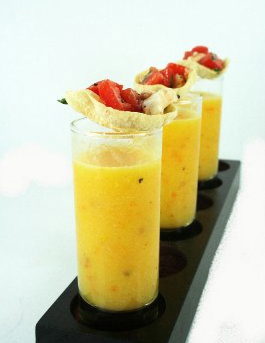
Bright red tomato gazpacho shows off the BLT topping. Photo courtesy Munchery.com.

  Like BLTs? Turn the concept into a soup, as Munchery.com did with this tomato gazpacho.

There are as many recipes for gazpacho as there are people who make them. Each region of Spain has its own preferred style, dating back hundreds of years. And then, there are modern approaches, from mango gazpacho to gazpacho with beer (the recipe iinks are below).

Here’s the history of gazpacho.

The recipe below is a thin tomato purée. No chunky vegetables are used, in order that the BLT topping can stand out.

But you certainly can place the garnish atop a chunky soup recipe (we have more of those at the bottom of this article).

You can also use the BLT topping on hot tomato soup.

 
RECIPE: SMOOTH TOMATO GAZPACHO

Ingredients

  • 1 slice country-style bread, about 1″ thick, crusts removed
  • 2 small cucumbers, peeled, seeded, and chopped*
  • 2 pounds very ripe tomatoes, seeded and coarsely chopped
  • 1 cup water
  • 1 clove garlic, peeled and chopped
  • 2 tablespoons sherry vinegar
  • 1/2 cup extra-virgin olive oil
  • Salt to taste
  • 1 teaspoon freshly ground black pepper
  •  
    For The BLT Garnish

  • Tomato gazpacho or tomato soup.
  • Crisp bacon, crumbled or chopped.
  • Baby arugula, representing the lettuce.
  •  
    If you want a BLTA, add some diced avocado. Munchery also added croutons, pickled onions and cubes of boiled potato.
     
    *If the tomatoes aren’t ripe enough or are too pricy, you can substitute 3 cups of tomato juice.


    Preparation

    1. SOAK the bread for a half hour in a small bowl, covered in water. Squeeze out the moisture with your hands.

    2. PURÉE the bread, cucumbers, tomatoes, garlic, vinegar, olive oil, and 1 cup of water in a food processor until very smooth.

    3. USE a coarse sieve to strain, pushing the purée through with the back of a wooden spoon. Season to taste with salt.

    4. CHILL the gazpacho in the refrigerator for at least 2 hours. Adjust the seasoning as needed. Serve in individual bowls or glasses, topped with the BLT garnish.
     
    MORE GAZPACHO RECIPES

  • Avocado Gazpacho, topped with shrimp
  • Gazpacho Verde (green gazpacho)
  • White Gazpacho with cucumber, leeks and sour cream
  • White Gazpacho with almonds, garlic and grapes
  • Mango Gazpacho with crème fraîche sorbet
  • Pineapple Gazpacho with chile heat
  • Yellow Bell Pepper Gazpacho
  • Tomato Gazpacho With Beer
  •   arugula-bowl-parkseed-230
    Baby arugula substitutes for the lettuce in this BLT garnish. You can also use it instead of iceberg or romaine lettuce on a BLT sandwich.


    Comments off

    TIP OF THE DAY: Make The Best French Fries

    fries-calphalon-fryer-WS-230
    [1] If you love to make French fries, you need a fry basket (photo © Calphalon).

    Julienne_Fries_alexia-230ps
    [2] Season your fries with rosemary, thyme or other favorite herb (photo © Alexia Foods).

    Sweet Potato Fries With Dipping Sauce
    [3] Sweet potato fries with green goddess dipping sauce (photo © Good Eggs).

      July 10th is National French Fry Day, the perfect day to explore how to make the best French fries.

    We contacted our friends at the Idaho Potato Commission, a website with tons of tips and recipes.

    They start by advising you to buy Idaho potatoes, which are branded russet potatoes that reflect the unique growing conditions of the state. Depending on where potatoes are grown, they will have more or less moisture. Idaho russets have less moisture, which is desirable for crisper fries.

    (By the way, all agricultural products reflect their terroir, pronounced tur-WAH, a French agricultural term referring to the unique set of environmental factors in a specific habitat that affect a crop’s qualities. It includes climate, elevation, proximity to a body of water, slant of the land, soil type and amount of sun. These environmental characteristics gives a fruit or vegetable its unique character.)
     
    Here’s how chefs do it—a twice-fried method. But first:

    > The 27 different types of French fries.

    > The history of French fries is below.

    > 16 yummy French fries recipes.

    > How to ceate your signature French fries recipe.

    > The history of potatoes and the different types of potatoes: a photo glossary.

    > The year’s 30 potato holidays.
     
     
    HOW TO FRY PERFECT FRENCH FRIES

    1. WASH and scrub the potato skins well, and allow to air-dry in a single layer on a sheet pan.

    2. USE a French fry cutter to cut the potatoes into the desired size and shape, leaving the skins on. RINSE thoroughly so the excess starches and sugars are removed.

    At this point, you can leave the sliced potatoes covered with water in the fridge up to 24 hours in advance of cooking.

    3. SPIN the potatoes dry with a salad spinner or drain on a drip screen (i.e., cooling rack) before frying.

    4. BLANCH or partially cook the fries to keep the potatoes from oxidizing/darkening, in a 250°F fryer for 2-3 minutes. Remove from the fryer and drain. Allow the fries to cool to room temperature before the final fry. Fries should be bendable. Then, chill in the fridge before the final fry.

    5. FINISH the fries in the fryer at 350°F for 3-4 minutes until golden brown and fully cooked. Remove and drain well. TIP: Fill the fry basket only half full. Better oil circulation results in crisper fries.

    6. After draining on a screen, season with salt. Do not season over the hot oil! Consider seasoning with dried herbs as well—rosemary or thyme, for example—or substituting garlic salt.
     
     
    THE HISTORY OF FRENCH FRIES

    It begins with the potato, of course. Potatoes originated in Peru and spread to other parts of Latin America. Fried potatoes—cooking potatoes in fat over a fire—is a practice that’s thousands of years old.

     
    Potatoes were “discovered” and brought back to Europe by the Spanish conquistadors—where they were uses as hog feed! The French were convinced that potatoes caused leprosy, and French Parliament banned the cultivation of potatoes in 1748.

    A French army medical officer, Antoine-Augustine Parmentier, was forced to eat potatoes as a prisoner of war, and discovered their culinary potential. Through his efforts, in 1772, the Paris Faculty of Medicine finally proclaimed that potatoes were edible for humans—though it took a famine in 1785 for the French to start eating them in earnest.

    In 1802, Thomas Jefferson’s White House chef, Honoré Julien, a Frenchman, prepared “potatoes served in the French manner” for a state dinner. The potatoes were “deep-fried while raw, in small cuttings.” French fries had arrived! By the early 20th century, the term “French fried,” meaning “deep fried,” was being used for other foods as well (onion rings and zucchini sticks, anyone?).


    CHECK OUT WHAT’S HAPPENING ON OUR HOME PAGE, THENIBBLE.COM.


    Comments off

    PRODUCT: Challenge Lactose Free Butter

    challenge-lactose-free-230sq
    A delicious butter spread that’s lactose free! Photo courtesy Challenge Dairy.
     

    An estimated 30 to 50 million Americans have lactose intolerance, a condition wherein individuals naturally lose the ability to digest lactose—the natural sugar component of milk—as they grow into adulthood.

    In some of the world’s populations, the condition begins in childhood, after weaning. In others, it happens on an individual basis in late middle age or beyond. Still other people never lose their ability to produce lactase, the enzyme that digests lactose.

    And since the inability to digest lactose continues to grow as many people age, our population has millions of contenders discovering their lactose intolerance every year.

    We are one of those people. Having grown up on butter, milk, cheese (cottage cheese, cream cheese, mozzarella and other fresh cheeses and lots of aged cheeses), sour cream, yogurt and ice cream, we suddenly became unable to digest them (or more accurately, they get digested with some unpleasant side effects).


    We quickly found lactose-free staples in:

  • Lactaid cottage cheese and ice cream
  • Green Valley cream cheese, sour cream and yogurt
  • Cheddar, the only cheese that is naturally 100% lactose free
  •  
    But what to do for butter?

    While no one has yet marketed a lactose-free bar of butter, Challenge Dairy now has a delicious lactose-free butter spread.

    The California-based maker of butter and cream cheese, representing some 600 dairy farm families, has made life easier for the lactose-intolerant.

    Their lactose-free spreadable butter clarifies the butter, a process that removes the milk solids that contain the lactose (this is the same process used to make clarified butter and ghee). The butter is then blended with canola oil to create a smooth, spreadable butter.

    The result: a buttery spread that has half the calories of regular butter. One tablespoon has 50 calories, 2 grams saturated fat (of 5.5 grams total fat) and 110 milligrams sodium.

    The lactose-free butter is available at retailers nationwide, including Albertsons, BI-LO, Harris Teeter, HEB, Jewel, Lucky’s, Meijer, Safeway, Savemart, Vons and Winn Dixie. A 15-ounce container is $4.49

    Learn more at ChallengeDairy.com.

    See the foods that have hidden lactose, below.


    FACTORS THAT IMPACT THE TASTE OF BUTTER

    Why do different brands of butter vary in flavor?

    Several factors are responsible, according to Challenge Dairy.

  • The cows’ diet has an effect on the flavor of the milk. Grass-fed cows, which graze in the pasture, have different diets depending on the season. The grass mix will be different in the spring, summer and fall, when clover, wildflowers and herbs are part of the blend. In the winter, the animals eat silage, grass that is compacted and stored in airtight conditions (as opposed to hay, which is dried first). Penned cows eat feed, a combination of hay, grain, silage and proteins (such as soybean meal), vitamins and minerals.
  • The cream that is used, churned from the butter, can have slightly different acid levels.
  • All butters are pasteurized and churned, but these processes are different among manufacturers, resulting in different flavors and textures.
  •   mashed-salmon-230
    Now, enjoy butter mashed potatoes to your heart’s content. Photo courtesy U.S. Potato Commission.
  • Butterfat level can differ slightly by different manufacturers (and by different products in the line, e.g. European butter).
  • The butter could be cultured or made from sour cream instead of sweet cream butter.
  • There can be a difference in the natural flavor that is usually added to unsalted butter (but not all brands—check the ingredients label). This flavoring is a natural milk derivative starter distillate (a distilled flavor made from fermented, cultured milk, similar to that used in the production of sour cream and buttermilk) that is added to the cream prior to churning. It produces flavor compounds that give unsalted butter a more pleasing taste, compensating for the absence of the flavor boost from salt.
  •  
    Check out the different types of butter in our Butter Glossary.
     
    SURPRISING SOURCES OF LACTOSE HIDDEN IN NON-MILK-BASED FOODS

    Some people are just mildly lactose intolerant, others are extremely so (more information). Every person handles it differently. If you think you might be lactose intolerant, a gastroenterologist can give you the test.

    As with sugar and salt, there is “hidden lactose” everywhere.

  • Creamy & Low-Fat Salad Dressings: Lactose gives texture and flavor to many creamy salad dressings. Kraft and Newman’s Own have some lactose-free varieties. Low-fat dressings also can use lactose as a filler.
  • Instant Foods: Coffee, mashed potatoes, oatmeal, soup, other instant foods and powdered drinks can contain lactose, which helps the granules dissolve quickly. Quaker instant oatmeal is milk-free, but check the labels on everything powdered before you buy.
  • Medications: There’s lactose in everything from birth control pills to digestion remedies (that’s ironic, since lactose causes digestive problems in the lactose-intolerant) and quick-dissolve tablets. Lactose is used as a filler or base, improves bioavailability and taste.
  • Processed Grains: Breakfast cereals, breads, cookies, crackers, granola bars, pancake and waffle mixes, and even potato chips can include lactose as a cheap sweetener. Read the label carefully, or look for vegan-labeled products.
  • Processed Meats: Bacon, cold cuts, hot dogs and sausages can contain lactose. Kosher products (including beef, turkey or seitan-based bacon) will be lactose free.
  • Sweetener Tablets: Lactose is used as a bulking agent in sweetening tablets (e.g. Equal Classic Tablets).
  •   

    Comments off

    RECIPE: Salmon Tostadas

    Norwegian-Salmon-Tostadas_salmonfromnorway-230

    Nutritionists advise that salmon and other fish make a healthier tostada or taco. Also substitute fat-free Greek yogurt for the sour cream! And substitute corn tortillas and shells for the white flour versions. Photo courtesy Salmon From Norway.


    According to Cabo Flats Cantina & Bar, there are 54,000 Mexican restaurants in the U.S., and $39 billion is spent each year on Mexican food.

    You can keep some of that restaurant money in your pocket by making these tasty salmon tostadas at home.

    Simple mesquite-seasoned salmon tostadas are a tasty Tex-Mex meal. You can grill the salmon or cook it on the stove top.

    RECIPE: FRESH SALMON TOSTADAS

    Ingredients For 4 Servings

  • 4 each 5-6 ounce salmon fillets, skin removed
  • 1 small head iceberg lettuce
  • 4 teaspoons mesquite barbeque seasoning
  • 2 tablelspoons canola oil
  • 8 tostada shells
  • 1 can refried black beans
  • 1 cup Mexican cheese blend, shredded
  • 3/4 cup salsa
  • Optional garnish: sour cream (substitute plain Greek yogurt)
  • Optional garnish: fresh cilantro leaves
  • Preparation

    1. SHRED the lettuce.

    2. SPRINKLE mesquite seasoning on each fillet. Heat a sauté pan over medium-high heat, add the canola oil and swirl to coat the bottom of the pan. Carefully place the salmon into the pan, and cook for 2-3 minutes until browned.

    3. TURN over carefully and cook for another 4-6 minutes or to desired temperature.

    4. HEAT the refried beans in a saucepan while the salmon finishes cooking.

    5. ASSEMBLE: Place 3-4 tablespoons of beans on each tostada shell, and place two shells overlapping on each plate. Mound lettuce on top of the beans and sprnkle with the cheese. Place a salmon fillet on top. Garnish with salsa and the optional sour cream and cilantro.
     
    Find more salmon recipes at SalmonFromNorway.com.
     
    TACO, TORTILLA, TOSTADA: THE DIFFERENCE

  • A taco is a corn tortilla with filling. Corn tortillas have more flavor and are whole grain. Taco chips are made from corn tortillas.
  • Flour tortillas are more pliable and used to roll burritos, enchiladas and soft tacos. Hard tacos are flour tortillas that have been deep fried into the familiar “U” shape.
  • Burritos are a meal-size alternative to tacos. Tacos are snack foods, and typically have one filling (beef, chicken, fish) plus garnishes (cilantro, lettuce, onion, salsa, sour cream, tomato, etc.). They can be made with corn or flour tortillas. The much larger burritos require a flour tortilla that won’t crack when rolled. It has multiple fillings—beans, cheese, meat, rice, vegetables, etc. While tacos date back to pre-Columbian times, the burrito is a 1940s century invention, credited to an unnamed vendor who wanted to sell rice and beans without having to provide plates.
  • Quesadillas are large flour tortillas toasted on a grill with fillingd (cheese, meat, onion, pepper), folded over and sliced into triangles.
  • >Tostada means toasted, and refers to a “tortilla tostada,” a toasted tortilla.
  •   

    Comments off

    TIP OF THE DAY: 12+ Uses For Flat Beer

    When leftover beer goes flat, there’s no need to toss it. With respect to all of the household and personal care uses, we prefer to consume it. When you add it to recipes, the flatness doesn’t matter at all; it becomes analogous to adding still wine.

    The beer is substituted for all or some of the water (or, in the case of a marinade, another liquid). Here are 12+ uses for flat, leftover beer:

  • Batter: Make beer batter shrimp, chicken, anything battered and fried.
  • Beans: Substitute for water, as in the Mexican recipe Frijoles Borrachos, “drunken beans”.
  • Beer Can Chicken: Set a whole chicken atop a beer can, atop a grill (recipe).
  • Braises: Add to pot roast and other slow-cooked meats like short ribs and pork butt. Check out this Belgian recipe for chicken with beer and prunes or carbonade flamande, a Belgian beef stew.
  • Brats and Franks: Steam them in beer.
  • Bread: Check out recipes for beer bread. There are a number of beer bread mixes, too: Just add the beer!
  •    

    waffled-pancake-pan-nordicware-WS-230
    Who knew: You can add flat beer to pancake and waffle recipes. The slight bitterness is a nice counterpoint to the sweet syrup. The Silver Dollar Waffle Griddle is from Nordicware.

  • Butter: Make “beer butter,” a compound butter used for cooking. There’s a recipe below to use as a bread spread.
  • Cheese Soup: This was a popular breakfast soup in medieval Europe, sometimes poured over yesterday’s bread (or toast). Try it for lunch or dinner (recipe).
  • Honey Beer Sauce: Cook chicken breasts in this tasty sauce.
  • Marinades and Brines: Beer helps to tenderize and adds flavor.
  • Pancakes and Waffles: Replace the water with beer.
  • Sauces: Use beer instead of wine.
  • Seafood: Combine with water to steam clams, mussels, shrimp, etc. Consider adding some Old Bay seasoning.
  •  

    beer-cheese-soup-melissas-230
    Use leftover beer in a hearty cheese soup—a breakfast staple in medieval Europe. Photo courtesy Melissas.com.
     

    RECIPE: HONEY MUSTARD BEER BUTTER

    Ingredients

  • 1 stick/8 tablespoons unsalted butter, softened to room
    temperature
  • 1 tablespoon honey
  • 1 heaping teaspoon Dijon or honey mustard
  • 1 tablespoon beer
  • 1/2 teaspoon salt
  •  
    Preparation

    1. BEAT the butter in a mixing bowl until very soft and silky, 2 to 3 minutes. Drizzle in the honey and continue mixing until well incorporated.

    2. ADD the mustard, beer and salt. Beat until all ingredients are thoroughly combined. Use immediately or tightly wrap and store in the refrigerator or freezer.


    Adapted from a recipe on SoupAddict.com, where it was used with Irish soda bread.


    Comments off

    The Nibble Webzine Of Food Adventures
    RSS
    Follow by Email


    © Copyright 2005-2026 Lifestyle Direct, Inc. All rights reserved. All images are copyrighted to their respective owners.