[1] Egg rolls with BBQ pork and sweet and hot chili dipping sauce. They’re baked, not fried. (Here’s the recipe (photo © Pork Be Inspired | National Pork Board).
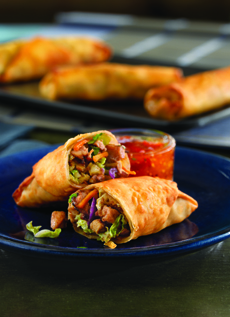
[2] Egg rolls served with a mix of rice vinegar and soy sauce (photo Red Stix | NYC [now closed]).
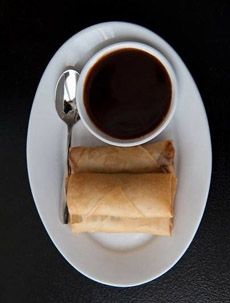
|
|
For the Chinese New Year, why not make your own egg rolls? Serve them as an appetizer, or as a snack with a cold beer.
EGG ROLL HISTORY
Like Chinese chicken salad, crab wontons, duck sauce, fortune cookies, General Tso’s chicken, and sweet and sour pork—not to mention the pu pu platter—the egg roll is a Chinese-American invention. Food historians believe it was first created in New York City in the early 1930s.
But over time, what was initially a richly layered roll with a mix of bamboo shoots, roast pork, scallions, shrimp, and water chestnuts evolved into a bland cabbage roll—a stuffing of shredded cabbage, flecked with bits of pork and carrot [source].
If you’d like to go back to the golden age of egg rolls, make your own! If you don’t like to deep fat fry, you can bake them.
This recipe came to us via Melissas.com, from Chef Martin Yan of Yan Can Cook.
See the difference between egg rolls and spring rolls, below.
RECIPE: CHEF MARTIN YAN’S EGG ROLLS
Ingredients For 12 Pieces
12 egg roll wrappers
1 tablespoon cooking oil
¾ pound ground pork, chicken or beef
2 teaspoons minced ginger
2 garlic cloves, minced
1/2 teaspoon sugar
2 tablespoons soy sauce
1 teaspoon sesame oil
12 ounces green cabbage, finely shredded
1 medium carrot, finely shredded
4 green onions, thinly sliced
1 egg, beaten with 1 teaspoon water
Cooking oil for frying
|
Don’t forget the condiments: hot mustard, jalapeño pepper jelly, plum sauce, ponzu sauce, sweet and sour sauce, Thai sweet chili sauce (sweet and hot) or just plain soy sauce. We like to serve two different options: Colman’s prepared mustard (a better version of “Chinese mustard”) and Thai sweet chili sauce (you can buy it or make your own).
OPTIONAL INGREDIENTS
You can add just about anything to an egg roll, as long as it’s finely chopped and well-drained (don’t add moisture).
There are fusion egg rolls that include pastrami (a Reuben egg roll) and corned beef and cabbage egg roll.
The menu at Rhode Island’s Egg Roll Cafe features the classic egg roll plus these flavors: Bacon-Egg-Cheese, Cheeseburger, Crab Rangoon, Fajita, Ham-Egg-Cheese, Pizza, Shrimp, Spinach & Feta, Steak & Cheese and Taco, among others.
Check out this recipe, featured in the Merced [California] Sun Star, which includes classic ingredients plus peanut butter and cinnamon. The creator, Fanny Go, was born and raised in Southern China (where there are no egg rolls) and now lives in Chicago.
In addition to her basic recipe, she suggests these optional extras which you can incorporate into Chef Yan’s recipe:
½ cup boiled shrimp, cut into dime-size pieces
½ cup shiitake mushrooms, soaked, squeezed and thinly sliced
½ cup well-drained bamboo shoots, julienned
¼ cup water chestnuts, thinly sliced
½ cup bean sprouts, well drained
Editor’s choice: Chinese sausage (if you can get hold of it)
Once you get the hang of it, you can experiment with your favorite fillings, from vegetarian to Swiss cheese—or anything that goes well with beer or wine.
Back to Chef Yan’s recipe:
|
|
Preparation
1. HEAT a wok or stir-fry pan over high heat until hot. Add the oil, swirling to coat the sides of the pan. Add the pork, ginger, and garlic; stir-fry until meat is cooked through, about 2 minutes. Drain the excess oil.
2. COMBINE the pork, sugar, soy sauce, and sesame oil in a medium bowl. Set aside for 30 minutes.
3. COMBINE the cabbage, carrot, and green onions in a large bowl. Add the meat mixture; toss well and let it cool slightly.
4. FILL the rolls: Place a wrapper on a clean flat surface in front of you so that it looks like a diamond. Place 3 tablespoons of filling in the center. Fold the bottom point up over the filling and roll once. Fold in the right and left points. Brush the beaten egg on the top point. Continue rolling until you have a tight cylinder. Place the filled rolls on a baking sheet and cover with a damp cloth while filling the remaining rolls.
5. FRY: Heat 2-3 inches of cooking oil over medium-high heat in a large pot or wok, to 350°F. Add the egg rolls, a few at a time, and fry until golden brown, 2-3 minutes per side. Lift out with a slotted spoon and drain on paper towels.
Serve with sweet and sour sauce, plum sauce, hot mustard, or jalapeño pepper jelly.
Recipe copyright Yan Can Cook, Inc., 2014
THE DIFFERENCE BETWEEN EGG ROLLS, SPRING ROLLS & SUMMER ROLLS
It can be very confusing, but we’ve done our best here to explain the differences.
While some countries, including China, serve fried egg rolls and spring rolls, the terms are not synonymous. An egg roll has a heavier pastry wrapper of wheat dough that contains eggs—hence the name. The cooked roll can be sliced into sections. Spring roll wrappers are made without eggs. A fried spring roll is very fragile and can shatter like phyllo.
Egg rolls are deep-fried. The wrappers are thicker, making egg rolls more of a filled pastry. They can have a vegetable, egg, meat, and/or seafood filling. The filling varies by chef, and can include chopped shrimp, ground beef, ground chicken or turkey, matchstick-sliced pork or Chinese sausage, minced cabbage, carrots, garlic, ginger, and mushrooms.
|
|
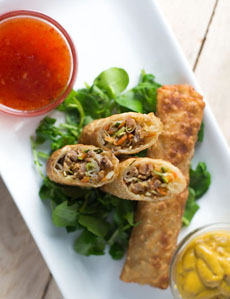
[3] Chef Martin Yan’s egg rolls, served with sweet and sour sauce (photo © Melissa’s | Yan Can Cook).
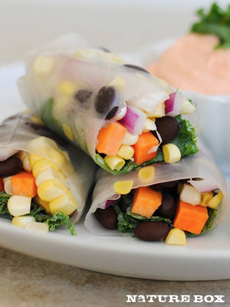
[4] Translucent rice paper enables spring and summer rolls to show off the ingredients inside. (photo © Nature Box).
|
|
Spring rolls can be fried or not. The fried versions use thinner wheat wrappers and are narrower and more finger-like. They can be filled with pork and/or shrimp. Spring rolls can also be served in an uncooked rice noodle wrapper. These are traditionally eaten during the Spring Festival in China, hence the name; and are also popular in Cambodia, Indonesia, Thailand, and Vietnam. The rice noodle wrappers are moistened into pliancy and translucency, then filled with seafood, bean thread vermicelli, red lettuce or Boston lettuce leaves, shredded cabbage, and carrot, plus wonderfully refreshing herbs—fresh mint, basil, and cilantro leaves. They are served with a sweet chili dipping sauce.
Summer rolls are made in the style of spring rolls, but with more seasonal ingredients. They are always in a rice noodle wrapper and never fried. The ingredients can be cooked, raw, or a mixture, and the colors and shapes show through the translucent wrapper. Ingredients typically include pork and/or shrimp or vegetables, rice vermicelli (noodles), and fresh herbs (basil, cilantro, and mint). The dipping sauce for summer rolls is typically a blend of rice wine vinegar and soy sauce or tamari, with minced scallions and a splash of toasted sesame oil.
The dipping sauces for the different rolls can be mixed and matched. Our favorites include peanut sauce, a blend of peanut butter and hoisin sauce with garlic; sweet and hot red chili sauce; and rice vinegar/soy sauce.
The way to best learn the differences, of course, is to go out and eat them, or make them at home. But note that even restaurants and retail establishments can abel these different rolls incorrectly.
CHECK OUT WHAT’S HAPPENING ON OUR HOME PAGE, THENIBBLE.COM.
|
|