THE NIBBLE BLOG: Products, Recipes & Trends In Specialty Foods


Also visit our main website, TheNibble.com.

RECIPE: Portobello ‘Steak’ & Salad

In keeping with the trends to more plant-based meals, this tasty recipe uses the “meatiest” mushrooms, portobellos.

(Is it portobello, portabella or portobella? Here’s the scoop.)
 
 
WHAT’S A PORTOBELLO/PORTABELLA MUSHROOM?

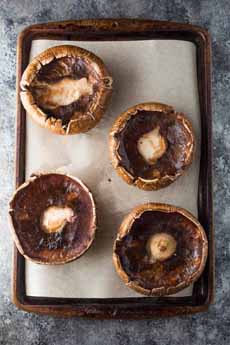
When cremini mushrooms (photo #3) are allowed to continue growing, they grow up into more complex-flavored portabellas, meaty in both taste and appearance (photo #2).

Portabellas can be from 3 to 10 inches in diameter. Like meat, they even release juices when cooked. Vegetarians enjoy them grilled in lieu of beef, and they make wonderful grilled vegetable sandwiches.

Portobellos are brown, with a slightly firmer texture than white mushrooms. They can be served whole or sliced, stuffed, or as “burgers” or “sliced steak,” as in the recipe below.

For a simple yet delectable starter, serve sliced grilled portobello drizzled with a balsamic reduction. The mushrooms are cultivated and available year-round.
 
 
RECIPE: PORTOBELLO “STEAK” & SALAD

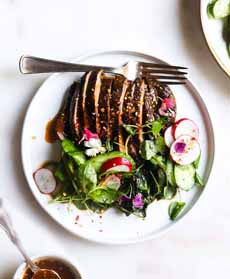
You can have your plant-based steak and eat it, too, with this portobello “steak” recipe (photo #1).

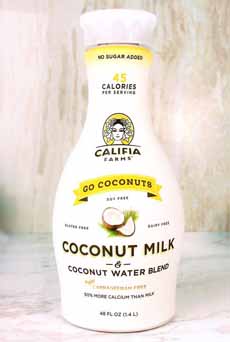
This recipe was created by Lindsey Baruch, a Los Angeles-based food photographer and recipe developer. She used Califia’s Go Coconuts coconut milk, a blend of coconut milk and coconut water, in the recipe.

“The taste and texture of a portobello “steak” is life-changing,” says Lindsey, “and can be marinated to any flavor. This recipe is easy with room to make it your own.”

The mushrooms are joined by a refreshing green salad of watercress, mint and cucumbers.
 
Ingredients For The Mushrooms

  • 4-5 portabella mushrooms (photo #2)
  • 1/4 cup Califia Go Coconuts coconut milk (photo #4)
  • 1/4 cup soy sauce
  • 2 tablespoons hot sauce (or to taste)
  • 2 teaspoon toasted sesame seeds
  • 1 teaspoon vinegar
  • 1 teaspoon chili flakes
  • Salt and pepper to taste
  • Oil for skillet
  •  
    Ingredients For the Salad

  • 2 Persian cucumbers
  • 5-6 thinly sliced radish
  • Bundle of watercress
  • Bundle of mint
  • Juice of 1 lemon
  • Salt and pepper to taste
  •  
    Preparation

    1. MAKE a marinade of the coconut milk, soy sauce, hot sauce, toasted sesame seeds, vinegar, chili flakes, salt and pepper. Marinate the mushrooms for 1 hour. While they’re marinating…

    2. PREPARE the salad. Slice the cucumbers and radishes and combine with with the mint and watercress. Add the lemon juice, salt and pepper and toss right before serving.

    3. HEAT a skillet with a drizzle of oil. Cook the portobellos until charred and crispy on the outside and cooked through on the inside (you can eat them “rare” if you prefer). Let them rest for 5 minutes and slice as you would a steak (see photo #1).

    4. SERVE with the salad, and a glass of red or white wine.


    Portabella 'Steak' & Salad
    [1] It may look like sliced steak, but they’re the vegetable equivalent: portobello mushrooms (photo courtesy Lindsey Baruch | A Life With Peace).

    Portabella Mushrooms
    [2] Portabella mushrooms (photo courtesy Sweet Peas And Saffron, which stuffs them with lasagna ingredients—here’s the recipe).

    Cremini Mushrooms
    [3] Cremini mushrooms (photo courtesy Good Eggs).

    Califia Go Coconuts Coconut Milk
    [4] Califia’s Go Coconuts coconut milk (photo courtesy Milk And Eggs).


    Comments off

    TOP PICK OF THE WEEK: Califia Farms

    Califia Unsweetened Almond Milk
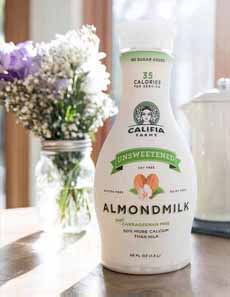
    [1] Exceptional-quality almond milk is available in original unsweetened plus 10 flavors (both photos courtesy Califia Farms).

    Califia Vanilla Better Half
    [2] In additions to coffee creamers, there are three flavors of “half and half.”

    Butternut Squash Soup
    [3] Enjoy creamy foods guilt-free (here’s the recipe for this Thai butternut squash soup).


    There are many quality brands of dairy-free creamers made from nuts and plants. One that we have a weakness for is Califia Farms.

    The California-based brand has bent over backwards to create a dairy-free line of products that offers just about everything in plant-based versions. There are:

  • Nut milks, primarily almond milks with some coconut milks
  • Coffee creamers and “half and half”
  •  
    In addition, there are:

  • Cold brew coffees
  • Probiotic dairy free yogurts and citrus juices
  •  
    The line is extensive. For example, in three products alone:

  • Almond milk in original unsweetened plus 10 flavors
  • Coffee creamers in original unsweetened plus 3 flavors
  • Better Half (half and half) in original sweetened, original unsweetened and vanilla
  •  
    There are also seasonal flavors (mint cocoa, pumpkin, etc.).

    In fact, there are so many products that you have to head to CalifiaFarms.com and see them for yourself.
     
     
    A GREAT PRODUCT LINE

    The reason the products are so good are the nuts. The better the almonds, for example, the better the almond milk.

    And the curvy bottles always make us smile.

    The products are all non-GMO. Everything is made with natural ingredients, with a focus on reduced sugar in products that typically contain them, and with unsweetened products. The line is carrageeenan-free* and certified kosher by OU.

    Many Americans seek to add more plant-based products to their diets.

  • More healthful. No cholesterol, saturated fat or lactose; rich in calcium, vitamins D, E and A; and far fewer calories than dairy milks. Nut milks also have 50% more protein than dairy milks.
  • Concern for animal welfare. No cows in feedlots here.
  • Concern for sustainability. Plant-based foods require less water and far less land pollution than animal-based products.
  •  
     
    WHERE TO FIND CALIIFA

  • Check out the store locator.
  • Shop direct from shop direct from CalifiaFarms.com or your favorite online grocer.
  • No luck? Email hello@califiafarms.com with the name and address of the retailer you’d like to carry the products.
  •  
    ________________

    *Some people avoid the thickener and emulsifier carrageenan. While it is a natural ingredient made from red seaweed, some evidence suggests that carrageenan triggers inflammation and gastrointestinal ulcerations. Here’s more information about it. Califia replaced the carrageenan a different natural thickener, locust bean gum, which is extracted from the seeds of the carob tree.


    Comments off

    Beyond Classic Hummus (Other Ways To Make & Serve The Popular Dip & Spread)

    Over the last two decades, hummus has evolved from a mezze at Middle Eastern and Mediterranean restaurants to the hottest, most nutritious dip and spread at supermarkets nationwide. It’s the darling of nutritionists, nutritious and versatile, and a better-for-you snack.

    It also is welcome to vegans, kosher consumers, and the lactose intolerant.

    Hummus is a thick paste that originated in the Middle East (see the history below). The classic recipe has two main ingredients, ground chickpeas (garbanzo beans) and tahini, a paste of toasted sesame seeds; along with olive oil, lemon, and garlic.

    The word hummus is Arabic, meaning chickpeas. The full name of the spread is hummus bi tahina, chickpeas with tahini.

    May 13th is International Hummus Day, a.k.a. World Hummus Day.

    Below:

    > The history of hummus.

    > Hummus comes to America and begets flavored hummus, hummus without chickpeas, and more.

    > Beyond a dip and spread, dozens of uses for hummus.

    > 25+ hummus recipes, including non-traditional uses such as dessert hummus and hummus sushi.

    Elsewhere on The Nibble:

    > 20 ways to make a hummus sandwich.

    > Hummus garnishes.

    > The year’s 20 appetizer and hors d’oeuvre holidays.
     
    Hummus Ingredients
    [7] Hummus ingredients: tahini (sesame paste), chickpeas (garbanzo beans or ceci), olive oil, lemon juice, garlic, and salt (photo: The Nibble).
     
     
    THE HISTORY OF HUMMUS

    Hummus (short for ḥummuṣ bi-taḥīnah, “chickpeas with tahini”) is a purée of chickpeas with tahini, typically with lemon and garlic.

    Food historians generally agree that no exact inventor or birthplace can be proven, because chickpeas and sesame have been eaten around the Eastern Mediterranean/West Asia for millennia, and dishes evolve gradually.

    Chickpeas, sesame, lemon, and garlic have been eaten in the Levant† for thousands of years. Chickpeas were first cooked in stews and other hot dishes. Puréed chickpeas eaten cold with tahini do not appear before the Abbasid period (750 to 1517 C.E.) in Egypt and the Levant†.
     
     
    The Earliest Known Recipes

    The earliest known recipes for a dish similar to hummus appear in medieval Arabic sources, notably 13th-century cookbooks from Cairo.

    This “hummus kasa” may not be the hummus we know today. Some historians suggest the modern, “classic” style we enjoy today (hummus bi tahini) may have been refined later.

    Some food historians believe the paste appeared a century earlier, prepared by Saladin, the first sultan of the Ayyubid dynasty (1174–1193). If so, it was more likely created by a cook in his kitchen, the idea of the warlord Saladin-as-cook being tough to swallow.

    Recipes for cold purée of chickpeas without tahini, but with vinegar, oil, pickled lemons, herbs, and spices—but no garlic—appear in medieval cookbooks; as do recipes with nuts vinegar (though not lemon), with many spices and herbs.

    From there, hummus becomes a daily staple across the Levant and Egypt, served with bread as part of home cooking and mezze culture, and becoming an iconic food of the region.

    Whomever and however, we’re grateful that it came to be part of our [almost] daily diet.
     
    Map Of The Levant
    [8] Hummus was born somewhere in the Levant, an old term for the portion of the Eastern Mediterranean that included modern Türkiye’s southern coast, Syria, Lebanon, Israel/Palestine, Jordan, and parts of northwestern Iraq and the Sinai Peninsula. There’s more about it in the †footnote below (map © Madain Project).
     
     
    Hummus Arrives In The U.S.

    Although ubiquitous in the Middle East, the word “hummus” may have first appeared in an American newspaper, Pittsburgh’s The Jewish Criterion, in 1949.

    The reference source isn’t surprising, since hummus was served and sold within Middle Eastern and Sephardic Jewish communities and in specialty groceries long before it was a national grocery item. Sahadi’s, a Middle Eastern grocery in Brooklyn, has been selling hummus since 1948.

    Packaged, refrigerated hummus had its national “launch” in the 1980s, into a culture that loved dips and healthier options. While served with classic pita and later, different chips, hummus and raw vegetables (crudités) became go-to snacks and party fare in many circles.

    The “big players” in the category—Sabra, Tribe, and Athenos—could be found nationwide. By 2016, Sabra accounted for 62% of U.S. grocery-store hummus sales.

    By 2016, TODAY reported that “Twenty years ago…most Americans could not pronounce the word ‘hummus’,” and U.S. grocery sales had exploded to hundreds of millions annually, with some estimates of 25% of American homes stocking it.

    But that was just the beginning. The U.S. hummus market value estimate in 2025 was $1.08B, forecast to reach $1.86B by 2032 [source: Research and Markets summary via GlobeNewswire].

    Americans, most of whom first discovered hummus served with pita, a Middle Eastern flatbread, turned it into a general dip for crudités and tortilla chips, and a sandwich spread.

       
    Butternut Squash Hummus
    [1] Flavor fusion: New flavors of hummus include ingredients not native to the Mediterranean, like this pumpkin hummus (photo © Good Eggs)

    Greek Salad With Hummus
    [2] A craveable Mediterranean lunch: hummus and Greek salad. Here’s the recipe from Garden In The Kitchen.

    Hummus Burger
    [3] This burger is made from hummus! Here’s the recipe (photo © Veganosity).

    Hummus Bites - Snacks
    [4] Hummus canapés a.k.a. “bites”: different flavors of hummus with different toppings (photo © Lantana Products).

    Hummus Sushi Rolls
    [5] Hummus sushi with arugula, carrots, cucumber, and red bell pepper. Here’s how to make your own. (photo © Sweet Potato Soul).

    Hummus Tacos
    [6] Hummus tacos. Here’s the recipe, along with hummus nachos, from Mountain Mama Cooks.

     
    If you didn’t order it at a restaurant or live near a neighborhood with an international market that carried it, you made your own hummus: the recipe couldn’t be easier.
     
     
    The Brands March On

    In addition to the Big Three, regional players expanded nationally: Cedar’s Mediterranean Foods, Hope Foods, Lakeview Farms, Lantana Foods. Regional players in the Northeast alone include Boar’s Head, Esti, Fresh Cravings, and Joseph’s. Store brands became a big part of national sales.

    And there’s still room for artisan producers, which using dried chickpeas instead of canned, extra virgin olive oil instead of canola/vegetable oil, high tahini-to-chickpea ratios, and a focus on texture (e.g. ultra-smooth or uniquely thick).

    In our grocer, we can pick from Abraham’s, CAVA, Ithaca, Roots, and Little Abraham, which grew out of a popular hummus shop in Washington, D.C.

    A true artisan product, they focus on regenerative agriculture (sourcing chickpeas from specific organic farms in Montana) and a small-batch production, for consumers who view hummus as a specialty craft food rather than a mass-market staple.
     
    Chunky Hummus
    [9] Commercial brands tend to be very smooth, but if you prefer a chunky style, it’s so easy to toss chickpeas and tahini into a food processor or blender (photo © Bush’s Beans).
     
     
    Can You Think Of A Flavor That Doesn’t Exist Yet?

    And the flavors! By July 2011, mainstream lifestyle media was already describing hummus as coming in “dozens of surprising flavors, from artichoke to chocolate.”

    Flavor proliferation became a core growth driver in the category—a seemingly endless variety of flavors and styles that tempt consumers.

    First there were Middle-Eastern-related flavors: Artichoke, Garlic, Red Pepper, Spinach, Za’atar.

    Beyond classic plain, “basic lines” can now be said to include Caramelized Onion, Chipotle, Cilantro, Harissa, Jalapeño, Kalamata Olive, Pesto, Roasted Garlic, Roasted Pine Nut, Roasted Red Pepper, Tomato Basil, and Sundried Tomato.

    Chocolate hummus (photo below) is used as a dessert but is also a sweet dip and a frosting substitute.
     
    Chocolate Hummus
    [10] Chocolate hummus can be a dessert, snack, filling, or frosting. Here they’re served with cinnamon pita chips. Stacey’s makes them, and you can make your own in a toaster oven (photo © SAJJ Mediterranean).
     
    Limited-time flavors pop up, from trending flavors like Everything Bagel to seasonal flavors like Pumpkin Americans have their choice.

    More fusion flavors include Chimichurri, Edamame, Guacamole, Lemongrass Chili, Ranch, and Sriracha/Thai Chili.
     
     
    Beyond the “Basics”

    As American cooks have riffed on the original recipe, hummus first became flavored. New ones seem to appear monthly to keep customers interested, often as limited editions that may then become permanent parts of the line.

    At home, we top plain hummus with whatever we’re in the mood for: Beet, Carrot, Cucumber Yogurt, Horseradish, Minced Lamb (from a store-bought lamburger).

  • If you like a particular flavor, try stirring it into hummus.
  • Add texture by topping plain or flavored hummus with pine nuts, pistachios, or whole/chopped chickpeas.
  • Add flavor with a garnish of toasted sesame seeds.
  •  
    Carrot Hummus
    [11] Whether store-bought or homemade, blend carrot puree into hummus and garnish with roasted carrots or carrot chips (photo © Seed + Mill | Facebook).
     
    Hummus Evolves Without Chickpeas

    The Eat Well hummus brand pioneered the use of other legumes and pulses* in a supermarket brand, with spreads made from:

  • Black beans
  • Edamame
  • Red lentils
  • White beans
  • Yellow lentils
  •  
    The sophisticated flavors of these “other bean hummus” varieties, all part of the Mediterranean Diet, provide wonderful alternatives to classic hummus.

    Like chickpeas, beans and legumes contribute protein, fiber, and healthy (monounsaturated) fat, low in sodium, and cholesterol free.

    Another innovation was to add Greek yogurt to classic chickpea hummus. It lowers the fat by 50% and the calories by 33%.

    Other brands followed suit, and now these variations can be found in markets nationwide.

    You can also use flavored olive oil instead of plain; add another layer of flavor with nut oil (almond, hazelnut, walnut, etc.).
     
    Yellow Lentil Hummus
    [12] Yellow lentil hummus, no chickpeas, served with crudités and baked eggplant chips (photo © Salt & Honey Catering).
     
     
    BEYOND A DIP AND SPREAD: OTHER USES FOR HUMMMUS

    Hummus is way more versatile than people might imagine. It behaves like a sauce, fat, binder, and purée all in one.

    Beyond snacking with flatbreads, vegetables, or chips, you can use hummus in every meal of the day. Use it in its paste form, or dilute it into a sauce with olive oil.

  • Breakfast: Spread it on toast, stir a spoonful into scrambled eggs or omelets for creaminess. For another egg idea, blend with yolks instead of (or in addition to) mayonnaise for deviled eggs.
  • Lunch: Add it to a vinaigrette for salads or grain bowls, or use it as a sandwich spread. A great topping for lamb, turkey, or veggie burgers. Use as a protein condiment instead of mayo in sandwiches/wraps (try it on grilled cheese, too).
  • Dinner: Thin it as a sauce for grains and vegetables, top a baked potato, make a crust by spreading on chicken or fish, then bake.
  • Stuffing Binder: Mix it into stuffed peppers, eggplant, or mushrooms instead of breadcrumbs.
  • Pasta & Pizza: Make a Middle Eastern pasta sauce by thinning with pasta water and olive oil; add garlic, chili flakes, and Parmesan for a creamy sauce without cream. Swap tomato sauce for hummus as a Middle Eastern pizza base topped with olives, feta, pepperoncini, roasted vegetables, and grilled chicken or lamb.
  • Plate Garnish: Swoosh onto a plate and lay the proteins and vegetables on top.
  • Salad Dressing: Thin with vinegar and/or lemon plus olive oil or warm water for a creamy vinaigrette.
  • Veggies: Add protein and richness to mashed potatoes or root vegetables. Toss carrots, cauliflower, or sweet potatoes with thinned hummus before roasting.
  •  
    Middle Eastern Pizza With Hummus
    [13] Fusion food: Middle Eastern pizza with hummus, kalamata olives, and feta. Here’s the recipe (photo © Taste Of Home).
     
     
    25+ MORE HUMMUS RECIPES

  • Almond Hummus Recipe
  • Asparagus Hummus
  • Avocado Toast With Hummus
  • Beet Hummus
  • Beyond Dipping: More Ways To enjoy Hummus
  • Black Garlic Hummus Recipe
  • Blender Hummus
  • Carrot Hummus Recipe With Carrot Soup
  • Carrot Hummus Recipe #2
  • Carrot Top Hummus
  • Dessert Hummus
  • Easy Hummus Recipe
  • Green Hummus Recipe
  • Hummus Bowls
  • Hummiki: Combine Hummus & Tzatziki
  • Hummus Layered Dip
  • Hummus Salad
  • Hummus Salad Dressing
  • Hummus Sushi
  • Hummus Tacos
  • Make Your Signature Hummus
  • Mexican Hummus
  • Nacho Hummus & Hummus Tacos
  • Pumpkin Spice Hummus
  • Rancho Gordo Hummus Recipe
  • Turn Plain Hummus Into Flavored Hummus
  • 20 Ways To Make A Hummus Sandwich
  •  
    ________________

    *The term pulse is used for crops harvested solely for the dry seed, such as lentils; as opposed to green peas, which are eaten fresh like vegetable crops, and can be eaten in younger forms, e.g. pea shoots.

    The Levant is an English term that first appeared in 1497. It originally referred to the “Mediterranean lands east of Italy.” The historical area comprises modern-day Iraq, Israel, Jordan, Lebanon, Palestine, and Syria. Among other popular foods, Levantine cuisine gave birth to baklava, falafel, kebabs, mezze (including tabbouleh, hummus, and baba ghanoush), pita and za’atar, among other dishes that are enjoyed in the U.S. and around the world.

    The name derives from the French levant, meaning “rising” or “the east”, referencing the rising sun. By the late Middle Ages, European merchants and travelers used it to describe the eastern Mediterranean, particularly areas under Ottoman rule that were important for commerce. In the 16th and 17th centuries, the term became institutionalized through the French Compagnie du Levant and English Levant Company, both chartered to regulate trade with the Ottoman Empire. In the 19th and 20th centuries, Orientalist scholarship further entrenched the term as a geographical and cultural designation, though its exact scope remained ambiguous. Today, while less common in political geography, the term persists in archaeological discourse and in historiography dealing with ancient and medieval eastern Mediterranean societies [source].
     

    CHECK OUT WHAT’S HAPPENING ON OUR HOME PAGE, THENIBBLE.COM.


    Comments off


    © Copyright 2005-2026 Lifestyle Direct, Inc. All rights reserved. All images are copyrighted to their respective owners.