|
January 23rd is National Pie Day, and we’ve been fielding questions about the difference between pies and tarts, and the difference between pie and pastry.
To start, we refer you to one of our most popular articles, The Difference Between Pie and Pastry.
Now on to pastry.
Pastry is a broad category that includes pies and tarts as well as smaller pastries: baklava, bear claws, cannoli, cinnamon rolls, cream puffs, danish, éclairs, napoleons, turnovers, and on and on through the celestial realm of pastry.
The word can refer to the finished pastry, or the dough from which it is made.
The key identifier of pastry is the crust (or shell). Pastry dough is made from flour, water and/or other liquid (e.g. milk), and shortening, which comprises solid fats (butter, lard, shortening, etc.) and and fillings/flavorings (chocolate, fruit, spices, extracts, etc.).
It can also have a leavening to make it rise. Types of leavening include baking powder, baking soda, beaten eggs, steam and yeast (but baking powder, baking soda and yeast are not used in pastry).
Pastries can be sweet or savory.
While most people think of pastry as sweet, savory pastries include pies (meat pies, vegetable pies, hand pies, pockets (including empanadas and stromboli), pot pies, quiches (a type of tart), vegetable and/or meat tarts and turnovers.
“Pizza pie” is not a pie, i.e., not a pastry. It is a flatbread with toppings.
Some history: The French word pâtisserie originally referred to anything made with pastry dough (originally called a paste, and later, pâte [pronounced pot]). It was not sweet. By the 20th century, the term came to be associated with sweets.
THE DIFFERENCE BETWEEN PASTRY & BREAD
The difference between pastry and bread is in the process as well as ingredients. While there are common ingredients (flour, water, salt), pastry has a high fat content, typically butter or shortening. Sweet pastries have sugar and other flavorings (vanilla, spices) as well as eggs and milk.
Here are a few of the other general differences:
Bread is made with flour, water and salt with yeast as a leavener (flatbreads do not use yeast). Yeast produces the small holes in the bread.
Pastry is made with flour and fat, usually with a little water. In some types of rich bread, like brioche, butter, eggs and milk are added.
In pastry, the dough is worked minimally, to avoid the development of gluten. In bread, the dough is mixed and kneaded to develop lots of gluten.
Pastry dough is not kneaded but is mixed just to the point where the fat and flour come together. Overworking the dough results in hard/tough pastry.
Pastry dough is not leavened and does not rise. Bread dough is leavened with yeast, and can take hours to rise. Since pastry dough is not leavened, it doesn’t rise.
Pastry dough is rolled out thinly and used as a base for for fillings or flavorings. Bread dough is molded into a loaf. It may have inclusions, e.g. nuts, olives, raisins, spices).
THE DIFFERENT TYPES OF PASTRY
Choux (pronounced shoo) pastry is a very light pastry that is often filled with cream.
Unlike other types of pastry dough, choux can be be piped into various shapes—the round cream puff and profiterole, and the elongated éclairs.
(The difference between cream puffs and profiteroles is that the latter are filled with ice cream and frozen.)
The high percentage of water in the dough causes the pastry to expand into a light, hollow shell when baking. The water turns to steam and causes the pastry to rise.
Once the choux dough has expanded, it is taken out of the oven; a hole is made in it to let the steam out. The pastry is then placed back in the oven to dry out and become crisp.
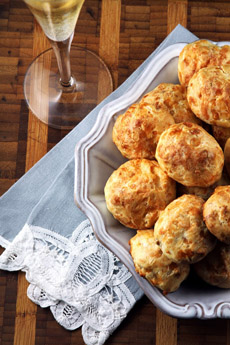
In addition to cream puffs and other sweet choux, there are savory choux pastries, filled with cheese, chicken, tuna, etc.
Here’s a recipe for choux pastry and gougères.
Flaky Pastry & Puff Pastry
Flaky pastry is a light and [as its name indicates] flaky. It is also known as quick puff pastry and blitz puff pastry.
Flaky pastry is similar to puff pastry, with this key difference:
With flaky pastry, large lumps of butter or shortening are mixed into the dough. With puff pastry (see below), large rectangles (shards) of butter or shortening are inserted between layers of pastry.
Flaky pastry is heavier than puff pastry, but easier to make. The layers expand when baked, yielding a crisp, buttery pastry. It is most often use for savory pies and wraps (e.g. sausage rolls).
Hot Water Crust Pastry
Hot water crust pastry is primarily used for meat pies. The combination of flour, hot water, eggs and lard produces a rich, crisp pastry.
The ingredients create a sticky paste that is shaped by hand, molded in a bowl or other container. As the crust cools, it is filled, covered with a top crust and baked.
Phyllo (Filo)
Phyllo is a paper-thin pastry dough that has many paper-thin layers. The name means leaf in Greek.
The dough is typically wrapped around a filling—sweet or savory—and brushed with butter before baking. Examples are baklava (photo #4) and spanakopita, spinach pie.
The result is a very delicate and very flaky pastry. Wear a napkin: There will be plenty of tiny shards flaking off with each forkful.
This is not an easy pastry to make, so some people prefer to purchase ready-made filo pastry, which is typically sold frozen.
Even ready-made phyllo is not easy to use: Each layer must be brushed with a liquid fat (melted butter, oil) and covered with a cloth so it doesn’t dry out before baking.
Puff Pastry
Puff pastry, a tender flaked pastry dough, is made with many layers of dough that puff up when baked.
The pastry rises as a result of the fat and air trapped between the layers, abetted by the water in the dough, which turns into steam.
This type of pastry is time-consuming and often left to professionals. It is used for savory pies and vol-au-vents, as well as popular pastries like cream horns and mille feuilles.
Rough Puff Pastry
Rough puff pastry is a cross between puff pastry and flaky pastry. It is easier to make than puff pastry, and still yields a light and flaky pastry.
It’s largely used for savoury pie and tarts and wraps.
Shortcrust Pastry
Shortcrust pastry is the simplest and most common pastry, commonly called “pie dough.” It is used for one- or two-crust pies and quiches; some people use it for tarts.
Shortcrust pastry is made with flour, fat, butter, salt, and water to bind the dough.
The term shortcrust refers to the cutting of the fat into the flour, which inhibits gluten formation by coating the gluten strands. The result is a flaky, tender pastry that can be used for sweet or savory pies, tarts and flans.
Here’s a recipe for a classic two-crust shortcrust.
Pâte Sucrée (Sweet Crust Pastry or Sweet Tart Pastry)
We make all of our tarts with pâte sucrée (pot sue-CRAY). A tart is is a shallow pastry with only a bottom crust. It is typically made in a fluted pan with a removable bottom.
Tart crusts are traditionally made with butter to achieve a buttery pastry flavor and a firm texture. A tart taken out of its pan can stand independently.
Savory tarts are usually made with shortcrust pastry, but some people find pâte sucrée essential for a sweet tart.
As opposed to shortcrust pastry/pie dough, which is typically made without sugar, pâte sucrée is a sweet dough that incorporates sugar and egg yolks. The sugar and egg yolks are used instead of water to bind the pastry.
The result is a rich, sweet shell for a tart. The crust is reminiscent of a shortbread cookie.
While both pie and tart crusts use the same ingredients (flour, shortening, cold water, salt), they are in different proportions for different purposes. See The Difference Between Pie and Pastry.
|
|

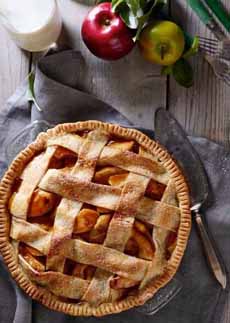
[1] An apple pie with a surprise—salted caramel—and a lattice crust. Here’s the recipe from Williams-Sonoma.
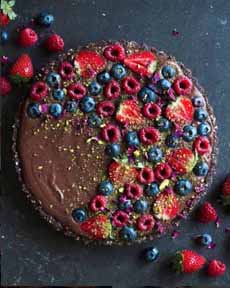
[2] A chocolate mousse tart with berries. Here’s the recipe from Rainbow Nourishments.
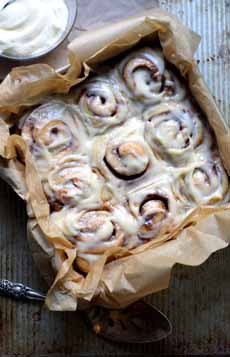
[3] Cinnamon rolls. Here’s the recipe from Baker Chick.
[4] Baklava, a Mediterranean pastry made with phyllo dough, filled with with nuts and honey.
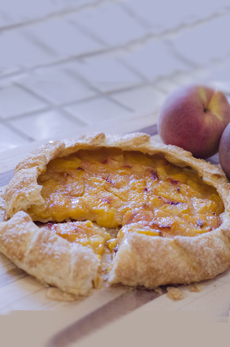
[5] A galette is a rustic pie, shaped by hand without a pie pan. It’s how pies were made in the centuries before pie pans became affordable to the rank and file (photo courtesy Frog Hollow Farm).
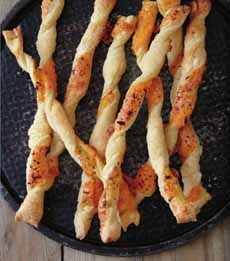
[6] Cheese straws are made from pastry dough (photo courtesy Melissas.com).
[7] Cream puffs can be savory, like these made with savory herb and mustard cream and pork, from The Greenhouse Tavern in Cleveland.
[7] These savory gougères—made with pancetta, thyme and fontina cheese—are from Chef Aida Mollenkamp. Here’s the recipe. All gougères are savory: They are made with cheese, often gruyère, and anything else the chef wishes to add. Smoked salmon and chives is a popular addition.
|