THE NIBBLE BLOG: Products, Recipes & Trends In Specialty Foods


Also visit our main website, TheNibble.com.

FOOD FUN: Pie Decoration

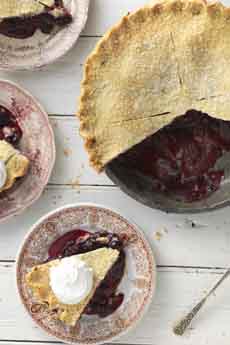
Blueberry Pie
[1] An elegant two-crust blueberry pie, with a sprinkle of decorating sugar (photo courtesy King Arthur Flour).

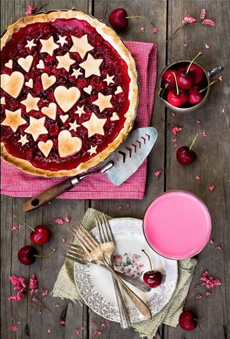
Cherry Pie
[2] Cut-outs are an easy way to decorate a one-crust pie (photo courtesy American Pie Council).


January 23rd is National Pie Day, a celebration for pie lovers everywhere.

Few of us would pass up a piece of pie because it had a plain top crust. In fact, bring it here right now, and a cup of coffee, too.

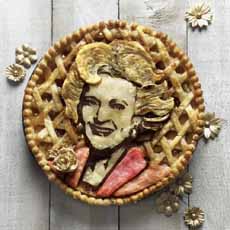
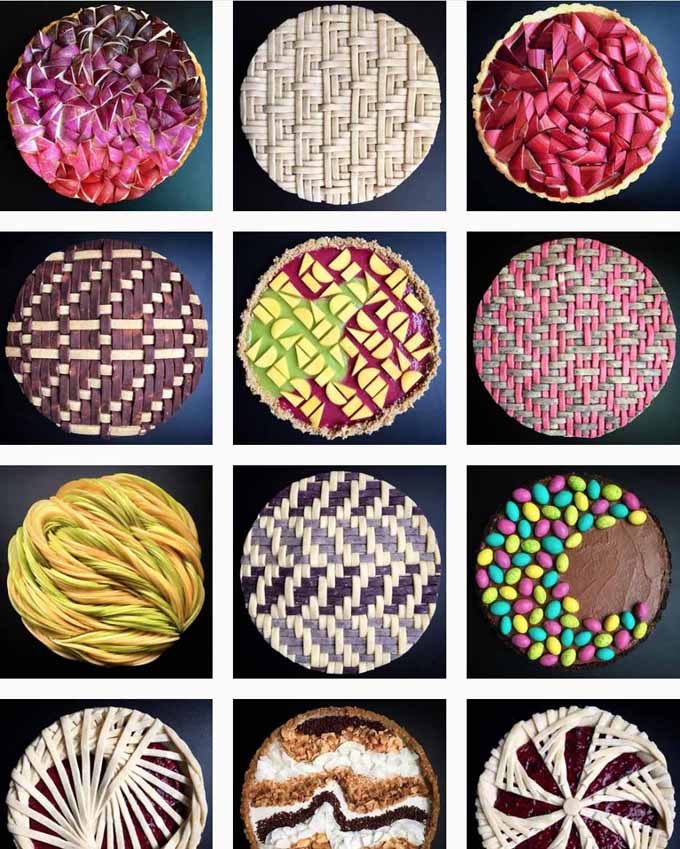
But if you’re a pastry artist like Lauren Ko of LoKo Kitchen, every pie top is a canvas, every pie an opportunity to create a new work of art. See her Instagram page for even more beauties.

Consider then twelve pies below. Some have top crusts, some don’t.

Each has its own personality, made with:

  • Candies and chocolate (curls, grated, pieces, etc.)
  • Coconut
  • Colored dough
  • Cookie crumbs
  • Cut fruits
  • Extruded dough
  • Geometric dough
  • Nuts
  •  
    For two crust pies, lattice and cut-outs (photo #2) have long been popular. The top crust lends itself to all sorts of craft work.
     
    There’s even more of a canvas with a one-crust pie, such as:

  • Banana cream pie
  • Cheesecake (which is a one-crust custard pie)
  • Chiffon pie
  • Chocolate pie/silk pie
  • Cream pie
  • Grasshopper pie
  • Key lime pie
  • Lemon pie
  • Pudding pie
  • Pumpkin pie
  •  
    Some one-crust contenders, like chess pie, pecan pie and tarte Tatin, are already so sweet that a counterpoint of crème fraîche, slightly sweetened sour cream or slightly sweetened/unsweetened whipped cream is a better choice.

    Others, like Bavarian cream pie, black bottom pie and nesselrode pie, already have too much going on up top.

     
    It’s possible that the right artist can envision further embellishment of a cream or meringue topping (lemon meringue pie, Mississippi mud pie). We leave that up to you.
     
     
    CHECK OUT THE DIFFERENT TYPES OF PIES IN OUR PIE GLOSSARY.

    Pie Decorations
    [3] Twelve beautiful pie tops by Lauren Ko, @LokoKitchen.


    Comments off

    FOOD HOLIDAY: The History Of Blondies For National Blondie Day

    January 22nd is National Blondie Day, a confection also called blond brownies and butterscotch brownies. (To add to the confusion, May 9th is National Butterscotch Brownie Day.)

    The shape and texture are similar to chocolate brownies, but the ingredients are different.

  • Blondies substitute vanilla for brownies’ cocoa powder.
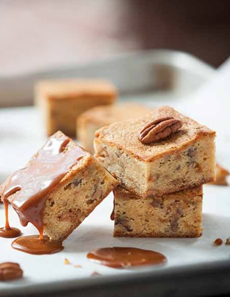
  • They contain brown sugar instead of white sugar (photo #1).
  • There is no chocolate or cocoa in the batter, but chocolate chips can be mixed in.
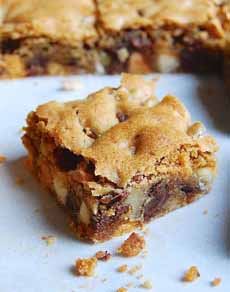
  • In addition chocolate chips (any type-photo #2), popular mix-ins include coconut, pecans or walnuts, toffee chips, even M&Ms.
  • Some people add a second sweetener: honey, for example, or maple syrup blondies.
  •  
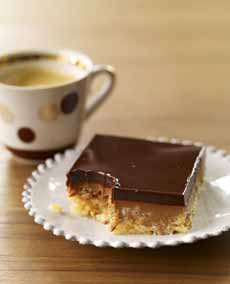
    Blondies tend not to be frosted, since the brown sugar is sweet enough. However, chocolate ganache is a nice (if messier) alternative to chocolate chips (photo #3). Since the beginning of recent food trends, some bakers use salted caramel ganache or dulce de leche.

    Blondies differ from white chocolate brownies, since the latter have white chocolate in the batter. We’ve encountered some blondies with chocolate chips called Congo Bars, but accurately, Congo Bars have both chocolate chips and walnuts; coconut can be substituted the walnuts.

    Like brownies, blondies are bar cookies cut into rectangles or squares. They’re great as a base for a sundae, topped with butterscotch, caramel or chocolate sauce.

    We know the history of brownies, but where did blondies originate?
     
     
    THE HISTORY OF BLONDIES

    Like brownies, blondies originated in the U.S. We’re just not absolutely certain of their creator.

    As bar cookies evolved in the late 19th century, molasses was a popular sweetener. Molasses bars were a popular treat.

    The first person publish a recipe for the brownies we know today was Fanny Farmer, in the 1896 edition of The Boston Cooking-School Cookbook (the history of brownies).

    But that recipe contained no chocolate; it was essentially what we today call a Blondie.

    According to Food Timeline, blonde brownies predate the chocolate version by about 10 years. Around 1896, a molasses-flavored bar cookie (no chocolate, cocoa or chocolate chips) called a brownie appeared. The name celebrated the elfin characters called Brownies, created by Palmer Cox and featured in popular books, stories, cartoons and verses of the time (the Eastman Kodak Brownie camera was also named after these elves).

    According to another source, in the 1906 edition of her cookbook, Farmer published an updated version of her cookbook that included a blondie recipe and a brownie recipe, both called brownies. Alas, we’ve only been able to get our hands on the 1896 version, reprinted and available on Amazon (link above), so we can’t do our own fact-checking.

    After the later introduction and popularity of chocolate brownies, the molasses brownies became known as blonde brownies. Subsequently, some bakers started to substitute brown sugar for the molasses, providing a butterscotch taste and a new name, butterscotch brownies.


    Blondies
    [1] Blondies with pecans, served with dulce de leche. Blondies can have a finer crumb (texture) if cake flour is used instead of all-purpose flour (photo courtesy Valrhona).

    Blondies
    [2] A classic, rustic blondie with chocolate chips and walnuts (photo courtesy King Arthur Flour).

    Iced Blondie
    [3] Blondies iced with chocolate ganache, at Baked NYC.

     
    Also according to Food Timeline, the name “Blondie” surfaces in the 1980s. It was not named for Dagwood Bumstead’s wife.

    Although we grew up in the food wonderland that is New York City, we don’t recall seeing a blondie or a butterscotch brownie until the mid 1970s or early 1980s.

    Then, some time around then, an artisan bakery whose name, alas, we can’t remember (and is no longer in business) began selling packaged blondies, brownies, chocolate chip cookies and other baked beauties in small grocery stores and delis. The line was superior to anything else being sold—and we believe that they introduced New York to blondies on a commercial scale.

    If you’re that bakery and are reading this, tell us your name…and thanks for the memories!
     
     
    BLONDIE RECIPES

  • Classic Blondie Recipe
  • Maple Syrup Blondies
  •  

    Comments off

    TIP OF THE DAY: Use More EVOO (Extra Virgin Olive Oil)

    Olive Oil Cruet
    [1] Our mother and grandmother always served olive oil and vinegar in cruets, so people could serve themselves at the table. They’re becoming a thing of the past, as salads come pre-dressed from the kitchen—or as more people use commercial dressings (photo courtesy Flavor For Life).

    Lemon Olive Oil Bread Dipper
    [2] The easiest switch is to serve EVOO with bread, instead of cholesterol-packed butter. You can add a splash of lemon juice or seasonings to enhance the oil—that’s what commercial bread dippers do (photo THE NIBBLE).

    Homemade Sweet Potato Chips
    [3] For tastier homemade chips, use olive oil instead of canola or other neutral oils (photo courtesy My Name Is Yeh | California Olive Ranch).


    It’s still the month for resolutions, our annual hopes of changing parts of our lives for the better.

    Adding more extra virgin olive oil to your life is one way, switching out less healthy fats.

    EVOO is a heart-healthy fat, high in polyphenols. It can lends extra flavor and textures to your favorite dishes.

    Olive oil is a versatile ingredient, and can replace other fats like butter and canola oil in almost all recipes, for a health boost.

    Think bread with an EVOO dipping oil instead of butter. Eat salad with an EVOO vinaigrette instead of creamy, heavy dressings. Use it as a pasta sauce.

    Here are three suggestions from California Olive Ranch to swap in extra virgin olive oil.
     
     
    1. BAKING

    Using olive oil in baked goods may seem strange to Americans, but it’s the fat used in Greece, Italy, southern France and the other olive oil-rich lands around the Mediterranean.

    EVOO adds a nuanced flavor to sweet treats, keeps cakes moist, and adds a luscious crumbly texture to crumbles.

    Some baking recipes will call specifically for extra virgin olive oil, but you can also substitute olive oil in recipes that call for butter for the flavor and health benefits.

    Try these recipes:

  • Lemon Olive Oil Poppyseed Muffins
  • Olive Oil Cornmeal Cake
  • Olive Oil Dark Chunk Loaf
  •  
     
    2. HOMEMADE VINAIGRETTE

    Homemade vinaigrette takes two minutes to make, at a mere fraction of the cost of buying bottled dressing. And no bottled dressing can beat the taste (or the quality of ingredients) of a simple homemade vinaigrette.

    Here’s a recipe that uses lemon juice instead of vinegar. It’s more sprightly. You can substitute lime juice, which is a classic Mexican variation.

    Homemade Vinaigrette Ingredients

  • 1/3 cup plus 2 tablespoons fresh lemon juice (ideally Meyer lemon)
  • 2/3 cup extra virgin olive oil
  • 1 tablespoon Dijon mustard
  • 3 large cloves garlic, peeled and crushed
  •  
    Preparation
    Just place all ingredients in a sealed jar and shake to combine. Is so easy: How can you not make your own vinaigrette?
     
     
    3. SAUTÉ & FRY

    It’s not true that you shouldn’t cook with extra virgin olive oil. It’s perfectly suitable for frying, poaching and sautéing.

    The accurate statement is that you shouldn’t cook with your $20 bottles of it—save the pricey bottles for salads or drizzling.

    Good olive oil will stand up well to high frying temperatures. A general rule of thumb is that the higher the quality of the oil and the fresher it is, the higher the smoke point will be.*

    Quality olive oil has a high smoking point upwards of 425°F, well above the ideal temperature for frying food of around 350°F. See the comparison chart below.

    In addition to frying eggs in olive oil, EVOO is a great choice for a simple stir-fry.
     
    Can we entice you to make this recipe for Olive Oil Sweet Potato Chips?

     
    Smoke Point Chart
     
    Chart courtesy California Oil Ranch.

    _______________

    *A high quality oil loaded with antioxidants will hold its form longer, while a lower quality oil with high free fatty acid content will smoke at a lower temperature.
      

    Comments off


    © Copyright 2005-2026 Lifestyle Direct, Inc. All rights reserved. All images are copyrighted to their respective owners.