THE NIBBLE BLOG: Products, Recipes & Trends In Specialty Foods


Also visit our main website, TheNibble.com.

FOOD FUN: Go Bananas

These healthful snacks—bananas, peanut butter and a second fruit—have so much pizzazz that we think they can go right to the dessert plate.

You can use any flavor of peanut butter (check out these flavors from PB & Co.—dark or white chocolate, honey, pumpkin spice).

If you’re not a PB or other nut butter fan, turn your sights to another sauce or spread:

  • Dessert sauce: caramel, chocolate, etc.
  • Berry or other fruit (finely diced, mashed or puréed)
  • Honey
  • Nutella
  •  
    For garnishes, consider:

  • Berries
  • Breakfast cereal: Cheerios, Fruit Loops, granola
  • Chopped or grated chocolate
  • Chopped nuts
  • Cookie crumbs
  • Crushed toffee
  • Diced fruits (apple, kiwi, etc.)
  • Dried fruits: blueberries, cherries, cranberries, raisins
  • Seeds
  • Sprinkles
  •  
    For a DIY experience, put all the toppings on the table and let everyone create his/her own.


    Banana Toppings

    Banana Toppings

    [1] & [2] Decorate bananas for snacking and dessert (photos courtesy Crazy Richard’s Peanut Butter).


  • For something more filling, adds a side of Greek yogurt or ricotta cheese. We sweeten our ricotta with a bit of Splenda, to emulate cannoli cream. Sour cream is another great pairing.
  • For a fancier dessert, add ice cream/frozen yogurt/sorbet and a dab of whipped cream.
  •  
     
    HERE’S MORE BANANA FUN & THE HISTORY OF BANANAS.
     

    Comments off

    Celebrate The First National Tea Day With These Tea Facts

    Tea Plantation
    [1] A tea estate in China. While China is the world’s largest tea-producing nation, it keeps most of what it grows for its own consumption (photo © The Meaning Of Tea).

    Two Leaves & A Bud
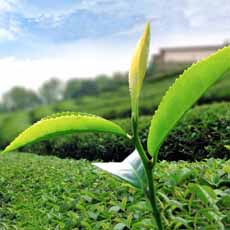
    [2] The top three leaves of the bush, called “two leaves and a bud,” are the only leaves used in premium tea (photo © Tea USA).

    Glasses Of Black Tea
    [3] Depending on where it’s grown, the same Camellia sinensis plant yields teas with different flavors, aromas, and colors (photo © National Honey Board).


    January 12th is the first-ever National Hot Tea Day, declared by the Tea Council of the USA, a trade association.

    Tea is the second most-consumed beverage in the world, after water. So have a cup as you read this:
     
     
    THE FLAVOR OF TEA VARIES DEPENDING ON WHERE THE TEA IS GROWN

    Black, green, or white, all tea comes from the Camellia sinensis plant (photos #1 and #2), a warm-weather evergreen. There’s one slight exception and one larger one:

  • In the Assam region of northeast India, the local variation, Camellia assamica was found to produce a finer leaf tea in that environment.
  • Herbal teas, discussed in the fifth bullet below.
  •  
    Whether tea is black, oolong, green, or white depends on how the fresh leaves of the tea plant are processed after they are plucked and; most importantly, their level of contact with oxygen.

    During oxidation, the tea leaves undergo natural chemical reactions that result in distinctive color and taste characteristics.

  • Black tea is allowed to oxidize for two to four hours.
  • Green tea is not oxidized at all—the leaves are steamed, rolled, and dried.
  • Oolong tea falls somewhere between green and black teas, in that the leaves are only partially oxidized.
  • White tea is not oxidized at all, and in fact, is plucked in the spring before the leaf buds even unfurl.
  • Herbal teas do not come from the tea plant Camellia sinensis but are an infusion of various leaves, roots, bark, seeds, or flowers of other plants. While they lack the caffeine of tea, they also are not associated with any of the potential health benefits of traditional teas.
  •  
    Tea is grown in thousands of tea gardens or estates around the world.
     
     
    THE FLAVOR VARIES DEPENDING ON WHERE THE TEA IS GROWN

    Along with wine grapes, coffee, cacao beans, and other agricultural products, local soil and climate result in corresponding flavor, aroma, and color variations (photo #3).

    As with coffee, each tea takes its name from the area in which it’s grown, and the areas in turn are known for their distinctive and uniquely flavored teas.

    Tea is also divided by grades, determined by leaf size. Smaller-sized leaves are used in tea bags while the larger-sized leaves can be found in packaged loose tea.

    While China is the world’s largest tea-producing nation, it keeps most of what it grows for its own consumption.

    The second largest consuming nation, India, is the largest exporter, followed by Sri Lanka, Kenya, Indonesia, Japan, and Taiwan.

    The largest importing nations are the United Kingdom, Australia, Canada, Russia, the United States, and The Netherlands.

     
    As with all foods, you can buy the average, the sublime, or something in-between. If you love a good cup of tea—or a tall frosty glass of iced tea—you’ll appreciate the difference between fine, “gourmet” tea made from top-quality whole leaves and mass-marketed tea bags produced from bits and pieces.

    A tip: When you buy higher-priced teas, first taste them plain, without milk or sweetener. The finest teas should be drunk black (plain) to appreciate their nuanced flavors and aromas.

    FINAL TIP: Don’t toss the leftover tea in the pot—pour it into ice cube trays. Tea ice cubes won’t dilute your iced tea. (Our favorite ice cube tray is the ISI Orka Ice Cube Tray—read our review to see why.)
     
     
    MORE ABOUT TEA

  • A Year Of Tea Party Ideas
  • Brewing The Perfect Cup Of Tea
  • The History Of Tea
  • How To Avoid Cloudy Iced Tea
  • How To Brew Iced Tea
  • How To Plan An Iced Tea Party
  • Pairing Tea With Food
  • Tea Facts
  • Tea Glossary: Tea Types & Terminology
  •  
     

    CHECK OUT WHAT’S HAPPENING ON OUR HOME PAGE, THENIBBLE.COM.


    Comments off

    RESTAURANT OF THE YEAR: Water In The East Village, New York City

    No matter how many great restaurants we eat at this year, we’re willing to state, at the beginning of January, that Water is our “restaurant of the year.”

    Unless you can’t imagine dinner without some kind of flesh, Water should be on your list for culinary excitement. It’s Japanese vegan cuisine.

    Created by restaurateur and bar impresario Ravi DeRossi, who specializes in vegetarian and vegan cuisine, along with the masterful Chef Steve Pereyda, Fire & Water has hung its sign at 111 East 7th Street. It’s just one door down from another DeRossi restaurant, Ladybird.

    Fire & Water is a dual concept. Fire is a vegan dim sum restaurant, Water is vegan Japanese (Fire is opening soon, and we hope to be the first in line).

    There is one tasting menu with two seatings nightly, Tuesday through Sunday, at 6:30 and 8:30. The menu is $65, with wine and saké available. We had a sake-and-wine pairing with each course and recommend it.
     
     
    WHAT YOU’LL EAT

    What’s on the menu? It doesn’t matter: Every bite is memorably exquisite. We hadn’t even left the table when we hungered to return for more.

    No matter how innocuous a dish sounds—seaweed salad, tempura pumpkin—each bite is sublime. Familiar foods like soba noodles and tofu are the best you can imagine, handmade by Chef Pereyda.

    The dishes are so packed with vibrant flavor and texture, that you can’t possibly miss fish and meat.

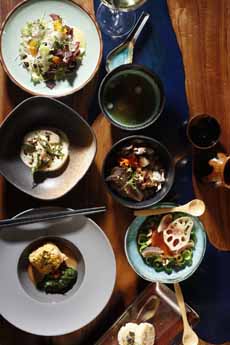
    Our eight-course tasting menu (photo #1), enjoyed over two hours:

  • Seaweed Salad with Salt Roasted Beets, Clementine, Wasabi Dressing
  • Celery Root with Yuba, Black Garlic, Mitsuba
  • Fresh Chilled Tofu with Brussels Sprouts, Hazelnuts, Fig Ponzu
  • Soba Noodles with Shishito, Yuzu, Shiso
  • Clear Ginger Broth with Salsify, Fried Tofu
  • Mushroom Chirashi with Leeks, Shio Kombu, Fresh Wasabi (photo #2)
  • Tempura Pumpkin with Sweet Sesame, Broccoli Rabe
  • Ginger chocolate Cake, Sesame Ice Cream, Miso Caramel
  •  

    Omakase Fire & Water NYC
    [1] The first seven courses (dessert comes later).

    Mushroom Chirashi
    [2] If we had to pick a favorite—and it’s tough—it would be the Mushroom Chirashi, a revelation (both photos courtesy Fire & Water).

     
    There is an extensive saké list created by sommelier David Yi-Hsian Dong, and wines that also pair well with the cuisine.

    This is an intimate dining experience. The space is small; dinner is served at an L-shaped bar of seven seats, where you get to watch Chef Pereyda gracefully preparing your food.

    There’s a table tucked into the front window that can accommodate four people, but you don’t get to see the food prep—an enjoyable part of the dinner.

    The decor is thoughtful and lovely. The bar is a slab of a beautiful tree, its natural crevices looking like water flowing through the wood. We wanted to take home the wallpapers in both the dining room and the restroom.

    The only downside: After this restaurant is “on the map,” we’ll have to wait months for a seat.

    Reserve online at FireAndWaterNYC.com, or call 646.767.0476


    Comments off


    © Copyright 2005-2026 Lifestyle Direct, Inc. All rights reserved. All images are copyrighted to their respective owners.