THE NIBBLE BLOG: Products, Recipes & Trends In Specialty Foods


Also visit our main website, TheNibble.com.

FOOD FUN: Alcohol & Gummy Candy

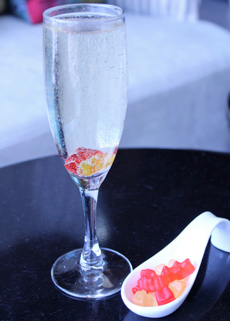
Champagne With Gummy Worms

Gummy Worm Mojito Cocktail

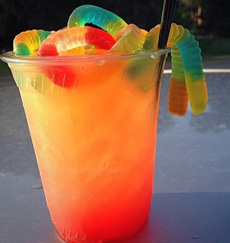
Gummy Worm Cocktail
[1] Champagne with gummy bears. [2] Mojito with a gummy worm garnish—although a Mezcal drink might make more sense with the worms (photos 1 and 2 courtesy Monarch Rooftop). [3] Gummies slithering in a Tequila Sunrise (photo courtesy Drinking In America).

  Search for “adult gummies” and you’ll turn up bottles and bottles of nutritional supplements.

They’re not just multivitamins but biotin, fiber, fish oil, melatonin, vitamin C and more. (Caveat: Before you get too excited, check the grams of sugar on the bottle.)

Let us introduce you instead to our kind of adult gummies: soaked in wine or spirits.

Some background: A few months ago, a candy boutique in Los Angeles, Sugarfina, introduced rosé-infused gummy bears. Thanks to social media, they were sold out by pre-order before they even arrived from Germany; there’s a long waiting list (Monarch Rooftop says the number now exceeds 14,000).

We had tried the Champagne Gummies, which are still available. There also are Cuba Libre Gummies, infused with rum and Coca-Cola.

We wouldn’t have known the Sugarfina gummies were infused with Champagne, much less with Dom Perignon. (We deduced that the amount of champagne used was “just a splash.”)
 
REAL ADULT GUMMIES

Monarch Rooftop, a lounge with a view of the Empire State Building (71 West 35th Street, Manhattan), infuses its own gummies for a selection of creative cocktails. The current menu offers:

  • Tipsy Teddy Bears: gummy bears soaked in Champagne/Rosé.
  • Rummy Worms: gummy worms soaked in rum and paired with a Mojito.
  • Fish Out Of Water: vodka-soaked Swedish Fish laid atop a blue Jell-O shot.
  •  
    They inspired us to infuse our own gummies by soaking them in alcohol. We first tried spirits, then wine. We briefly considered a Boilermaker: beer with whiskey-infused gummies instead of the shot. Maybe for the Super Bowl?

    Whatever you want to infuse, the recipe is below.
     
    National Gummy Worms Day is July 15th, giving you plenty of time to test your own cocktail menu.

    MAKE YOUR OWN ALCOHOL-INFUSED GUMMY CANDY

    The hardest part of this is deciding which spirit and which fruit juice to use. You can halve the spirits and juice and make a split batch to see which you like better. Flavored vodka is even better.

    Beyond Gummy Bears & Worms

    So many decisions! There are gummy butterflies, Easter bunnies, fish, flower blossoms, frogs, fruits, gummy rings, lobsters, peaches, penguins, pigs, rattlesnakes, sharks, Smurfs, soda bottles and turtles.

    You can make your own adult gummy recipe book, with different shapes and flavors for different occasions. Tequila-infused gummies for your Margarita? Certainly: And get the Mexican Hat gummies.

    Check out the novelty gummies on Nuts.com.


    Tips

  • Look for a large size of gummies: a 1 kg tub (2.2 pounds) or bulk pricing. A five-pound bag of Haribo Gold-Bears is $12 on Amazon.com. That’s $2.40/pound. If your local store sells them in bulk for much more than that, you may wish to consider your options.
  • Don’t overlook flavored vodkas. We think they’re a better choice than plain vodka. We also loved sipping artisan gin, so made them for a small snack bowl. We ours soaked in gin; although we used everyday Tanqueray to infuse.
  • Test the amount of alcohol. You can make a split batch, or vary the amount your next batch.
  • Make them as gifts, too, with a reminder note to consume within five days.
  • These are not Jell-O shots. Don’t expect a buzz.
  •  
    RECIPE: ALCOHOL-INFUSED GUMMY CANDIES

    Plan ahead: The gummies need to infuse in alcohol for five days.

    Ingredients

  • 1-1/2 cups of vodka or other spirit or wine
  • 2 pounds gummi candy
  •  
    Preparation

    1. PACK the gummies into a lidded container and cover with the spirit. The alcohol should barely cover the top of the gummies.

    2. STIR, cover with the lid and place the container in the refrigerator.

    3. STIR twice a day for five days. If you use a large enough container, you can simply shake it. When ready, drain and serve.

    That’s it!
     
    What If They’re Too Alcoholic?

    First, taste them on the third day. If they’re what you expect, drain them and enjoy. If they’re still too boozy, try them with a cocktail. The combination may provide the right counterpoint. If not…

    You can fix the batch by draining the alcohol and covering the alcohol in apple juice. Shake and taste in a few hours. They may need to juice-infuse overnight.
     
    THE HISTORY OF GUMMY CANDY

    Gummi candy was first produced by Haribo, a Bonn, Germany, confectioner. Haribo is a contraction of Hans Riegel Bonn.

    Founder Hans Riegel invented the Dancing Bear, a fruit gum made in the shape of a bear, in 1922. It was succeeded in 1967 by what would become known worldwide as Gummi Bears, which would spawn an entire zoo of gummi animals.

    Gummi worms, however, were introduced by another gummi candy manufacturer, Trolli (named for forest trolls), in 1981.

    Many Americans use the English spelling, gummy, instead of the German gummi.


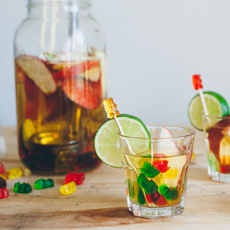
    Gummy Bear Sangria

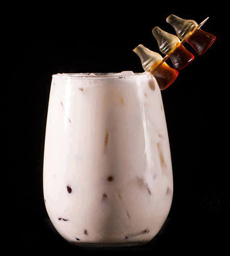
    Cocktail With Gummy Candy

    /home/content/p3pnexwpnas01 data02/07/2891007/html/wp content/uploads/shark tank sugarfactory 230
    [1] Wine-infused dummies with sangria. Given all the fruit, we’d serve them on the side. Here’s the recipe from TrendHunter.com. [3] A root beer float with soda bottle gummies. Add vanilla vodka along with the root beer and ice cream. Check out these alcoholic root beer float recipes on Yummly.com. [4] What to drink while watching “Shark Tank.” At the Sugar Factory in New York City, it’s called The Ocean Blue (photos 2 and 3 courtesy Sugar Factory).

    MORE WAYS TO SERVE GUMMIES

    Beyond filling candy bowls, you can:

  • Garnish the rim of soft drinks or cocktails.
  • Garnish desert plates.
  • Top cupcakes or iced cookies.
  • Use as ice cream/sorbet toppers.
  • Make gummy fruit kabobs, alternating gummies with fresh fruits.
  • Dip in chocolate and harden on wax paper or parchment, for “gourmet” gummies. For this one, it’s better to avoid the smaller gummies like bears.
  • Decorate the rim of cocktails.
  • Add to popcorn.
  • Make gummy trail mix: gummies, M&Ms or Reese’s Pieces, nuts, pretzels and raisins or dried cherries or cranberries.
  • Make the classic Dirt Cake or Dirt Pudding.
  •   

    Comments off

    RECIPE: Atlantic Beach Pie, A Spin On Lemon Meringue Pie

    Lemon Meringue Pie Slice
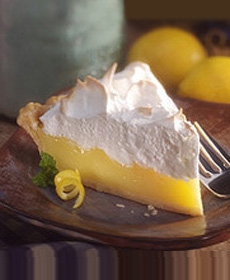
    [1] A slice of classic lemon meringue pie. Here’s the recipe (photo © IncredibleEgg.org).
    Atlantic Beach Pie Recipe
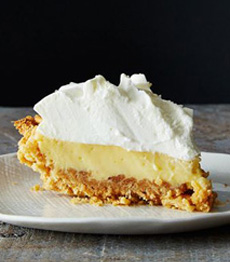
    [2] The Atlantic Beach Pie variation substitutes a crunchy saltine crust, and whipped cream for the meringue. The original recipe from Bill Smith of Crook’s Corner is below (photo © Crook’s Corner | Our State magazine).
    Atlantic Beach Pie
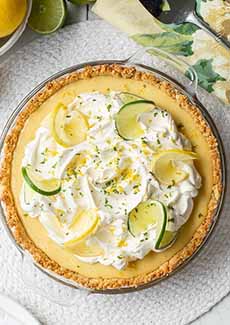
    [3] Subsequent cooks have toyed with the recipe, adding different garnishes like lemon and/or lime zest and wheels of lemon and lime. We aren’t keen on garnishes that can’t be eaten by most people [why waste food?], so we prefer candied lemon or lime peel. It’s very easy to make, and one of our favorite candies. Here’s the recipe. Also see photos #6 and #7.
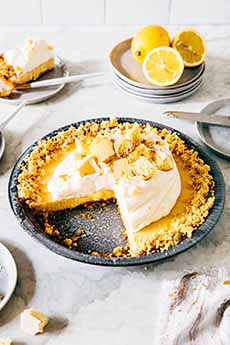
    Atlantic Beach Pie With Biscotti Crust
    [4] Some bakers vary the crust, using Ritz crackers for less saltiness. In the version above, Michelle Lopez of Hummingbird High uses lemon biscotti and crumbles extra biscotti on top. Here’s the recipe (photo © Hummingbird High).
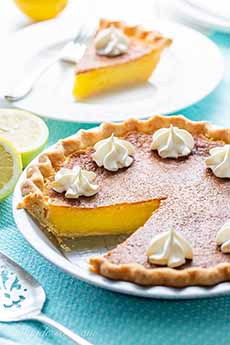
    Lemon Chess Pie
    [5] If you’re a lemon pie fan, don’t stop trying new recipes. Chess pie is a lemon custard pie baked in an all-butter pie crust. Here’s a recipe (photo © Saving Room For Dessert).
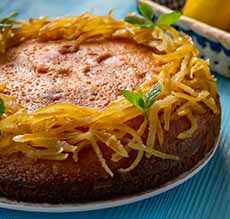
    Sponge Cake Garnished With Candied Lemon Peel
    [6] Use candied lemon peel to garnish many desserts. We also enjoy it with an espresso. You can dip the candied peel in chocolate, too. Here’s the recipe (photo © Ami Fruits | Paris Gourmet).


    August 15th is National Lemon Meringue Pie Day, celebrating one of America’s favorite pies. We’re celebrating with an Atlantic Beach Pie, a variation that originated at the Atlantic shore of North Carolina.

    > The recipe follows the history of Atlantic Beach pie.

    > The history of pie.

    > The different types of pie: a photo glossary.

    > The year’s 31 pie holidays.

    > The difference between pies and tarts.

    > The history of lemons.

    > The different types of lemons: a photo glossary.
     
     
    THE HISTORY OF THE ATLANTIC BEACH PIE

    Lemon-flavored custards, puddings and pies date to the Middle Ages, which concluded in the 15th century. Meringue was perfected in the 17th century.

    The modern lemon meringue pie, which inspired the 21st-century Atlantic Beach pie, is a 19th-century recipe, attributed to Alexander Frehse, a baker in the Swiss canton of Romandie. By the late 19th century, the dish had reached the U.S. and achieved popularity.

    It combines a lemon custard single crust pie with meringue, the fluffy topping made from egg whites and sugar, baked on top. Here’s the classic lemon meringue pie recipe.

    Fast-forward a century to Atlantic Beach Lemon Pie, a Southern specialty from the beaches of North Carolina.

    Like the lemon meringue pie, the Atlantic Beach pie has a lemon curd filling. But instead of the traditional pie crust (usually a flaky crust but some recipes use a shortbread or a graham cracker crust), the Atlantic Beach pie uses something evocative of the salty ocean: crushed saltine crackers (some recipes use Ritz Crackers).

    Instead of the meringue top, Atlantic Beach pie has whipped cream sprinkled with coarse salt.

    The recipe was developed by Bill Smith, then chef at Chapel Hill, North Carolina.

    As a child in the 1950s and 1960s, Bill, who grew up near the North Carolina coast, had vacationed in Atlantic Beach, North Carolina, where local tradition was that only citrus-based desserts could be safely eaten after eating seafood.

    In fact, some coastal seafood restaurants offered lemon meringue pie as their only dessert.

    Bill became a chef, and was working at Crook’s Corner in Chapel Hill, North Carolina when asked to develop a dessert for a 2011 Southern Foodways Alliance.

    He developed a pie inspired by the lemon meringue pies of North Carolina’s seafood restaurants, changing the crust and the topping.

    Chef Bill added his own touch, substituting whipped cream for the meringue topping.

    Chef Bill has been generous with his recipe. We encountered this recipe in OurState, magazine in Greensboro, North Carolina, whose editor asked him to write about it. Here’s the original article.

    A bit of biography: Bill was recognized by the James Beard Awards as a finalist for Best Chef Southeast in 2009 and 2010. He retired from Crook’s Corner in 2019 after almost 30 years, to focus on writing and other food-related activities. Here’s more about him.

    The restaurant closed in 2021, a victim of the Pandemic.
    &nbps;
     
    It’s Not Like Key Lime Pie

    Some recipe authors refer to Atlantic Beach pie as “like Key lime pie.” It isn’t.

    While both pies have a citrus-based filling made with eggs, Key lime pie typically uses sweetened condensed milk. The latter creates a creamier filling.
     
     
    RECIPE: ATLANTIC BEACH PIE

    Ingredients For The Crust

  • 1½ sleeves of saltine crackers
  • 1/3 to ½ cup softened unsalted butter
  • 3 tablespoons sugar
  •  
    Ingredients For The Filling

  • 1 can (14 ounces) sweetened condensed milk
  • 4 egg yolks (tip: eggs separate more easily when cold)
  • ½ cup lemon juice* (about 4 juicy lemons) or Key lime juice (16 Key limes, or substitute juice from 5-6 regular limes)
  •  
    Ingredients For The Garnish

  • Whipped cream
  • Coarse sea salt (especially black lava or pink salt like alea for contrast)
  •  
    Preparation

    1. PREHEAT the oven to 350°F. Place the crackers in a plastic bag, seal and crush crush with a rolling pin into tiny, flaky pieces. You will have about 2½ to 3 cups of cracker crumbs. Do not use a food processor or you will end up with cracker dust that doesn’t work.

    2. ADD the sugar, then knead in the butter until the crumbs hold together like dough. Press into an 8-inch pie pan. Chill for 15 minutes, then bake for 18 minutes or until the crust colors a little. While the crust is cooling…

    3. BEAT the egg yolks into the milk, then beat in the citrus juice. It is important to completely combine these ingredients.

    5. POUR into the shell and bake for 16 minutes until the filling has set. The pie needs to be completely cold to be sliced. Serve with fresh whipped cream and a sprinkling of sea salt.
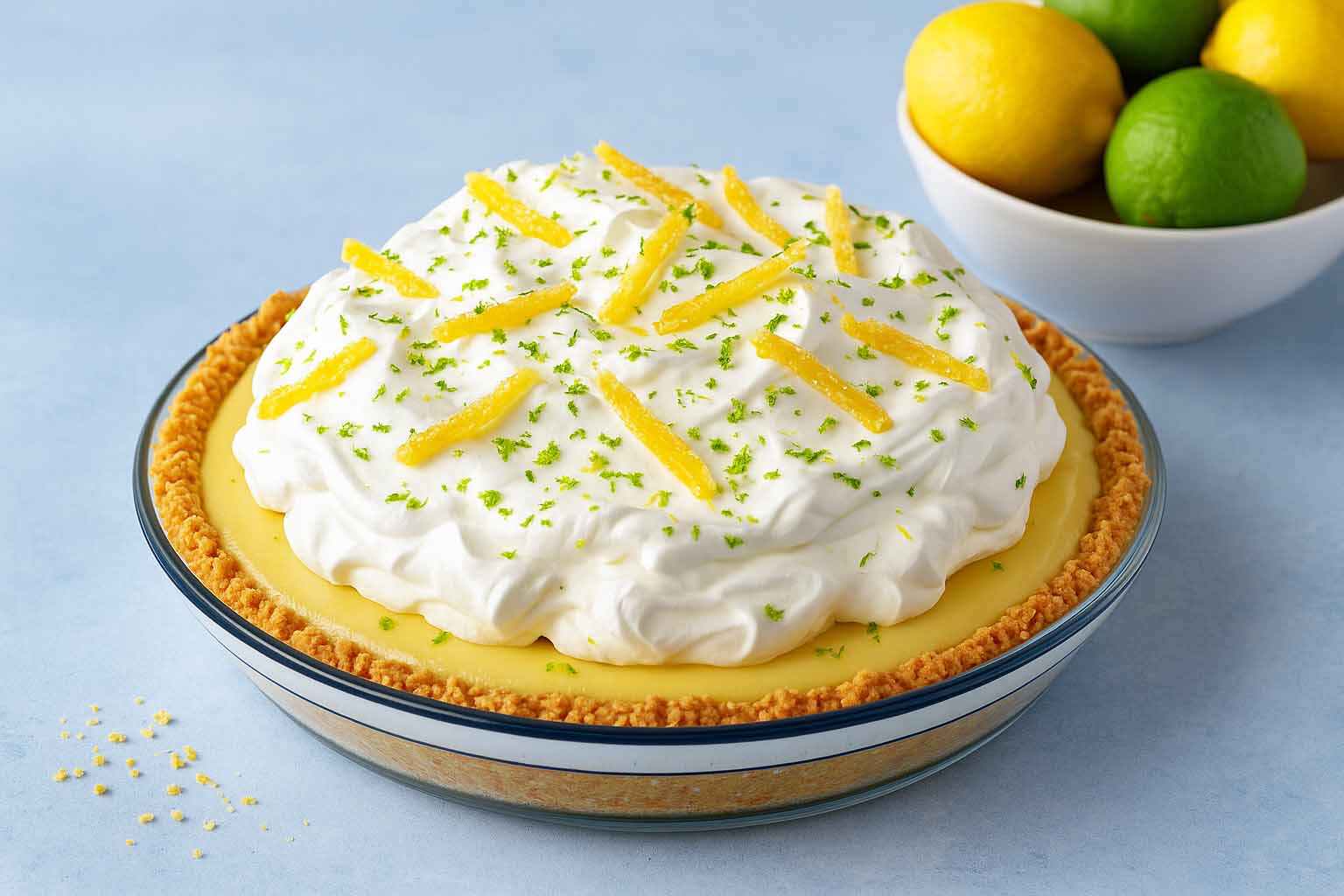
     
    Atlantic Beach Pie
    [7] Lemon peel makes an attractive and sweet-tart garnish. Make extra to serve with coffee (A.I.photo).

     
    THE HISTORY OF PIE

    The ancient Egyptians, who were great bread bakers, worked out the details of early pastry. Theirs was a savory pastry: a dough of flour and water paste to wrap around meat and soak up the juices as it cooked.

    Before the creation of baking pans in the 19th century, the coffin (from the French word for box), a very thick crust, was used to bake all food. It was inedible, not like the later “en croute” dishes. Its primary function was to protect and seal the food during cooking and storage†.

    Pastry was further developed in the Middle East and brought to Mediterranean Europe by the Muslims in the 7th century. Another leap occurred in the 11th Century, when Crusaders brought phyllo dough back to Northern Europe (the First Crusade was 1096 to 1099).

    Greek and Roman pastry did not progress as far as it could have because both cultures used oil, which can’t create a stiff pastry. In medieval Northern Europe, the traditional use of lard and butter instead of oil for cooking hastened the development of other pastry types.

    Pies developed, and the stiff pie pastry was used to provide a casing for the various fillings. By the 17th century, flaky and puff pastries were in use, developed by French and Italian Renaissance chefs. These pastry chefs began to make highly decorated pastry, working intricate patterns on the crusts.
     
    What’s Your Favorite Pie??

    Check out the different types of pie in our yummy Pie Glossary.

    Perhaps you find some additional soon-to-be favorites!
     
    ________________

    *To get more juice from a lemon (or any citrus), microwave it for 10 seconds. Then roll it on the counter, exerting pressure with your palm. You’re now ready to halve and juice it.

    †Coffins were typically made with inedible dough that would bake into a rigid mold—stiff, dry, and rock-hard to hold the contents while baking and transport the cooked food. The used coffin could be given to the poor who would soak it. Dogs, pigs, or poultry could also consume the softened pastry. Or it could be used to thicken soups and stews.


    CHECK OUT WHAT’S HAPPENING ON OUR HOME PAGE, THENIBBLE.COM.


    Comments off

    TIP OF THE DAY: Oven-Roasted Tomatoes

    When you encounter a bumper crop of tomatoes or see a great sale on tomatoes past their peak: roast them! You can use any fresh tomato: beefsteak, cherry, grape, plum, roma; conventional or heirloom.

    Healthful and delicious, you can serve them as a side with anything, add them to salads and pasta, serve them with a cheese course, and on and on.

    There are so many ways to use this basic recipe. Some of our favorites:

  • Sprinkle with coarse and crunchy or seasoned salt and/or fresh-ground pepper and serve as an antipasto or salad course
  • Blend with simmered with onions, red wine and herbs for a flavorful tomato sauce.
  • Use as a pizza topping.
  • Chop and add to risotto.
  • Serve with a cheese plate.
  • Serve with your favorite soft cheese, drizzled with balsamic vinegar and fine olive oil.
  • Use as a general garnish, plate décor or side.
  •  
    RECIPE: OVEN-ROASTED TOMATOES

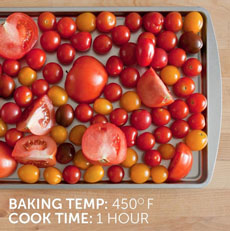
    This slow-roasted recipe requires 20 minutes prep time and 1 hour of cook time. It makes enough for leftovers, which can be added hot to pasta, cool to burgers, salads and sandwiches. Use them within a week.

    Roast a mix of sizes and colors for a more beautiful presentation.

    Ingredients For 10 Servings

  • 3 pounds ripe tomatoes, any type
  • 1/4 cup extra-virgin olive oil
  • 1 tablespoon chopped fresh thyme (substitute basil, marjoram, oregano or savory)
  • 3 garlic cloves, finely chopped
  •  
    Preparation

    1. PREHEAT the oven to 375°F with a rack in the center. Line a shallow roasting pan or rimmed baking sheet with parchment paper.

    2. PREPARE the tomatoes: Wash, remove any stems and slice them in half lengthwise (with large tomatoes, make a few thick slices). Gently scoop out the seeds with a small spoon. Set the tomatoes, cut side up, in a single layer on the baking sheet. Drizzle with the olive oil and sprinkle with the thyme and garlic.

    3. ROAST for 40 minutes, then increase the oven temperature to 400°F. Continue to until the tomatoes caramelize, about 20 minutes.

    4. TURN off the oven and let the tomatoes sit inside for 10 minutes. Remove the pan to a rack and let cool completely.
     
    PLUM TOMATOES & ROMA TOMATOES: THE DIFFERENCE

    If you wonder why plum tomatoes (a.k.a. Italian plum tomatoes) and roma tomatoes look the same, it’s because for the most part, they are.

    The plum tomato can be oval or cylindrical, while the roma is oval or pear-shaped. Their vines are slightly different.

    They are meatier subspecies, with less liquid and seeds than other tomatoes. That’s why they’re preferred for canning and for tomato sauce.
     
    FUN TOMATO FACTS

    The scientific name of the tomato is Solanum lycopersicum. Individual sizes from cherry to beefsteak are subspecies of lycopersicum.

    Tomatoes are members of the Solanaceae family, popularly called the nightshades. Botanically they are berry*-type fruits.

    Other edible nightshades include eggplant, naranjilla, potato (but not sweet potato), tomatillo.

    Another popular nightshade is the chile pepper: hot and sweet varieties and the spices and condiments made from them, such as cayenne, chili powder, hot sauce and paprika.

    Tomatoes originated in the Andes Mountains of Peru, where thousands of different types grew wild. They were first cultivated by the Incas and spread to Central America, the Aztec Empire.


    Beautiful Heirloom Tomatoes

    Cherry Tomatoes

    Roasted Tomatoes Recipe

    Heirloom Plum Tomatoes
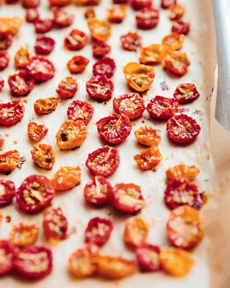
    [1] Beautiful heirloom tomatoes (photo courtesy The Chef’s Garden). [2] Simple roasting produces glorious results (photo courtesy Hidden Valley). [3] Roasted cherry tomatoes (photo courtesy Good Eggs | San Francisco). [4] Heirloom roma tomatoes (photo courtesy Hannah Kaminsky | Bittersweet Blog).

     
    The tomatillo (Physalis philadelphica), a cousin in the Solanaceae family, grew wild in Central America. It was cultivated by the Aztecs and called tomatl (pronounced to-MAH-tay).

    When the Aztecs began to cultivate the red berry* from the Andes, they called the new species xitomatl (hee-toe-MAH-tay), meaning “plump thing with navel” or “fat water with navel.”

    The Spanish arriving in what is now Mexico called the tomato tomatl (spelled tomate). The Spanish called the smaller green fruit, called tomatl by the Aztecs, tomatillo.

    Tomate first appeared in print (in Spanish) in 1595 [source and a deeper discussion].
     
    __________________
    *The scientific use of “berry” differs from common usage. In botany, a berry is a fruit produced from the ovary of a single flower. The outer layer of the ovary wall (the pericarp) develops into an edible fleshy portion. Thus, “berry” includes many fruits that are not commonly thought of as berries, including bananas, cucumbers, eggplants, grapes, tomatillos and and tomatoes. Paradoxically, fruits not included in the botanical definition include strawberries and raspberries, which are not true berries [source].
      

    Comments off

    FOOD HOLIDAY: Recipes For National Creamsicle Day

    Creamsicle Cheesecake Recipe
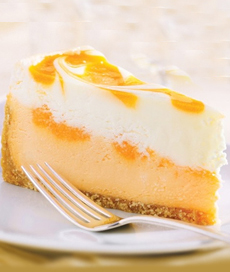
    [1] How about a Creamsicle cheesecake for National Creamsicle Day? Here’s the recipe (photo © Sweet Street Desserts).

    Creamsicle Cheesecake
    [2] This recipe from Cook’s Country layers the cake, sherbet and ice cream in a springform pan lined with lady fingers (photo © Cook’s Country).

    Creamsicle Milkshake

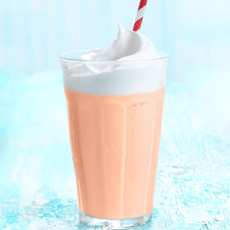
    [3] Prefer a drink? Try a Creamsicle shake or cocktail (photo courtesy Williams-Sonoma).


    The Creamsicle® was created by the Popsicle Corporation, established in the Depression by Frank Epperson, who had invented the Popsicle®. The vanilla ice cream pop, coated with orange sherbet, became a sensation.

    Today Creamsicle® and Popsicle® are registered trademarks of the Unilever Corporation. Any company wishing to use the name for a product must get a license from Unilever.

    But in the Wild West of online recipes, anything goes.

    Here’s more Creamsicle history.

    Since August 14th is also National Creamsicle Day, take a look at other Creamsicle-inspired food.
     
    FAVORITE CREAMSICLE VARIATIONS

    The easiest, and a favorite of ours, is a simple bowl of vanilla ice cream and orange sorbet (mango sorbet is a great substitute).

    You can also make vanilla cupcakes with orange frosting or top vanilla ice cream with orange liqueur.

    Here are more celebratory recipes:

  • Creamsicle Cheesecake
  • Creamsicle Cocktail
  • Creamsicle Ice Cream Cake
  • Creamsicle Milkshake (recipe below)
  •  
    Also check out fior di Sicilia, an Italian essence used to flavor baked goods and beverages. Its flavor and aroma are reminiscent of a Creamsicle.
     
    RECIPE: CREAMSICLE MILKSHAKE

    Make this recipe, from Williams-Sonoma kitchens, in 5 to 10 minutes.
     
    Ingredients Per Drink

  • 1/2 cup vanilla ice cream, firmly packed
  • 1/2 cup orange sherbet, firmly packed
  • 1/3 cup milk, plus more as needed
  • Optional garnish: orange wheel/wedge or whipped cream
  •  
    Preparation

    1. COMBINE the ingredients in a blender and process on the low setting. If the shake is too thick, add more milk until the desired consistency is reached.

    2. POUR the shake into a tall glass and garnish as desired.


    CHECK OUT WHAT’S HAPPENING ON OUR HOME PAGE, THENIBBLE.COM.


    Comments off

    TIP OF THE DAY: Savory Tomato Clafoutis

    Clafoutis (cluh-FOO-tee) is a rustic tart, initially made with cherries in the Limousin region of south-central France, where black cherry trees abound.

    Today, other stone fruits and berries are also used. When other kinds of fruit are used instead of cherries—apples, berries, pears, other stone fruits including prunes—dried plums—the dish is properly called a flaugnarde (flow-NYARD).

    In the centuries before ceramic pie plates were invented (during the Renaissance), the filling was placed into a hand-crafted dough with no sides (think of a galette, or a pizza with a higher side crust).

    The fruit is placed in a pie shell and covered with a flan (custard)-like filling; then baked until puffy. The fruit is not only inside the custard, but tempting nuggets pop through at the top.

    The recipe originated in the Limousin region of France, where black cherries were plentiful (red cherries can also be used). The name derives from the verb clafir, to fill, from the ancient language of Occitania, the modern southern France.

    Fruit clafoutis can be served warm, room temperature or chilled; vegetable clafoutis are better warm.
     
    RECIPE: SAVORY TOMATO CLAFOUTIS

    A savory clafoutis is similar to a quiche. Without a crust it is a savory custard, and can be made in a pie plate or in individual ramekins.

    This recipe was contributed by Karen, FamilyStyle Food to Go Bold With Butter, a source of wonderful recipes.

    Karen made the dish as a custard, without a crust. You can do the same, or use a pie crust or a crust of crushed biscuits/crackers.

    Prep Time is 10 minutes, cook time is 55 minutes. Serve it warm from the oven or room temperature, for brunch, lunch or dinner, or as a first course or snack.

    For a more artistic presentation, use cherry tomatoes in an assortment of colors. You can also combine cherry and grape tomatoes.

     
    Ingredients For 4-6 Servings

  • 12 ounces cherry or grape tomatoes in assorted colors, halved
  • 3 tablespoons butter, melted
  • Kosher salt or seasoned salt*
  • 2 eggs, separated
  • 1/8 teaspoon sugar
  • 3 tablespoons all-purpose flour
  • 1/4 cup finely grated Parmesan cheese
  • 1/2 cup heavy cream
  • 1/2 cup fresh basil leaves, sliced into ribbons
  • Optional crust
  • Optional garnish: marinated tomato “salad”†
  •  
    __________________
    *We used rosemary salt, a blend of sea salt and rosemary. You can make your own by pulsing dried rosemary (or other herb) and coarse salt in a food processor. Start with a 1:3 ratio and add more rosemary to taste.

    †We cut up the leftover tomatoes and marinated them with diced red onion and fresh herbs in a vinaigrette of olive oil and balsamic vinegar. Drain it thoroughly through a sieve and then use it as a topping or a side garnish.

      Cherry Clafoutis

    Mixed Berry Clafoutis

    roasted-tomato-clafoutis-goboldwbutter-230
    [1] A classic clafoutis, a custard tart with black cherries (here’s the recipe from FoodBeam.com). [2] This mixed berry clafoutis is from The Valley Table, which highlights the cuisine of New York’s Hudson Valley. It is garnished with fresh berries and a side of crème fraîche. [3]A tomato clafoutis with flavorful summer tomatoes (photo courtesy FamilyStyleFood.com.

     
    Preparation

    1. PREHEAT the oven to 375°F. Prick the bottom of the pie shell all over with a fork. Line the bottom with parchment paper and fill with pie weights or dried beans. Bake until the crust begins to color around the edges, 15 to 20 minutes. Remove from the oven, set aside and raise the oven temperature to 400°F.

    2. TOSS the tomatoes and butter on a baking sheet and sprinkle with salt to taste. Roast 15-20 minutes until the tomatoes are soft and begin to caramelize. Transfer the tomatoes to 9-inch round or square baking dish, or set aside until Step 5.

    3. REDUCE the oven temperature to 375°F. Whisk the egg yolks, 1 teaspoon salt and the sugar in large bowl until lightened and creamy. Stir in the flour, 3 tablespoons of the Parmesan and the cream.

    4. BEAT the egg whites in separate bowl or heavy-duty mixer until they form soft peaks. Fold into yolk mixture until blended. Pour batter over tomatoes and sprinkle with basil.

    5. BAKE 18-20 minutes or until batter is puffed and light golden. Sprinkle remaining cheese over top and serve warm.
     
    CHECK OUT THE HISTORY OF PIE

    Invented by the ancient Egyptians, for some 2,000 years food was not baked in containers (e.g. pie plates, baking pans), but completely wrapped in dough. The dough wrap was called a coffin, the word for a basket or box.

    Here’s the scoop.


    Comments off

    The Nibble Webzine Of Food Adventures


    © Copyright 2005-2026 Lifestyle Direct, Inc. All rights reserved. All images are copyrighted to their respective owners.