THE NIBBLE BLOG: Products, Recipes & Trends In Specialty Foods


Also visit our main website, TheNibble.com.

TOP PICK OF THE WEEK: Baileys Red Velvet Irish Cream Liqueur

A few weeks ago we wrote about Bailey’s Red Velvet Irish Cream Liqueur in a product review.

We’ve grown so very fond of it that we’ve elevated it to a Top Pick Of The Week.

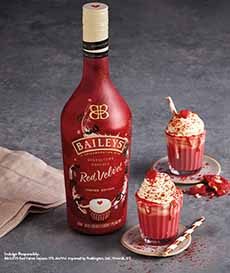
A special edition for Holiday 2019, chocolate lovers should not miss this one (photo #1).

Baileys Red Velvet Irish Cream liqueur has rich cocoa flavor that classic red velvet cake should have, but most rarely do (that’s our humble opinion).

It smells like cocoa, tastes like cocoa made with heavy cream, and for eye appeal, it’s a dusty rose color.
 
 
USES FOR BAILEYS RED VELVET IRISH CREAM LIQUEUR

Sip it straight! This stuff is just too good to mix into cocktails, to bake into brownies or red velvet cake, or to swirl into cheesecake.

But you can:

  • Drizzle it over cheesecake and ice cream.
  • Add it to hot whole milk or half-and-half and drink it as “hot red velvet chocolate.”
  • Make a float, as in photo #1: Fill a small glass halfway with Baileys Red Velvet, add vanilla or chocolate ice cream, and top with whipped cream.
  •  
    We bought ourselves a few bottles to last through the year, and a few more bottles as holiday gifts.

    We hope you love it as much as we do!


    [1] Sip the pink elixir from a liqueur glass, or turn it into a mini ice cream float, shown here with vanilla ice cream and whipped cream (photo © Diageo).


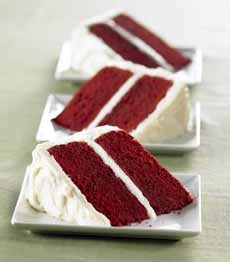
    [2] Have some as a chaser after a piece of red velvet cake. Here’s the recipe from McCormick (photo © McCormick).


    Comments off

    TIP OF THE DAY: Christmas Mocktail Menu


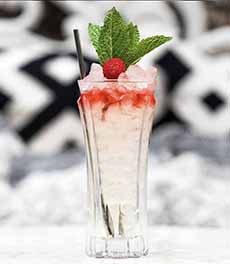
    [1] Jingle Belle: 7-Up and bitters with a raspberry-mint garnish (photo © Beatnik | Chicago).


    More and more people don’t drink alcohol, and seek club soda or soft drinks at parties.

    If some of your guests fall into that category, why not create a “Mocktail Menu?”

    It’s quite easy, and it will bring them some extra holiday cheer.

    Some suggestions:

  • Jingle Belle: 7-Up, bitters and raspberry-mint garnish (see photo).
  • Merry Cranberry: cranberry juice spritzer, with club soda or ginger ale and a mint garnish.
  • Virgin Mary: virgin Bloody Mary and a celery stick garnish (make your own Mary mix with the recipe below—it’s so much better than store-bought).
  •  
    Even guests who do drink alcohol may turn to the Mocktail Menu for their third drinks, and beyond.

     
    RECIPE: VIRGIN BLOODY MARY

    This is the same mixture used for a regular Bloody Mary, just without the vodka.

    Our recipe makes a spicy drink with lots of flavor and just 41 calories per 8-ounce glass. Plus, it has 74% of the daily requirement of vitamin C and 22% of vitamin A.

    As an alternative to horseradish you can use 6 drops of hot sauce, but the horseradish adds much better flavor.

    If you don’t want any heat, use more Worcestershire and lemon juice; then experiment with a drop or two of hot sauce to round out the flavors.

    Ingredients For Four 8-Ounce Drinks

  • 32-ounce bottle tomato juice
  • 2 tablespoons prepared horseradish
  • 2 tablespoons Worcestershire sauce
  • 1 teaspoon celery salt
  • Juice of a fresh lemon or lime
  • Garnish: 4 celery sticks
  •  
    Preparation

    Combine the ingredients and chill. Before serving, stir or shake the mix.

    If it’s well chilled, there’s no need for ice, that dilutes the drink.


    Comments off

    RECIPE: Holiday Meringue Drops

    Austin, Texas has become a hot city to visit and move to, abetted by its ever-expanding food scene.

    One place of interest is Fluff Meringues & More is a modern patisserie that proffers European treats in a market full of cupcakes and Southern pecan pie.

    A meringue cookie is the opposite of these latter favorites. The light fluffs of egg whites and sugar are cholesterol free, lower in calories and welcome at home on an assorted cookie plate, a dessert plate garnish or with after-dinner coffee and tea.

    At Fluff Meringues & More, you can have a civilized afternoon tea respite, with fetching pastries, scones, mousse, homemade marshmallows and of course, meringues. Put it on your go-to list for a visit to Austin.

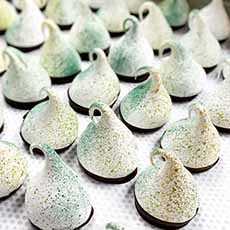
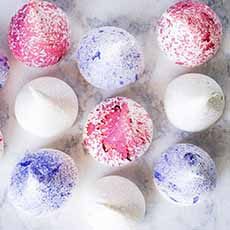
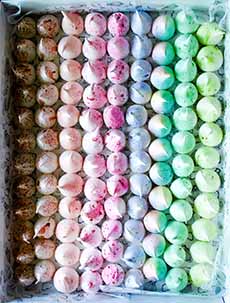
    While you can see the wealth of meringue flavors in photo #3, Fluff Meringues & More has shared a holiday-inspired flavor with us: Vanilla Cardamom Pistachio Meringue Drops.
     
     
    RECIPE: VANILLA CARDAMOM PISTACHIO MERINGUE DROPS

    Ingredients For Approximately 35 Drops

  • 150g white cane sugar
  • 300g egg whites
  • 10ml vanilla extract
  • 2g ground cardamom
  • 200g crushed pistachios
  • 300 dark chocolate
  • Gel food coloring in colors of choice
  •  
    Preparation

    1. PREHEAT the oven to 400°F. Separate egg whites from the yolks, being sure not to allow any yolk to drip into the whites. Weigh the whites as you go. Reserve the yolks for another use).

    2. WEIGH the sugar to match the 2:1 egg white ratio. Spread the sugar out on tray. Place in the oven and heat for 7-8 minutes. While the sugar is heating…

    3. WHIP the egg whites in a stand mixer until they are stiff. Start on medium speed for 2 minutes, then move to high until stiff peaks form.

    4. REMOVE the sugar from oven and reduce the oven temperature to 215°-230°. The oven will need to decrease in temperature quickly, so leaving the door open a bit for a few minutes helps.

    5. BEGIN adding the sugar immediately. Initially spoon in large spoonfuls until 1/3 to 1/2 pf the mixture is gone. Let mix on high for 30 seconds, then start slowly streaming in the remainder of the sugar.

    6. WHIP until all the granules are dissolved and the batter is stiff, tacky, and shiny. Add the cardamom and whip for 10-15 seconds. Add the vanilla and whip for 5-10 seconds. Don’t over-mix vanilla!

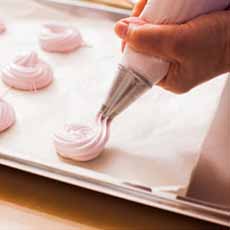
    7. LOAD the meringue into a piping bag and pipe meringue drops onto a parchment-lined baking sheet. Bake for 50 minutes in the lower rack of the oven. Cool on rack for 20 minutes. While meringues are cooling…

    8. HEAT the white chocolate in a double boiler (or very carefully in the microwave, at 30 seconds until melted. NOTE: If you burn the chocolate, you’ll have to start over. Stir and make sure the melted chocolate is smooth.

    9. PLACE the crushed pistachios in a wide bowl. After the meringues are cool, delicately dip the bottoms of the drops into the melted chocolate, then dip into the pistachios. Place the dipped meringues back on a sheet of clean parchment paper and let them set for 15-20 minutes.

  • If you want to paint colors on top, here’s how.
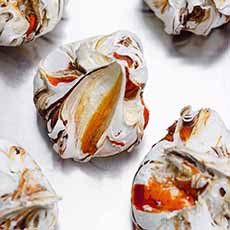
  • If you want to color the dough, and pipe out swirled meringues, here’s how.
  • Here’s how to make standard meringues in any color.
  • Remember that you can play around with flavors to create your “signature” meringue cookie.
  •  
    Now you’re ready to serve or store them in an airtight container.

     
    THE HISTORY OF MERINGUE

    Some sources say that that meringue was invented in the Swiss village of Meiringen in the 18th century, and improved by an Italian chef named Gasparini.

    Not all experts agree: The Oxford English Dictionary, for example, states that the French word is of unknown† origin.

    The one fact we can hang on to is that the name of the confection called meringue first appeared in print in chef François Massialot’s seminal 1691 cookbook, available in translation as The Court And Country Cook.

    The word meringue first appeared in English in 1706 in an English translation of Massialot’s book. But before then…

  • Two considerably earlier 17th-century English manuscript books of recipes give instructions for confections that are recognizable as meringue. One is called “white biskit bread” in the book of recipes started in 1604 by Lady Elinor Poole Fettiplace (1570-c.1647) of Gloucestershire.
  •  


    [1] You can serve white meringues, but doesn’t the edible gel “paint” look great? (photos #1 to #3 © Fluff Meringues & More).


    [2] You can apply the concept to any holiday; for example, pink and purple for Valentine’s Day or Mother’s Day. You may also enjoy these Rosewater Raspberry Meringues.


    [3] A great party tray. Fluffs Meringue & More calls this their Rainbow Tray.


    [4] You can swirl caramel, chocolate or other flavor into the meringue batter (photo © Fika | NYC (now closed).

    Red Wine Meringues
    [5] You can get sophisticated, as with these Red Wine Sea Salt Meringues. Here’s the recipe (photo and recipe © Raw Spice Bar).

  • The other is called “pets” in the manuscript of collected recipes written by Lady Rachel Fane (c. 1612–1680) of Knole, Kent. Slowly-baked meringues are still referred to as pets in the Loire region of France (the reference appears to be their light fluffiness, perhaps like a kitten?).
  •  
    Meringues were traditionally shaped between two large spoons, as they are sometimes are at home today, by those without piping equipment.
     
    The Dawn Of The Piping Bag & Tip

    Meringue piped through a pastry bag was introduced by the great French chef Marie-Antoine Carême (1784-1833—he preferred to be called Antonin), the founder of the concept of haute cuisine and the Mother Sauces.

    He invented modern mayonnaise and many other recipes, including charlotte russe, coeur à la crème, croquembouche, éclairs, mille-feuille and other iconic French recipes.

    He also invented modern mayonnaise, éclairs, and other icons of French cuisine.
     
    The Term “Meringue”

    No one can find a historical derivation of the word “meringue,” but there are many attributions to different countries (but not, surprisingly, from France).

    The latest suggestion is that it comes from Middle Dutch meringue, meaning light evening meal—possibly from the Latin merenda, “light evening meal.”

    How about the Middle Low German “meringe,” from mern, “to dip bread in wine.” Who wouldn’t like to dip a meringue in a glass of wine?

    Contenders from include 1700 on include, from the Walloon dialect, maringue, shepherd’s loaf; marinde, food for the town of Meiringen (Bern canton, Switzerland), is completely lacking.

    None of the others sounds right, either. By default, we like the Latin merenda, the feminine gerund of merere to merit, since who doesn’t merit a delicious confection?

    As our mother often said: “Who cares; let’s eat!”


    Comments off


    © Copyright 2005-2026 Lifestyle Direct, Inc. All rights reserved. All images are copyrighted to their respective owners.