THE NIBBLE BLOG: Products, Recipes & Trends In Specialty Foods


Also visit our main website, TheNibble.com.

TOP PICK OF THE WEEK: Wonder Melon Watermelon Drink


[1] Wonder Melon watermelon juice in two flavors (all photos © Wonder Melon).


[2] Enjoy a glass of straight juice, or blended into a smoothie.


[3] Make Watermelon Margaritas (photo from Wonder Melon | Facebook).


Some 10 years ago, a California company called Sundia sold the most delicious pure watermelon juice.

Alas, they got out of the juice business, and we lost our favorite juice.

It’s quite time-consuming to juice a watermelon at home, so since then we’ve tried every watermelon juice and blend we came across. Nothing made the grade.

Finally, Wonder Melon: two varieties of watermelon juice blends: Watermelon Cucumber Basil and Watermelon Lemon Cayenne.

The cold pressed juices are are refreshing drunk plain, in smoothies or cocktails. They are:

  • 100% all natural and organic
  • Certified Fair Trade
  • Certified kosher parve by OU
  • Gluten Free
  • Non GMO Verified
  • Vegan
  •  
    WATERMELON CUCUMBER BASIL WONDER MELON

    This juice is expertly blended with Watermelon Juice, Lemon Juice, Apple Juice, Cucumber Juice, and Basil for an incredibly refreshing juice that’s perfectly sweet with a touch of tartness and light herbaceous. With only 80 calories a bottle, it’s a drink you can’t resist.

    Food Trivia: Cucumbers and watermelons are first cousins.

    Both are from the binomial order Cucurbitales and family Cucurbitaceae, differing only at the genus level.

    That’s why if you eat the white portion of watermelon rind, it tastes just like cucumber.
     
    WATERMELON LEMON CAYENNE WONDER MELON

    A touch of tartness from lemon and hint of heat from cayenne pepper, the juice has just 4 ingredients: watermelon juice, lemon juice, apple juice and a dash of cayenne. An 8.45-ounce bottle has 100 calories.

    There’s a store locator on the website.

    You can purchase Wonder Melon on Amazon.
     
     
    THE HISTORY OF WATERMELON

    Watermelon, Citrullus lanatus, is believed to have originated in the Kalahari Desert in southern Africa. An ancestor of the modern watermelon still grows there.

    That ancestor is not tasty at all: bitter and with many seeds. It was cultivated for the water inside, to quench thirst in the desert.

    Mutations over thousands of years of cultivations created the sweet flesh we enjoy today.

    Watermelons are about 92% water—that’s how they got their name. In ancient times, travelers carried watermelons as a replacement for water—a watermelon canteen, as it were.


    Watermelon has been cultivated as early as 2000 B.C.E. The first recorded watermelon harvest occurred nearly 5,000 years ago in Egypt. Watermelon seeds have been found in the tomb of Egyptian Pharaoh Tutankhamen (King Tut).

    Here’s more of the watermelon’s history.

    Check out watermelon nutrition.


    Comments off

    TIP OF THE DAY: Meatless Mondays As A New Year’s Resolution


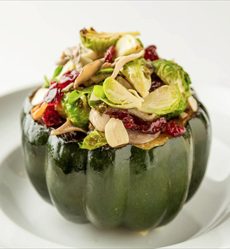
    [1] Acorn squash stuffed with Brussels sprouts, dried cranberries and almonds (photo © Chef Eric LeVine).

    Spinach Stuffed Portabella
    [2] Stuffed Portabella Mushrooms. Here’s the recipe from Healthy Recipes Blog (photo © Healthy Recipes Blog).


    [3] Potato latkes with grilled root vegetables, applesauce, sour cream and Maille mustard (substitute nondairy sour cream—photo © Maille).


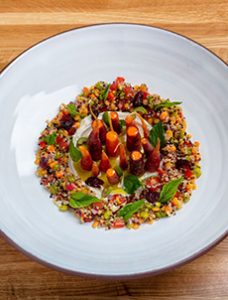
    [4] Quinoa and beans salad with roasted heirloom carrots (photo © Obra Kitchen Table | Miami)


    [5] Angel hair pasta with San Marzano tomatoes and extra-virgin olive oil (photo © Davio’s | Boston).


    New year, new goals.

    As advocates for sustainability, our first tip of the year focuses on Meatless Mondays.

    If you’re not already in the fold, now’s the time to open the gate.

    It’s not just about meat. Cheese and other dairy products, including yogurt and cottage cheese, contribute the same greenhouse gases that meat does.

    Yes, you could eat fish; in fact, substituting more seafood for meat is another important resolution.

    So if you really want to help Planet Earth, we propose to make Meatless Monday, Vegan Monday.

    Almost every health, nutrition and sustainability expert advises: Eat a plant-based diet. Here, we’re only asking you to eat a plant-based Monday.
     
     
    MEATLESS MONDAY: WHERE TO BEGIN

    There are countless online recipe troves to tempt you. You can make—or take out, or order in:

  • Beans and legumes
  • Grain bowls
  • Grilled vegetable plates
  • Pasta
  • Salads
  • Stir-frys
  •  
    For protein, add:

  • Legumes
  • Nuts and seeds
  • Quinoa
  • Tempeh
  • Tofu
  • When you look at recipes, you’ll discover that quite a few popular foods are on the Meatless Monday menu.

  • Casseroles, soups and stews galore are vegan and vegetarian.
  • Cauliflower steaks, kale, quinoa and other trending foods are easy to make. Our local Chinese restaurant has Kung Pao Cauliflower.
  • Chili is made from beans.
  • Chinese, Indian and Middle Eastern cuisines have many vegan options. Falafel, anyone?
  • Hummus is made from chickpeas, a legume. A lunch of hummus and raw vegetables, or a hummus and veggie sandwich, does the trick.
  • Meatless burgers are ubiquitous. Try different brands to see which you prefer.
  • Pasta Primavera tossed with olive oil is a winner. (O.K., you can have a teaspoon of grated parmesan.)
  •  
    Restaurant chains nationwide from Burger King to Chik-Fil-A to KFC offer meatless options. Hooters just debuted Meatless Wings (just as crisp and half the calories of its chicken wings).

    Here are 147 chains with vegan options.

    Here’s a Whole Foods article, 9 Easy Ways to Eat More Plants at Every Meal.
     

    MEATLESS MONDAY HISTORY

    It may seem like Meatless Monday is a 21st-century idea, but it originated during World War I.

    Before formal rationing began, the U.S. Food Administration promoted reduced consumption of key staples to aid the war effort.

    President Woodrow Wilson issued a proclamation calling for every Tuesday to be meatless and for one meatless meal to be observed every day, for a total of nine meatless meals each week [source].

    “Food Will Win the War,” proclaimed government ads. “Meatless Monday” and “Wheatless Wednesday” were introduced to encourage Americans to do their part.

    The effect was overwhelming. More than 13 million families signed a pledge to observe the national meatless and wheatless conservation days.

    During World War II when President Franklin D. Roosevelt relaunched the campaign to help the war efforts. In the immediate post-war years, President Harry S. Truman continued the campaign to help feed war-ravaged Europe [source].

    Most of us alive today hadn’t heard the term until 2003, when the concept was relaunched by a former advertising executive turned health advocate, Sid Lerner.

    In association with Johns Hopkins University (The Bloomberg School of Public Health’s Center for a Livable Future), the concept was reintroduced as a public health awareness campaign.

    The “new’ Meatless Monday was launched to addresses the prevalence of preventable illnesses associated with excessive meat consumption.

    With the average American eating as much as 75 more pounds of meat each year than in generations past, the message of “one day a week, cut out meat” became a way for people to do something good healthwise. The health benefits of reducing meat consumption became regular stories for the nation’s news outlets.

    With awareness of global warming and the causes of greenhouses gases, Meatless Monday has achieved even greater promotion as an environmental campaign, and has been growing worldwide.

    The growing vegan movement has greatly helped the movement. Even for omnivores, cafeterias and restaurants offer meat-free options not only on Mondays, but everyday.

    Make one of your New Year’s resolutions to join in.


    Comments off

    FOOD HISTORY: Galette Des Rois, Epiphany Cake (The Original King Cake)

    Epiphany, a Christian holiday celebrated on January 6th, marks the end of the Christmas season and the beginning of Carnival (which concludes with the beginning Lent).

    January 6th, which is 12 days after Christmas in the Gregorian calendar, is also known as Twelfth Night.

    It can get confusing to those not schooled in the tradition. Epiphany is also known as Three Kings Day, the Day of Kings and Feast Of The Kings (Fête des Rois in French). It’s the day that the Three Kings (les rois) appeared in Bethlehem bearing gifts for Baby Jesus.

    And it’s celebrated with a special cake, Galette des Rois (Cake Of The Kings, a.k.a. King Cake).
     
     
    HOW TO CELEBRATE EPIPHANY

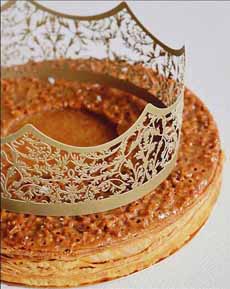
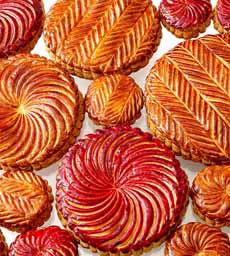
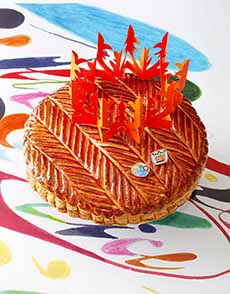
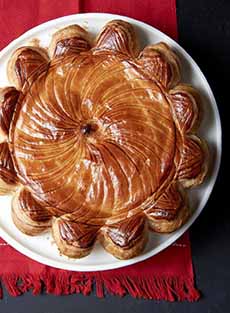
    Epiphany is celebrated with parties for children and adults alike. Whatever the food served, the “must have” is a Galette Des Rois (photos #1 and #2), otherwise known as an Epiphany Cake.

    The cake is a frangipane* tart. In France, people enjoy it throughout January, regardless of religious background.

    Composed of two circles of puff pastry (pâte feuilleté) with frangipane (almond-enhanced pastry cream) in between, each cake comes with a hidden charm or other trinket, called a fève, or bean†, baked into it. A gold paper crown, provided by the baker, sits on top.

    The person who gets the slice with the charm becomes “king” or “queen” for the day, and gets to wear the gold paper crown. But it’s an entailed honor: By tradition, the king or queen has to provide next year’s galette.

    Most people head to the nearest French bakery to buy a Galette Des Rois.

    But you can bake one: Here’s an Epiphany Cake recipe from the two-Michelin-star French chef Héléne Darroze.
     
     
    THE HISTORY OF GALETTE DES ROIS

    Hiding some type of token in food is a pre-Christian tradition, with roots in the Roman feast of Saturnalia‡. When the Church later instituted the Feast of The Epiphany to celebrate the arrival of the three wise kings, the tradition of the bean in the cake remained.

    The Galette Des Rois as we know it first appeared in the 14th-century [source].

    Before the custom of the gold paper crown emerged (probably in the 19th century), the cake was covered with a white napkin and carried into the dining room.

    The tradition was adopted by other countries, to a more or less extent.

  • In the south of France, the preference is for a brioche-style cake covered with candied fruit. In Western France, the cake is shortbread-style with fillings such as chocolate-pear and raspberry [source and recipe].
  • In the U.K., in the 17th, 18th and 19th centuries, fruitcakes with a hidden bean were covered in marzipan and topped with crowns. The day was reserved for revelry and games.
  • During the French Revolution, when King Louis XVI was beheaded, the feast still occurred—but the cake was renamed “Gâteau de l’Egalité” (cake of equality). Even though the cake referred to the Three Wise Men, since the cry of the people was “Down with the King,” anything called “king” was renamed.
  • In New Orleans a similar cake, called King Cake, is used for Mardi Gras, the bookend to the Carnival season. The cake is different—a yeast cake decorated in sugars the colors of New Orleans: purple, gold and green. There’s no crown. (Here’s the history of Mardi Gras and King Cakes.)
  •  
     
    TRADITIONAL VS. MODERN

    While traditionalists like the cakes in the photos, others bake outside the box.

  • Fauchon has created a galette in the shape of a giant pair of lips, adding passion fruit, raspberry and rose petals to the recipe.
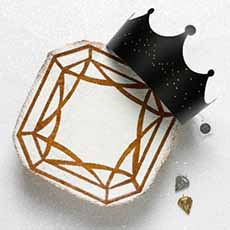
  • Dalloyau created a “crystal galette,” with touches of bitter orange and Papua New Guinean vanilla. They’ve even added crystals to the crown (photo #5)
  • Chef Laurent Fau placed a Black Forest Cake cherry rim around the galette.
  • Lenôtre created a charmer called À l’heure du goûter (“time to eat),(photo).
  • Scroll down on this page to see innovative Galettes Des Rois.
  •  
    Are you inspired to create your own Epiphany Cake? Traditional or not, January 6th is a day to celebrate with a good piece of cake.

    Don’t eat sugar? Make a vegetable filling, like creamed spinach with a hint of nutmeg.

    ________________

    *WHAT IS FRANGIPANE? Frangipane is a dense pastry cream flavored with almond paste. The almond paste base is enriched with sugar, butter and eggs. (Alternatively, milk, sugar, flour, eggs and butter are mixed with ground almonds). It is related to marzipan, which also has a base of almond paste. A key difference is that frangipane is a spreadable cream, and marzipan is a semi-hard almond candy.


    Galette Des Rois
    [1] Famed patissier Ladurée fills the puff pastry with almond cream, then garnishes the top with a confit of mandarin orange topped with a crunchy biscuit (cookie) of nougatine (almond croquant).

    Galette Des Rois
    [2] Beautiful galettes with different patterns, from the great Parisian pâtissier Pierre Hermé.

    Galette Des Rois
    [3] Pierre Hermé adds some color—and two chocolate treats—to this galette.

    [4] Modern chefs add their own creative touches (photo © Breads Bakery | NYC).

    Modern Galette Des Rois
    [5] After centuries of tradition, some pastry chefs are ready for a major change, like this “Crystal Cake” from French pâtissier Dalloyau. (photo © Dalloyau).

     
    †Modern trinkets can include anything from a charm to a coin to a plastic Baby Jesus. In earlier days, a bean was more available. Today, any meltable trinket is inserted into the bottom of the cake after baking.

    ‡Saturnalia, a festival spanning December 17-23, honored Saturn, the Roman god of agriculture. Festivals were organized in honor of the gods between late December and early January. A dry bean would be hidden in a dish prepared for the household staff (slave servants). The slave who got that helping would be given the “kingship,” which included drinking, gambling and general bawdiness.

    Many Christian celebrations date back to pagan customs. They were adapted by Christians to make religious conversion more familiar to pagans. The Christian festival of the Epiphany is even older than Christmas and Easter [source].


    CHECK OUT WHAT’S HAPPENING ON OUR HOME PAGE, THENIBBLE.COM.

     
    &nbsp


    Comments off


    © Copyright 2005-2026 Lifestyle Direct, Inc. All rights reserved. All images are copyrighted to their respective owners.