THE NIBBLE BLOG: Products, Recipes & Trends In Specialty Foods


Also visit our main website, TheNibble.com.

TIP OF THE DAY: Make An Herb Vinaigrette Salad Dressing

Updated August 2026

There is no National Salad Dressing Day, but there should be. Few people want to eat a plate of undressed greens.

So today we tackle salad dressing, starting with some food trivia:

The word “salad” derives from the Latin herba salta, salted herbs. In ancient Rome, greens were usually seasoned with salty dressings, including garum.

Below:

> The history of salad dressing.

> Recipe: Dijon-herb vinaigrette.

Elsewhere on The Nibble:

> America’s top 10 salad dressing, past and present.

> Green goddess salad dressing recipe.

> The history of salad.

> The world’s 15 lettuce holidays.

> The year’s 40+ salad holidays.

> The year’s 18 sauce, dips, and dressings holidays.
 
 
1. THE HISTORY OF SALAD DRESSING

Salad greens were picked and eaten by man, likely from the furthest days of prehistory. But salad dressing came much later.

We know from the written record that the Babylonians used oil and vinegar for dressing greens nearly 2,000 years ago. Ancient Egyptians added Asian spices to those basic ingredients.

But what about creamy salad dressings that are so popular in the U.S.?

Modern mayonnaise was created by the great French chef Marie-Antoine Carême (1784-1833), founder of the concept of haute cuisine. He blended vegetable oil and egg yolks into an emulsion; his recipe that became famous throughout Europe, and subsequently, the U.S. and the world [more about it].

Mayonnaise became the base of creamy salad dressings, even when buttermilk* or blue cheese was added.

Salads & Royalty

Salads were favorites in the courts of European monarchs. Royal chefs often combined as many as 35 ingredients in one gigantic salad bowl.

Sometimes, the monarch’s favorite salad included few or no greens.

  • King Henry IV of England preferred boiled, diced new potatoes and sardines, tossed with an herb dressing.
  • Mary, Queen of Scots, liked boiled celery root diced and tossed with lettuce, creamy mustard dressing, truffles, chervil and hard-cooked egg slices.

But the conventional dressing for green salads remained oil and vinegar.

Salad Dressing In America

  • In 1912, Richard Hellmann, a deli owner in New York, began to sell his mayonnaise in wooden containers. A year later, he began to market his “blue ribbon mayonnaise in glass jars.
  • In 1919, Joe Marzetti, a restaurateur in Columbus, Ohio, began packaging his dressings to sell to restaurant customers.
  • In 1925, the Kraft Cheese Company entered the salad products business with the purchase of several regional mayonnaise manufacturers [source].

 
Salad Dressing Today

Most of the salad dressings sold in the U.S. have a mayonnaise base. The most popular bottled dressing in the U.S. is ranch, a re-naming of buttermilk dressing.

Creamy dressings have three things that vinaigrettes don’t have: cholesterol, dairy, many more calories. They lack the heart-healthy monounsaturated fatty acids and antioxidants of olive oil.

So if you’re a frequent salad eater who piles on the creamy dressing, get out the oil and vinegar and make green salads the healthy foods they should be. You can:

  • Use any kind of culinary oil—plain or flavored—but the healthiest ones for vinaigrettes, with the most monounsaturated fat besides olive oil, are avocado and canola (rapeseed) oils.
  • Use any vinegar, too, from plain wine vinegar to flavored vinegars or alternate vinegars like balsamic and rice vinegars (the different types of vinegar).
  • Use vinegar substitutes, such as citrus juice.
  • Use any type of mustard, plus mustard relatives like horseradish or wasabi.
  • Use any spices and herbs.
  • Use splashes of other flavors, like anchovy paste, pomegranate juice, tahini, even tomato paste.

 
Do the math, and you’ll realize that with all of the permutations and combinations†, you could make a different vinaigrette every day of the year.
 
 
2. RECIPE: DIJON-HERB VINAIGRETTE

Ingredients

  • 1 tablespoon Dijon mustard
  • ¼ cup champagne vinegar or white wine vinegar
  • ⅓ cup olive oil
  • 1-1/2 teaspoon minced garlic
  • ¼ teaspoon black pepper, freshly ground
  • Pinch salt
 

A vinaigrette
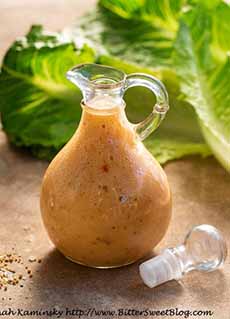
[1] A vinaigrette, emulsified to prevent separation (photo © Hannah Kaminsky | Bittersweet Blog).

Balsamic Vinaigrette
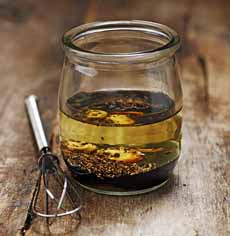
[2] One of our favorites: balsamic vinaigrette (photo © Canola Eat Well For Life).

Parsley Vinaigrette
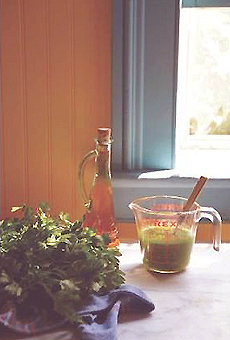
[3] Parsley vinaigrette. Enough herbs will turn the vinaigrette green (photo © Hero Foodservice).

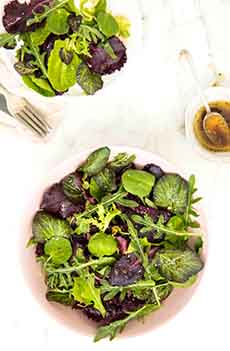
Summer Salad With Nasturtium Leaves
[4] Whether your ingredients are basic or fancy green salad welcomes a vinaigrette. Potato and pasta salads, too (photo © Good Eggs).

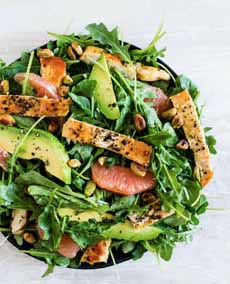
Chicken Grapefruit Salad
[5] This arugula salad adds chicken, grapefruit, avocado and a tasty citrus-rice vinegar vinaigrette (photo © Nutmeg Nanny).

 
Fresh Herbs

  • ¼ cup fresh flat-leaf parsley, roughly chopped
  • 2 tablespoons fresh tarragon, roughly chopped (substitute ¼ cup dill or basil ribbons)
  • 2 tablespoons fresh chives (substitute scallions), minced

 
Preparation

1. WHISK together the first four ingredients. If you prefer, you can use the shaking technique:

Combine the vinegar and garlic in a 1-pint jar and let sit for about 5 minutes. Add the mustard, olive oil, salt and pepper. Cover with the lid and shake vigorously until emulsified, about 10 seconds.

2. DRIZZLE the vinaigrette over the salad, add the herbs and toss. Serve immediately.
 
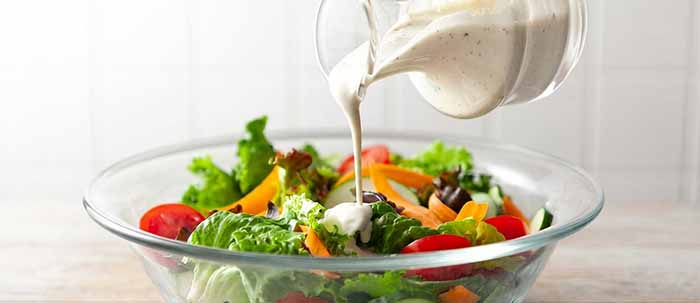
Mixed Salad With Ranch Dressing
[6] Salad with America’s favorite bottled dressing, ranch (photo © Pixabay).

________________

*There is also cream dressing, made with heavy cream and vinegar—no mayo. It originated in the area of Lyon, in the Auvergne-Rhône-Alpes region of France.

†If you never learned them in high school math, permutations and combinations calculate the various ways in which objects from a set may be selected; in this case, how many different recipes could be created from a set of ingredients.


CHECK OUT WHAT’S HAPPENING ON OUR HOME PAGE, THENIBBLE.COM.


Comments off

FOOD HOLIDAY: Cheeseburger Recipes For National Cheeseburger Day

Pimento Cheese Cheeseburger
[1] Pimento cheese on a cheeseburger is a special treat (photo © Gardenia Restaurant | NYC [now closed]).


[2] Switch out the bun for a different bread: baguette, brioche, English muffin, focaccia, or pita, for example (photo © Thomas Breads).


[3] A bacon cheeseburger with blue cheese (photo © Cheesecake Factory).

Double Cheeseburger With Frizzled Onions
[4] A simple double cheeseburger: lots of protein (photo © Allen Brothers).


In case you missed National Double Cheeseburger Day on September 15th, September 18th is National Cheeseburger Day. So we know what we’re having for lunch!

Several restaurants claim that they created the hamburger, by placing a ground beef patty inside bread.

Several also claim the invention of the cheeseburger, although it’s not a stretch to see that any cook could have easily thought to garnish the patty with cheese, lettuce, tomato, onions, etc.—and that it happened everywhere burgers were made.

Louis’ Lunch in New Haven, Connecticut claims to have served up the original burger in the U.S. in 1900, placing a beef patty, tomato, onion, and cheese between two slices of toasted white bread—no ketchup or mustard. They still serve it the same way.

So: Did they invent both the burger and the cheeseburger?
 
> Check out the history of hamburgers.

> See more cheeseburger recipes below.

> The year’s 25+ beef holidays.

> The different cuts of beef: a photo glossary.
 
 
FANTASY CHEESEBURGERS

While people use different cheeses (we’re partial to Brie or Gruyere) and pile on ingredients like avocado or onion rings, some restaurateurs go overboard:

  • The $295 Cheeseburger. Serendipity 3 in New York City created Le Burger Extravagant in 2012. At $295, it was declared the world’s most expensive burger by The Guinness Of World Records. The burger is topped with black truffles, fine cheddar cheese from fromager James Montgomery in Somerset, England, and a fried quail egg. The Wagyu beef is infused with white truffle butter, and the roll is dusted with edible gold. A mini blini with caviar and crème fraîche was nestled on the top of the roll [source]. It’s not on the current menu.
  • The $5,000 Burger. In the no-cheese burger category, the record goes to the $5,000 cheeseburger that Chef Hubert Keller served at his Las Vegas restaurant a year earlier. A Kobe beef patty was topped with foie gras and black truffles, plus truffle sauce. It came with a bottle of 1995 Petrus Bordeaux, $2500 at the time—and of course, a side of fries. Was cheese extra? [source]
  •  
    We don’t know any high rollers to treat us, so we’ll stick with some of the creative—and affordable—cheeseburger recipes below.

    As you eat yours, enjoy Jimmy Buffett singing “Cheeseburger In Paradise.”
     
     
    MORE CHEESEBURGER RECIPES

  • Bacon Cheeseburger Crescent Ring
  • Bacon Cheeseburger Pizza
  • Cheeseburger Baked Potato
  • Cheeseburger Day Toppings From NYC Restaurants
  • Cheeseburger Hot Pockets
  • Cheeseburger Recipes With Better Cheeses
  • Creative Restaurant Cheeseburgers
  • Elvis Presley Cheeseburger
  • Creative Toppings For Burgers, Franks & Brats
  • Gourmet Cheeseburger Toppings
  • Mushroom-Stuffed Bacon Cheeseburger
  • Patriotic Cheeseburger For Memorial Day & July 4th
  • Pimento Cheese Cheeseburger
  • Taco Cheeseburger
  • Turkey Bacon Cheeseburger With Jarlsberg
  •  
    Plus

  • Caramelized Onions (one of our favorite cheeseburger toppings)
  • Homemade Burger Buns
  •  
    Man who invented the cheeseburger was smart; man who invented the cheeseburger was a genius.” — Matthew McConaughey


    CHECK OUT WHAT’S HAPPENING ON OUR HOME PAGE, THENIBBLE.COM.


    Comments off

    TIP OF THE DAY: Ancient Grains Are New Again

    September is National Whole Grains Month, an occasion to revisit some oldies but goodies.

    Thanks to King Arthur Baking (formerly King Arthur Flour) for this primer on eight* ancient grains.

    “Ancient grains” is a marketing term used to describe a category of grains and pseudocereals, that are purported to have been minimally changed by selective breeding over recent millennia.

    They are distinguished from more widespread cereals such as corn, rice and modern varieties of wheat, which are the products of thousands of years of selective breeding [source].

    King Arthur sells the flour versions ground from ancient grains. They’ve provided the following information, including details on how the flours “bake up.”

    Here are their recipes for using the different flours to bake banana bread, cinnamon bread, muffins, pancakes and scones.

    The whole grains from which these flours are ground make delicious grain bowls, sides, salads, or substitutes for rice in any of your recipes (check out Bob’s Red Mill or Whole Foods to buy the whole grains).

    To start you thinking in the “ancient” direction for the whole grains, there’s a recipe below for Kamut & Kale Salad. Bob’s Red Mill has more recipes.

    More than half of them are gluten free: amaranth, buckwheat, millet, quinoa and teff.

    1. AMARANTH

    Amaranth is versatile, full of whole-grain nutrition, and enhances the flavor of many recipes. It’s naturally gluten-free. Like quinoa, it contains all nine essential amino acids plus lysine, a protein missing in most grains. Amaranth is a good source of iron, magnesium, and phosphorus.

    > Flavor: Earthy and peppery.
    > Flour Texture: Tender in small amounts; dense in larger quantities.
    > Works Best In: Pancakes and quick breads.
    > Gluten Free: Yes.

    2. BARLEY

    Barley is exceptionally high in fiber and low in starch, making it one of the lowest glycemic index (GI) grains you can use. With three times the soluble fiber of oats, it’s a delicious, nutty-tasting way to add nutrition to baked goods.

    > Flavor: Subtly sweet and nutty.
    > Flour Texture: Often moist in small amounts; crumbly in larger quantities.
    > Works Best In: Pancakes and quick breads.
    > Gluten Free: No.

    3. BUCKWHEAT

    Buckwheat is hearty, gluten-free, and a good source of magnesium, copper, and dietary fiber. Enjoy its health benefits, but also turn to it for its bold, nutty flavor.

    > Flavor: Bold, toasty, and rich.
    > Flour Texture: Moist and tender in small amounts; chalky in larger quantities.
    > Works Best In: Pancakes and quick breads.
    > Gluten Free: Yes.

    4. KAMUT

    Kamut is an ancient variety of durum, with a grain twice the size of modern-day wheat. It contains some gluten; but the gluten format is different from modern wheat, so it may be digestible by people with slight gluten sensitivities. It’s a good source of protein and dietary fiber. In the U.S., the commercial name for kamut is Khorasan wheat (here’s why).

    > Flavor: Rich and buttery.
    > Flour Texture: Light and tender in small amounts; verging on crumbly in larger quantities.
    > Works Best In: Scones, quick breads, and muffins.
    > Gluten Free: No.

    5. MILLET

    Millet is packed with nutrition for flavorful, healthier baked goods. Naturally gluten-free, it adds mild flavor to both sweet and savory recipes. You might recognize whole millet: The small yellow seeds are often used in bird seed mixtures.

    > Flavor: Sweet and corn-like.
    > Flour Texture: Cornbread-like in small amounts; sandy in larger quantities.
    > Works Best In: Muffins and quick breads.
    > Gluten Free: Yes.

    6. QUINOA

    Quinoa adds whole-grain nutrition and essential amino acids to baked goods. Naturally gluten-free, quinoa is one of the only plant foods that’s a complete protein, offering all the essential amino acids including lysine. Quinoa is also one of the grain world’s best sources of potassium.

    > Flavor: Bold and nutty.
    > Flour Texture: Moist in small amounts; dry in larger quantities.
    > Works Best In: Muffins and quick breads.
    > Gluten Free: Yes.

    7. SPELT

    Spelt is an ancient strain of wheat. It’s high in protein and has a nutty, complex flavor that’s sweeter and lighter than that of whole wheat. Gluten-containing spelt is a good source of fiber, iron, and manganese.

    > Flavor: Sweet with a taste of whole wheat.
    > Flour Texture: Soft and moist in small amounts; dry in larger quantities.
    > Works Best In: Pancakes, quick breads, and muffins.
    > Gluten Free: No.

    8. TEFF

    Teff is a whole grain, and also a versatile, gluten-free flour that adds whole-grain nutrition to baked goods. This ancient East African grain is used to make the Ethiopian flatbread, injera. It’s a good source of iron and fiber.

    > Flavor: Toasted and earthy.
    > Flour Texture: Tender in small amounts; gritty in larger quantities.
    > Works Best In: Quick breads and muffins.
    > Gluten Free: Yes.
     

    RECIPE: KAMUT & KALE SALAD

    Recommendation: It’s a chore to cook and peel fresh beets. Instead, we buy them cooked and peeled from Beetology.

    Ingredients For 4-6 Servings

  • 2 cups cooked kamut
  • 6 ounces kale, shredded
  • 1/4 red onion, thinly sliced
  • 1/4 cup fresh mint Leaves, minced
  • 1-1/2 cups seedless red grapes, halved
  • 1 pound red beets, cooked, peeled, and sliced
  • Optional: feta or goat cheese
  •  
    For The Vinaigrette

  • 2 tablespoons olive oil
  • 1 tablespoon red wine vinegar
  • 1 teaspoon lemon juice
  • 1 teaspoon Dijon mustard
  • 1/4-1/2 teaspoon salt
  •  
    Preparation

    This recipe was created by Hannah Kaminsky of Bittersweet Blog. If you’d like to serve it warm or hot, begin the assembly as soon as the kamut is fully cooked. Otherwise, chill the cooked grains for at least two hours before proceeding.

      Amaranth
    [1] Amaranth, naturally gluten-free. Like quinoa, it contains all nine essential amino acids and lysine, a protein missing in most grains (all grain photos © King Arthur Baking).

    Barley
    [2] Barley is one of the lowest glycemic index (GI) grains.

    Buckwheat

    [3] Buckwheat flour is hearty and gluten-free.

    Kamut
    [4] Kamut contains some gluten. In the U.S., the commercial name for kamut is Khorasan wheat. Here’s why.

    Millet
    [5] Naturally gluten-free, millet adds mild flavor to both sweet and savory recipes.

    Quinoa
    [6] Naturally gluten-free, quinoa is one of the only plant foods that’s a complete protein.

    Spelt
    [7] Spelt has a nutty, complex flavor that’s sweeter and lighter than whole wheat.

    Teff
    [8] Teff, a whole grain, is a good source of iron and fiber.

    Kamut Kale Salad
    [9] Update your kale salad with kamut. Recipe and photo © Hannah Kaminsky | Bittersweet Blog).

     
    1. COOK the kamut. Hannah uses the pasta method, which means adding 1 cup of grains to 4 or 5 cups of water. Bring to a boil and then reduce the heat to a simmer. Cook for 45 – 60 minutes until the grains are tender but still toothsome, and drain off the excess water. This ensures the perfect texture every time without the threat of having grains stick and burn on the bottom of the pot.

    2. MEASURE out what you need for the recipe and store any extra in an airtight container in the fridge. It keeps well for up to a week.

    3. TOSS the cooked kamut, kale, onion, mint, grapes and beets together in a large bowl.

    4. WHISK together in a separate bowl the oil, vinegar, lemon juice and mustard, adding salt to taste. Pour the dressing over the vegetables and grains, mixing thoroughly to coat. Top with crumbled cheese and serve.
     
    ________________

    *There are other ancient grains, such as einkorn and farro; but they are not typically ground as flour. They are, however, available as whole grains.


    Comments off


    © Copyright 2005-2026 Lifestyle Direct, Inc. All rights reserved. All images are copyrighted to their respective owners.