|
One of the most popular ways of cooking rice in Italy, risotto is a Northern Italian rice dish cooked with stock or broth*, stirring regularly until it reaches a creamy consistency.
Risotto can be embellished in many ways, from saffron to mushrooms to lobster and beyond.
While we love risotto, we don’t have patience to stand in front of the stove, add liquid, stir, closely watch and repeat—for 20 minutes or more! And that’s after the initial prep work.
That’s why we don’t cook it at home—but pounce upon it when we see it on restaurant menus.
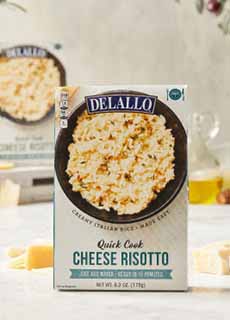
But with DeLallo Quick-Cook Cheese Risotto, we can have a creamy risotto on the plate in 15 minutes after the water comes to a boil. You need only stir occasionally, not vigilantly.
The seasoned rice in the box is partially cooked in advance, using a slow absorption cooking process—just like cooking from scratch.
It is parboiled (also called converted—like Uncle Ben’s), then simmered with flavorful broth until the liquid is absorbed. The grains are then dried naturally for more than 24 hours.
The result captures the flavor and texture of the longer process, although you’ve just added water!
Recipe ideas follow. Also below:
> The history of risotto.
Elsewhere on The Nibble:
> The history of rice and the different types of rice: a photo glossary.
> The year’s 15+ rice holidays.
RISOTTO MIX-INS
You can add whatever you like to the risotto, either into the rice at the end of cooking, or as a topping. DeLallo suggests:
Chopped toasted walnuts
Grilled shrimp or chicken
Italian sausage and sautéed greens
Mushrooms and chicken
Pesto and peas
Roasted or steamed broccoli (photo #4)
Roasted red peppers and artichokes
Roasted assorted vegetables
Sautéed zucchini and corn
Anything you like
Some classic favorites in Italy are asparagus, barolo (the wine turns the rice deep red), mushrooms (photo #3), primavera (carrots, celery, onions, peas, potatoes), pumpkin/butternut, radicchio and speck, seafood, tomato and truffles.
Our personal favorite is a mix of shrimp and scallops, followed by asparagus, morels and ramps and in the spring and butternut squash and nutmeg in the fall and winter. (But like ice cream, we’ll eat any “flavor.”)
The easiest topping is some fresh-grated parmesan (there is cheese in the mix—but it’s enlivened by adding some aged parm), fresh parsley or chives and a few grinds of black pepper.
Enjoy your risotto fix. You can purchase DeLallo Quick-Cook Cheese Risotto online, or check the store locator (call ahead to see if the risotto is in stock).
At the low price of $4.29 a box, we’re giving them as stocking stuffers this holiday season.
THE HISTORY OF RISOTTO
How did rice, the staple grain of Asia, end up some 4,700 miles away, in wheat-focused Italy?
It was due to the Silk Road trade that Arab traders brought rice to the Middle East, and introduced it to Italy and Spain in the the Middle Ages.
The Moors and Saracens who settled in Sicily introduced rice to Sicily, as early as the 13th century [source].
From Sicily it spread to the Naples, and later was brought north to Milan and the Po Valley, where the short-grain rice varieties used for risotto (arborio, arborio is typically wider and longer than carnaroli and vialone nano†) found ideal growing conditions: flat lands, abundance of water, and humidity. .
Rice became a staple throughout northern Italy; and today, the Po Valley remains one of the largest rice producers in Europe.
Rice has been grown in southern Italy since the 14th century. Its cultivation eventually reached Milan in the north, where the conditions were great for growing short-grain rice.
It turned out that shorter-grain rice grew well in northern Italy, especially in the Po River Valley, where the paddies are irrigated by fast-flowing streams originating in the Alps.
The popularity of rice grew throughout Italy, primarily among the wealthy at first, since the “new” food was sold for exorbitant prices.
Rice became a huge cash crop, with enormous profits made by sellers in Genoa, Venice [source].
And once the outside world discovered the quality of the short-grain Italian rice, the money poured in, more and more was planted, it became more widely available, and the price came down. the availability of the short-grains spread, making the rice far more widely accessible.
From the 13th to the 17th centuries, rice was cooked only in boiling water. In 1779, when rice was, for the first time, wet with broth and sautèed in butter. Later, a pinch of chopped onion was added [source].
The Birth Of Risotto Milanese
The precursor: The first cookbook recipe identifiable as risotto dates from 1809: “Riso Giallo in Padella.” The rice is sautéed in butter; sausage, bone marrow, onions, saffron and hot broth are gradually added.
1809 is when the recipe for “riso giallo in padella” (pan-fried yellow rice) first appears in a cookbook. In 1929, the Milanese chef Felice Luraschi named the dish “Risotto alla Milanese Giallo.” His recipe calls for rice, fat, beef marrow, saffron, nutmeg and stock, flavored at the end with grated cheese [source].
The birth of modern risotto: A bit later in Milan, the most famous risotto dish, Risotto alla Milanese, was created. It was imbued with saffron, like paella.
In 1829 the name “Risotto alla Milanese” appears for the first time in the recipe book, “Nuovo Cuoco Milanese Economico” (New Economic Milanese chef).
For the first time the rice is not boiled, but cooked with butter and broth that is gradually poured, and enriched with beef marrow bone and cervellata, a medieval sausage stuffed with cheese, beef and veal meats, and saffron [source].
Why saffron? The region had been under Spanish rule for almost two centuries, and rice dishes, including paella, had become staples in Milan.
The slow-cooking principles of paella were combined with the local starchy, short-grain rice and an unknown chef created “Risotto alla Milanese” with rice, chicken stock, saffron, onions, butter, wine, parmesan and flat-leaf parsley [source].
As with paella, saffron provided not only flavor, but yellow-hued rice. (In 1981, the famous Italian chef Gualtiero Marchesi added a leaf of gold foil on top of his Risotto Milanese, his emblem for a noble dish signature of the Italian culinary tradition (gold foil has no flavor).
|
|
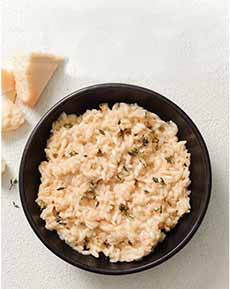
[1] DeLallo’s Quick-Cook Risotto (photos #1 and #2 © Delallo).

[2] The boxes make great small gifts for foodies.
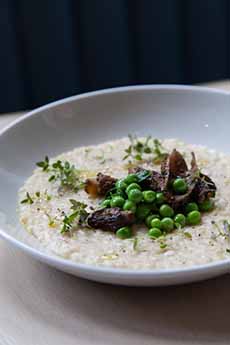
[3] A risotto with classic toppings: green peas and wild mushrooms, with a bit of fresh thyme (photo © Cafe Clover | NYC).
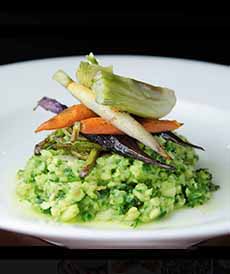
[4] You can stir ingredients into the risotto, as well as use them as garnishes. This recipe mixes minced zucchini and broccolini into the rice, and tops it with roasted baby carrots, fennel and fiddleheads (photo © Blossom Restaurant | NYC).
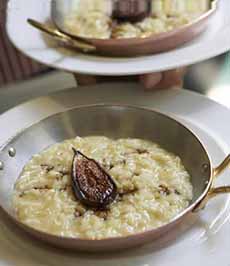
[5] Less common but equally delicious: a fresh fig and balsamic risotto at Union Square Cafe (photo © Union Square Cafe | NYC).
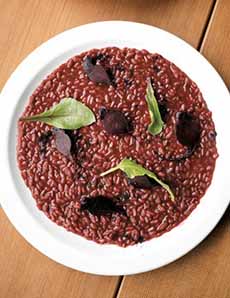
[6] Risotto made with red rice at Matthew Kenney Cuisine (photo © Matthew Kenney Cuisine).
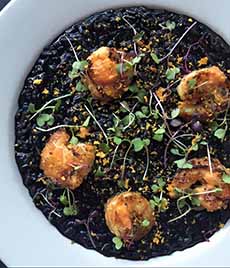
[7] Squid Ink Risotto With Shrimp: irresistible! (photo © Jeff Prehn | Barbuto Restaurant | NYC) |
Modern Risotto Milanese
Risotto became a favorite way to use short-grained rice in Italy, particularly northern Italy.
Today the dish is served extensively, almost unchanged, in the kitchens and restaurants of the world.
Ingredients as varied as duck, game, pumpkin, sausage, snails, squid ink, truffles, and almost anything else are paired with this classic dish.
While arborio, carnaroli and vialone nano rices† still rule, chefs have used red rice (photo #6), black rice, and other varieties to create risotto dishes.
Almost any ingredient can be added to the rice, from shellfish to sausages, vegetables and herbs to game.
Risotto is such a popular dish that a whole festival is organized in its honor. The Festival Nazionale del Risotto takes place in Biella each year since 2012 (although obviously not 2002).
________________
*While ingredients are largely the same, there is a difference between stock and broth. Stock is made from bones, while broth is made mostly from meat or vegetables. In stock, the gelatin in the bones creates a thicker liquid. Broth tends to be thinner and more flavorful, imbued with flavor from the meat and/or vegetables.
†Arborio rice is more widely available and less expensive, but it’s not as starchy as carnaroli or vialone nano and thus absorbs liquid—which provides the creaminess—a little less well. Vialone nano is a newer variety, developed and grown in Italy since 1937. It is a cross between Vialone and Nano rice varieties. Carnaroli is the most recent, dating to about 1945, a cross between vialone and lencino. It is superior to both of its predecessors, due to its higher amylose content. Highly prized, it is the most widely used rice in Italian cuisine [source].
CHECK OUT WHAT’S HAPPENING ON OUR HOME PAGE, THENIBBLE.COM.
|