THE NIBBLE BLOG: Products, Recipes & Trends In Specialty Foods


Also visit our main website, TheNibble.com.

Cheeseburger Fun: 15 Elevated Recipes For National Cheeseburger Day

Pimento Cheese Cheeseburger
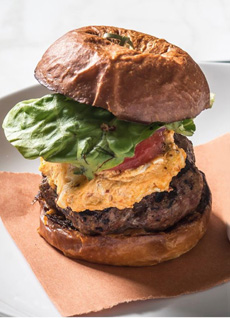
[1] Pimento cheese on a cheeseburger is a special treat (photo © Gardenia Restaurant | NYC [alas, closed]).


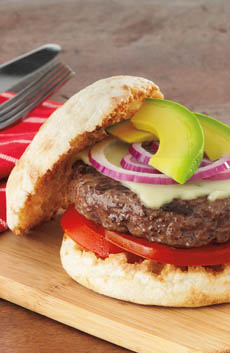
[2] Switch out the bun for a different bread: baguette, brioche, English muffin, focaccia, or pita, for example (photo © Thomas Breads).


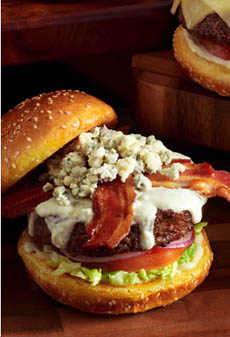
[3] A bacon cheeseburger with blue cheese (photo © Cheesecake Factory).

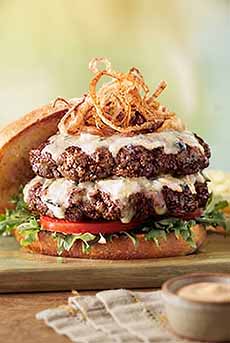
A double cheeseburger with onion rings.
[4] A simple double cheeseburger: lots of protein (photo © Allen Brothers).

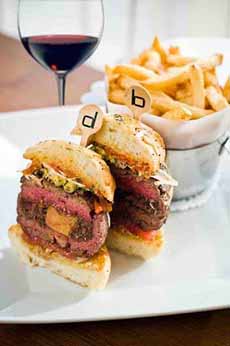
DB Burger, the original gourmet burger.
[5] In 2001, the DB Burger started the gourmet burger movement. Our experience: Too many stuffings made it impossible to distinguish the foie gras and the truffles (photo © Daniel Boulud).


Updated September 2026

In case you missed National Double Cheeseburger Day on September 15th, September 18th is National Cheeseburger Day. So we know what we’re having for lunch!

Several restaurants claim that they created the hamburger by placing a ground beef patty inside bread.

What about the cheeseburger?

Check out the info below. As you eat your CB, enjoy Jimmy Buffett singing “Cheeseburger In Paradise.”
 
Below:

> A brief history of cheeseburgers.

> Fifteen+ elevated cheeseburger recipes.

> Fantasy cheeseburgers.

> Is a cheeseburger a sandwich?

> The video history of the cheeseburger.

Elsewhere on The Nibble:

> The history of cheeseburgers.

> The history of hamburgers.

> The history of cheese.

> The year’s 25+ beef holidays.

> The different cuts of beef: a photo glossary.

> The different types of cheese: a photo glossary.
 
 
1. A BRIEF HISTORY OF CHEESEBURGERS

Several people and places claim the invention of the cheeseburger, although it’s not a stretch to see that any cook could have easily thought to garnish the patty with cheese, not to mention lettuce, tomato, onions, and more.

Louis’ Lunch in New Haven, Connecticut claims to have served up the original burger in the U.S. in 1900, placing a beef patty, tomato, onion, and cheese between two slices of toasted white bread—no ketchup or mustard. They still serve it the same way.

Lionel Sternberger of The Rite Spot in Pasadena claims he invented it around 1924, serving it under the menu name “The Aristocratic Burger: The Original Hamburger with Cheese.”

So: Did they invent both the burger and the cheeseburger?

Some hard facts:

  • O’Dell’s (Los Angeles): The first evidence in print appears to be from a Los Angeles restaurant, O’Dell’s. A menu from 1928 explicitly listed a “cheeseburger.”
  • Trademark Filings: Print records from the U.S. Patent Office show that Louis Ballast of the Humpty Dumpty Drive-In in Denver, Colorado, officially applied for and was awarded a trademark for the word “cheeseburger” in the mid-1930s, which helped transition the item from regional diner slang into standardized print menus nationwide.

 
Check out the video below for a thorough discussion.
 
“Man who invented the cheeseburger was smart; man who invented the cheeseburger was a genius.” — Matthew McConaughey
 
 
2. 15+ MORE CHEESEBURGER RECIPES

You likely have your own favorite cheeseburger recipe, but take a look at these elevated CBs:

 
Plus

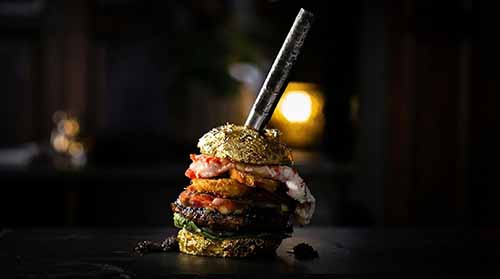
The Golden Boy, a $6,000 burger created for a charity auction.
[6] The Golden Boy, originally priced at $6,000 in 2021. It’s still on the menu at De Dalton’s in the Netherlands (photo © De Daltons).

 
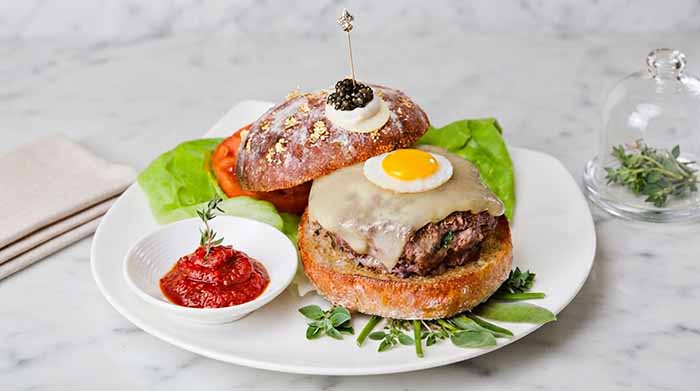
The Serendipity 3 $295 cheeseburger.
[7] Serendipity 3’s $295 cheeseburger in New York City (photo © Liz Stegner | Serendipity 3).
 
 
3. FANTASY CHEESEBURGERS

In 2001, Chef Daniel Boulud shocked the foodie world with his famous DB Burger, created for the opening of his restaurant, DB Bistro Moderne, in Manhattan. A sirloin patty was stuffed with braised short ribs, foie gras, and black truffles.

The concept and price shocked the culinary world and essentially kickstarted the modern gourmet burger boom. Its initial $27 price tag* seems like chump change given what followed.

(By the way, we had the DB Burger and thought it was an attention-getter that didn’t pay off on the palate. With all that stuffing, you couldn’t taste the foie gras or the truffles.)

  • The $295 Cheeseburger. Serendipity 3 in New York City created Le Burger Extravagant in 2012 (photo #7). At $295, it was declared the world’s most expensive burger by The Guinness Of World Records. The burger is topped with black truffles, fine Cheddar cheese from the fromager James Montgomery in Somerset, England, and a fried quail egg. The Wagyu beef is infused with white truffle butter, and the roll is dusted with edible gold. A mini blini with caviar and crème fraîche was nestled on the top of the roll, and it was held together with a diamond-encrusted gold toothpick. At the time, Guinness Book Of Records named it the world’s most expensive burger [source]. It’s still on the menu.
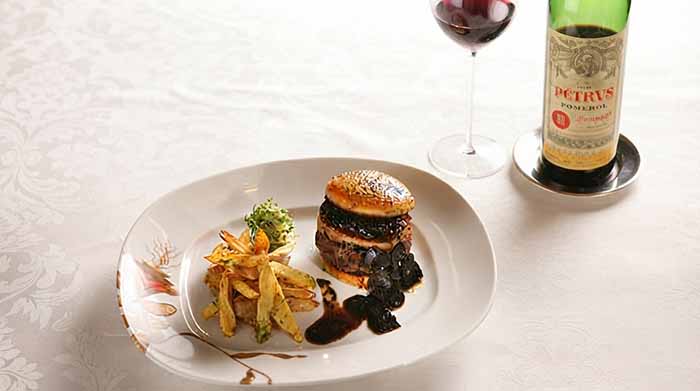
  • The $5,000 Burger. In the no-cheese burger category, the record goes to the $5,000 cheeseburger that Chef Hubert Keller served at his Las Vegas restaurant, Fleur, a year earlier, in 2011 (photo #8). The FleurBurger was a Kobe beef patty topped with foie gras and black truffles, plus truffle sauce. It came with a bottle of 1995 Petrus Bordeaux, $2500 at the time—and of course, a side of fries and a “special sauce” made with truffles (was cheese extra). The creation was a limited-run concept [source].
  • It turns out that the FleurBurger couldn’t claim the “world’s most expensive” title, or even Las Vegas title. Carl’s Jr. had that honor in 2006, when it introduced its $6,000 “combo meal” burgers, offered on the room-service menu at The Palms Casino. It, too, included a bottle of Petrus.
  • The Golden Boy ($6,000 / €5,000) 2021 brought forth a saffron-infused champagne bun covered entirely in edible 24-karat gold leaf (photo #6). The patty combines 100% A5 Japanese Wagyu beef and chuck short ribs, layered with Beluga caviar, white truffle, King crab poached in Puligny-Montrachet Burgundy wine, 100% vintage Joselito Ibérico Bellota ham, white-truffle-infused Cheddar, and a barbecue sauce made with Kopi Luwak coffee and Macallan whiskey. NOTE: This was served by De Daltons, a restaurant located in Voorthuizen, the Netherlands. It was initially a charitable tie-in, with the proceeds donated. Chef Robbert Jan de Veen specifically set out to beat the previous Guinness World Record holder. It’s still on the menu!
  • The 1849 Burger (~$110 / £80) This cheeseburger debuted in December 2020 alongside the launch of Gordon Ramsay Burger inside Harrods, London. “1849” honors the year Harrods was founded. An A5 Wagyu beef patty was layered with slices of Wagyu beef, pecorino, truffle-porcini aïoli, and 12-year-aged balsamic vinegar. It’s still on the menu.
  • The $50 Burger at Wild Rye in Oregon: This example is one of many higher-priced burgers that are still within reach of us regular folks. An Aberdeen Angus patty topped with a foie gras torchon, summer truffle aïoli, smoked provolone, Bordelaise onions, and a dusting of gold dust. It was introduced in summer 2024 by Chef Karl Holl when Wild Rye opened at Brasada Ranch in Oregon. It’s still on the menu.

 
We don’t know any high rollers to treat us, so we’ll stick with some of the creative—and affordable—cheeseburger recipes above.
 
Hubert Keller's $6,000 cheeseburger with a bottle of Petrus.
[8] Hubert Keller’s FleurBerger came with a bottle of 1995 Petrus in 2011, with lots of truffles but no cheese (despite being called a cheeseburger colloquially or in some menus). And it wasn’t even the most expensive burger in Las Vegas! But it came with a tray of gourmet condiments (not shown).


4. IS THE CHEESEBURGER A SANDWICH?

Burger, cheeseburger, hot dog: All of these are sandwiches. They’re a roll (or two pieces of bread) with a filling.

That’s the dictionary definition, and that should be the end of the discussion.

However, this seems to have become one of the great culinary debates online.

It seems that many purists and casual diners argue that a burger occupies its own distinct food category entirely separate from traditional sandwiches.

They’re entitled to their opinion, but their opinion is wrong.


*The DB Burger was still on the menu in 2020 when the pandemic engendered the closing of the restaurant. It was $35 and included a carafe of Beaujolais.
 

CHECK OUT WHAT’S HAPPENING ON OUR HOME PAGE, THENIBBLE.COM.


Comments off

TIP OF THE DAY: Ancient Grains Are New Again

September is National Whole Grains Month, an occasion to revisit some oldies but goodies.

Thanks to King Arthur Baking (formerly King Arthur Flour) for this primer on eight* ancient grains.

“Ancient grains” is a marketing term used to describe a category of grains and pseudocereals, that are purported to have been minimally changed by selective breeding over recent millennia.

They are distinguished from more widespread cereals such as corn, rice and modern varieties of wheat, which are the products of thousands of years of selective breeding [source].

King Arthur sells the flour versions ground from ancient grains. They’ve provided the following information, including details on how the flours “bake up.”

Here are their recipes for using the different flours to bake banana bread, cinnamon bread, muffins, pancakes and scones.

The whole grains from which these flours are ground make delicious grain bowls, sides, salads, or substitutes for rice in any of your recipes (check out Bob’s Red Mill or Whole Foods to buy the whole grains).

To start you thinking in the “ancient” direction for the whole grains, there’s a recipe below for Kamut & Kale Salad. Bob’s Red Mill has more recipes.

More than half of them are gluten free: amaranth, buckwheat, millet, quinoa and teff.

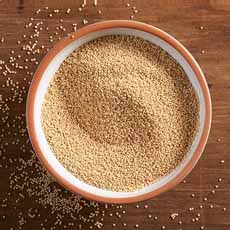
1. AMARANTH

Amaranth is versatile, full of whole-grain nutrition, and enhances the flavor of many recipes. It’s naturally gluten-free. Like quinoa, it contains all nine essential amino acids plus lysine, a protein missing in most grains. Amaranth is a good source of iron, magnesium, and phosphorus.

> Flavor: Earthy and peppery.
> Flour Texture: Tender in small amounts; dense in larger quantities.
> Works Best In: Pancakes and quick breads.
> Gluten Free: Yes.

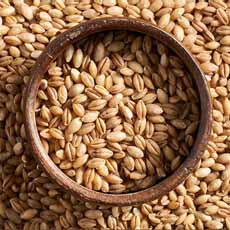
2. BARLEY

Barley is exceptionally high in fiber and low in starch, making it one of the lowest glycemic index (GI) grains you can use. With three times the soluble fiber of oats, it’s a delicious, nutty-tasting way to add nutrition to baked goods.

> Flavor: Subtly sweet and nutty.
> Flour Texture: Often moist in small amounts; crumbly in larger quantities.
> Works Best In: Pancakes and quick breads.
> Gluten Free: No.

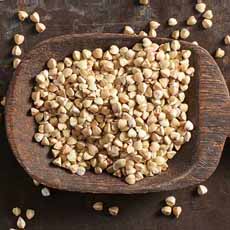
3. BUCKWHEAT

Buckwheat is hearty, gluten-free, and a good source of magnesium, copper, and dietary fiber. Enjoy its health benefits, but also turn to it for its bold, nutty flavor.

> Flavor: Bold, toasty, and rich.
> Flour Texture: Moist and tender in small amounts; chalky in larger quantities.
> Works Best In: Pancakes and quick breads.
> Gluten Free: Yes.

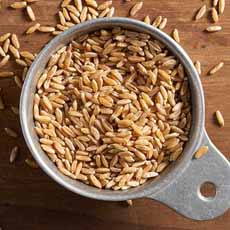
4. KAMUT

Kamut is an ancient variety of durum, with a grain twice the size of modern-day wheat. It contains some gluten; but the gluten format is different from modern wheat, so it may be digestible by people with slight gluten sensitivities. It’s a good source of protein and dietary fiber. In the U.S., the commercial name for kamut is Khorasan wheat (here’s why).

> Flavor: Rich and buttery.
> Flour Texture: Light and tender in small amounts; verging on crumbly in larger quantities.
> Works Best In: Scones, quick breads, and muffins.
> Gluten Free: No.

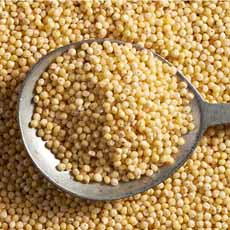
5. MILLET

Millet is packed with nutrition for flavorful, healthier baked goods. Naturally gluten-free, it adds mild flavor to both sweet and savory recipes. You might recognize whole millet: The small yellow seeds are often used in bird seed mixtures.

> Flavor: Sweet and corn-like.
> Flour Texture: Cornbread-like in small amounts; sandy in larger quantities.
> Works Best In: Muffins and quick breads.
> Gluten Free: Yes.

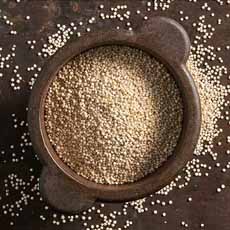
6. QUINOA

Quinoa adds whole-grain nutrition and essential amino acids to baked goods. Naturally gluten-free, quinoa is one of the only plant foods that’s a complete protein, offering all the essential amino acids including lysine. Quinoa is also one of the grain world’s best sources of potassium.

> Flavor: Bold and nutty.
> Flour Texture: Moist in small amounts; dry in larger quantities.
> Works Best In: Muffins and quick breads.
> Gluten Free: Yes.

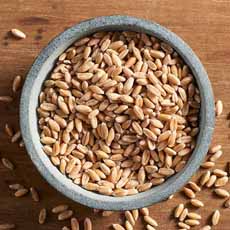
7. SPELT

Spelt is an ancient strain of wheat. It’s high in protein and has a nutty, complex flavor that’s sweeter and lighter than that of whole wheat. Gluten-containing spelt is a good source of fiber, iron, and manganese.

> Flavor: Sweet with a taste of whole wheat.
> Flour Texture: Soft and moist in small amounts; dry in larger quantities.
> Works Best In: Pancakes, quick breads, and muffins.
> Gluten Free: No.

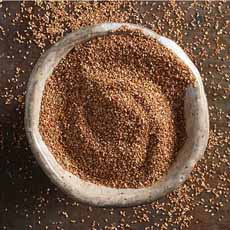
8. TEFF

Teff is a whole grain, and also a versatile, gluten-free flour that adds whole-grain nutrition to baked goods. This ancient East African grain is used to make the Ethiopian flatbread, injera. It’s a good source of iron and fiber.

> Flavor: Toasted and earthy.
> Flour Texture: Tender in small amounts; gritty in larger quantities.
> Works Best In: Quick breads and muffins.
> Gluten Free: Yes.
 

RECIPE: KAMUT & KALE SALAD

Recommendation: It’s a chore to cook and peel fresh beets. Instead, we buy them cooked and peeled from Beetology.

Ingredients For 4-6 Servings

  • 2 cups cooked kamut
  • 6 ounces kale, shredded
  • 1/4 red onion, thinly sliced
  • 1/4 cup fresh mint Leaves, minced
  • 1-1/2 cups seedless red grapes, halved
  • 1 pound red beets, cooked, peeled, and sliced
  • Optional: feta or goat cheese
  •  
    For The Vinaigrette

  • 2 tablespoons olive oil
  • 1 tablespoon red wine vinegar
  • 1 teaspoon lemon juice
  • 1 teaspoon Dijon mustard
  • 1/4-1/2 teaspoon salt
  •  
    Preparation

    This recipe was created by Hannah Kaminsky of Bittersweet Blog. If you’d like to serve it warm or hot, begin the assembly as soon as the kamut is fully cooked. Otherwise, chill the cooked grains for at least two hours before proceeding.

      Amaranth
    [1] Amaranth, naturally gluten-free. Like quinoa, it contains all nine essential amino acids and lysine, a protein missing in most grains (all grain photos © King Arthur Baking).

    Barley
    [2] Barley is one of the lowest glycemic index (GI) grains.

    Buckwheat

    [3] Buckwheat flour is hearty and gluten-free.

    Kamut
    [4] Kamut contains some gluten. In the U.S., the commercial name for kamut is Khorasan wheat. Here’s why.

    Millet
    [5] Naturally gluten-free, millet adds mild flavor to both sweet and savory recipes.

    Quinoa
    [6] Naturally gluten-free, quinoa is one of the only plant foods that’s a complete protein.

    Spelt
    [7] Spelt has a nutty, complex flavor that’s sweeter and lighter than whole wheat.

    Teff
    [8] Teff, a whole grain, is a good source of iron and fiber.

    Kamut Kale Salad
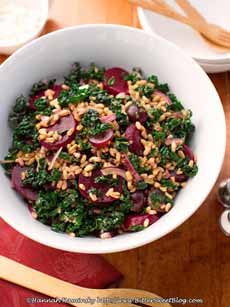
    [9] Update your kale salad with kamut. Recipe and photo © Hannah Kaminsky | Bittersweet Blog).

     
    1. COOK the kamut. Hannah uses the pasta method, which means adding 1 cup of grains to 4 or 5 cups of water. Bring to a boil and then reduce the heat to a simmer. Cook for 45 – 60 minutes until the grains are tender but still toothsome, and drain off the excess water. This ensures the perfect texture every time without the threat of having grains stick and burn on the bottom of the pot.

    2. MEASURE out what you need for the recipe and store any extra in an airtight container in the fridge. It keeps well for up to a week.

    3. TOSS the cooked kamut, kale, onion, mint, grapes and beets together in a large bowl.

    4. WHISK together in a separate bowl the oil, vinegar, lemon juice and mustard, adding salt to taste. Pour the dressing over the vegetables and grains, mixing thoroughly to coat. Top with crumbled cheese and serve.
     
    ________________

    *There are other ancient grains, such as einkorn and farro; but they are not typically ground as flour. They are, however, available as whole grains.


    Comments off

    TIP OF THE DAY: Uses For Savoy Cabbage

    Savoy cabbage (Brassica oleracea var. sabauda L.) is the prettiest member of the cabbage species (Brassica oleracea).

    It’s also known as choux de savoie (France), cavolo verza (Italian), and Milan cabbage and Lombardy cabbage (English).

    Savoy is a loose-headed cabbage with crepe-like, crinkled, frilly leaves and a sweet, earthy flavor.

    We enjoy it much more than a standard head of white cabbage—which is the industry name for what consumers call green cabbage.

    It’s not as hard as conventional white/green and red cabbage. The leaves are still crunchy, but more tender tender.

    As is common with agricultural products, there are many different varieties of Savoy cabbage, which is grown worldwide.

    Savoy King is the most popular variety with U.S. growers, and favored for its versatility whether raw or cooked [source].

    It is considered to be the most versatile of all cabbages, and can be substituted for both western hard-heading cabbages and Chinese loose-heading varieties (like Napa cabbage).

    A head of cabbage will keep 1-2 weeks in the fridge, when loosely wrapped in plastic and stored in the crisper drawer.
     
     
    HOW TO ENJOY SAVOY CABBAGE

    In addition to serving raw in salads and slaws, Savoy cabbage can be baked, boiled, braised, grilled, roasted, steamed and stir-fried.

    Simply cooked as a side dish (or on a vegetable plate), tossed with butter with black pepper, is nice enough.

    But you can build on it by adding cherry tomatoes, grated cheese, mushrooms, peas, whatever. Here are other ways to enjoy Savoy cabbage.

  • Add it, torn or grated, to green salads.
  • It can be a traditional coleslaw, an international version like this Vietnamese cabbage slaw, or a sweet-and-tart slaw with apples, walnuts and parmesan cheese.
  • It can be prepared simply (we love it with bacon), added to casseroles curries, soups and stews.
  • It makes a prettier corned beef and cabbage.
  • It’s a popular wrapper, stuffed with meats such (beef, chicken, duck, sausage, rice, and/or chopped vegetables.
  • Add it to stir-fries (how about a Thai stir-fry with peanut sauce?).
  • It’s a bread-type substitute, standing in for sandwich bread (wraps), taco shells or spring roll wrappers.
  • It’s delicious pickled, as a condiment.
  • Savoy cabbage and bacon is a side for meat and poultry.
  • It pairs with pasta, such as orecchiette (or cut of choice) with savoy cabbage and bacon or pancetta (add peas and mushrooms, too).
  •  
     
    CREATE A RECIPE

  • Savoy cabbage pairs well with most herbs: caraway, dill, horseradish, mint, sage and thyme for starters, plus garlic and mustard.
  • Create a dish using apples, avocados, carrots, corn, fennel, onions, peas, and/or potatoes.
  • Add a sauce or gravy of choice.
  • Add nuts: almonds, peanuts and walnuts.
  •  

    SAVOY CABBAGE HISTORY

    Cabbage was most likely domesticated somewhere in Europe before 1000 B.C.E., although Savoys weren’t bred and cultivated until the 16th century C.E.

    The first known documentation of this crinkly cabbage is in the 1500s, in a region that bordered France, Italy, and Switzerland that was then ruled by the Italian House of Savoy.

    The historical territory was shared among the modern countries of France, Italy and Switzerland.

    The elegant-looking cabbage was embraced in Savoy; and wherever it traveled since.
     
     
    > The Detailed History Of Cabbage


    Head of Savoy Cabbage
    [1] What a beauty: Savoy cabbage is the loveliest-looking variety (photo © Monika Grabowska | Unsplash).


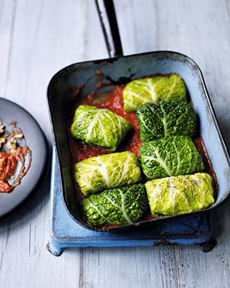
    [2] Stuffed cabbage in a vinegar-spiked tomato sauce. Here’s the recipe from Waitrose (photo © Waitrose).


    [3] Take stuffed cabbage to new heights with this Barley “Risotto” Stuffed Cabbage. It has a surprise: Guinness beer. Here’s the recipe (photo © Guinness)


    [4] Use Savoy cabbage leaves as wraps. Here, it’s taco filling; but conventional fillings like tuna are also delectable (photo © Vegetarian Everyday Cookbook).


    Comments off


    © Copyright 2005-2026 Lifestyle Direct, Inc. All rights reserved. All images are copyrighted to their respective owners.