|

[1] One way to eat more local food is to join a CSA (photo © With Love LA).
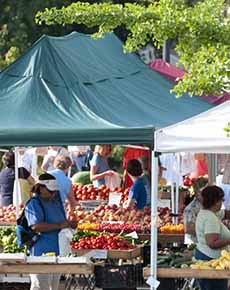
[2] Another way to buy local produce, baked goods, cheeses, jams, meats and more is to shop at farmers markets. Here’s how to find a farmers market near you (photo © Prince William County | Virginia).
[3] Whole Foods and other markets highlight local foods, such as this local granola brand (photo © Winsight Grocery Business).
[4] Choose a local or regional beer instead of a national brand or imports (photo © Blue Moon Brewing Co. | Denver).
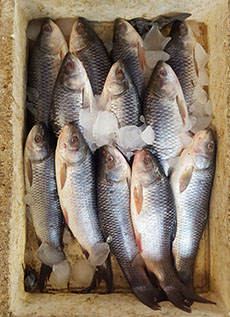
[5] Fish can come from across the globe, or across your state (photo © Steemit).
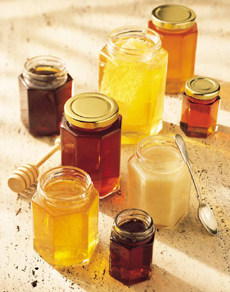
[6] Look for locally-produced honey (photo © National Honey Board).
|
|
September 22nd brings a new food holiday to our attention: National Eat Local Day. It nudges us to be aware of local food options.
There’s more about it below. But first:
Do you remember when you first heard the term “locavore?”
Perhaps it was the with the press surrounding the publication of The Locavore’s Handbook in 2010 (there are a number of books on the topic).
If you live in California, perhaps it was the publicity about the launch of the locavore movement, born on World Environment Day 2005, in San Francisco.
The word “locavore” was chosen as the 2007 Word of the Year by the New Oxford American Dictionary.
It wasn’t a revolution, but slowly over the last 15 years, more and more people have become conscious of living sustainably.
That includes cutting down on “food miles,” the distance food travels from its farm or factory to your area—and the amount of fuel and greenhouse gas expended to get it there.
Hence: Eat Local.
YOU DON’T HAVE TO BE A LOCAVORE
The locavore movement asks people to buy food grown within a manageable radius of where they live: 50, 100 or 150 miles, or within their state’s border.
There are different types of locavore. For example:
Some locavores won’t consume coffee or tea, because they’re not grown locally (in fact, they’re imports).
Others won’t buy olive oil: Unless a locavore lives in Arizona, California, Florida, Georgia, Hawaii, Texas or Oregon, there’s no local olive oil [source].
The list goes on, from chocolate (grown only in Hawaii, as is sugar) to citrus (grown in the southern states). And on, and on.
There are three types of locavores, based on strictness of consumption*.
But we’re not asking you to declare yourself a locavore; only to do your best to eat locally on National Eat Local Day.
(And maybe a few other days—the more, the better).
The idea of committing to eating only locally produced foods has become trendy in the last few years—so trendy that some markets proudly display “Local” signs for fresh foods and shelf-stable foods alike.
BUY LOCAL FOODS WHEN YOU CAN
National Eat Local Day encourages all of us to support our local farmers, dairies, cheesemakers, jams, meat producers and other local business—from honey producers to granola makers.
There are many more in your community than you’d think. Just check out your local farmers markets.
National Eat Local Day was founded by Chef Sarah Stegner of Prairie Grass Cafe in Northbrook, Illinois; and media relations expert Cindy Kurman, president of Chicago-based Kurman Communications.
Their goal is to encourage consumers to prepare a totally locally sourced menu at home, and for restaurateurs and chefs to provide at least one totally locally sourced menu item at their restaurants on September 22nd.
If miss out today, pick another day. In fact, make it a family goal to pick as many days as you can.
Their overall aim is to raise awareness of the importance of supporting our local sustainable farms and other local food producers. It may be easier than you think to go from farm to [your] table.
While you might not be able to prepare a totally locally sourced meal—few states grow grain and potatoes, for example—here are some foods you can always find locally, regardless of the season. One easy place to find them is a farmers market (here’s how to find your local farmers markets).
In alphabetical order:
Beer, Wine & Spirits. Almost every state has a craft brewery, and many have wineries as well. Local distilleries are the latest to pop up locally. There’s also local cider and kombucha.
Bread. Buy bakery-fresh bread and baked goods from mom-and-pop bakers, instead of packaged and sealed factory brands.
Dairy. Look for milk, cheese, yogurt and butter from local dairies and creameries†.
Eggs. Local farm-fresh eggs, which you can get at farmers markets, have a flavor far superior to store-bought eggs. At a grocer, ask which eggs are from locally pastured hens versus factory hens. Pasteurized hens get better treatment, and their eggs contain up to 20 times more healthy omega-3s.
Fruit. Fruits such as apples and pears go into cold storage when harvested, and are released as needed year-round. Beyond these fruits, the key is to eat seasonally, like melons in the summer. But no one will fault you for buying citrus anytime.
Honey. Most honey sold in the U.S. comes from China or Argentina. But every state in the U.S. has at least one beekeeper! Here’s a local honey finder.
Meat & Poultry. Look for sustainable, humanely raised, local or regional pork, beef, chicken, turkey and lamb. Stock up your freezer.
Pasta. Look for a local pastaficeria—that’s Italian for pasta-maker. Specialty markets will carry fresh, loose pasta as well as dried pasta from a local maker.
Seafood. Even if you’re not near the seacoast, there are lakes and rivers with fish aplenty. In New York State, there are more than 165 fish species in the state’s 7,500 lakes and ponds and 70,000 miles of rivers and streams.
Vegetables. As you can see in the photos, local produce is available from CSAs, farmers markets, and groceries such as Whole Foods aim to provide as much local foods as they can. Greenhouse veggies such as leafy greens, mushrooms, and sprouts are available year-round, as are cold-storage vegetables like cabbage, garlic, onions, root vegetables and squash.
> 4 WAYS TO FIND LOCALLY GROWN FOOD
________________
*Ultrastrict locavores avoid all ingredients that have not been grown and produced locally. Marco Polo rule locavores use salt and dried spices that are not local (the rule references foods Marco Polo brought back from his travels). Wild card locavores eat locally as much as possible, but bend their “foodshed” to include chocolate, coffee, sugar, tea or any any items they feel essential [source].
†A dairy is a place, often on a farm, where milk is processed and turned into products such as butter and cheese. A creamery is a place where dairy products are prepared or sold (i.e., the milk comes from a dairy).
|