THE NIBBLE BLOG: Products, Recipes & Trends In Specialty Foods


Also visit our main website, TheNibble.com.

FOOD FUN: May The Fourth Be With You

Princess Leia Cookies
[1] Turn milk and cookies into Princess Leia for Star Wars Day (photo courtesy Bourbon House | NOLA).

Mallomars Box
[2] The current and original Mallomars packages (photo courtesy NPR.org).

Homemade Mallomars
[3] Bake your own Mallomars with this recipe from Saveur.

  Star Wars Day, May 4th, celebrates George Lucas’ Star Wars films. (“May the forth be with you”—get it?)

Treat yourself to milk and cookies, Princess Leia-style.

You’ll need soft cookies to adhere to the rim of the glass. We used Mallomars (photo #2). They’re probably sold out by now (the season ends in April), but like all Mallomars fans, we keep extra boxes on hand until they reappear in stores in the fall.

Or, bake your own with the recipe below.

Or, bake any chocolate cookie (to evoke Princess Leia’s brunette hair buns) and notch them while they’re still warm.
 
 
MALLOMARS HISTORY

Nabisco’s Mallomars are a very popular cookie in Metropolitan New York City, the original home of Nabisco.

A graham cracker circle is topped with marshmallow, then coated with a dark chocolate. The result is a puffy, sink-your-teeth-in delight.

The cookies were introduced in 1913, the same year as the southern Moon Pie—a cookie which has similar ingredients, but a different flavor. According to Wikipedia, the first box of Mallomars was sold in West Hoboken, New Jersey (now Union City).

They are sold only from October through through April, following a tradition that began of necessity, before refrigerated trucks.

  • Eighty-five percent of all Mallomars are sold in the New York metropolitan area.
  • The cookies are produced at a factory in Scarborough, Ontario, Canada.
  •  
    The concept spread. In the U.K., chef Boyd Tunnock created Tunnock’s Teacakes in 1956, using Italian meringue on a biscuit (cookie) base, covered with milk chocolate.
    They look like Mallomars’ fraternal twin.

    See the chocolate-marshmallow cookie variations in different countries.
     
     
    HOMEMADE MALLOMARS RECIPE

    Want to make your own? Here’s a recipe from Saveur (photo #3).


    Comments off

    GIFTS: Asobu Cold Brewer & Drinkmate Spritzer

    Looking for Mother’s Day gifts? Want to get the jump on Father’s Day? Want to treat yourself?

    Here are two kitchen items that got our attention—and given how many products we see each year, that’s hard to do!
     
     
    ASOBU COLDBREW INSULATED PORTABLE BREWER

    For lovers of cold brew coffee, this beauty from Asobu very efficient.

    It brews your coffee into an insulated thermos, so you can keep cold brewed coffee with you all day, anywhere. Or, you can pour a cup and give it a quick zap in the microwave.

    Just add coarse coffee grounds and cold water to the mesh cone and let it slowly drip. The resulting coffee is what you’ve come to expect from cold brew. Remove the top portion, add the leak-proof lid, and you’re ready to go—or stay.

    The brewing carafe top is clear Tritan, an extremely durable BPA-free plastic that is used in the finest water bottles and food containers.

    There are four color choices:

  • Black/Black
  • Copper/Black
  • Silver/Black
  • White/White
  •  
    The brewer is $50.00. You can buy it online at AsobuBottle.com.
     
     
    DRINKMATE SPRITZER

    What will you sparkle next? asks the box of the Drinkmate Spritzer.

    Unlike devices that carbonate water only, Drinkmate lets you carbonate anything, anywhere.

    It’s a fun device for lovers of sparkling beverages.

    The easily-portable system consists of a DrinkMate Spritzer gun, a BPA-free half-liter reusable carbonating bottle and two CO2 carbonator cylinders (for a total of 32 bottles of sparkling beverages).

    Easy to operate, easy to clean, no electricity or batteries are used.

    What can you carbonate? Any liquid. Water, of course, but also unleash your creative mixologist with:

  • Cocktails
  • Juice
  • Soda
  • Tea
  • Wine
  •  
    You can also re-carbonate sparkling wine or beer that has gone flat.

    The kit is $90 at Home Depot and other e-tailers/retailers, in black, red or silver.

      Asobo Cold Brewer
    [1] Asobu Coldbrew, in four elegant colors (photo courtesy Kettle And Cord).

    Drinkmate Spritzer
    [2] Drinkmate Spritzer turns almost any liquid into a carbonated beverage (photos #2 and #3 courtesy Drinkmate).

    Drinkmate Spritzer
    [3] The Drinkmate kit.


    Comments off

    FOOD FUN: 400 Food Histories

    Avocado Halves
    [1] Food histories from A (almonds, apple brown betty, avocado and 14 more), to Z…

    Zucchini Bread
    [2] Zucchini bread (photo #1 courtesy Tio Gazpacho, photo #2 courtesy Betty Crocker).

    History Of Cheese
    [3] The Edible Series books have deep histories of foods and beverages.
    Feast Of Sorrow
    [4] A historical novel for lovers of great food and intrigue. Get your copy on Amazon.

      We love culinary history, and today is a red-letter day:

    We’ve just added our 400th food history to our History Of Foods & Beverages directory.

    We first began to write food histories some 14 years ago, and one day had enough to create The History Of 100 Favorite Foods & Beverages. Little did we think that we’d get to 400.

    These histories are embedded in our articles. A gazpacho recipe, for example, includes The History Of Gazpacho.

    If we write an article on a particular food, we’ll either link to an existing history or create a new one. Food history #401 will debut in two days.

    Sometimes the history is at the top of an article, but often it is at the end. So if you don’t see “The History Of [The Food]” immediately, scroll down.

    WHY ALL THE FOOD HISTORY?

    It enriches our appreciation of different foods, and the people who bred them into their modern form. For example:

  • The kernels of corn on the cob were discovered thousands of years ago as little more than a weed with tiny seeds.
  • Big beefsteak tomatoes (in fact, all tomatoes) evolved from a fruit the size of a cherry tomato.
  • The original pig was the size of a cat.
  • The large citrus fruits of today evolved over millions of years from small berries. Many were not much more than a cluster of seeds in their skin, until farmers bred the flesh to have lots of juicy sacs.
  •  
    Dedicated farmers cross-bred and nurtured plants and animals over millennia, until they became the foods we enjoy today. We thank them with every history we write.
     
     
    THE EDIBLE SERIES OF BOOKS

    Some of our histories are just a paragraph or two; some are quite detailed, based on the amount of verifiable information available.

    If you want to dive deep into the histories, take a look at Reaktion Press’ excellent The Edible Series, distributed by the University Of Chicago Press.

    There are currently 77 titles for sale on the websites.

    Written by culinary historians in their areas of expertise, the books are some 130 pages long, and often add historical recipes.

    For Mother’s Day, give Mom the history of her favorite food. Peruse the list.
     
     
    A HISTORICAL FICTION: FEAST OF SORROW

    We greatly enjoyed Feast Of Sorrow: A Novel of Ancient Rome (photo #3), which explores the Roman gourmand
    Marcus Gavius Apicius, and the wealthy epicure’s remarkable rise and fall in the first century C.E.

    Set among the upstairs-downstairs politics of a prominent Roman family, the novel by Crystal King focuses on the man who inspired the world’s oldest cookbook.

    His singular ambition to serve as culinary advisor to Caesar—an honor that would cement his legacy as Rome’s leading epicure—led to his destruction.

    But more than a fictional bio, the book describes in historic detail how food was prepared in ancient times.

  • How did the wealthy keep prepare enormous feasts and keep foods cold when they didn’t even have running water, much less electricity?
  • What was the kitchen like? Why was the cook the most expensive slave in the house?
  •  
    You’ll be enthralled.


    Comments off

    TOP PICK OF THE WEEK: Willliam Dean Chocolates

    People have asked us to recommend chocolates for Mother’s Day, and this year’s recommendation is William Dean Chocolates.

    We first encountered the brand at a chocolate show in New York City, a short time after its founding in 2007. The chocolates were—are—stunning, and the story of the chocolatier, Bill Brown, even more so (William is his and his father’s name; Dean is his grandfather).

    He is one of the senior business executives we know* who left corporate life to make artisan chocolate.

    After watching an episode on The Food Network while a corporate executive, he made truffles for his staff.

    He later saw the work of artisan chocolatiers and knew he had found his next calling: to turn his lifelong artistic bent into making beautiful chocolates.

    He learned to airbrush and paint chocolates, and to create creamy ganaches with irresistible flavor combinations that are tucked beneath the painted chocolate shells.

    He read every book he could find about chocolate, took classes and trailed top chocolatiers to learn even more. Within two years, he was ready to open his doors.

    Bill Brown now has a chocolate emporium in Florida, where customers drop in for coffee and chocolates or desserts (wish we were there!), and to buy gift boxes of chocolate or just a quarter-pound treat for the day.

    He makes chocolate bonbons in some 30 flavors, from classics like Amaretto, Espresso, Grand Marnier and Passion Fruit to modern favorites like Crème Brûlée, Dulce de Leche, Lavender and Salted Caramel.
     
     
    GIFT BOXES

    Boxes are sold in 5, 10, 15, 20, 30 and 36 pieces. The assortments include dark, milk and white chocolate, although you can order custom boxes.

    Boxes range from $12 to $70. There is a 36-piece assortment in a handsome wood box, but the shop’s standard blue box is beautiful enough (so nice you won’t want to toss the empty box).

    Special boxes are available for corporate gifts, weddings and other occasions.

    Order at WilliamDeanChocolates.com, and don’t forget a box for yourself!
     
     
    LEARN MORE ABOUT CHOCOLATE

  • The Flavors & Aromas of Chocolate – Part I: Understanding the Descriptors
  • The Flavors & Aromas of Chocolate – Part II: Varietal Chocolates From Different Regions
  • From Pod To Palate: The History Of Chocolate
  • Glossary Of Chocolate Terms
  • Understanding Prestige Chocolate
  •  
     
    ________________

    *Joan Coukos of Chocolat Moderne and Kee Ling Tong of Kee’s Chocolates are two we love, among others.

      William Dean Chocolates
    [1] Thirty pieces of heaven in a two-tiered box (all photos courtesy William Dean Chocolates).

    William Dean Chocolates
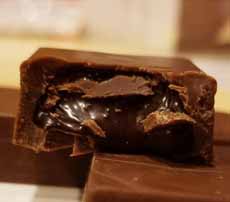
    [2] Key Lime bonbon.

    William Dean Chocolates
    [3] Rosemary Caramel bonbon.

    William Dean Chocolates
    [4] Port With Figs & Plum bonbon.


    Comments off

    RECIPE: Spring Pea Crostini

    Spring Pea Crostini
    [1] Spring Pea Crostini (photo courtesy Hannah Kaminsky | Bittersweet Blog).

    Shelled Peas
    [2] Spring peas fresh from the field (photo courtesy The Chef’s Garden).

    Fresh Mint
    [3] Fresh mint (photo courtesy Good Eggs).

    Fresh Spinach
    [4] Fresh spinach (photo courtesy Good Eggs).

    Garlic Cloves
    [5] Garlic, to infuse the olive oil (photo courtesy Domain Image).

      One of the great treats of spring is spring peas, also known as English peas and garden peas.

    With their beautiful color and fresh sweetness, they should be substituted for the ubiquitous avocado toast during their limited spring run. Simply mash them into a chunky spread with bright mint and lemon accents, and spread the mixture on your toast.

    Our colleague Hannah Kaminsky went one step further and created a more sophisticated tartine (French for an open-face sandwich, photo #1). Her recipe is below.

    While we might call it a mash, she calls the recipe pistou, after the French condiment that uses the same ingredients.
     
     
    WHAT IS PISTOU

    Pistou (pee-STEW) is a cold sauce that originated in Provence, the southeast region of France that borders Italy. However, recipes by other names have a much longer history.

    The Roman poet Virgil described a sauce made by crushing herbs in a mortar with garlic, salt and olive oil. He was not specific about the herbs. Over time, the sauce evolved into the basil-based Genovese pesto and pistou in Nice—both areas rich in basil.

    Pistou is the Provençal word for “pounded,” after the traditional method of pounding the ingredients using a mortar and pestle (Virgil’s cook did it the same way).

    And like Virgil’s recipe, the original Provençal pistou sauce has just three ingredients: fresh herbs (basil), cloves of garlic and olive oil.

    Is Pistou The Same As Pesto?

    Some people think pistou is the same as Italian pesto, which originated in Genoa, the capital of the region of Liguria. But it is different: There are no pine nuts or grated pecorino/parmesan in classic Provençal pistou.

    Over time, every recipe gets enhanced by creative cooks. Today, some pistou recipe variations include grated cheese, chili flakes or lemon juice. Some cooks add mint or sage. Some add tomatoes. Some even add nuts, which creates a vegan pesto (no cheese).

    As long as it contains herbs, garlic and olive oil, it’s pistou. Hannah Kaminsky has taken an even different direction, substituting mint for the basil and adding and spinach and fresh peas.

    How To Use Pistou

    Pistou is most popularly used in the Provençal dish soupe au pistou, a soup similar to minestrone that can include white beans, string beans, tomatoes, potatoes, summer squash, pasta and herbs. Other vegetable-rich soups can also get the pistou treatment, to enliven the flavors of the soup. The pistou is incorporated into the soup just before serving.

    Like pesto, pistou is very versatile: added to bean salad; atop crostini or bruschetta (the difference), toast or plain bread; with grilled meats (Argentine chimichurri is a similar sauce made with parsley); or used, like pesto, as a pasta sauce. Try it as a condiment with eggs.
     
     
    RECIPE: CROSTINI WITH MINT & SPRING PEA PISTOU

    Crostini sounds exotic, but it’s just Italian for toasted bread. The bread used is an Italian loaf, so it’s different from large, flat American slices.

    With bruschetta, the bread is grilled, not toasted. Here are more differences.

    The pistou can be prepared in advance and stored in an airtight container in the fridge for 3-4 days.

    Ingredients For 4 Servings

    For The Minted Pea Pistou

  • 1/2 cup fresh mint, lightly packed
  • 1 cup fresh spinach, lightly packed
  • 3 tablespoons garlic oil*
  • 2 tablespoon lemon juice
  • 1 pound (3 cups) fresh-blanched or frozen-thawed green peas
  • 1/2 teaspoon salt
  • 1/4 teaspoon ground black pepper
  •  
    Plus

  • 4 thick slices toast (we like a crusty, rustic loaf)
  • 1 cup ricotta
  • 1/2 cup fresh peas
  • Optional garnish: pea shoots or sprouts (substitute a minced fresh herb)
  • Optional garnish: edible flowers
  •  
    Preparation

    1. MAKE the pistou. Place the mint, spinach, garlic oil, and lemon juice in the food processor and blend until the leaves are broken down and the mixture is fairly smooth. Pause to scrape down the sides of the container as needed.

    2. ADD the peas, salt and pepper, and pulse until spreadable but still slightly coarse.

    3. TOAST the bread and add a thick layer of ricotta to each slice. Follow with the pea pistou and garnish with fresh peas, pea shoots, and edible flowers. Savor a taste of spring, no matter the weather outside!

    ________________

    *We buy garlic-infused olive oil, but you can infuse your own. Place the 4 tablespoons of olive oil in a small pan with a peeled, crushed garlic clove; the extra tablespoon is to allow for loss during the cooking process. Sauté the garlic over medium heat for three to five minutes. The garlic should sizzle, but not cook. Lower the heat if it starts to brown around the edge. Turn the heat off and let the oil cool. Remove the garlic and use the oil. The reason for cooking the oil is to avoid any botulism present in the garlic. It’s a small risk, but still possible.


    Comments off

    The Nibble Webzine Of Food Adventures
    RSS
    Follow by Email


    © Copyright 2005-2025 Lifestyle Direct, Inc. All rights reserved. All images are copyrighted to their respective owners.