THE NIBBLE BLOG: Products, Recipes & Trends In Specialty Foods


Also visit our main website, TheNibble.com.

Make A Gratin: Potatoes Au Gratin & Other Vegetables

Americans love melted cheese: on burgers, nachos, pizza, sandwiches, in fondue and queso dips. On the elegant end of the melted cheese menu is a gratin (grah-TAH, although Americans say GRAH-tin), a casserole that is topped with seasoned breadcrumbs and cheese, which is browned.

Potatoes au gratin is a popular rendition, but your favorite vegetables can be given the same treatment* if family members won’t eat their broccoli, cauliflower, eggplant, green beans, spinach, etc.

The basic gratin recipe is below. Tailor it to your tastes.
 
 
GRATIN VS. SCALLOPED POTATOES

Our mother was very fond of tomatoes au gratin, when she needed a tomato fix during the winter season. She also preferred onions au gratin to creamed onions for the melty cheese.

Both dishes use thinly-sliced potatoes, and people often use the terms interchangeably. We have seen this error in major online recipe databases, like All Recipes.

And even earlier cooks used what today would be incorrect terminology. Gratin Dauphinois, a French dish of sliced potatoes baked in cream, has no cheese or crumbs.

For today’s correct usage:

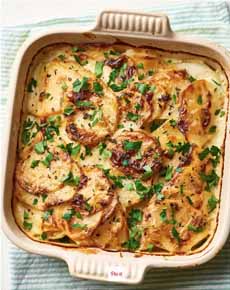
  • Scalloped potatoes (photo #2) use milk or cream instead of cheese.
  • Why are they called scalloped? The leading explanation is that when the sliced potatoes were layered in the dish, the edges of semi-circles created a “scalloped” effect, as the term is used in dress- and furniture-making.
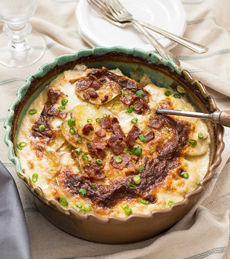
  • Potatoes au Gratin (photo #1) refers to any dish that is topped with cheese and/or bread crumbs. The potatoes are layered with bits of butter and cream, and the casserole is baked until brown and crispy. The cheese can be melted and the crust formed in an oven, under the grill, or with a salamander.
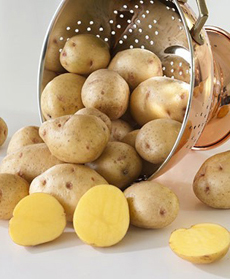
  • Both dishes can use russets or Yukon Golds, but the latter hold their shape much better and make better-sized slices.
  •  
    Before we head to the recipe, here’s some gratin history:
     
     
    THE HISTORY OF POTATOES AU GRATIN

    Gratin recipes originated in Europe, possibly in Provence, which once used the word gratoneya to a certain way of cooking foods (source).

    Most people would think it originally came from the French word gratin, a derivative of the verb grater, to grate.

    But in the 16th century, that word referred to what we today call the fond, the French word for bottom, indicating food which sticks to the bottom of the pot and has to be scraped (gratte) off to be eaten.

    Since the 19th century the meaning has changed to indicate a crisply baked, browned top, and the term “au gratin” indicates a dish topped with grated cheese.
     
     
    RECIPE: POTATOES AU GRATIN (POTATO GRATIN)

    This recipe (photo #1), from the Idaho Potato Commission, builds on the original, adding bacon, garlic and scallions.

    While gruyère is the classic recipe cheese, this variation uses a combination of gruyère and parmesan.
     
    Ingredients

  • 6 large Yukon Gold potatoes, 1/8″ slices
  • 1 head garlic
  • 1 teaspoon olive oil
  • 1 pound thick-sliced bacon, cut into 1-inch pieces
  • 4 tablespoons unsalted butter, plus more for greasing
  • 2¼ cups heavy cream
  • 4 scallions, thinly sliced
  • ¼ cup freshly chopped chives
  • ½ cup grated gruyère or parmesan cheese (more cheese if you like)
  • 1/4-1/2 cup panko breadcrumbs
  • Salt and pepper
  •  
    Variations

    Cooks add their own touches. Here are some suggestions:

  • Add-ins: bacon, chopped bell peppers, minced ham, scallions
  • Fresh herbs: chives, parsley, thyme.
  • Mixed cheese: add blue, goat, parmesan or other favorite to the gruyère.
  • Mixed potatoes, e.g. white and sweet (or all sweet).
  • Mixed root vegetables: add slices of carrot, rutabaga, turnips, even beets.
  • Seasonings: a spoon of dijon mustard or horseradish, some nutmeg.
  •  
    Preparation

    1. PREHEAT the oven to 350°F. Generously butter 9-inch-by-13-inch casserole dish.

    2. SLICE a thin layer off the head of garlic and place the bulb on a piece of foil. Drizzle with olive oil and sprinkle with salt and pepper. Fold the foil into a pouch and place on a baking sheet. Bake for 35-40 minutes, or until the cloves are soft and tender. Allow the garlic to cool long enough to handle; then squeeze out the cloves and set aside.

      Bacon Gratin Recipe
    [1] Potatoes au gratin. The recipe, from the Idaho Potato Commission, is below.

    Scalloped Potatoes
    [2] Scalloped potatoes are similar to gratin, but don’t have a cheese and breadcrumb topping. Instead, they’re made in a milk base. Here’s the recipe from The Kitchn.

    Yukon Gold Potatoes
    [3] Yukon Golds, the potatoes of choice (photo courtesy Bonnie Plants).

    Spinach Gratin
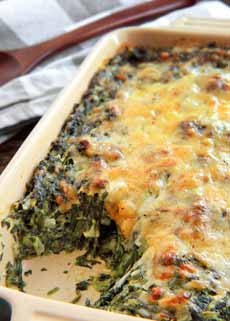
    [4] Spinach gratin, with a mix of three cheeses. Here’s the recipe from Everyday Kitchen.

    Eggplant Gratin
    [5] Eggplant gratin, with mozzarella and parmesan. Here’s the recipe from Food For Love.


    3. HEAT a large sauté pan over medium heat. Add the bacon and cook, stirring occasionally, until the bacon is crispy. Using a slotted spoon, transfer the bacon to a paper towel-lined plate; set aside.

    4. ADD the butter, cream, and roasted garlic to a saucepan. Heat over medium-low heat until the butter is melted. Whisk the mixture to combine all of the ingredients and break up the roasted garlic cloves.

    5. PLACE a layer of potato slices on the bottom of the prepared casserole dish. Pour a thin layer of the cream mixture over the top. Sprinkle with kosher salt and black pepper. (Season each layer as you build it, and lightly press down on the layers before adding the next one.)

    6. TOP with approximately 2 teaspoons chives, 2 tablespoons scallions, 3 tablespoons bacon, and 2 tablespoons cheese. Repeat until all of the potatoes are used up. Top the final layer with the remaining cream, chives, scallions, bacon and cheese.

    7. BAKE at 350°F uncovered for 1 hour and 15 minutes, or until the potatoes are cooked through and the top is crispy and golden brown. Serve immediately.

    ________________

    *Some vegetables, particularly dense ones like broccoli and cauliflower, require some pre-cooking. Check a recipe, but first toss the florets and stem slices in olive oil and a bit of salt, then roast them at 425° for 15 to 20 minutes.
     

    CHECK OUT WHAT’S HAPPENING ON OUR HOME PAGE, THENIBBLE.COM.


    Comments off

    TIP OF THE DAY: Mushroom Toast

    Mushroom Toast
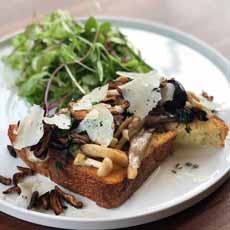
    [1] Mushroom toast. Serve it any time of the day, including with a leisurely glass of wine or beer (photo courtesy Edwards Dessert Kitchen).

    Assorted Mushrooms
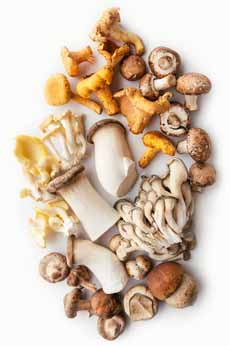
    [2] A wealth of mushrooms from which to choose (photo courtesy Good Eggs).

    Lobster Mushrooms
    [3] Lobster mushrooms. If you can find them, they add color to the plate (photo courtesy Baldor Food).


    Tired of avocado toast? We sure are.

    It’s not that we don’t like it; it’s just ubiquitous. We’d like a change.

    We found inspiration in this mushroom toast from Edwards Dessert Kitchen in Minneapolis (photo #1). We’ve created our version of the recipe, below.

    Aim for 3 varieties of mushrooms: different shapes and textures (photo #2—see the different types of mushrooms).

    Enjoy mushroom toast for breakfast, for lunch or light dinner with a side salad or soup, or as a first dinner course.

    The assorted mushrooms make the dish elegant, and the splash of sherry adds a wonderful richness that enhances the flavor profile, even at breakfast.

    To round out the course, a salad of cherry tomatoes and sweet onions, in a Dijon vinaigrette with some fresh herbs, is a nice counterpoint. For crunch, add some celery or fennel. Mesclun works, too.
     
    RECIPE: MUSHROOM TOAST

    Ingredients For 4 Servings

  • 2 tablespoons butter plus additional for toast (let soften to room temperature)
  • 2 tablespoons olive oil
  • 12 ounces assorted mushrooms: oyster, shiitake and white beech, for example, cleaned
  • Salt and pepper to taste
  • Optional: 1 small clove garlic, thinly sliced
  • Optional: splash of sherry or red wine
  • 4 ounces baby spinach, cleaned (substitute kale)
  • Optional: shake of nutmeg
  • 4 slices brioche
  • Garnish: shaved parmesan or other firm cheese
  • Optional: snipped parsley or chives
  •  
    Preparation

    1. HEAT the olive oil and butter in a large saucepan over medium heat. Cook and stir the mushrooms, garlic, sherry/wine, salt and pepper until the mushrooms are lightly browned, about 5 minutes.

    2. REDUCE the heat to low and simmer until the mushrooms are tender, 5 to 8 additional minutes. Remove and set aside, covering to keep warm.

    3. SAUTÉ the spinach in the same pan. As an alternative, you can wilt it by pouring boiling water over spinach in a colander. Press to remove water. Season either with with salt, pepper and nutmeg. Set aside and keep warm.

    4. TOAST the bread and lightly butter it. As the bread toasts, warm the mushrooms and spinach in the microwave for 45 seconds or more.

    5. TOP the toast with the mushrooms, then the spinach and optional herbs. Shave the cheese over the tops and serve.


    Comments off

    FOOD 101: Wild Rice For National Wild Rice Week

    The fourth week in September is National Wild Rice Week. Did you know that wild rice isn’t rice?
     
     
    A COUSIN OF TRUE RICE

    Wild rice is a member of the Poaceae family, genus Zizania; it is a cousin to true rice, the genus Oryza.

    Like Orzya, it grows in in shallow water. Instead of being cultivated in paddies, as the name indicates, it grows wild in small lakes and slow-flowing streams.

    There are four species of wild rice, three native to North America.

  • Northern wild rice (Zizania palustris) from the Great Lakes region. It is the state grain of Minnesota.
  • Wild rice (Zizania aquatica) grows in the Saint Lawrence River and on the Atlantic and Gulf coasts.
  • Texas wild rice (Zizania texana) grows along the San Marcos River in central Texas.
  • The fourth species is native to China, Manchurian wild rice (Zizania latifolia, also called Zizania caduciflora).
  •  
    The tassels at the top of the stalks can be seen swaying over rivers, lakes and floodplains from late August through September.

    Called manoomin by the local Chippewa, wild rice is a protected crop that can be harvested only by state residents holding a valid license.

    In the Great Lakes region, the rice is harvested by hand, by the Chippewa natives. Paddling in canoes (or propelling with push poles—illustration #3, below), they use the traditional instruments, wooden flails, to make the grains fall from the stalks.
     
     
    WILD RICE NUTRITION

    Wild rice is high in protein for a grain, second only to oats in protein content. Like true rice, it does not contain gluten.

    Wild rice is also a good source of minerals and *vitamins, the amino acid lysine and dietary fiber. It low in fat.

    While some recipes and store rice mixes combine wild rice with other versions (white rice, brown rice), this is to keep the cost down. It prevents you from enjoying the joy of wild rice.

      Wild Rice
    [1] Wild rice, not a member of the rice genus but a first cousin (photo courtesy Tocabe Native American Restaurant).

    Wild Rice Pilaf
    [2] One of the most popular preparations: wild rice pilaf with mushrooms (photo and recipe from the New York Times).

     
    Wild rice takes longer to cook than white rice, but wild rice delivers a complex, nutty flavor profile that can be the star of the plate.
     
    Wild Rice Vs. Brown Rice

    Cooked wild rice has about 30% fewer calories than brown rice and 40% more protein. It also contains more fibre, potassium and zinc.

    So treat yourself: Spring for a bag and make this recipe, courtesy of The New York Times.
     
     
    WILD RICE RECIPES

    Wild rice can substitute for potatoes or grains, and is used in a wide variety of foods such as dressings/stuffings, casseroles, salads, soups, even desserts.

    Here are some wild rice recipe collections to peruse:

  • Food Network
  • Midwest Living
  • The Lean Green Bean
  •  
    We always add it to our Thanksgiving turkey dressing.
     
     
    > The different types of rice.

    > The history of rice.
     
    Wild Rice Harvesting
    [3] Nineteenth century tribal women harvesting wild rice in the traditional manner. From The American Aboriginal Portfolio by Mrs. Mary H. Eastman. Illustrated by S. Eastman. Philadelphia: Lippincott, Grambo & Co. 1853.

    ________________

    *One cup of cooked wild rice provides 5% or more of the daily value of iron, and potassium, riboflavin and thiamin; 10% or more of the daily value of B6, folate, magnesium, niacin and phosphorus; 15% of zinc; and more than 20% of manganese.


    CHECK OUT WHAT’S HAPPENING ON OUR HOME PAGE, THENIBBLE.COM.


    Comments off

    TIP OF THE DAY: Make Masala Chai Concentrate

    Chai Tea
    [1] A cup of chai, garnished with star anise. You can re-use one of the stars used to brew the concentrate (photo courtesy The Prairie Homestead).

    Masala Chai Tea Blend
    [2] A hearty masala chai spice blend (photo courtesy Spice Station).

    Elephant Tea Pot
    [3] Enjoy your Indian tea in an elephant tea pot (alas, this one from Houzz is no longer available, but other designs are).

    Masala Chai
    [4] Don’t want to make chai concentrate? Buy it from Rishi and other brands (photo by Katherine Pollak | THE NIBBLE).


    The fall season ushers in traditional autumnal foods and beverages.

    In the latter department, there are apple cider, hot chocolate, mulled wine/mulled cider/hot buttered rum, spiced tea (like Constant Comment), flavor twists on cocktails (like a maple Old Fashioned), and the infamous Pumpkin Spice Latte (infamous for its 50g of sugar).

    And then, there’s masala chai, which translates to “spiced tea” in English: masala means “spice blend” or “mixture of spices” in Hindi/Urdu‡, and chai is the word for tea.

    Note that when someone asks for “chai tea,” in English, they’re asking for “tea tea,” since “chai” already means tea! This is called redundant translation, and if you enjoy learning the quirks of language, check out the ‡‡footnote.

    The full term “masala chai” specifically refers to tea brewed with a blend of aromatic spices like cardamom, cinnamon, cloves, ginger, and black pepper, along with milk and sugar.
     
     
    CHAI COMES TO THE U.S.

    While everything else on the fall beverage list has been on American menus for centuries, chai has only become nationally popular since the end of the 19th century, when artisan tea companies began to add it to their line. See the history of chai below.

    The recipe that follows, from Jill Winger of The Prairie Homestead is, pleasantly sweet and spicy, but not too sweet or too spicy. After you try the first batch, you can make it sweeter and/or spicier.

    Use your sweetener of choice, or none at all so that people (dieters, the sugar-averse) can have their drink as they prefer. The recipe follows, but first, tea lovers can mark this whole list of tea holidays:

    > The year’s 23 tea holidays.

    > The history of masala chai is below.

    > The history of tea.

    > The different types of tea: a photo glossary.
     
     
    RECIPE: CHAI CONCENTRATE

    Ingredients For 1 Quart Of Concentrate

  • 6 cups water
  • 1/4 to 1/3 cup sweetener of choice
  • 2″ to 3″ piece fresh ginger root, sliced
  • 5 cinnamon sticks
  • 1 teaspoon peppercorns
  • 3 star anise
  • 15 cloves
  • 5 allspice
  • 2 teaspoons cardamom seeds
  • 5 black tea bags
  • Milk of choice
  •  
    Preparation

    1. BRING the water and sweetener to a boil in a medium pot, and simmer until the sweetener is fully dissolved.

    2. ADD all of the spices, and continue to simmer on low heat for 20 minutes.

    3. REMOVE the mixture from the heat, add the tea bags, and let them steep for 10 minutes.

    4. STRAIN out the spices and tea bags and store the concentrate in the fridge (it will last for several weeks).

    5. SERVE: Mix the chai concentrate 1:1 with milk. Gently heat in a small saucepan until it reaches the desired temperature (we heated it for 2:45 minutes in our microwave; yours may take less or more time). Pour into a mug and enjoy…perhaps with some graham crackers.
     
    Recipe Tips

  • If you have ground spices instead of whole, look online for the equivalent amount for substitution. If you don’t have one of the ingredients and don’t want to purchase it, just leave it out.
  • Use a muslin bag or cheesecloth to hold the spices; then you don’t have to straining them out.
  • For extra richness, trade some of the milk for cream or half-and-half.
  •  
     
    THE HISTORY OF CHAI (MASALA CHAI)

    The original masala chai (masala means spice, chai means tea), is very different from the contemporary recipe. The first version was an ancient Indian ayurvedic beverage—a cleansing spice tonic that did not include any tea.

    When the British began to establish tea plantations in Assam, in 1835, they added milk and sweetener to their tea, as they did at home. At the time, tea was too expensive for most Indians and was largely grown for export (this is unfortunately true of other third-world crops, including coffee).

    In the early 1900s, the British-owned Indian Tea Association began to promote tea consumption to Indian consumers. Because black tea was still an expensive ingredient, vendors used milk, sugar and spices—the ingredients of today’s masala chai—to create a flavorful drink while keeping costs down.

    The drink’s popularity spread throughout India and became even more popular in the 1960s, when mechanized tea production made black tea affordable for the common man.
     
     
    TEA TRIVIA: After water, tea is the most widely consumed beverage in the world. Coffee takes third place.
     
     
    ________________

    *CHAI VS. TEA: All related forms of the word chai—Turkish çay, Russian/Persian/Hindi/Urdu chay, etc.—derive from the original Mandarin, cha. Cha became the Cantonese, Mandarin and Japanese word for tea. Other Chinese dialects have different words; e.g. the Wu dialect spoken around Shanghai uses the word zu and the Hokkien dialect spoken around the port of Xiamen in the Fujian province uses the word tay. The word “cha” traveled to the Middle East and Eastern countries, while “tay” traveled to Europe and became our word for tea.

    Xiamen was the port of trade first used by Europeans (mainly the Portuguese) in 1541. Near the end of the Ming Dynasty, in 1644, British merchants set up trading posts there; in the 19th century, it was China’s main port for exporting tea. As a result, the Hokkien dialect spoken there, not Mandarin which traveled west via overland trade routes, influenced what Europeans called the beverage. What the Xiamenese people call tay, the British spell tea, the French spell thé, the Spanish té, the Italians tè and the Germans, tee. The pronunciation varies from “tay” to “tee.”

    Other words from the Hokkien language that entered English: ketchup (kiô-chap), Pekoe (pekh-hô), kowtow (khàu-thâu) and Japan (Jit-pún).

    Cream tea is a refreshment of a baked scone with jam and clotted cream, served with a cup of tea. It is traditionally enjoyed in the afternoon, often after lunch; but is much simpler than the more elaborate afternoon tea. It originated in the southwest of England in Devon and Cornwall, but now can be found all around the U.K.

    ‡Hindi and Urdu are very closely related languages that share the same grammatical structure and much of their vocabulary, but they differ in several key ways. Briefly, Hindi is the official language of India (along with English). Urdu is more associated with Islamic culture and was historically the court language of Muslim rulers in the Indian subcontinent. Urdu is the national language of Pakistan and also spoken by Muslims in India.

    In everyday conversation, Hindi and Urdu speakers can easily understand each other: The spoken forms are essentially the same language. In writing, however, Hindi uses the Devanagari script (the same used for Sanskrit) while Urdu uses a modified Arabic script, written right to left.

    Linguistically, many scholars consider them to be two standardized forms of the same language, sometimes called Hindustani.
     
    ‡‡“Redundant translation” or “RAS syndrome” (Redundant Acronym Syndrome) occurs when English speakers combine a foreign word with its English equivalent. This happens because as foreign words enter English, speakers often lose awareness of the original meaning and treat them as proper nouns or specific terms rather than translations. The redundancy helps clarify meaning for English speakers who might not know the foreign word’s literal translation. Examples:

    Food Terms:
    > Chai tea (chai = tea)
    > Gyro sandwich (gyro = a type of sandwich/wrap)
    > Naan bread (naan = bread)
    > Panini sandwich (panini = sandwiches, plural of panino)
    > Queso cheese (queso = cheese in Spanish)
    > Salsa sauce (salsa = sauce)
    >Shrimp scampi (scampi = shrimp in Italian)

    Geographic Terms:
    > Sahara Desert (Sahara = desert in Arabic)
    > Rio Grande River (Rio = river in Spanish)
    > Mount Fujiyama (yama = mountain in Japanese; it’s just “Mount Fuji” or “Fujisan”)
    > La Brea Tar Pits (la brea = the tar in Spanish)

    Other Examples:
    > PIN number (PIN = Personal Identification Number)
    > ATM machine (ATM = Automated Teller Machine)
    > HIV virus (HIV = Human Immunodeficiency Virus)
    > LCD display (LCD = Liquid Crystal Display)

    Most English speakers use redundant terms unconsciously and without any intent to be redundant: They’ve simply learned the phrases that way. However, in academic or professional contexts precision matters. Even in social situations, should you correct someone? Yes, if you perceive that the person would welcome the knowledge.


    CHECK OUT WHAT’S HAPPENING ON OUR HOME PAGE, THENIBBLE.COM.


    Comments off

    WINE: Châteauneuf-du-Pape, A Great Red Wine From Provence

    A few weeks ago, we received a pitch promoting particular wines for International Châteauneuf du Pape day, held on the third Friday in September (today). It inspired us to write about the wine, one of our favorite reds.

    In France, wines are named after their communes (think village or county), departments (think state) or regions.

    The village of Châteauneuf-du-Pape lies in the Southern Rhone, north of the city of Avignon.

    Châteauneuf-du-Pape (pronounced pop) isn’t a wine common to American wine lists these days. It’s pretty pricey, with top bottles going for $100 more at retail, before the restaurant mark-up.

    But in our youth, when even the best wines were more or less affordable, Châteauneuf-du-Pape was a staple at top steakhouses. If you could afford the steak, you could afford the wine.

    Châteauneuf-du-Pape is the largest and most important wine appellation in the southern Rhône. Ninety-five percent of the wines are red, with rich red-fruit aromas, strong fruit flavors and plenty of spice and high alcohol (14%).

    The best wines may also exhibit notes of garrigue, a term for the herby aroma of the Proveçal underbrush.

    A small amount of white wine is produced, but it is typically consumed locally. Regulations do not allow the production of rosé wine [source].
     
     
    IS IT NAMED FOR A CASTLE (CHÂTEAU)?

    There’s a 14th-century medieval castle in ruins at the top of the hill, but the town isn’t named for the castle.

    Rather, the first mention of the village is in a Latin document from 1094 that uses the name Castro Novo, referring to a new village. At that time castro, or château in French, was used to denote a fortified village, rather than the mansion it later came to denote.

    In 1309s, Pope Clement V, the “pape” in Châteauneuf du Pape, moved the papacy to Avignon. A total of seven popes resided for the next 67 years.

    He and subsequent popes loved the local wine, and encouraged more viticultural in the area. As a result, almost all of the cultivable land is planted with grape vines.

    By the 16th century, the village was officially called Châteauneuf du Pape.
     
     
    THE WINES OF CHÂTEAUNEUF DU PAPE

    The Châteauneuf-du-Pape appellation is an A.O.C.* (appelation origine contrôlée), meaning that by law it can only be produced locally, from specific grapes grown in the commune of Châteauneuf-du-Pape and in portions of four adjoining communes.

    Almost all wines from the Southern Rhône are blends. Châteauneuf-du-Pape is no different.

    Grenache is the most widely planted grape, but by law 18 grapes† are allowed in the blend. Winemakers use different grape selections and percentages based on what they are trying to achieve.

    Grenache is followed by Mourvèdre, Syrah and Cinsault. And yes, some vintners use all 18 grapes, and a few use 100% grenache.

    A popular blending template is known as GSM: Grenache, Syrah and Mourvèdre.

  • Grenache is vigorous and fruity, but it’s thin-skinned and lacking pigment.
  • Mourvèdre is darker and more powerful, providing deep color and anti-oxidative protection.
  • Syrah gives the wine spice and backbone.
  •  
    Even the glass bottles distinguish themselves, with a textured crest on the top half of the bottle (photos #1 and #2; some vintners forgo the expense and use conventional bottles).
     
     
    WHAT TO BUY

    Consult with your wine store clerk about the options at hand, and their peak drinking times (some are ready to drink now, some aren’t).

    What you need to be aware of is that there are three tiers of price/quality:

  • Top tier: Château de Beaucastel, Domaine de la Janasse, Domaine du Pégau, Domaine Saint-Préfert, Domaine du Vieux Télégraphe ($60-$100). Reserve wines can be well above $ 100, to as much as $400.
  • Mid-tier: Château La Nerthe, Château Mont-Redon, Le Clos de l’Oratoire des Papes, Le Vieux Donjon,($40-$60).
  • Most affordable: Château de la Gardine, Domaine Moulin-Tacussel, E. Guigal, Pére Anselme ($30-$40).
  •  
    Treat yourself to a bottle, and share it with your favorite red wine lovers.

    —Kris Prasad


    Beaucastel Wine
    [1] Château de Beaucastel, a world-renowned Châteauneuf-du-Pape wine (photo courtesy Lipman Events).

    Chateauneuf-du-Pape
    [2] The crest of Châteauneuf-du-Pape, used by many of the wine producers (photo © Joe Fisher | Flickr. All rights reserved.

    Chateau La Nerthe
    [3] Château La Nerthe, priced in the middle range (photo courtesy Snooth).

    Mont Redon Bottle
    [4] Château Mont-Redon, another mid-tier wine (photo courtesy The Local Drop).

    Vieux Telegraphe Bottle
    [5] Another of the greats, Domaine du Vieux Télégraphe (photo courtesy Benchmark Wine Group).

     
    ________________

    *A.O.C., an abbreviation of appellation d’origine contrôlée, is a legal designation that places rigid standards on how and where a French product can be produced. This ensures consistent quality and preserves its reputation, and distinguishes an authentic product (e.g., Parmigiano Reggiano) from a generic one (e.g. parmesan cheese).

    †The grapes, in order of use are Grenache, Syrah, Mourvèdre, Cinsault, Clairette, Grenache Blanc, Bourboulenc, Roussanne, Counoise, Muscardin, Vaccarese, Picpoul Picardan, and Terret Noir. Very recently, additional varieties have been added by law for a total of 18 varieties.


    Comments off

    The Nibble Webzine Of Food Adventures
    RSS
    Follow by Email


    © Copyright 2005-2026 Lifestyle Direct, Inc. All rights reserved. All images are copyrighted to their respective owners.