THE NIBBLE BLOG: Products, Recipes & Trends In Specialty Foods


Also visit our main website, TheNibble.com.

FOOD FUN: Tomato Cheesecake & More Sweet Tomato Dessert Recipes

Tomato Cheesecake
[1] Tomato cheesecake, a sweet dessert (photos #1, #2 and #3 © Italian Association of Canned Tomatoes Producers).

Tomato Cheesecake
[2] A close up of the slice of tomato cheesecake.

Canned Tomatoes
[3] Canned tomatoes from Italy (we use San Marzano, as does this recipe).

Green Tomato Crumble Pie
[4] Green Tomato Crumble Pie. Here’s the recipe from Healing Tomato (photo © Healing Tomato).

Tomato Sorbet
[5] Tomato sorbet. Here’s the recipe from Andrew Zimmern (photo © Andrew Zimmern).

Tomato Soup Cupcakes
[6] Tomato soup cupcakes. Here’s the recipe from Country Cleaver (photo © Country Cleaver).


Now that the crop of local summer tomatoes has faded for most of us, we turn our thoughts to canned tomatoes.

The “usual suspects” for these bright red conserved tomatoes include chili, pasta sauce, shakshuka or Spanish omelet, and Sloppy Joes (add your favorites to the list).

But how about tomatoes for dessert? From ice cream and sorbet to cakes and pies, we have a stack of recipes below for sweet tomato desserts.

We’ll start here with this recipe for a charming Tomato Cheesecake, a visual beauty that will also have your family and friends say “tomato what?” when you present it.

You can remind them that the tomato is a fruit, and its natural sugar levels can easily be enhanced into sweetened tomato condiments like chili sauce, conserve and jam and that classic American sweet sauce, ketchup.

Tomato gelato, granita and sorbetto can be widely found in Italy (recipes below), and are included in the recipes below.
 
 
RECIPE: TOMATO CHEESECAKE

This scrumptious recipe was sent to us by the Italian Association of Canned Tomato Producers, a trade association that represents Europe’s finest canned tomato producers, their fruits grown under the Mediterranean sun of Italy.

Ingredients For 6 Servings

In Europe, “biscuit” is the word for a plain cookie in the U.K., like the rectangular biscuits served with tea.

You can substitute digestive biscuits, English tea biscuits, graham crackers or shortbread for the biscuits referred to below. Just don’t use American biscuit dough: It’s a different item entirely.

And while the Social Tea Biscuits made by Nabisco are derivative of English tea biscuits, they don’t make a good crust.

Ready to roll? Cook and bake time is 1 hour 30 minutes.

Note that the tomato jam is slow-cooked for 10 hours. You can make it the day before.
 
For The Biscuit Base

  • 5 ounces biscuits
  • 1 stick butter
  • 2 cups fresh basil
  •  
    For The Filling

  • 5 ounces sugar
  • 4 egg yolks
  • 1 pound bufala ricotta (substitute cow’s milk ricotta)
  • 1 teaspoon grated lemon peel
  • Pinch salt
  • 1 teaspoon extra virgin olive oil
  •  
    For The Topping

  • 6 ounces tomato passata (puréed tomatoes)
  • 1/4 cup water
  • 1 tablespoon sugar
  • 1 stalk celery
  • 1 teaspoon salt
  • 1 packet gelatin
  •  
    For The Tomato Jam

  • 35 ounces San Marzano peeled tomatoes
  • 10 ounces sugar
  • 2 teaspoons salt
  • 20 leaves fresh basil
  • Peel of 1 lemon
  •  
     
    Preparation

    1. MAKE the biscuit base. the butter with the basil. Then crumble the biscuits and add them to the butter and spread the mixture into a cake tin and leave to solidify.

    2. MAKE the filling. Whip the egg yolks with the sugar and a teaspoon of extra virgin olive oil. Whisk the ricotta and add it to the yolks.

    3. PLACE the filling on the base and bake in a preheated oven at 350°F for about 20 minutes. Once cooked, leave to cool and proceed with the tomato topping.

    4. MAKE the topping. Finely dice the celery and add the tomato passata; cook for 8 minutes. Strain the liquid from the pot (you can keep it for another purpose) and add the water, sugar, salt and gelatin. Boil for a few minutes and then sieve the topping onto the cheesecake and let it cool.

    5. MAKE the jam. Put all the ingredients into a baking dish, cover with parchment paper and cook at 210°F for at least 10 hours, thus obtaining tomato jam. The tomato jam is served as a condiment on the plate, or passed from a dish with a spoon.
     
     
    MORE TOMATO DESSERTS

    There are easy ways to have tomatoes for dessert. Cherry tomatoes, sweet to begin with, fit right in.

  • fruit salads. Add grape and cherry tomatoes to other berries or fruits of choice.
  • Fruit pies. Toss in some halved cherry tomatoes for a surprise.
  • Make a double of the tomato jam recipe above, and spoon it over ice cream, sorbet or pound cake.
  • It’s easy to make a sweet tomato compote. Just cook down halved cherry tomatoes with a spoonful of sugar, just like making a jam. Add a splash of balsamic vinegar or fruit vinegar, and some optional chopped basil.
  •  
    You can also peruse these more involved recipes:

  • Green Tomato Layer Cake
  • Green Tomato Crumble Pie
  • Green Tomato Pie
  • Sweet Tomato Tart (you can serve this with a cheese course)
  • Sweet Tomato Turnovers
  • Tomato, Basil and Ricotta Gelatos
  • Tomato Cheesecake With Basil-Pine Nut Crumble
  • Tomato Sorbet
  • Tomato Soup Cupcakes With Mocha Buttercream
  • Tomato & Salted Plum Granita
  • Tomato Sorbet and Basil Panna Cotta
  • Tomato Soup Cake With Cream Cheese Frosting
  •  
     
    THE HISTORY OF TOMATOES

    THE HISTORY OF SAN MARZANO TOMATOES


    Comments off

    TIP OF THE DAY: Cooking Rice From Scratch

    It often surprises us to hear people who are perfectly dependable cooks say that they can’t cook rice.

    We’ve been cooking rice from scratch for many years, and the only time we’ve had a problem is when we didn’t check the time and the bottom rice scorched (which infuses the rest of the rice with a a scorched flavor and aroma).

    So if you want to take another pass at cooking perfect, fluffy white* rice, here are some tips. The process goes fairly quickly.

    Of course, start by reading the package directions.

    Wait: Start by purchasing top-quality rice. Top brands include:

  • Anson Mills
  • Lotus Foods
  • Lundberg Family Farms
  •  
    As with any agricultural products, quality differences are based first on rootstock/seeds, then terroir, growing conditions and production techniques.
     
     
    PREPARING THE RICE PRIOR TO COOKING
     
     
    1. Measuring The Rice

    Instead of using a measuring cup for uncooked rice, use a scale for accuracy.
     
     
    2. Pre-Washing The Uncooked Rice

    Instead of placing water in a sieve or strainer† and running tap water over it, pre-wash by measuring the rice into a clean bowl. Pour cold water onto the uncooked rice, quickly stir 2 – 3 times, then discard the water immediately.

    This step helps to eliminate the and bran that are quickly absorbed by uncooked rice when you wash it.
     
     
    3. Draining The Rice

    Use a fine mesh strainer to sieve the water out of the bowl of pre-washed rice. Make sure the unclean water is thoroughly strained out.
     
     
    4. Cleansing The Rice

    Very gently and slowly, stir the wet, drained, uncooked rice in the strainer (do not add water). The friction between the rice grains will naturally remove any impurities that are left from the pre-wash.

    The gentle, slow process will prevent rice grains rice from breaking. Broken grains can cause the cooked rice to become very soggy.
     
     
    5. Washing The Rice

    Now it’s time to run water through the rice. Then gently stir it a few times.


    Jasmine Rice
    [1] Jasmine rice has long, slender grains and a hint of jasmine fragrance (photo © Hannah Kaminsky | Bittersweet Blog).

    Cooked Jasmine Rice With Asparagus
    [2] A bowl of fluffy jasmine rice with asparagus (photo © Lundberg Family Farms).

    Short Grain Japanese Rice
    [3] A bowl of cooked short-grain rice, which is the type used in Japanese restaurants. The short grain variety is more glutinous, making it stickier. That means that a forkful of it will hold together, without falling off the fork—or chopsticks (photo © Sushi Inoue | NYC).

     
    Repeat the cleansing and washing processes (steps 4 and 5) three times, or until the water draining in the washing process becomes transparent. When finished, make sure all the water is thoroughly strained out.

    Washing is the first step toward producing perfect rice. It is more than just running water through the rice and draining.

    This type of washing allows the rice to absorb the water better. Impurities and debris prevent heat from distributing properly, causing unevenly cooked rice and/or overly sticky rice.
     
     
    6. Cooking The Rice

    Cook according to package directions. You should end up with beautiful, fluffy rice.

    And don’t turn your back and let the rice scorch!

    This happens because all the water in the pot has been absorbed by the rice before the stated end of the cooking time (maybe the heat was higher than a simmer?).

    Because there is no water left in the pot, the heat scorches, then burns, the rice on the bottom.
     
     
    The History of Rice

    The Different Types Of Rice

    ____________________

    *Different types of rice have different cooking requirements.

    †A strainer is a type of sieve typically used to separate a solid from a liquid. The word “sift” derives from sieve.
      

    Comments off

    TIP OF THE DAY: A Different Take On Avocado Toast Recipes

    Avocado Hummus Toast
    [1] Avocado toast and hummus with hot sauce (photo © Hope Hummus).

    Avocado Hummus Toast
    [2] “Three Shades Of Avocado Toast,” avocado, hummus and tahini (photo Food Deco | Instagram).

    Lobster Avocado Toast
    [3] For a special occasion: lobster avocado toast (photo © Ocean Prime Restaurant).

    Avocado Toast Radishes
    [4] Avocado toast with deviled hamachi collar (substitute smoked fish) and sliced radishes (photo © Kindred Restaurant | Davidson, North Carolina).

    Avocado  On Rice Crackers
    [5] Scooped balls of avocado (use a melon baller) on a rice cracker, with broccoli florets, beet microgreens and spices (photo Food Deco | Instagram)

    Avocado Toast On Brown Rice
    [6] Another rice base: This recipe uses a rectangle of brown rice instead (photo © Think Rice).


    Avocado toast first appeared on menus nationwide at hip coffee shop with Millennial clientele.

    From there, it began to replace breakfast and lunch choices among other demographics.

    Last weekend, we attended a birthday brunch at a restaurant. The honoree and all of her grandmother friends ordered…avocado toast, topped with a fried egg.

    The rest of us ordered the Chicken & Waffles, Eggs Benedict and Tuna Niçoise.

    In fact, since the first mashed avocado appeared on whole grain toast, the [recip3e] itself has been expanded. Here’s some of what you can find in restaurants nationwide—and make for yourself at home.

    Thanks to Flavor & The Menu for the original article.
     
     
    ENHANCED AVOCADO TOAST

    To start, you can slice the avocado or mash it. You can use your choice of bread, from crusty rustic to multigrain, rice crackers to…bagels.

    Check out photo #5, which uses rice crackers instead of bread, and photo #6, which substitutes crispy squares of pan-fried brown rice for the toast (here’s the recipe).

    You can choose from a buffet of garnishes:

  • Crumbled Cheese: blue, feta, goat, parmesan/asiago, queso fresco
  • Fancy: crab, lobster (photo #3), shrimp
  • Greens: baby arugula, mesclun, microgreens, sprouts
  • Herbs: basil, chives, cilantro, dill, oregano, thyme
  • Pesto: particularly sundried tomato pesto
  • Pickled: carrots, chiles, gherkins, onions, mushrooms, and any other pickled vegetables
  • Nuts: chopped pistachios, sliced almonds or other toasted nuts
  • Onions: pickled, red, scallions, sweet
  • Seeds: chia, flax, pomegranate, pumpkin, sunflower, toasted sesame
  • Smoked Fish: herring, salmon, sturgeon, whitefish
  • Spices: chile flakes, curry, paprika
  • Spicy/Peppery: chiles, horseradish, hot sauce, radish, watercress
  • Plus: hummus (photos #1 and #2), lemon or lime zest, flavored EVOO drizzle
  •  
    From there, consider these directions:

    1. PUT AN EGG ON IT

    Perhaps the first enhancement to a slice of avocado toast was an egg: boiled, hard boiled and sliced, fried, poached or scrambled. It adds protein, and lets the topped toast transition to brunch or lunch.

    For a special occasion, consider duck or quail eggs.
     
     
    2. GO MEDITERRANEAN

    Avocado blends beautifully with Mediterranean flavors Alternate or layer mashed avocado with hummus

    Add some local cheese: crumbled feta or grilled halloumi, for example. Maybe even a honey drizzle?

    For accents: dukkah, harissa, lemon zest, sumac, tahini drizzle, za’atar.
     
     
    3. ADD SOME “CREAMY”

    Top the avocado with something creamy: crème fraîche, Greek yogurt, sour cream.

    To that, you can add crumbled cheese (see the list above).

    For an extra touch, add a favorite flavor to the yogurt or sour cream: curry, dill, garlic.

    Or blend it with basil or sundried tomato pesto. For the holiday season, add some pumpkin purée.
     
     
    4. VEGGIE TIME (FRUITS, TOO!)

    Top the vegetable (avocado) with more vegetables—whatever you like. chefs are looking to avocado toast as a fitting platform. The sky’s the limit, where the build out can simply star a bevy of fresh produce or can star complex and intriguing flavors and textures—all pulled from the veg-centric universe.

  • Fresh vegetables: cherry tomatoes; scallions; shaved broccoli stems, carrots and fennel, cauliflower florets.
  • Grilled vegetables: any assortment.
  • Marinated and pickled vegetables: carrots, onions/scallions, mushrooms, pimento, sundried tomatoes
  •  
    You can pickle just about any vegetable. Asparagus, baby corn, beets, carrots, green beans (“dilly beans”), mushrooms, okra, pearl onions, sliced onions, snap peas, tomatoes and turnips, for example.

    Pickled fruits also enhance avocado: apples, Asian vegetables (bean sprouts, bok choy, etc.), pears, rhubarb and stone fruits (cherries, nectarines, peaches, plums).

    Here’s how to make 2-hour pickled fruits and vegetables.
     
     
    MORE AVOCADO TOAST (AND FRIENDS OF AVOCADO TOAST) RECIPES

  • Avocado & Sour Cream Toast
  • Loaded Avocado Toast Or Crostini
  • Mashed (Or Smashed) Pea Toast
  • Sweet Potato Toast
  •  
    THE HISTORY OF AVOCADO TOAST

    Although a relatively new trend in the U.S. (we first noticed it about six years ago), avocado toast has been “commonplace for a long time,” according to Wikipedia.

  • In Australia and Chile, large avocado growers, people have been eating avocado toast for decades.
  • In the U.K., it has been a popular snack since the early-1970s.
  • In Mexico, where the avocado is indigenous (the history of avocado), avocado on corn tortillas dates to ancient times.
  •  
    Surely, some conquistador, or more likely one of the nuns who followed in the early 16th century (the nuns created fusion European-Aztec cuisine, adapting New World ingredients to Old World cooking styles), first put sliced avocado on a piece of toasted European bread. But the record is mute on that.

    According to an article in The Washington Post, chef Bill Granger of Sydney, Australia may have been the first person to put avocado toast on a menu, in 1993. Another Australian chef believes that the combination of avocado and toast emerged in Queensland, Australia in the mid-1970s.

    Now, Millennials call it “smashed avo.”

    In 1999, Nigel Slater published a recipe for an avocado “bruschetta” in London’s newspaper, The Guardian.

    Even earlier, in 1962, a New York Times article showcased an “unusual” sandwich of avocado on toast.

    And even earlier than that, in 1937, The New Yorker published an article, “Avocado, or the Future of Eating,” in which the protagonist eats “avocado sandwich on whole wheat and a lime rickey.” [source]

    But credit social media with launching this low-key breakfast and snack into stardom, with an endless number of photos making it a must-have for avocado lovers.


    Comments off

    TIP OF TODAY: Stop Potatoes From Sprouting

    September is National Potato Month (August 19th is National Potato Day). While we’ll share recipes later in the month, today we have a safety message.

    You’ve probably never heard of getting glycoalkaloid toxicity from potatoes.

    The effects are mostly gastrointestinal. They are often delayed 8 to 10 hours after consuming a bad potato.

    The poisonous ingredient is solanine*, which is very toxic even in small amounts (here’s more information).

    The compound mostly resides in the stem and leaves, as well as in green potatoes and new sprouts (eyes, or buds).

    You can avoid it by only buying potatoes as you need them, storing them in a cool and dry place—not in the refrigerator.

    Potatoes will naturally sprout around 120-150 days after harvesting. To keep them fresh for as long as possible:

  • Store them in a cool place (not cold), well ventilated and dark. The ideal temperature range is 42° 55°F. Some humidity is helpful.
  • Don’t store potatoes in a plastic bag without holes. Harvested potatoes continue to breath and any trapped moisture will make the potatoes age more quickly.
  • Don’t leave potatoes on the countertop. They will turn green from the light.
  • >Don’t store potatoes in the fridge. The cold will convert the potato starch to sugar, which causes problems when cooking. Fried potatoes will fry up with dark flesh, and baked or mashed potatoes will taste sweet.


    DO YOU HAVE TO THROW OUT POTATOES THAT HAVE SPROUTED?

    According to Dr. David Douches, director of the Potato Breeding and Genetics Program at Michigan State University, you can still eat them.

    However, the sprouts must be removed and discarded because they aren’t edible.

  • When a potato begins to sprout, the starch inside the potato converts to sugar, enabling the sprout to grow.
  • If the potato is still firm to the touch, it’s fine to cook it. Just remove the sprouts, and any soft spots. The potato will still have most of its nutrients.
  • But if the potato is wrinkled and shrunken and the sprouts are long, throw it out.
  • Never eat potatoes that are green below the skin or otherwise spoiled.
  • Remember the well-worn food adage: When in doubt, throw it out.
  •  
    To prepare a sprouted potato for cooking:

  • Snap off the eyes. Peel or scrub off the rest of the eye under cold running water.
  • Use a paring knife or vegetable peeler to remove any remainder.
  •  
     
    TIPS


    Sprouted Potatoes
    [1] If the potato is still firm, cut away the eyes with a paring knife (photo © Best Food Facts).

    Sprouted Potatoes
    [2] Remove the eyes under running water (photo © National Capital Poison Center).

    Assorted Potatoes
    [3] Just buy what you need. You don’t know how long ago the potatoes were harvested; after 120 days they can begin to sprout (photo © Potatoes USA).

  • Don’t Freeze Potatoes. While you can store potatoes in a garage or other cool place, don’t let them freeze. You’ll have to toss them.
  • Plant The Eyes. Like avocado pits, you can plant the eyes—or the entire sprouted potato. You’ll get at least a plant, if not a potato. However…
  • Serious Growing. If you want to grow a crop of potatoes, use certified potato seeds from nurseries.
  •  
     
    POTATO HISTORY

    Potatoes are native to the Andes Mountains of Peru. Here’s the history of our beloved spuds and the different types of potatoes.

    _______________
    *Solanine is found in species of the Nightshade family (Solanaceae), within the genus Solanum. This includes the potato (Solanum tuberosum), the tomato (Solanum lycopersicum), and the eggplant (Solanum melongena). Bell and chile peppers are a different genus in the Nightshade family. However, solanine is limited to the potato.

    Solanine can occur naturally in any part of the plant, including the leaves, fruit and tubers. It has pesticidal properties, and it is one of the plant’s natural defenses.


    Comments off

    TIP OF THE DAY: A Rainbow Of Vegetables In Unusual Colors

    Colored Carrots & Beets

    [1] Different colors of beets and carrots (photo © The Chef’s Garden).

    Purple Brussels Sprouts

    [2] Purple brussels sprouts (photo © Frieda’s Specialty Produce).

    Multicolored Cauliflower
    [3] Cauliflower in the conventional white, plus orange and purple. In the front is romanesco, a variation of cauliflower that has spikes (photo © Nourish The Roots).

    Multicolored Green Beans
    [4] Green beans don’t have to be green photo © The Pines Restaurant | Brooklyn).

    Red Leaf Lettuce
    [5] Red butterhead lettuce is just one of several red leaf lettuces (photo © Good Eggs).

    Colored Radishes
    [6] Colored radishes (photo © The Chef’s Garden)


    September is National Fruits & Vegetables Month. You know that fruits come in a rainbow of colors, but how about veggies?

    Sure, you can find multicolored baby carrots, bell peppers, chiles and heirloom tomatoes.

    But there’s much more to look for.

    So today’s tip is: Keep an eye out and treat yourself to whatever is new and different.

    Grocers know that customers want new options, so even if there’s no farmers market near you, keep looking.

    It’s not just about fun; there are nutritional benefits as well. Colored foods tend to be more antioxidant rich than pale and white foods.

    For example, orange cauliflower contains high levels of beta-carotene; purple cauliflower contains anthocyanin, an antioxidant that gives purple color to a variety of foods, including red cabbage and red onions. Green cauliflower just happens to have more protein than the other colors.

    Some of the veggies below are natural mutations (as was red grapefruit and many other foods); some are cross-bred. None are GMO.

  • Asparagus: Look for purple and white in addition to green.
  • Beets: Beyond red beets, look for orange, yellow and white (photo #1). Chioggia beets have red skin, but a surprise interior of concentric red and white circles.
  • Bell Peppers: Beyond the familiar green and red are black (purplish), orange, yellow and white bell peppers (photo). They all start out green, and ripen into the different colors.
  • Brussels Sprouts: Look for the pretty purple variety (photo #2).
  • Cabbage: You may use green and red/purple cabbages, but have you tried the beautiful Savoy cabbage with its crinkled leaves? It’s green, as are bok choy and Chinese cabbage, but don’t don’t overlook them when you’re looking for variety.
  • Cauliflower: White cauliflower is now joined by orange, purple and pale green (photo #3).
  • Chiles: A nice accent for those who like heat, different varieties are available beyond the familiar red and green, to brown, orange, purple and yellow.
  • Carrots: The original carrot was white, like a turnip. The other colors—orange, purple, red, yellow—were mutants (photo #1). Here’s the story.
  • Cauliflower: The familiar white cauliflower is joined by heads of green, orange and purple, all natural mutants of white cauliflower (which itself was bred to be whiter). Green cauliflower, also called broccoflower, has a lighter green cousin.
  • Endive: Pale green endive has a variety with purplish-red-tipped leaves. It’s the color of radicchio, which is a cousin of endive.
  • Eggplant: Beyond the familiar dark purple, also grows green (Thai eggplant), lavender, orange (Ethiopian, scarlet or Turkish eggplant), pink, and striped purple and white (graffiti eggplant) and white eggplant. The lighter colored eggplants tend to be less bitterness than the dark purple.
  • Green Beans: These are a mutation where the skin of a regular green bean grows violet (photo #4). Alas, they are only purple when raw; cooking engenders the familiar green skin. But they sure are impressive crudités! (Photo and more information.) And don’t forget the yellow wax beans. A mix of green and yellow is interesting, and much more available.
  • Lettuce: Look for red lettuces, including red butter lettuce (photo #5), red oak leaf lettuce and red romaine.
  • Kale: Kale leaves are largely green, but look for Red Russian Kale, with some reddish leaf tinge and a purple spine.
  • Microgreens: These tiny sprouts are often green, but some varieties—beet and daikon, for example—are red. In any color, they’re a delightful accent to foods.
  • Onions: Red onions and shallots are familiar vegetables, but remember to use them for color accents.
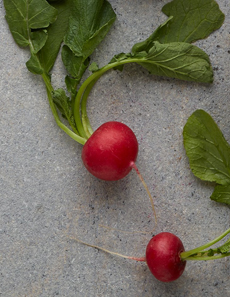
  • Radishes: Most of us know the red skin with white flesh, but look for black radishes (black or brown skin, white flesh), candy stripe radishes (red skin, red and white striped flesh), Easter radishes (orange, pink, purple or white or white skin, white flesh), green radishes (skin and flesh), purple radishes (purple skin, purple and white center), watermelon radishes (green flesh, green flesh with a rosy center)(photo #6).
  • Red leaf lettuce: There are quite a few varieties of red lettuce. Two of our favorites for “prettiest” are red fire lettuce (scroll past the green lettuce) and the beautifully spotted freckles lettuce.
  • Romanesco: Also called Romanesque cauliflower, Romanesco broccoli and Romanesque cabbage, there’s a reason for the different names. Professional plant taxonomists can’t decide precisely where this exotic beauty belongs. A natural vegetable first discovered in Italy, it is one of the most beautiful vegetables imaginable (photo #3, plus a closer look here).
  • Sweet Potatoes: The skin of sweet potatoes can be brown, purple, red, white, or yellow; and the flesh can be orange, purple, white or yellow.
  • Sweet Red Corn: Look for it during the summer corn season. (Photo.)
  • Swiss Chard: Long familiar in green with red accents, check farmers markets to find it in vivid orange, pink, purple, yellow and white. (Photo.)
  • Tomatoes: Anyone who has visited a farmers market has seen the lush colors beyond red: brown, green, orange, purple, striped, yellow, white. While they’re summer produce, you can find mixed color cherry tomatoes year-round.
  •  
    Isn’t nature grand?


    Comments off

    The Nibble Webzine Of Food Adventures


    © Copyright 2005-2026 Lifestyle Direct, Inc. All rights reserved. All images are copyrighted to their respective owners.