THE NIBBLE BLOG: Products, Recipes & Trends In Specialty Foods


Also visit our main website, TheNibble.com.

Julia Child’s Tuna Salad Recipe For National Sandwich Month

August is National Sandwich Month. While we’ve published many delicious sandwich recipes, we’d like to share a variation on the classic tuna salad sandwich.

It’s not just any variation: It’s Julia Child’s recipe.

Cookbook author Dorie Greenspan published the recipe in The New York Times last year, sharing that it was one of Julia Child’s lunchtime favorites.

Since Julia was on the road much of the time, being fed rich foods, when she returned home she preferred simple foods.

Here’s Dorie’s charming story.

And a charming fact: Julia Child’s birthday August 15th, right in the middle of National Sandwich Month.
 
 
MAKE JULIA’S TUNA SALAD SANDWICH

Here’s Julia’s recipe as adapted by Dorie Greenspan.

For her tuna salad, Julia required:

  • Tuna packed in oil.
  • Hellmann’s mayonnaise.
  • Mix-ins such as capers, chopped celery, cornichons, chopped Vidalia onion, herbs (chives, parsley), squeeze of lemon juice.
  • Salt and freshly-ground pepper, preferably white*.
  • Garnishes: butterhead† lettuce (soft lettuce), tomato slice, onion slice (preferably Vidalia)
  •  
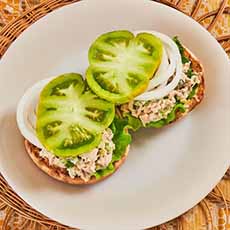
    Julia would serve the sandwich on white bread, or open-face on a Bays English muffin (photo #2).

    This tuna salad recipe is great with us. Not to challenge an icon, but personally:

  • We might add an element of sweetness, substituting sweet gherkins for the cornichons.
  • We’d serve the tuna salad on rye or seeded toast.
  •  
    Of course, you don’t need to make a sandwich.

  • Consider lettuce cups or a scoop of tuna atop a green salad.
  • For a snack or apéritif, serve the tuna on baguette or ficelle‡ slices, with a glass of wine.
  •  
    What beverage should you serve?

    The beverage that might have been served in Julia’s kitchen with the tuna sandwich was not recorded in the article. But we’d go for an iced tea.

    A squeeze of lemon or lime would not only brighten the tea, but also the tuna flavors.
     
     
    > CREATIVE SANDWICHES WITH GLOBAL INFLUENCES (SERVED ON AREPA, BAO, DOSA, ROTI & MORE)
     
     
    > THE HISTORY OF THE SANDWICH
     
     
    > THE DIFFERENT TYPES OF SANDWICHES
     
    ________________
     
    *In French cooking, white pepper is used to season light-colored food. The idea is to avoid black specks on the food. Today, rules are more relaxed—and most people enjoy the black specks, or don’t notice them.

    †Butterhead is a soft leaf lettuce, such as bibb or Boston. The different types of lettuce.

    ‡Ficelle is a long loaf that’s thinner than a baguette—1″ to 2″ wide. The word is French for “string.”


    [1] An adaption of Julia Child’s signature tuna salad sandwich. Here’s the recipe from Dorie Greenspan and The New York Times (photo Heami Lee © New York Times, Food Stylist Maggie Ruggiero, Prop Stylist: Rebecca Bartoshesky).


    [2] Use tuna in oil, preferably olive oil. The oil makes the tuna more flavorful (photo © Vital Choice).


    [3] Bay’s was Julia’s English muffin of choice (photo © Bays).

    Jar Of Capers
    [4] Capers are a great garnish for so many dishes. Capers are the flower bud of the plant; the larger caperberries are the fruit with seeds inside. Both are brined before jarring, and thus contribute tangy saltiness as well as flavor to dishes (photo © Good Eggs).


    Comments off

    Hatch Pepper Gift: A Cookbook & Gift Box Of Hatch Chile Foods

    A Basket Of Fresh Hatch Chiles
    [1] Hatch chiles have a short growing season: just August and September (all photos except #2 © Melissa’s Produce).

    Mild Red Hatch Chiles
    [2] Dried hatch chiles (photo © Otis Acres Micro Farm.


    [3] Once dried, you can enjoy Hatch chiles year-round. This Hatch-At-Home box from Melissa’s has everything from seasonings and salsa to polenta and popcorn.


    [4] For an even more special gift, send the new Hatch cookbook along with the Hatch-At-Home box.


    Hatch chiles from New Mexico are one of the most prized chiles of the southwestern U.S. There are both mild and hot varieties of these meaty fleshed chiles. The chiles are named after their original growing area of Hatch, New Mexico in the Mesilla Valley, just north of Las Cruces. The valley, which stretches along the Rio Grande’s southernmost bend before crossing into Texas and Mexico, is covered with row after row of green, leafy Hatch chile plants for most of the summer.

    Chefs say that the intense sunlight, hot days and cool nights in the valley result in a uniquely flavored chile.

    The harvest season is August through early September, but depending on weather conditions, the harvest can begin as early as July and finish in early October.

    Every September, after the harvest, there are Hatch chile festivals. In towns throughout New Mexico, the aroma of roasted chiles fills the air, along with the sounds of the Hatch chiles popping and crackling as they roast in propane-powered roasters.

    Here’s how to roast Hatch chiles over an open flame on a grill or a gas stove, or under the broiler.

    The difference between red and green versions is that green chiles (photo #1) are left on the vine longer until they turn red (photo #2).

    Green chiles have a brighter, zestier flavor while red chiles have a deeper, richer flavor. (It’s the same with bell peppers, which are members are the same family (Solanaceae) and genus (Capsicum).

    Heat lovers note: Unlike fresh chile peppers, dried chiles do not lose heat, taste, flavor or aroma when cooked.

    > Check out the different types of chiles.
     
     
    HAVE A HATCH CHILE FESTIVAL AT HOME

    You don’t have to head to New Mexico for a Hatch chile festival. Have one at home, with this bounty of Hatch products from Melissa’s (photo #3).

    The Hatch-at-Home box heats things with everything you need for a Hatch food adventure.

  • Hatch Pepper Salsa
  • Hatch Pepper Shaker, both Green Mild and Red Hot (use the shakers to add flavor and heat from breakfast to desserts)
  • Hatch Pepper Shaker (Green Mild)
  • Hatch Pepper Popcorn and Kettle Corn
  • Hatch Pepper Seasoning
  • Hatch Pepper Pecans, both green and red chile versions
  • Hatch Pepper Polenta (slice and pile high with savory toppings as an appetizer, or as a side topped with roasted vegetables)
  • Hatch Pepper Clean Snax
  • Dried Hot Hatch Peppers (the dried versions impart a deeper, richer flavor to your recipes)
  •  
    Get a box for yourself, send one for a gift. Order the Hatch-At-Home box here.

    Discover more wonderful fruits and vegetables at Melissas.com.
     
     
    HATCH PEPPER COOKBOOK

    Discover delicious ways to use Hatch chiles in chile, chicken recipes, dips, sandwiches, sauces, soups, stews, Southwestern and Tex-Mex cuisine (photo #4).

    Try delicious and fun recipes like Sweet, Smoky & Spicy Party Nuts, Sweet Potato Bread with Hatch Pepper Compound Butter, Lobster Mac & Cheese with Hatch Peppers, Grilled Surf & Turf with Kale Sprout Slaw, and Hatch Pepper Pecan & Vanilla Bean Ice Cream (how can you resist the latter?).

    You can purchase the hardbound cookbook, or download a PDF.
     
     
    WINE PAIRINGS

    Melissa’s recommends a Viognier(vee-own-YAY) with Hatch recipes. The white wine grape, best-known in France, is planted in California, Oregon, Texas, Virginia and Washington (see the *footnote for details).

    Viognier’s floral aromatics and notes of juicy stone fruits pair perfectly with the kick of Hatch spice.

    You can also uncork a Chardonnay, Riesling or Sauvignon Blanc.

    And that’s your own Hatch chile festival!


    WHAT’S THE DIFFERENCE BETWEEN CHILES & PEPPERS OR CHILE PEPPERS?

    The original name, chile, comes from the Aztec language of the New World (chilli). When Columbus’ crew first tasted chiles, in the Caribbean, the heat and pungency reminded them of black pepper. They referred to the chiles as peppers or chile peppers.

    But black pepper is a completely unrelated genus; the fruits (yes, chiles are fruits) should be called chiles (the Spanish transcription) or chilies.

    But after 500 years, it’s tough to change the record.

    ________________

    *On the nose, Viognier wines can also be very herbal, with aromas of chamomile, lavender, thyme and even a hint of pine. In aged examples and sweeter styles, this potentially overpowering herbal profile is softened by honeyed notes. The variety is not well known because it is difficult to cultivate; it is extremely prone to powdery mildew and is known for both low and unpredictable yields. Viognier is cultivated in Argentina, Australia, Chile, France, Italy, Japan, New Zealand, South Africa, Spain, Switzerland the U.S. [source]. The origin of the Viognier grape is unknown, possibly originating in Dalmatia (present-day Croatia) and then brought to France’s Rhône Valley by the Romans [source].


    Comments off

    Korean Hot Dog Recipe (A.K.A. Korean Corn Dogs)

    This summer we were introduced to K-Dogs, at a store in Manhattan’s Chinatown. Known as Korean hot dogs or corn dogs*, they are typically made of hot dogs (also called sausages†) or mozzarella cheese (or a combination of both), placed on sticks, dipped in yeasted batter and coated with panko breadcrumbs.

    Then, they’re then deep-fried until they’re crisp and golden brown, dusted with sugar, and drizzled with ketchup, mustard, mayo, or all three.

    The result: sweet, salty, and completely delicious. They’ve become a craze in Korea, quickly becoming one of the most popular street foods.

    And shops are opening across the U.S., too; from San Diego across to New York.

    There’s a recipe to make your own Korean Hot Dogs below.
     
     
    HAVE IT YOUR WAY

  • A popular variation is the gamja hot dog (gamja means potato or French fries), where the dog is covered with french fries bits as well as the other coatings (photos #1 and #2).
  • The mozzarella dog is made with a thick mozzarella stick instead of a dog. If you like gooey, stretchy cheese, this one’s for you. You can combine mozzarella and dog on one stick (photo #3). Or, wrap cheddar around the meat, so it oozes out as you bite into the crispy-coated dog.
  • Looking for something else? How about trading the dog for Spam, rice cake, fish cake, or squid?
  • Want a change from panko or fries? Get crispy rice noodles or ramen noodles.
  •  
     
    KOREAN DOGS IN THE U.S.

    With shops popping up nationwide, we’re fortunate to have one in our own town. Oh! K-Dog is a small chain with locations in Arkansas, Georgia, New York City, and Texas (and coming soon to Connecticut, Illinois, and New Jersey).

    There are lots of options, from the variations described above to a greater range of toppings and seasonings. Top your dog with:

  • Cheese Mustard (a creamier version of honey mustard)
  • Garlic Sauce
  • Gochu Hot Sauce
  • Honey Mustard
  • Ketchup
  • Sugar
  • Sweet Chilli
  •  
    Then, season your topping with:

  • Coconut
  • Honey Butter
  • Onion Sprinkle
  • Parmesan Cheese
  • Snowing (an herby cheddar cheese sprinkle)
  •  
    The company says that its most popular sauce combination is mix of ketchup, sweet chili, cheese mustard, and a sprinkle of honey butter.

    The runner-up in popularity is spicy gochu sauce and garlic sauce with an onion sprinkle.

    And, quite a few customers like it with the sugar coating, which is the traditional Korean way.
    Ready to make your own?
     

    RECIPE: KOREAN HOT DOGS (CORN DOGS)

    We found two great recipes online, both with tips to create the perfect Korean hot dog.

    Start with this recipe from Foxy Folksy.

    You can use any type of hot dog or sausage: beef, chicken, pork, veggie.


    [1] Korean hot dogs: classic, with ketchup and mustard, or covered with french-fried potato bits (photos #1, #3 and #4 © OH! K-Dog | NYC).


    [2] Homemade Korean hot dogs, a.k.a. corn dogs. Here’s the recipe from Foxy Folksy (photo © Foxy Folksy).


    [3] Mozzarella can be combined with a hot dog (shown before and after battering and frying).


    [4] Party time!

     
    While Koreans like hot and spicy food—and Americans have adopted gochujang Korean chili sauce—we didn’t find heat options in the recipes we found, or in the restaurants, either.

    So feel free to add heat:

  • Gochujang or sriracha hot sauce
  • Hot mustard (e.g. Chinese mustard)
  • Minced jalapeño or other chili pepper
  • Spicy ketchup (add hot sauce to regular ketchup)
  • Sprinkle of Aleppo pepper, cayenne, crushed chili flakes, or wasabi
  •  
    Here are more corn dog tips from I Am A Food Blog.

    July is National Hot Dog Month, and July 21st is National Hot Dog Day.

    You’ve got plenty of time to plan for a K-dog party next year (photo #4).
     
    ________________

    *They’re called corn dogs in Korea, only because they’re battered and fried on a stick like American corn dogs. However, American corn dogs are battered in a cornmeal batter—hence the name. Korean corn dogs are battered in a yeasted dough or a rice flour batter.

    †Hot dogs are a type of sausage. You can use a classic American frank or a thicker sausage.


    CHECK OUT WHAT’S HAPPENING ON OUR HOME PAGE, THENIBBLE.COM.


    Comments off


    © Copyright 2005-2026 Lifestyle Direct, Inc. All rights reserved. All images are copyrighted to their respective owners.