THE NIBBLE BLOG: Products, Recipes & Trends In Specialty Foods


Also visit our main website, TheNibble.com.

Greek Chicken Wings & More Wing Recipes For National Chicken Wing Day

Updated July 2026

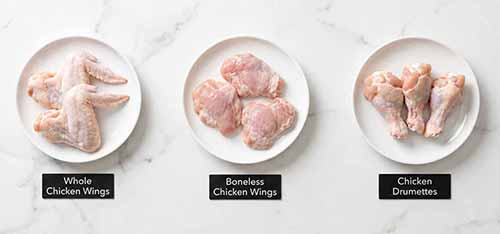
July 29th is National Chicken Wing Day. America loves its chicken wings, but there’s a debate over what types are best: bone-in vs. boneless and drumettes vs. the wingettes/flats*.

RTA Outdoor Living, maker of custom prefabricated outdoor kitchens and cooking appliances, has released the results of a new study that reveals what Americans really feel about chicken wings, hot dogs, BBQing, pizza, and more (here’s the full survey).

The highlights for National Chicken Wing Day:

  • Boneless wings are more popular than bone-in wings, with 63.4% of respondents choosing boneless.
  • Drumettes are the winner, with 2 in 3 respondents preferring them. They’re tje thick, meaty section closest to the bird’s body, named because it looks like a miniature chicken leg or drumstick.
  •  
    Whole Chicken Wings, Boneless Chicken Wings, & Drumettes
    [8] Boneless chicken wings are the easiest to eat (photo: The Nibble).
     

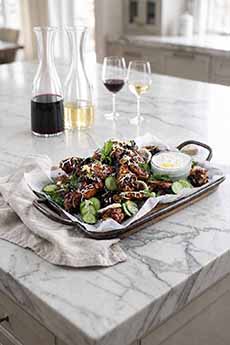
    Now how about some chicken wings? Here’s something a bit different from Smithfield Culinary: Greek-style wings (photo #1).

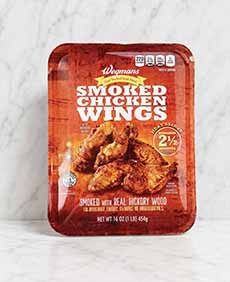
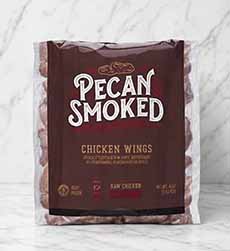
    This recipe is easier than it looks because you purchase pre-smoked, pre-cooked chicken wings (photos #2 and #3, for example).

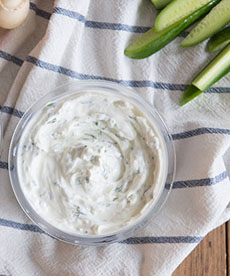
    You could also purchase the tzatziki (yogurt-cucumber dip), but the homemade version below is far superior.

    Just note that you have to drain the yogurt for the tzatziki sauce overnight. Opa*!

    Below:

    > Smokin’ Greek chicken wings recipe.

    > 14 more chicken wing recipes.

    Elsewhere on The Nibble:

    > The year’s 40 chicken holidays.

    > The year’s 16 Greek food holidays.

    > The different types of chicken and chicken cuts: a photo glossary.

    > The history of chicken.

    > The history of chicken nuggets.
     
     
    RECIPE: SMOKIN’ GREEK CHICKEN WINGS

    Ingredients For 4-6 Servings
     
    For The Greek Dry Rub Spice Mix

  • 1 teaspoon dried parsley
  • 1 teaspoon rosemary
  • 1 teaspoon thyme
  • 1 teaspoon marjoram
  • 1 teaspoon basil
  • 1 teaspoon dill
  • 1 teaspoon cinnamon
  • 1 teaspoon nutmeg
  • 2 teaspoons granulated garlic
  • 2 teaspoons dried oregano
  •  
    For The Tzatziki Sauce

    You can purchase ready-made tzatziki‡ (tuh-ZEE-kee) or make your own fresh tzatziki.

  • 2 cups Greek yogurt (strained overnight)
  • 4 garlic cloves, grated or puréed
  • ¼ cup chopped fresh mint leaves
  • ¼ cup fresh dill
  • 2 lemons, zested and juiced
  • 1 grated English cucumber
  • Salt and pepper to taste
  • Optional heat: chopped jalapeño
  •  
    For The Chicken Wings

  • 2 dozen smoked chicken wings
  • 4 tablespoons extra virgin olive oil
  • 2 lemons, zested and juiced
  • 1 tablespoon puréed or grated garlic
  • Salt and pepper to taste
  • 3 tablespoons Greek dry rub spice mix
  •  
    For The Garnish

  • Dill, snipped
  • Mint leaves, torn or snipped
  • Feta cheese, crumbled
  • Lemon wedges
  • Cucumber wheels
  •  
    Preparation

    1. MAKE the spice mix. Stir all of the ingredients in a bowl until thoroughly incorporated. Set aside.

    2. MAKE the tzatziki sauce, mix all ingredients thoroughly until incorporated. Set aside (or make in advance and chill in the fridge).

    3. MAKE the wings. If frozen, thaw completely. Preheat the oven to 375°F.

    4. COAT the wings in the mix of olive oil, lemon juice, zest, and garlic. Season with salt and pepper to taste, then coat with the Greek dry spice rub.

    5. PLACE the wings in a baking dish and heat in the oven until they are golden brown and heated through (see package instructions). Meanwhile:

    6. REMOVE the wings from the oven briefly and lightly toss them with 1 cup of tzatziki sauce. Return to the oven and bake until edges become slightly charred.

    7. TO SERVE: Top with the herbs and feta. Serve with the remaining tzatziki on the side.
     
     
    MORE CHICKEN WING RECIPES

  • Buffalo Brussels Sprouts
  • Buffalo Chicken Grilled Cheese Sandwich
  • Buffalo Chicken Meatballs
  • Buffalo Chicken Nuggets
  • Buffalo Chicken Steamed Dumplings
  • Buffalo Wing Pizza
  • Cauliflower Buffalo Wings
  • Classic Buffalo Wings Recipe
  • Cocoa-Habanero Wings: A Mexican Touch
  • Deconstructed Buffalo Wings
  • Ginger-Orange Asian Chicken Wings
  • Honey Sriracha Wings
  • Low-Calorie Buffalo Chicken Parfait
  •  

    A Platter Of Greek Chicken Wings
    [1] Smokin’ Greek chicken wings—the wings are purchased already smoked. The recipe is below (photo: The Nibble).

    A Package Of Wegman's Smoked Chicken Wings
    [2] Wegman’s smoked chicken wings are ready to heat and eat (photo: The Nibble).

    A Package Of Wal-Mart Smoked Chicken Wings
    [3] Walmart and other stores also sell cooked chicken wings. Here, Walmart’s pecan-smoked chicken wings (photo: The Nibble).

    Tzatziki Yogurt Cucumber Sauce
    [4] Tzatziki, a refreshing cucumber-yogurt dip and sauce (photo © Cava Grill).

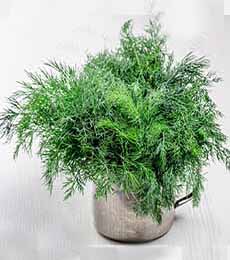
    Pot Of Fresh Dill
    [5] Fresh dill (photo Wuestenigel | CC-BY-2.0 License).

    Bunch Of Fresh Spearmint
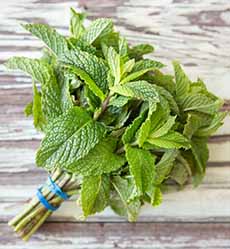
    [6] Fresh mint (photo © Good Eggs).

    Sheep's Milk Feta Cheese
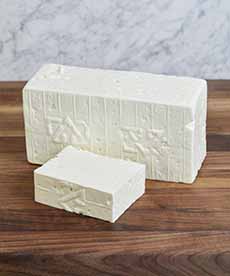
    [7] Beautiful Essex sheep’s milk feta cheese from De Laurenti, from sheep that graze on the Isle of Lesbos (photo © DeLaurenti).

     
    ________________

    *Drumettes are the portion of the wing that’s attached to the main part of the chicken. It’s shaped like the larger chicken drumstick, hence the name. There’s one main piece of bone in the middle, but there are some joints and cartilage on both ends. The wingette or flat is the middle part of the wing. The shape is flat with two thin bones that run parallel to each other down the length of the flat. It has tender dark meat and is completely covered with skin. Here’s a larger discussion of these.

    In Greek culture, opa! is the expression that sometimes accompanied the traditional act of plate smashing. However, it’s also used to express enthusiasm in general: No dishware need be sacrificed. Here’s more on the Greek custom of smashing plates.

    The word tzatziki comes from the modern Greek τζατζίκι, which itself is a borrowing of the Ottoman Turkish word cacık. The Turkish term traces its roots to the Persian word zhazh—meaning various herbs—combined with a diminutive suffix, and shares a linguistic cousin with the Armenian word cacıg.


    CHECK OUT WHAT’S HAPPENING ON OUR HOME PAGE, THENIBBLE.COM.


    Comments off

    Lasagna Recipes Including Gluten-Free For National Lasagna Day

    Lasagna
    [1] This Indian-accented lasagna is gluten-free. The recipe is below (photo © Urban Accents).

    Eggplant Parmigiana Lasagna Recipe
    [2] Eggplant Parmigiana Lasagna combines two favorites. Here’s the recipe (photo © DeLallo).

    Lasagna Soup Recipe
    [3] Something different: lasagna soup! Here’s the recipe (photo © Wisconsin Dairy).

    Ravioli Lasagna
    [4] Ravioli lasagna, a great hack, is the easiest way to make a lasagna. Here’s the recipe (photo © The Nibble).

    Pumpkin Lasagna
    [5] Who needs a lasagna pan? This recipe is made in a Dutch Oven (photo © Williams Sonoma).

    Bottle Of Urban Accents Punjab Red Tandoori Spice Blend
    [6] Urban Accents’ tandoori spice blend combines 19 herbs and spices (photo © The Nibble).


    Updated July 2026

    A hot summer day doesn’t seem like prime time for lasagna, but July 29th is, in fact, National Lasagna Day, and the next celebration isn’t until October, National Pasta Month.

    Our featured recipe today is an Indian-style lasagna that’s gluten-free and noodle-free, giving this popular comfort food gets a new twist.

    The dish dates back to Roman times, although Roman lasagna was not the classic style we know today, with layered noodles, cheese, and tomato sauce.

    Among other reasons, that’s because the Romans did not have tomatoes, which originated in Peru (as cherry tomatoes) and were brought to Europe by the Spanish Conquistadors in the 16th century. They were enjoyed as houseplants until the 18th century!

    Below:

    > Fusion food: Indian-style lasagna, gluten free.

    > Homemade tandoori spice blend.

    > 17 more lasagna recipes, including more gluten-free options.

    Elsewhere on The Nibble:

    > The history of lasagna.

    > The history of pasta.

    > The different types of pasta: a photo glossary.

    > The year’s 20 pasta holidays.
     
     
    RECIPE #1: INDIAN-STYLE LASAGNA, GLUTEN FREE

    Lasagna is an Italian dish made from noodles, but the recipe has been reinvented many times over with gluten-free options. This recipe, an Italian-Indian flavor fusion, uses thin layers of mashed potatoes instead of noodles.

    To accent the Indian style, the recipe switches out the Italian Bolognese sauce—ground beef and oregano for a spicy ground lamb sauce (photo #1).

    The recipe, from Urban Accents, uses their Punjab Red Tandoori Spice Blend (photo #6).

    This medium-heat Indian seasoning blend combines paprika, turmeric, ginger, and some 16 other spices and herbs. It adds “just the right amount of Indian-style heat” to chicken, lamb, marinades, rice, seafood, turkey, and vegetable dishes.

    Prep time is 20 minutes, cook time is 90 minutes, total time 110 minutes.
     
    Ingredients For 10 Servings

  • 2 tablespoons extra virgin olive oil
  • 1 medium onion, minced
  • 2 pounds ground lamb (substitute with ground beef or turkey)
  • 2-1/2 teaspoons salt, divided
  • 1 teaspoon black pepper, freshly grated
  • 1 cup chopped parsley
  • 3 cans (14.5 ounces) tomato sauce
  • 3-1/2 teaspoons Urban Accents Punjab Red Tandoori Spice Blend* or the recipe below.
  • 2 tablespoons lemon juice
  • Zest of one lemon
  • 1-1/2 pounds Yukon gold potatoes, peeled & thinly sliced
  • 1/2 pound ricotta salata cheese
  •  
    Preparation

    1. PREHEAT the oven to 375°F. Lightly oil a 9″ x 13″ baking dish.

    2. MAKE the filling. Heat the olive oil in a large skillet over med-high heat and sauté the onion until translucent.

    3. ADD the lamb, 1 teaspoon salt, and 1 teaspoon pepper. Cook until the lamb is browned and cooked through. Stir in the parsley and set aside to cool.

    4. MAKE the sauce. In a medium saucepan, over low heat, combine the tomato sauce and Punjab Red Tandoori spice. Simmer for 5 minutes. Take off the heat and add 1-1/2 teaspoons of salt, the lemon juice, and lemon zest.

    5. ASSEMBLE. Spread a thin layer of sauce on the bottom of the baking dish. Place a layer of potatoes on top of the sauce, using half of the potatoes. Spread half of the meat mixture; then half of the remaining sauce.

    6. REPEAT, layering the potatoes, meat mixture, and sauce. Spread the cheese on top; cover and bake for 50 to 60 minutes. Uncover and bake for an additional 10-15 minutes to brown the top. Allow to rest before slicing.
     
     
    RECIPE #2: TANDOORI-STYLE SPICE BLEND

    While Urban Accents’ spice blend has 19 ingredients, here’s a simpler recipe if you want to make do with what you already have.

    Ingredients For 1 Tablespoon

  • 1½ teaspoon paprika (use smoked paprika if you want more “tandoor oven” char flavor)
  • ¾ teaspoon ground ginger
  • ½ teaspoon garlic powder (or dehydrated garlic)
  • ½ teaspoon ground coriander
  • ½ teaspoon ground cumin
  • ¼ teaspoon turmeric
  • ¼ teaspoon cayenne pepper (adjust based on your heat preference)
  • A pinch of garam masala or a pinch each of cardamom, cinnamon, cloves, and nutmeg
  • ½ teaspoon salt or to taste
  • Optional: A small squeeze of fresh lime juice or a pinch of citric acid†
  •  
     
    Tandoori Spice Blend
    [7] Blend your own. Top row: paprika, ground ginger, garlic powder. Middle row: ground coriander, turmeric, cayenne, ground cumin. Bottom row: warm spices (cinnamon, cardamom, cloves, and nutmeg), coarse sea salt (photo © The Nibble).


    18 MORE LASAGNA RECIPES
  • Asparagus & Pesto Lasagna
  • Butternut Squash & Pumpkin Lasagna
  • Dessert Lasagna
  • Dutch Oven Pumpkin Lasagna
  • Eggplant Parm Lasagna
  • Indian-style Lasagna)
  • Lasagna Hack: A Pasta Bake With Chicken Parm
  • Lasagna Soup
  • Mexican Chicken Lasagna
  • Pasta Al Forno: Lasagna Made With Ziti
  • Polenta & Pesto Lasagna, Gluten Free
  • Pumpkin Lasagna With Ricotta & Swiss Chard
  • Pumpkin & Mushroom Lasagna
  • Ravioli Lasagna
  • Ravioli Lasagna With Pumpkin Sauce
  • Rice Pesto Lasagna, Gluten Free
  • Scamorza Cheese & Porcini Lasagna
  • Spinach Lasagna
  •  
     
    ________________

    *There are many different Indian spice blends. You can substitute curry powder or garam masala, both of which are composed of numerous spices. You can look for recipes online, or simply pull ground spices from your pantry: black pepper or cayenne, coriander, cumin, dry mustard, fenugreek, garam masala, garlic, ginger, mint, paprika, salt, tumeric, etc. Now you see how the Urban Accents Punjab Red Tandoori Spice is a blend of 19 different spices!

    The Urban Accents blend includes citric acid for tang.


    CHECK OUT WHAT’S HAPPENING ON OUR HOME PAGE, THENIBBLE.COM.


    Comments off

    Scattered California Roll, California Roll Chirashi Sushi

    This Scattered California Roll comes under the category of “Why didn’t we think of this?” But we’re thankful that Grace Parisi came up with the idea (there’s more about Grace below).

    This recipe is in the chirashi sushi category. The name means “scattered sushi” in Japanese, and it’s the easiest sushi to make because, rather than rolling everything nice and tidy in a sheet of seaweed (it takes both practice and seaweed), the ingredients are scattered atop a bowl of rice.

    Grace combined the idea with grain bowls, and you can substitute your grain of choice for the rice.

    Wine pairing: The flavors of toasted sesame seeds, seasoned sushi rice, and sweet crab pair well with a crisp, aromatic Austrian Riesling.

    > Check out the different types of sushi and sashimi in our Sushi Glossary.

    > The history of sushi.

    > The history of the California Roll is below.

    > The original California Roll history.
     
     
    RECIPE: CHIRASHI SUSHI “CALIFORNIA ROLL” a.k.a. SCATTERED CALIFORNIA ROLL

    This recipe is made with fresh Dungeness crab meat, but if you can’t get it, substitute one whole bairdi crab cluster (1 body, 4 legs, 1 claw), a type of snow crab.

    Other options: canned lump crab meat or crab stick (the different types of crab meat).

    Prep time is 30 minutes.
     
    Ingredients For 4 Servings

  • ¼ cup unseasoned rice vinegar, divided
  • 1½ teaspoons sugar
  • Kosher salt
  • 1½ cups Japanese or sushi rice, rinsed and drained (or substitute)
  • 2 Dungeness crab clusters (2 bodies, 8 legs, 2 claws), thawed
  • 2 tablespoons soy sauce
  • 4 teaspoons vegetable oil
  • 1 tablespoon finely chopped pickled ginger†
  • 1 to 2 teaspoons wasabi paste, depending on heat preference
  • 4 radishes, cut into fine matchsticks
  • 2 scallions, cut into 1-inch matchsticks
  • 2 Persian cucumbers, thinly sliced
  • 1 ripe avocado, thinly sliced (optional)
  • 1 tablespoon toasted sesame seeds
  • 1 8-by-7½-inch sheet of nori (Japanese seaweed), finely shredded
  •  
    Preparation

    1. MAKE the rice. In a small bowl, combine 2 tablespoons of the rice vinegar with the sugar and ½ teaspoon salt, stirring until dissolved. Set aside.

    2. COMBINE the rice with 2 cups of water in a medium saucepan, and bring to a boil over high heat, Reduce the heat to low, cover, and cook until the liquid is absorbed, about 15 minutes. Let the pot sit off the heat, covered, for 10 minutes.

    3. SPREAD the rice in a large shallow bowl or on a baking sheet and toss with the reserved sweetened vinegar. Refrigerate briefly until cool. Meanwhile…

    4. STEAM the crab. Fill a large skillet with 1 inch of water and bring to a boil over high heat. Add the crab, cover, and steam for 2 to 3 minutes, until just heated through. Remove the meat and break it into 1-inch pieces. You can save shells for stock (stick them in the freezer for future use).

    5. PREPARE the dressing. In a small bowl, combine 2 tablespoons of rice vinegar with the soy sauce, oil, ginger, and wasabi paste. Season with salt.

    6. ASSEMBLE AND SERVE. Add the radishes, scallions, and cucumbers to the rice, pour the dressing over them, and toss gently to combine. Fold in the crab and spoon the mixture into bowls. Garnish with the avocado, sesame seeds, and shredded nori just before serving.

    You can wrap any leftover crab, rice, and avocado in green leaf or butter lettuce leaves for a light lunch or snack.
     
     
    THE HISTORY OF THE CALIFORNIA ROLL

    The history of the California roll is recent, brief, and contested. A North American invention, there are two different sources for the original California roll.

    One says that it was first made in the 1960s by Ichiro Mashita, a sushi chef who worked at Tokyo Kaikan in Los Angeles’ Little Tokyo. He started to use creamy avocado as a replacement for toro, the creamiest cut of tuna, which wasn’t always available. He combined it in a roll with cucumber and fish cake (the latter two traditional sushi bar ingredients) into a maki (roll) sushi.

    He subsequently substituted real crab for the fish cake, and did something about the fact that some of his American customers were still picking off the unfamiliar nori from the outside of his maki sushi. He decided to make the roll with the rice on the outside to hide the seaweed.

    He is thus credited with inventing the uramaki, a.k.a. reverse roll or inside-out roll. The technique also created a fatter roll (“more for the money?”) [source].

    Also in Los Angeles, Ken Seusa of Kin Jo restaurant on La Cienega Boulevard was experimenting with Western ingredients. And he also began making uramaki with avocado, cucumber and crab. He was given the credit for its invention by Gourmet magazine in 1980, but Mashita-san became viewed as the creation of the precursor.

    We don’t know who made the cost-saving substitution of crab stick/imitation crab/sea leg/surimi‡ (photo #8) for real crab leg.

    And now, the name California roll.

    Hidekazu Tojo, a chef and sushi chef from Osaka, Japan, moved to Vancouver, British Columbia, in 1971. Japanese food had not yet taken off; the city had just four Japanese restaurants at the time.

    Since Canadians (as well as Americans) were not used to consuming raw fish, he tweaked a roll that could be enjoyed by anyone. This included cooked crab (now often substituted by the more affordable crab stick) instead of raw fish.

    The name “California” was bestowed by visitors from Los Angeles, to honor their home state, the continent’s avocado capital.

    Some sources state that Tojo named it in their honor.
     
    The roll was an instant hit and sushi overall became sushi part of the California’s 1970s health food trend.

    Both the California roll and the California roll temaki (hand roll), where the ingredients are wrapped in a cone of nori (dried seaweed), became popular among both fans and non-consumers of raw fish.
     
     
    Variations

    The wildly-popular roll continues to evolve. Variations include spicy California roll, mango California roll, and a garnish of sesame and/or roe on the outside (photos #6 and #7).

    Not to mention crunchy California roll, deep fried with eel sauce, and crispy California roll that contains fried tempura flakes.

    It is also made with crab salad (authentic or imitation).

    Tojo is also credited with the invention of the B.C. (for British Columbia) roll, an uramaki of cooked salmon in a sweetened barbecue sauce, and cucumber. There are variations of this roll that include barbecued salmon skin with mayonnaise [source].


    Chirashi Sushi California Roll Bowl Recipe
    [1] California roll ingredients turned into chirashi sushi (photo © Sitka Salmon Shares).

    Whole Dungeness Crab On Ice
    [2] Dungeness crab (photo © Good Eggs).

    Bottle Of Nakano Rice Vinegar
    [3] Rice vinegar is available seasoned and unseaoned. For this recipe, you need unseasoned. (photo © Nakano Rice Vinegar).

    A Bowl Of Japanese Rice With Chopsticks
    [4] A bowl of Japanese rice (photo © Mgg Vitchakorn | Unsplash).

    California Roll Uramaki (Reverse Roll)
    [6] A classic California Roll uramaki, or reverse roll, with the rice on the outside, garnished with sesame seeds (photo © Umami Information Center).

    California Roll With Masago
    [7] Subsequent variations include substituting masago (capelin roe) or tobiko (flying fish roe) for the sesame seeds, or using a combination of both.

    Surimi, a.k.a. imitation crab, crab stick, and sea leg.
    [8] Surimi, a.k.a. crab stick, crab leg, sea leg, and imitation crab (photo © Fresh Direct).


    WHAT IS JAPANESE RICE? WHAT IS SUSHI RICE?

    Japanese rice, the rice served at every Japanese meal, is a cultivar of Japonica (a.k.a. sinica) rice. It is one of the two major domestic types of Asian rice varieties*.

    The plump, short grains have a characteristic sticky, firm texture and are slightly sweet. When cooked, they are sticky enough to easily be picked up with chopsticks. (Here’s more about Japanese rice.)

    Sushi rice is made by seasoning this Japanese short-grain rice with a mixture of rice vinegar (a mild form of vinegar), sugar, salt, and often kombu (kelp). These seasonings impart a balance of sweet, salty, and sour taste flavors that pair so well with the raw fish.

    The term sushi means vinegared rice: su = vinegar, shi = rice.
     
     
    THANKS TO SITKA SALMON SHARES & GRACE PARISI

    Sitka Salmon Shares’ Culinary Director Grace Parisi is a cook, writer and cookbook author. Formerly the Senior Test Kitchen Editor at Food & Wine Magazine and Executive Food Director at TimeInc Books, her work has appeared in Cooking Light, Health, O Magazine, Epicurious, Fitness, Today, Serious Eats, Martha Stewart, and many more. She’s the author of more than 6 books, among them The Portlandia Cookbook and Get Saucy, which was nominated for a James Beard award for Best Single Subject Cookbook.
     
     
    ________________

    *Japonica rice is extensively cultivated and consumed in East Asia, whereas in most other regions of Asia, indica rice is the dominant type of rice. Here’s the difference between the two.

    In California, rice production is dominated by short and medium-grain japonica varieties, including cultivars developed for the local climate, such as Calrose.

    A cultivar is a type of plant that people have bred for desired traits (selective breeding). Many cultivars of rice are grown worldwide. The two major subspecies (indica and japonica) have more than 40,000 varieties. Here’s a small list of them.

    Pickled ginger recipe: If you can’t find pickled ginger in the Asian products aisle of your supermarket or a local Asian grocer, make your own. Use 1 teaspoon each grated fresh ginger, rice vinegar, and sugar. Allow the flavors to meld for an hour or more.

    Surimi was created in Japan in the 12th century. Chefs would grind and salt leftover fish as a means of preserving their extra catch. In the 1960s, a Japanese chemist discovered that by adding sugar to the traditional surimi-making process, he could stabilize the product, freeze it, and preserve its shelf life. Here’s more about surimi.


    CHECK OUT WHAT’S HAPPENING ON OUR HOME PAGE, THENIBBLE.COM.


    Comments off


    © Copyright 2005-2026 Lifestyle Direct, Inc. All rights reserved. All images are copyrighted to their respective owners.