|
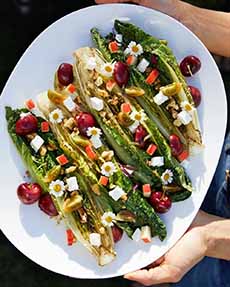
[1] Grilled romaine hearts with apples, cherries, walnuts, and feta cheese (photos #1 and #2 © Envy Apples).

[2] An Envy apple.
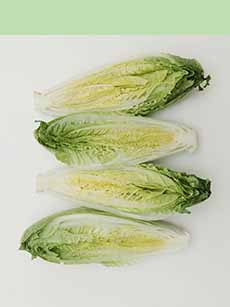
[3] It’s easy to grill hearts of romaine (photo © Hitchcock Farms).
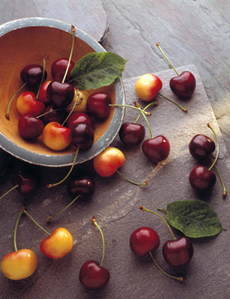
[4] Use fresh pitted cherries. The photo shows are a mixture of Bing and Queen Anne varieties (photo © Washington State Fruit Commission).
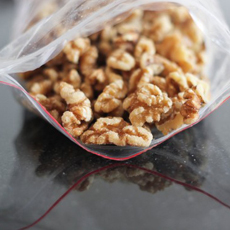
[5] Walnuts are delicious on this salad, but you can substitute pecans (photo © Bake Your Day [now closed]).
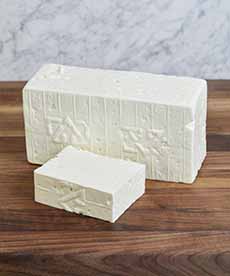
[6] This recipe uses feta, but you can substitute blue cheese or goat cheese (photo © DeLaurenti).
[7] It’s easy to emulsify a vinaigrette by shaking the ingredients in a jar (photo © Colavita).
|
|
When you turn on the grill for burgers, franks, chicken, whatever, how about including a grilled salad (a.k.a. charred salad) into the “whatever?”
Over the long holiday weekend, we had the opportunity to grill romaine, which we enjoy in a grilled Caesar salad. But yesterday, we added fruit and nuts. It was a crowd-pleaser.
The recipe for this sweet and spicy grilled salad was sent to us by Envy apples. Envy is a crossbreed of Braeburn and Royal Gala apples, bred for a sweet flavor and satisfying crunch.
> The history of salad.
> The history of apples.
> The history of romaine is below.
> There are 13 more grilled salad recipes below.
RECIPE #1: GRILLED ROMAINE SALAD
Ingredients For 4 Servings
1 Envy apple or other sweet-tart variety
¼ cup cherries
1 tablespoon butter
¼ cup walnuts or pecans
4 hearts of romaine lettuce, washed
¼ cup feta cheese or substitute (blue, goat)
Honey vinaigrette dressing (recipe below)
Optional garnish: edible flowers
Preparation
1. PREHEAT the grill. Slice the apples into 1-inch cubes and set aside.
2. PIT the cherries, cut them in half and set them aside.
3. SAUTÉ the walnuts in butter until the edges are browned.
4. SLICE the romaine in half lengthwise and place on the grill. Grill romaine until char marks appear.
5. PLACE the romaine on a serving tray and top with the sautéed walnuts, feta cheese, apples, and cherries. Drizzle with vinaigrette. Garnish with optional flowers.
RECIPE #2: HONEY VINAIGRETTE
Ingredients
1/2 cup EVOO
1/4 cup white balsamic or white wine vinegar
1-2 tablespoons honey to taste
2 cloves mincd garlic
1/2 teaspoon each oregano and parsley
Salt and pepper to taste
Preparation
1. COMBINE all ingredients in a jar and shake until blended.
MORE GRILLED SALAD RECIPES
Couscous Salad With Grilled Peaches
Grilled Asparagus & Mushroom Salad
Grilled Belgian Endive
Grilled Caesar Salad
Grilled Endive & Bok Choy
Grilled Green Beans & Grilled Green Beans Salad
Grilled Potato Salad With Bacon, Blue Cheese & Bacon Dressing
Grilled Potato Salad With Bacon, Corn & Jalapeño
Grilled Potato Salad With Hot Dogs
Grilled Radicchio Salad
Grilled Stuffed Avocado Bar
Grilled Stuffed Portabella Mushrooms
Grilled Zucchini With Cumin & Mint
THE HISTORY OF ROMAINE LETTUCE
Romaine (Lactuca sativa L. var. longifolia) is the most upright growing of the four major types of lettuce. It has a cylindrical shape instead of a round head like iceberg or Boston lettuces. The leaves are long and crisp with a distinctive rib down the center.
Romaine has been cultivated and eaten cooked or raw for more than 5,000 years and may very well be the oldest form of cultivated lettuce [source].
It was grown and eaten raw or cooked in China’s early history. Paintings in Egyptian tombs‡ dating from about 4500 B.C.E. show a type of lettuce with long pointed leaves, similar to romaine lettuce.
It was called Cappadocian‡‡ lettuce by the Romans, which led to its being called Roman lettuce. In Italian the translation is lattuga romana and in French laitue romaine, leading to the shortened name “romaine” [source].
In the 14th century, when the popes moved their papal residence from Rome to Avignon, France,† they grew romaine in the palace gardens. It then became known as Avignon lettuce.
When romaine arrived in England, it was called cos lettuce after the Greek island of Cos (also spelled Kos, the birthplace of Hippocrates!), off the coast of Turkey in the Aegean Sea, where the variety was said to have originated*.The first mention of cos lettuce in English dates from the late 17th century [source].
Romaine is also known as Cos lettuce in some parts of the U.S. source.
As with other dark leafy greens, the antioxidants (specifically, carotenoids) contained within romaine lettuce are believed to play roles in blocking the early stages of various cancers [source].
In terms of nutrition, romaine is the most nutritious lettuce. It has the most vitamins, minerals, and antioxidants per serving, delivering more folate, potassium, beta-carotene, and lutein [source].
Romaine is the second most important type of lettuce, iceberg lettuce being the first.
________________
*Other authorities trace cos to the Arabic word for lettuce, khus [source]. Romaine lettuce is commonly used in Middle Eastern cuisine [source].
†French-born Pope Clement V moved the papacy to Avignon in response to an increasingly fractious and political environment in Rome.
‡According to Wikipedia, for 3000 years (from at least 2700 B.C.E.), the lettuce was associated with the ancient Egyptian god of fertility, Min, for its resemblance to the phallus.
‡‡Cappadocia is a region in central Turkey.
|