THE NIBBLE BLOG: Products, Recipes & Trends In Specialty Foods


Also visit our main website, TheNibble.com.

Palate Cleanser: A Way To Refresh Your Taste Buds Between Courses

A palate cleanser is a serving of food or drink typically served between the fish and meat course at a formal dinner and at other food events, such as wine tastings.

The palate, or roof of the mouth, works with the nose and tongue to determine what you taste.

The purpose of the palate cleanser is to cleanse the mouth of the lingering flavors of the prior course, bite, or sip to enable the flavors of the next course to shine through. In essence, the palate cleanser “resets” the taste buds.

A light palate cleanser also gives you a few moments to slow down the consumption of a progression of rich dishes.
 
 
THE HISTORY OF THE PALATE CLEANSER

The concept originated in French fine dining, where a lemon sorbet was often served between the fish and the meat courses. A scoop of sorbet was presented in a footed glass dish or a Champagne sorbet glass (you can use another small wine glass—photo #1—or a juice glass).

While we can’t find the precise origin of palate cleansing, it appears in 19th-century menus for sumptuous, multi-course French meals.

Each region of France had its own specialty—usually a locally produced product such as a shot of Calvados (apple brandy), or a scoop of Calvados sorbet, in Normandy.

Palate cleansers are also known as entremets*, Trou Normand (in Normandy [literally, “a Norman hole”]), Trou Bourguignon (in Burgundy [a Burgundian hole]), and remise en bouche.

While intermezzo is Italian for palate cleanser, not all small dishes served between courses are palate cleansers. For example, an amuse-gueule (“it entertains [the] throat,” in French) or amuse-bouche (the same thing, with bouche being the word for mouth instead of gueule for throat) are creative nibble served before a meal to whet the appetite.

These latter bites emerged as a mini course during the nouvelle cuisine movement, which emphasized smaller, more intensely flavored courses.

They differ from hors d’oeuvres in that they are very small, usually just one or two bites, and offered free of charge.

While sometimes the amuse-bouche could be a rather simple offering—such as a plate of olives or a ramekin of tapenade (remember the relish tray?), it often becomes a showcase of the artistry of the chef

Per the famous chef Jean-Georges Vongerichten, “The amuse-bouche is the best way for a great chef to express his or her big ideas in small bites” [source].
 
 
TYPES OF PALATE CLEANSERS

A tart sorbet or granita is the most popular palate cleanser. A combination of cold, crisp, and sharp flavors, lightly sweetened, helps to dispel strong flavors or grease from the food most recently ingested.

Apple, citrus flavors, and mint sorbet are the clear winners here. You can add a garnish of fresh basil, mint, or tarragon

You can also make a sorbet with alcohol, like the aforementioned Calvados. Our wine editor makes his with grappa or marc†.

Also on the list:

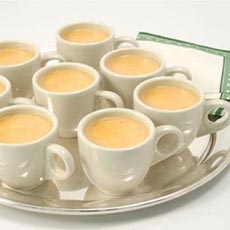
  • Demitasse of vichyssoise, cucumber, or other chilled, moderately-flavored soup (photo #5)
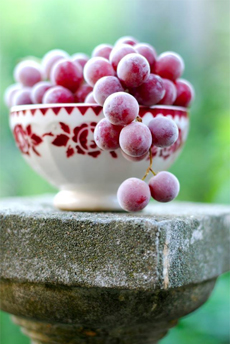
  • Frozen grapes (photo #2)
  • Prosecco or cava (a small glass)
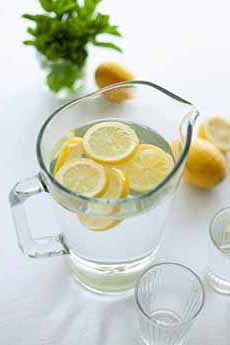
  • Sparkling water with a twist of citrus, or flat lemon water or cucumber water (photo #3)
  • Tea, a chilled demitasse, black, green, or mint
  •  
    Palate cleansers can be specific to beer tastings, cheese tastings, or wine tastings. Favored at these tastings are:

  • Apple slices (ideally tart, with optional sea salt flakes)
  • Bread, preferably a neutral flavor like baguette
  • Celery sticks, thinly sliced
  •  
    There are many other types of palate cleansers, from sucking on a lemon or lime wedge to eating water biscuits (unsalted crackers) to pickled ginger, as is served with sushi and sashimi.

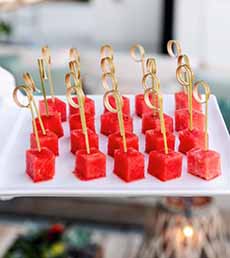
    For a casual gathering, cubes of watermelon with or without a mint leaf are a good bet (photo #4).

    If you have nothing else on hand, offer a sprig of mint or parsley to chew on.

    Most people come to prefer a specific palate cleanser that best works for them at a particular type of tasting.
     
     
    ________________

    *Historically, an entremet was a palate cleanser. Today the term is used in France to indicate an individual dessert; specifically, a cake with layers prepared separately using individual molds or rings, then assembled to form the final dessert. Here are some delicious examples.

    Marc, short for eau de vie de marc (its full name), also called pomace brandy, is distilled from what is left over after pressing the grapes used in wine production. The skins, pulp, seeds, and sometimes stems, are collectively called pomace. It can be aged briefly or for years. The result tastes like very strong whiskey. It is served as a digestif at the end of dinner, after the cheese and dessert. Some people have it with their espresso. You don’t pronounce the c at the end of the word. It is pronounced mahr, to rhyme with car. In Italian it is called grappa, bagaço in Portuguese, and orujo in Spanish.


    Sorbet In A Sherbet Champagne Glass
    [1] Citrus sorbet (here, rainbow sorbet) is enhanced with a splash of prosecco. Here’s the recipe (photo © Neighborhood Food Blog).

    Bowl Of Frozen Grapes
    [2] Serve frozen grapes in ramekins (photo © Fresh Direct | Facebook).

    Add Sliced Lemons To A Pitcher Or Glass of Water To Make Lemon Water
    [3] A glass of lemon water or cucumber water (or both) is an easy-to-make palate cleanser (photo © Julia Zolotova | Unsplash).

    Dessert Picks Of Watermelon Cubes
    [4] Watermelon cubes on picks are another easy option (photo © Piadina Restaurant | Hotel San Luis Obispo | California).

    Tray Of Lobster Bisque Demitasse Cups
    [5] A demitasse of chilled soup is a more elegant palate cleanser (photo © Hancock Gourmet Lobster).


    CHECK OUT WHAT’S HAPPENING ON OUR HOME PAGE, THENIBBLE.COM.


    Comments off

    Limited Edition Golden Selection Pineapple From Dole

    Dole Golden Selection Pineapple
    [1] The new Golden Selection pineapple (all photos © Dole).

    Dole Golden Selection Pineapple
    [2] Golden Selection is available at selected supermarkets in the U.S. and Canada.

    Pineapple Salad
    [3] Dole’s Gazpacho Salad recipe is one way to show off the flavor and color of Golden Selection pineapple.


    Dole Food Co. has introduced its limited-edition Golden Selection pineapple, a sweeter and juicier golden pineapple. It’s available at select supermarkets in the U.S. and Canada.

    The new variety has been cultivated not only to taste sweeter but to offer a more vibrant tropical flavor and aroma that “balances the pineapple’s customary sweet and tart sensations while elevating the indulgent taste experience.” Of course, we had to try it and received samples from Dole.

    The pineapples delivered as promised.

    Sustainably farmed, extra sweet, with flesh as gold as the sun, Dole developed this more golden-hued and aromatic pineapple in response to consumer demand for a sweeter pineapple-eating experience.

    While all Dole pineapples are tender, sweet, and packed with nutrients (healthy enzymes, and Vitamins B6 and C, for starters), the new Golden Selection Pineapples taste just a little sweeter and brighter. You’ll notice the difference.

    They also deliver exceptional juiciness and vibrant tropical personality.

    Fewer than 6% of all pineapples possess the taste and appearance qualifications necessary to be tagged a Golden Selection pineapple.

    While most of us think of Hawaii as the domain of Dole pineapples, the Golden Selection pineapples are grown in Costa Rica, where the soil and climate help to produce a softer and deeper golden-hued shell and richer golden flesh

    The new variety will be available in limited quantities based on seasonality. Look for them, and let these pineapples transport you to paradise.
     
     
    > Head to the Dole Golden Selection web page for more information.

    > June 27th is International Pineapple Day.

    > The history of pineapples.
     
     
    RECIPES FOR YOUR GOLDEN SELECTION PINEAPPLES

    These recipes can be made with any pineapple, but have been selected for their particular affinity for sweeter pineapples.

  • Cool Summer Gazpacho Salad (photo #3)
  • Ginger-Chili Ahi Tuna Poke Skewers
  • Magic Carpet Lemon Curd Cups
  • Pineapple Carpaccio
  •  
     
    RECIPE: SPICY PINEAPPLE SALAD

    You can serve this salad on romaine or Bibb lettuce leaves as an appetizer or salad course, or with a scoop of lemon sorbet for dessert.

    We adapted it from a recipe by Ruth Reichl who adapted it from a recipe by Zarela Martinez who adapted it from…well, it’s a classic Mexican salad.

    Depending on how much or little you like jalapeños, you can dice them into the salad or garnish the top with circles.


    To serve the salad as dessert, use only the first five ingredients plus a pint of lemon sorbet. A bit of lime zest grated atop the sorbet adds to the color and the flavor.

    Aim to add both red and green colors. If you can only find green jalapeños, for example, use red bell peppers.
     
    Ingredients For 4-6 Servings

  • 1 large ripe pineapple, peeled and cored
  • 1 small red onion, small dice
  • 1-2 red jalapeños, de-seeded and de-veined, small dice
  • 1 large red or green bell pepper
  • Lime zest plus 2-1/2 tablespoons lime juice (about 1 large lime)
  • 1/4 cup extra virgin olive oil
  • 1/2 teaspoon salt, or to taste
  • 2 tablespoons cilantro leaves
  • Whole romaine or Bibb lettuce leaves
  •  
    Preparation

    1. CUT the peeled and cored pineapple lengthwise into quarters; then cut each quarter crosswise into 1/4-inch slices. (Note: We don’t have a pineapple corer so we cut the entire peeled pineapple in quarters, then sliced away the core.)

    2. CUT the onion into small dice. De-seed and devein the jalapeños and cut into small dice.

    3. TOSS the pineapple, onion, and jalapeños together in a serving bowl.

    4. WHISK together the lime juice and zest, olive oil, and salt. Taste and adjust seasoning if desired.

    5. POUR the dressing over the pineapple mixture and toss to combine well.

    6. ADD the lettuce leaves to individual plates and serve the salad with a garnish of cilantro. For dessert:

    7. SPOON into individual dessert dishes and top with a scoop of lemon sorbet with an optional grating of lemon zest on top.


    CHECK OUT WHAT’S HAPPENING ON OUR HOME PAGE, THENIBBLE.COM.


    Comments off

    Karkade, An Egyptian Iced Tea Recipe For National Iced Tea Month

    As with the U.S., different types of tea are enjoyed in Egypt, hot and iced. One of the popular herbal teas is karkadè (KAR-kah-day, with a rolled “r”), brewed from dried hibiscus leaves.

    The flavor of hibiscus is floral, tart and fruity, reminiscent of cranberry juice.

    Sugar and honey are added for a sweet and tart treat, but you can use a different sweetener or none at all.

    > The history of tea.

    > The history of iced tea.

    > The history of tea bags.

    > The different types of tea: a glossary.
     
     
    RECIPE: ICED KARKADÈ, AN EGYPTIAN HERBAL ICED TEA

    You can enjoy the tea hot, although we think that hibiscus tea shows best when iced.

    You can replace the orange flower water with rose water or any floral water (check out the different floral waters).
     
    Ingredients For 4 Servings

  • 1 cup hibiscus flowers
  • 4 cups boiling water
  • 1/2 cup sugar, or to taste
  • 4 teaspoons honey
  • 2 teaspoons orange flower water
  • Crushed ice
  •  
    Preparation

    1. STEEP the hibiscus flowers and the water in a pitcher for 40 minutes—but no longer than 1 hour to avoid bitterness.

    2. STRAIN the tea into another pitcher or vessel. Press the flowers to release the excess liquid.

    4. ADD the other ingredients—sugar, honey, and orange flower water—and stir to combine thoroughly.

    5. DRINK hot or place in the refrigerator to cool.


    CHECK OUT WHAT’S HAPPENING ON OUR HOME PAGE, THENIBBLE.COM.


    Glasses Of Hibiscus Iced Tea
    [1] Hibiscus iced tea (photo © Rania Alhamed | Pexels).

    Hibiscus Flowers On The Bush
    [2] Hibiscus Flowers on the bush (photo © Kelly Sikkema | Unsplash).

    Dried Hibiscus Flowers
    [3] More often in the U.S., hibiscus tea is brewed from tea bags or loose hibiscus flowers (photo © The Spice House).


    Comments off


    © Copyright 2005-2026 Lifestyle Direct, Inc. All rights reserved. All images are copyrighted to their respective owners.