THE NIBBLE BLOG: Products, Recipes & Trends In Specialty Foods


Also visit our main website, TheNibble.com.

TIP OF THE DAY: Top 10 Pasta Cooking Tips

It seems like a no-brainer to boil pasta, yet there are several “best practices.”

For National Pasta Month, here are some basic pasta tips that many people—including our interns—don’t know.
1. USE A LARGE, LIDDED POT. Pasta needs room to cook without sticking: 4-5 quarts of water per pound of pasta. Although it may seem counter-intuitive, after the pasta is added, a larger pot of water will return to a boil faster. Especially with long cuts (strand or ribbon pasta), more water helps to reduce sticking, by washing away the exuded starch* from the pasta surface more efficiently. A six-quart stock pot is perfect for boiling pasta.

2. SALT THE WATER. Salt the water before you boil it—1-2 tablespoons for a large pot. You need the salt or the pasta will be bland.

3. NEVER ADD OIL TO THE POT. This longstanding “tip” was a marketing ploy from a salad oil company back around the 1960. The company sought ways for consumers to use more oil, and convinced many people that adding oil to the water prevents the pasta from sticking. However, the practice covers the pasta with a slick of oil so the sauce doesn’t stick.

   
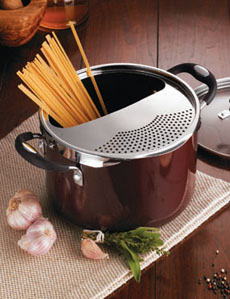
Stock Pot for Pasta
This six-quart stock pot from Tramontina has a removable drain spout: No colander is needed to drain the pasta.
 

4. PLACE A LID ON THE POT to EFFICIENTLY bring the water to boil. It takes long enough boil with a lid holding in the heat. You’ll be waiting forever (and water will evaporate) without one.

5. SCOOP UP A CUP OF PASTA WATER and set it aside before you drain the pasta. This starchy water can thicken your sauce. Add a tablespoon to the sauce, or more as desired. This is especially important with egg-based sauces like carbonara, since it also helps prevent the egg from curdling when it touches the hot pasta.

6. NEVER RINSE THE PASTA AFTER YOU DRAIN IT. This washes away the remaining surface starch, which you need in order for the sauce to stick to the pasta.


bucatini-steak@whisky-230
Another tip: Cut down on carbs by serving smaller portions of pasta as a first course, followed by a protein course. Photo courtesy Steak & Whisky.
  7. QUICKLY TOSS THE HOT PASTA WITH THE HOT SAUCE. While restaurants in the U.S. often place the sauce on top of the pasta, that’s a visual enhancement rather than a flavor enhancement. A top restaurant will serve the pasta already tossed with the sauce. The hotter both the pasta and the sauce are, the more flavor the pasta will absorb. Have the sauce heated in a covered pot (or in the microwave), ready to go when you drain the pasta.

8. USE THE POT TO BLEND THE PASTA AND SAUCE. After you’ve drained the pasta pot, dump the pasta back in, along with the sauce. Cover the pot and let the pasta absorb the sauce for a minute; then stir again and serve immediately.

9. ADD SOME MINCED FRESH HERBS. You can toss them with the pasta and sauce, or use it as a garnish on top of the dish. We also have a peppermill filled with crushed red chili flakes, to grind into the pasta or for self-service at the table.

10. USE REAL PARMESAN CHEESE. The best way to get the most robust cheese flavor is to keep a wedge and pass it around the table with a grater, so people can freshly grate as much as they like.

 
HOW MUCH PASTA DO YOU NEED?

Here’s advice from Barilla:

  • One pound of dry short-cut pasta (bow ties, elbows, penne, rigatoni, etc.) yields nine cups cooked. One pound of spaghetti or linguine yields seven cups cooked.
  • As a main course, plan for 1/4 cup of dried pasta (4 ounces) per person. A one-pound package should provide four dinner-size servings.
  • If you’re serving pasta as a first course or a side dish, plan for 1/8 cup of dried pasta (2 ounces) per person.
  • The final cooked amount will vary by shape. Spaghetti and macaroni shapes (short cuts) can double in volume when cooked. Read the package information. For example, it may say that 1/2 cup elbow macaroni = 1 cup cooked pasta, 3/4 cup penne = 1 cup cooked pasta, 1/8 pound spaghetti = ¼ cup cooked pasta, etc.
  • Egg noodles do not expand significantly when cooked; and fresh pasta, which contains a lot of moisture, doesn’t expand at all. For these varieties, plan three ounces for a first course or side dish and five ounces for a main dish.
  •  
    Rule Of Thumb Measurements

  • Small to Medium Pasta Shapes (bow ties, elbow macaroni, medium shells, mostaccioli, penne, radiatore, rigatoni, rotini, spirals, twists, wagon wheels): 8 ounces uncooked = 4 cups cooked.
  • Long Pasta Shapes (angel hair, bucatini, fettuccine, linguine, spaghetti, vermicelli): 8 ounces uncooked or 1½ inch diameter bunch = 4 cups cooked.
  • Egg Noodles: 8 ounces uncooked = 2½ cups cooked.
  •  
    MATCHING PASTA WITH THE RIGHT SAUCE

    GLOSSARY OF PASTA TYPES

     
    *When you drop pasta into a pot of boiling water, the starch granules on the surface of the pasta instantly swell up and pop. This discharges the surface starch and briefly, the pasta’s surface is sticky with the released starch. Most of this surface starch will dissolves into the water.
      

    Comments off

    Sunchokes (Jerusalem Artichokes) Are In Season: Recipes & History

    Fresh from California, sunchokes are in season. They’re typically harvested in the fall, around October, after the plant’s flowers have died back. Their flavor gets even better after a light frost.

    Their autumnal availability makes them a seasonal ingredient for many fall and winter holiday dishes. This brings us to the question: What are sunchokes? Also below:

    > The history of sunchokes.

    > Sunchoke recipes.
     
     
    WHAT ARE SUNCHOKES?

    Sunchokes, a modern term for Jerusalem artichokes (Helianthus tuberosus) are edible tubers that grow underground, similar to potatoes. The word is a contraction of “sunflower chokes”; sunchokes are close relatives of sunflowers. They are both in the botanical family Asteraceae and the genus Helianthus.

    Sunchokes taste like a cross between potatoes and artichoke hearts (although they are related to neither), with a slightly nuttiness. Although many people peel them before cooking, we enjoy the earthy flavor of the skins. (We also loved baked potato skins, if that’s any measure.)

    Root vegetables are generally storage organs, enlarged to store energy in the form of carbohydrates. True roots include:

  • Taproots, such as beet, burdock, carrot, celeriac, daikon, dandelion, jicama, parsley root, parsnip, radish, rutabaga, salsify and turnip, among others not well-known in the U.S.
  • Tuberous roots, such as cassava/yuca/manioc, Chinese/ Korean yam, and sweet potato, among others.
  • Other root vegetables include:

  • Bulbs (fennel; garlic, green onion/scallion, leek, onion, shallot and the rest of the Allium family)
  • Corms (Chinese water chestnut, taro)
  • Rhizomes (arrowroot, galangal, ginger, ginseng, lotus root, turmeric)
  • Tubers (Chinese artichoke/crosne, Jerusalem artichoke/ sunchoke, potato, ube, yam)
  •  
    Sunchoke tubers are elongated and uneven, typically 3-4 inches long and 1.2–2 inches thick. The color is often light brown, but some varieties are purple, red or white. Brown sunchokes vaguely resemble ginger root in appearance, and can be eaten raw or cooked.

    > There is no food holiday for sunchokes, but December is Root Vegetables and Exotic Fruits Month.
     
     
    JERUSALEM ARTICHOKE HISTORY

    Jerusalem artichokes are native to eastern North America and were first cultivated by Native Americans, long before the arrival of the Pilgrims and Puritans. The plant grew wild along the eastern seaboard from Georgia to Nova Scotia.

    The explorer Samuel de Champlain first encountered it in 1605, growing in a Native American vegetable garden in Cape Cod, Massachusetts. The Native Americans called the food sun roots, and introduced them to the Pilgrims, who grew them as a staple food.

    By the mid-1600s, Jerusalem artichokes had become a common vegetable for human consumption in France, where they were transported by de Champlain. In New England, they were a staple for the settlers. They were also used as livestock feed on both continents.

    The French worked their culinary magic on the tuber, which reached peak popularity at the turn of the 19th century. But if you fast-forward two centuries, some glory remains: The Jerusalem artichoke was named “best soup vegetable” at the 2002 Nice Festival For The Heritage Of The French Cuisine. [Source]
     
     
    THE NAME “JERUSALEM ARTICHOKE”

    The Jerusalem artichoke is not part of the artichoke family but is a member of the sunflower family. The tall yellow flowers are decorative; the tasty part is the root in the ground.

    Why is it called Jerusalem, when the Jerusalem artichoke is native to North America?

    De Champlain felt the tuber tasted like artichokes, and he brought plants back to France with the name Jerusalem artichokes (the modern French name is topinambour). The Puritans referred to their settlement as “New Jerusalem” (after the Book Of Revelations), which may account† for the first part of the name.
     
     
    THE NAME “SUNCHOKE”

    Around the 1970s, California growers realized that they had a marketing problem with Jerusalem artichoke. Just as the unexciting “prunes” became “dried plums”—and the Patagonian toothfishbecame the very popular Chilean sea bass—a more tantalizing name was sought. A suggestion of “sunflower artichoke” was contracted to sunchoke.

    Other names include earth apple, and sunroot.
     
     
    SUNCHOKE RECIPES

    Sunchokes can be cooked like potatoes: boiled, fried, grilled, mashed, microwaved or steamed. Raw, it is reminiscent of jicama, and can be added raw to salads. in stir-fries and soups and simply blanched and sauteed with garlic. They can be mashed or blended into mashed potatoes.

    And there’s nothing like a medley of roasted root vegetables, such as beets, carrots, parsnips, turnips and sunchokes. Here are more elaborate recipes:

  • Brioche-Crusted Fish With Sunchoke Purée and Sunchoke Pickles (recipe)
  • Fried Sunchoke Chips With Rosemary Salt (recipe)
  • Hanger Steak With Shallots & Sunchokes (recipe)
  • Olive Oil Poached Salmon With Sunchoke Purée (recipe)
  • Roast Sunchokes (recipe)
  • Sunchoke & Arugula Salad (recipe)
  • Sunchoke & Kale Hash With Farro (recipe)
  • Sunchoke Purée (recipe)
  • Sunchoke Soup WIth Pumpkin Seeds (recipe)
  • Tamarind-Braised Short Ribs with Truffle Sunchoke Purée, Watercress Purée, and Glazed Chanterelle Mushrooms (recipe)
  •  

    Jerusalem Artichoke (Sunchoke)
    [1] The Jerusalem artichoke, or sunchoke, is the root of a sunflower-like plant. Some subscpecies are purple, red or white (photo © Culinary Vegetable Institute).

    Jerusalem Artichoke Plant
    [2] You can see the resemblance of this Jerusalem artichoke plant to its cousin, the sunflower (photo by PJF | Wikimedia).

    Bowl Of Raw Sunchokes
    [3] A bowl oof raw sunchokes (photo © Melissa’s Produce).

    Bowl Of Raw Sunchokes
    [4] Different subspecies of sunchokes have different shapes (photo © Vicia).

    Sunchokes & Kale
    [5] Mix sunchokes with mashed potatoes or other roots, or combine them into a hash with kale and farro. Here’s the recipe (photo © Food & Wine).

    crispy-jerusalem-epicurious-230r
    [6] Crispy Jerusalem artichokes. Here’s the recipe (photo © Epicurious).


    Before cooking, scrub sunchokes well with a vegetable brush under running water. They can be eaten raw, but have been known to cause gastric upset in some people. It you have a tender tummy, first try a small piece of the raw root.
     
     
    HOW TO BUY SUNCHOKES

    Choose chokes that are firm, with no soft spots. As with potatoes, avoid nicks or cuts in the peel.

    Store in a cool, dry place, or keep the sunchokes in the crisper drawer of the fridge, wrapped in a paper towel to absorb excess moisture.
     
     
    SUNCHOKE NUTRITION

    One cup of sunchokes has 109 calories, 0 fat or cholesterol, 6 mg sodium, 643 mg potassium, 26 g total carbohydrte, 2.4 g dietary fiber, 14 g sugar and 3g protein.

    Most significant among vitamins and minerals, one cup contains 10% DV of vitamin C and 28% DV of iron.

    ____________________

    *Parsley root is not related to parsley, the herb, but is a beige root vegetable that resembles a parsnip or turnip. The edible leaves that grow above the ground do resemble curly parsley leaves, but taste like celery. Parsley root is also called turnip-rooted parsley. In Germany it is known as Hamburg parsley, and is a popular winter vegetable in Germany, Holland and Poland.

    The Italian word for sunflower is girasole (gee-rah-SO-lay), which could have evolved to “Jerusalem” over time. However, Jerusalem artichokes predated any significant Italian immigration to America by two centuries. A better explanation for the name is that it derives from the Puritans gave their New World settlement: New Jerusalem.
     
     
    A Basket Of Sunchokes
    [6] A basket of just-harvested sunchokes (photo © Ela Martinez | Unsplash).
     

    CHECK OUT WHAT’S HAPPENING ON OUR HOME PAGE, THENIBBLE.COM.

     
    &nbsp
      

    Comments off

    TIP OF THE DAY: Pears At Every Fall Meal

    Who doesn’t like to bite into a perfectly ripe pear, soft to the touch, dripping with juice? Whether in a packed lunch or as a grab-and-go snack, pears are one of the delights of fall.

    But pears don’t have to be ripe to be delicious. Hard pears can be baked, cooked (especially poached), even grated as a garnish onto cake, pudding, pancakes and yogurt.

    Here are suggestions from USA Pears, the national trade association, for incorporating pears into cooked recipes. There are many delicious pear recipes on the organization’s website.

    At the least, treat yourself to pear purée, the pear version of applesauce that can be served at any time during the day, as a condiment, side, topping or dessert. You can also use it in pear-accented cocktails. Peartini, anyone?

    Here’s a quick recipe to try with a ripe pear. A hard pear can be cooked first.

    RECIPE: NO-COOK SIMPLE PEAR PURÉE

    Ingredients For 1 Serving

  • 1 ripe pear
  • Dash of lemon juice
  • Optional: cinnamon or added sweetener, to taste
  •  
    Preparation

    1. PEEL and core the pear. You can leave the skin on the pear; it will provide vibrant flecks of color in the purée.

    2. CUT into chunks and purée in a food processor or blender until smooth. The splash of lemon juice helps prevent the purée from browning.

    3. TASTE and adjust for sweetness as needed. Add a dash of cinnamon as desired.


    Pear-Butternut Squash Soup

    /home/content/p3pnexwpnas01_data02/07/2891007/html/wp content/uploads/pear puree usapears 230

    TOP PHOTO: Pear-Butternut Squash Soup. BOTTOM PHOTO: Pear Purée (like applesauce). Images courtesy USA Pears.

     
    Preparation For Hard Pears

    Poach the pears before pureeing. Pears can be poached in red and white wine, fruit juice, beer, sake, coconut milk or water. Add some spice to your poaching liquid: cloves, cinnamon, salt, black pepper, vanilla bean, orange zest, nutmeg, cardamom.

    1. PEEL THE pears, leaving stem and core intact. Heat the poaching liquid over medium heat until it starts to simmer. Reduce the heat to low and continue simmering while fully immersing pears into the poaching liquid. Simmer until pears are soft and easily pierced with a fork, 5 to 15 minutes depending on the size of the pear.

    2. REMOVE the pears from liquid and let cool. Core the pears, remove the stems, cut into chunks and purée in a food processor or blender until smooth. Taste and adjust sweetness; add spices as desired.
     
    PEAR RECIPES FOR BRUNCH

  • Cheddar Pear Scones (recipe)
  • German Pancake with Caramelized Pears (recipe)
  • Pear and Maple Breakfast Sausage (recipe)
  • Pear and Quinoa Breakfast Custard (recipe)
  • Pear-Stuffed French Toast (recipe)
  •  
    PEAR RECIPES FOR LUNCH

  • Curried Butternut Squash & Pear Bisque (recipe)
  • Curried Pear & Chicken Salad (recipe)
  • Ham, Brie & Pear Sandwich (recipe)
  • Pear & Cabbage Slaw (recipe)
  • Pear & Quinoa Salad With Greens (recipe)
  • Pear, Sausage & Fontina Calzones (recipe)
  • Pear, Spinach & Parmesan Salad (recipe)
  • Red Wine Poached Pear Salad (recipe)
  • Shaved Pear & Beet Salad (recipe)
  • Shrimp Tacos With Pears & Slaw (recipe)
  • Turkey Burgers with Caramelized Pears and Sweet Onion (recipe)
  •  
    PEAR RECIPES FOR COCKTAILS & HORS D’OUEVRE

  • Feta & Pear Crostini (recipe)
  • Pear, Blue Cheese & Walnut Flatbread (recipe)
  • Pear Hummus (recipe)
  • Pear Martini With Pear Purée (recipe)
  • Walnut Pesto Toast with Sliced Pears and Gorgonzola Cheese (recipe)
  •  

    /home/content/p3pnexwpnas01_data02/07/2891007/html/wp content/uploads/pear hummus usapears 230

    poached-pears-in-chocolate-sauce-usapears-230
    TOP PHOTO: Pear hummus. BOTTOM PHOTO: Pears Belle Hélène (poached pears with chocolate sauce). Images courtesy USA Pears.

      PEAR RECIPES FOR DINNER

  • Braised Pork with Pears and Sherry Vinegar (recipe)
  • Grilled Pork Chops with Pears and Rosemary Butter (recipe)
  • Korean Barbecue Beef (recipe)
  • Pear Barbecue Sauce (recipe)
  • Pear and Sesame Glazed Beef (recipe)
  • Penne With Roast Pear & Feta (recipe)
  • Pizza With Pears, Shaved Ham and Fresh Basil (recipe)
  • Soba Noodles With Tea-Poached Pears (recipe)
  •  
    PEAR RECIPES FOR SIDE DISHES

  • Anjou Pear and Red Potato Gratin (recipe)
  • Grilled Pears Stuffed With Mascarpone & Bacon (recipe)
  • Braised Cabbage With Pears (recipe)
  • Pear Purée (recipe)
  • Savory-and-Sweet Ham, Pear, and Gruyère Strata (recipe)
  • Quinoa Pilaf With Carrots, Ginger & Pears (recipe)
  •  
    PEAR RECIPES FOR DESSERTS

  • Cider & Bourbon Poached Pear Tart (recipe—note that the recipes says “torte,” but it’s actually a tart. A torte is a cake. Torte means cake in German.)
  • Cider-Poached Pears With Pound Cake (recipe)
  • Pears Belle Hélène (recipe)
  • Pear-Caramel Galette (recipe)
  • Pear Cranberry Bread Pudding (recipe)
  • Pear Sorbet (recipe)
  • Pear & Frangipane Tart (recipe—also delicious with chocolate sauce)
  • Pumpkin Ale-Poached Peas In Caramel Sauce (recipe)
  •  

    THE HISTORY OF PEARS

    Pears are one of the world’s oldest cultivated and beloved fruits. The trees thrive in cool temperate climates, and there is evidence of pears as food since prehistoric times. Many traces of it have been found in Switzerland’s prehistoric lake dwellings. [Source]

    In the pear genus Pyrus, some 3,000 varieties are grown worldwide, The tree is thought to have originated in present-day western China, and to have spread to the north and south along mountain chains. In 5000 B.C.E., one Chinese diplomat was so enamored of them that he resigned his post to develop new varieties.

    In The Odyssey, the Greek poet Homer lauds pears as a “gift of the gods.” Roman farmers documented extensive pear growing and grafting techniques. Pliny’s Natural History recommended stewing them with honey and noted three dozen varieties.

    Seventeenth-century Europe saw a great flourishing of pear cultivation, especially in Belgium and France. Many of the modern varieties began to emerge.

    Early colonists brought the first pear trees to America’s eastern settlements, where they thrived until crop blights proved too severe to continue widespread cultivation. Fortunately, pioneers had brought pear trees brought to Oregon and Washington in the 1800s, where they thrived in the agricultural conditions of the Pacific Northwest. It remains the major pear-growing center of the U.S.


    Comments off


    © Copyright 2005-2026 Lifestyle Direct, Inc. All rights reserved. All images are copyrighted to their respective owners.