THE NIBBLE BLOG: Products, Recipes & Trends In Specialty Foods


Also visit our main website, TheNibble.com.

HALLOWEEN: Best Chocolate Witch

Chocolate Witch

Bewitching in dark or milk chocolate. Photo courtesy Li-Lac Chocolates.


We’ve been looking around, and think we’ve found the best chocolate witch for Halloween. Eight inches tall and weighing in at 14 ounces of solid chocolate, the Big Halloween Witch from Li-Lac Chocolates is our favorite this season.

There are many nifty chocolate molds around, but we like the garments and expression of this particular paranormal practitioner of magic. With her crooked smile, flowing robe and pointed hat, carrying her broomstick and jack-o’-lantern, she’s almost too cool to eat.

The chocolate witch is made fresh to order in milk or dark chocolate, and is certified kosher (dairy) by OU.

Get yours at Li-LacChocolates.com, or at the company’s retail stores in New York City.

The 90-year-old chocolatier has been delighting New Yorkers for generations. We love to sneak in for a bite; or, in the case of this witch, many bites.

 
THE HISTORY OF TRICK OR TREATNG

“Guising” traditions began as a Christian practice in the Middle Ages, when children and sometimes poor adults would dress up in the costumes and go around door to door during Hallowmas (All Saints Day, November 1st, the day after Halloween). They begged for food or money in exchange for songs and prayers for the dead (the latter called “souling”).

That tradition was ported to the U.S., with children going door to door for treats in exchange for reciting a poem or singing a song. Bonfires, a European tradition on All Hallows Eve (Halloween), were also held.
 
The night before Halloween came to be called Mischief Night, when the neighborhood youth would sow some wild oats. Front gates were removed, windows were soaped and outhouses were tipped over [source].

The term “trick or treat” didn’t emerge until the 1920s. The first printed reference is found in a newspaper from 1927 [source].

While today the “trick” portion of trick-or-treat is usually an idle threat, it began with youthful participants who insistently rang doorbells and promised worse (knocking over trash cans, sticking a pin in the bell so keep it ringing, papering the house) if they did not get a treat. The residents paid the price in candy or other treats, and the costumed visitors went on to the next house.

Individual trick-or-treating evolved in some locales in the 1960s and 1970s, into community events for the whole family, house parties for kids, and other activities that circumvented the need to send children to strange houses (and the reverse, to avoid having to opening one’s door to strangers).


THE HISTORY OF HALLOWEEN CANDY

For hundreds of years, Halloween came and went with no candy! Costumed children going door-to-door received everything from homemade cookies and cake to fruit, nuts, coins and toys.

It wasn’t until the 1950s that candy manufacturers began to promote their products for Halloween.

In the 1960s, following a hoax that miscreants had inserted pieces of glass into apples and other treats, factory-made, wrapped candy became the only acceptable treat to hand out. Producers of the most popular candies made miniatures, making a household’s candy giveaway more affordable.

Here’s some trivia about popular Halloween treats:


Chocolate Pumpkins

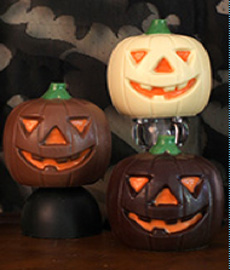
Chocolate pumpkins from Woodhouse Chocolate.


  • Candy corn: Candy corn was invented in the 1880s in Philadelphia by George Renninger of the Wunderle Candy Company. He didn’t trademark it, so other companies produced their own versions. The Goelitz Confectionery Company (now the Jelly Belly Candy Co.), has been making candy corn since 1898, and originally marketed it as “chicken feed.”
  • Hershey’s: The first Hershey’s Milk Chocolate Bar was produced in 1900; Hershey’s Kisses followed in 1907. Chocolate, which had previously had been a luxury item, became affordable for average Americans.
  • Reese’s: In 1917, Harry Burnett Reese joined the Hershey Company as a dairyman and later worked in the factory. He began making candies in his home basement, and ultimately left Hershey to built his own factory. He invented in Reese’s Peanut Butter Cups in 1928. Full circle: In 1963, Hershey acquired the H.B Reese Candy Company.
  • Mars: In 1923, a Minnesota candy maker, Frank Mars, launched the Milky Way Bar. It was followed by Snickers in 1930 (reportedly named for his favorite horse) and Three Musketeers in 1932. Frank’s son Forrest Mars joined the company, had a falling out with his father, relocated to England and created the Mars Bar.
  • Kit Kat: The Kit Kat Bar first appeared in England in 1935, known as Rowntree’s Chocolate Crisp. In 1937 it was rechristened the Kit Kat Chocolate Crisp said to be named after a venerable London literary and political group, the Kit-Cat (or Kit Kat) Club. The brand was acquired by Switzerland-based Nestlé, which debuted the Nestlé Crunch Bar in the late 1930s.
  • M&Ms: In 1941, Forrest Mars launched M&Ms. He had anticipated that World War II would engender a cocoa shortage, so he partnered with Bruce Murrie, son of a Hershey executive, to get access to a sufficient supply. M&Ms stands for Mars & Murrie.
  •  
    [Source]


    Comments off

    PRODUCT: Pumpkin Design Loaf Pan

    pumpkin-loaf-pan-nordicware-ws-230
    This Nordic Ware loaf pan makes plain cake look lovely. Photo courtesy Williams-Sonoma.
      With the disclosure that we love to eat cake, and can enjoy a slice a day, we actually prefer loaf cakes to elaborately iced and filled cakes. We can have our cake and eat it, too, because we convince ourself that a loaf cake is better for you.

    (In fact, because there’s no extra sugar- and butter-laden filling and frosting, it is a bit better. A bit.)

    That’s why we allowed ourself to buy another loaf pan. This intricately sculpted pan adds autumnal beauty to a banana bread, carrot cake, chocolate loaf, pound cake, pumpkin bread, spice bread, zucchini cake….

    Not to mention, cornbread soda bread and other homemade loaves.

    All you have to do is buy the pan and pour in the batter. The beautiful Nordic Ware pan—an exclusive to Williams-Sonoma—will take over.


    You can top the cake with a simple glaze or a dusting of confectioners’ sugar, but we think the plain relief of pumpkins and vines is lovelier.

    The pumpkin loaf pan is made of durable cast-aluminum, which ensures even baking. The nonstick finish guarantees your cake will release easily, and clean-up will be a breeze.

    Get yours at Williams-Sonoma stores or online.
      

    Comments off

    Boston Cream Pie Recipe & History For National Boston Cream Pie Day

    October 23rd is National Boston Cream Pie Day, but don’t let the name fool you. Boston Cream Pie is a layer cake: two layers of buttery sponge cake sandwiched with crème pâtissière (pastry cream or vanilla cream filling) or custard filling and topped with a glaze of chocolate ganache.

    The history and recipe follow, but first:

    > A brief history of cake and the different types of cake: a photo glossary.

    > The history of sponge cake.

    > The year’s 55 cake holidays.

    > The difference beteween crème pâtissière, custard, and other custard-related desserts and fillings.

    > The history of pie: a photo glossary.

    > The year’s 31 pie holidays.

    > How about a recipe for Boston Cream Cheesecake?
     
     
    BOSTON CREAM PIE HISTORY

    The modern Boston Cream Pie was created for the opening of the Parker House Hotel in Boston, in October 1856. An Armenian-French chef, M. Sanzian, sandwiched two layers of sponge cake with crème pâtissière, and topped the cake with a chocolate ganache glaze.

    His recipe was a re-working of the early American pudding-cake pie. The first reference, a recipe published in 1855, calls it a “pudding pie cake.” It had a powdered sugar topping.

    According to What’s Cooking America, the cake was originally served at the hotel with the name Chocolate Cream Pie or Parker House Chocolate Cream Pie. “Boston” came later.

    As a throwback to its origin, the ganache top of the cake is sometimes decorated with confectioners’ sugar, or icing designs can be made in the ganache, as in the second photo.

    For a more festive cake, the bare sides can be covered with pastry cream and toasted almonds (which is how the cake is currently prepared at the Parker House—here’s their recipe).

    According to Omni Parker House, what made the dessert so special was its chocolate icing. Back in 1856, chocolate was mainly consumed as a beverage or in puddings; the chocolate bar was yet to be perfected (here’s the history of chocolate timeline).

    So chocolate icing was an innovative use of chocolate at the time. [Source]
     
     
    But why is the cake called a pie?
     
    The answer is most likely that, in the mid-19th century pie tins were more common than cake pans. The distinction between calling something pie or cake was more flexible than it is today. The cake might well have been baked in pie tins. (By the same token, cheesecake is not a cake, but a cream cheese-flavored custard pie.)
     
     
    How About Cream Pie Vs. Creme Pie?

    What’s the deal with two different spellings, cream, and creme?

    Cream is the appropriate spelling in the U.S. Crème, pronounced KREHM, is the French spelling.

    To make things appear more fancy or exclusive, some Americans began to use the French spelling without the accent, pronouncing creme as KREEM.

    It may be pervasive, but it isn’t correct.

    Boston Cream Pie was declared the official dessert of Massachusetts in 1996. The pie beat out other iconic Massachusetts desserts, including Fig Newtons, Toll House Cookies, and Indian Pudding.

    The combination of flavors are such a hit that you can find Boston cream angel cake, bar cookies, cupcakes, donuts, ice cream, even cocktails (photo #11)!

    Check out photos #7 to #11 for recipes.

    Trivia: You may have noticed that éclairs and cream puffs share a very similar flavor profile, substituting choux pastry for Boston’s sponge cake. The combination of pastry cream and chocolate icing makes them close cousins to the Boston cream pie concept.

    All three recipes emerged in the mid-19th century.
     
     
    RECIPE: BOSTON CREAM PIE

    This recipe was sent to us by GoBoldWithButter.com. It was developed by Taylor Mathis of TaylorTakesATaste.com. Prep time is 30 minutes, cook time is 40 minutes.

    For a different twist, here’s a Boston Cream Cheesecake recipe (actually a pie).
     
    Ingredients For A 9-Inch Cake
     
    For The Sponge Cake

  • 1 cup milk
  • 3 tablespoons unsalted butter (plus extra for the baking pans)
  • 2 teaspoons vanilla
  • 1/4 teaspoon almond extract
  • 2 cups all-purpose flour
  • 2 teaspoons baking powder
  • 1/4 teaspoon salt
  • 5 large eggs, room temperature
  • 1-3/4 cup granulated sugar
  •  
    For The Vanilla Cream Filling

  • 5 large egg yolks
  • 4 tablespoons all purpose flour
  • 2/3 cup granulated sugar
  • 1/8 teaspoon salt
  • 2 cups milk
  • 3 tablespoons unsalted butter
  • 1-1/2 teaspoon vanilla
  • 1/8 teaspoon almond extract
  •  
    For The Chocolate Glaze

  • 1 cup semi-sweet chocolate chips*
  • 1 cup bittersweet chocolate chips*
  • 1/2 cup milk
  • 1/8 teaspoon salt
  • 6 tablespoons unsalted butter
  • 1 teaspoon vanilla
  •  
    Preparation

    1. PREHEAT the oven to 350°F. Butter and flour two 9-inch round cake pans and set aside.

    2. SIFT together the flour, baking powder, and salt in a medium bowl. Set aside.

    3. BRING the milk to a boil in a small saucepan. Remove from the heat and add the butter, stirring until the butter melts. Add the vanilla and almond extracts, stir and set the pan aside.

    4. BEAT the eggs on medium-high speed in the bowl of an electric mixer, for 7 minutes. Add the sugar and mix for an additional 8 minutes.

    5. REDUCE the mixer speed to low. Add 1/3 of the flour mixture. After the flour has been mixed in, add 1/2 of the milk mixture and blend. Add the next 1/3 of flour and blend. Add the remaining milk mixture and blend. Add the remaining 1/3 of the flour and blend. Turn off the mixer and scrape the batter down from the sides of the mixing bowl.

    6. DIVIDE the batter equally between the two prepared pans. Bake for 25 minutes, remove from the oven and let the layers cool in the pans for 5 minutes. Invert the cakes and cool completely on a wire rack.

    7. PREPARE the vanilla cream filling: In a medium bowl, combine the egg yolks, flour, sugar, and salt. Stir with a fork until the flour and sugar are well mixed with the egg yolks. Set aside.

    8. BRING the milk to just boil in a large, heavy-bottomed saucepan. Remove the pan from the stove. Add 1/3 of the hot milk to the egg mixture; stir to blend. Pour the egg mixture into the saucepan with the remaining 2/3 of the milk; stir to blend. Return the saucepan to medium-high heat, stirring constantly. When custard begins to boil…
     
    9. REDUCE the heat to low and cook, stirring constantly, until the pastry cream thickens. Remove the pastry cream from the heat and pour it into a bowl. Add the butter and stir until well incorporated. Add the vanilla and almond extracts; stir to blend. Cover the pastry cream with plastic wrap and refrigerate until cool.

    10. PREPARE the chocolate glaze: Place chocolate chips, milk, and salt into a heatproof bowl. Set the bowl over a pan of simmering water and stir the chocolate until melted and well blended with milk. Remove from the heat. Add the butter to the chocolate, 1 tablespoon at a time, stirring well after each addition. Add the vanilla and stir to blend. Set chocolate glaze aside.

    11. ASSEMBLE the cake: Place 1 sponge cake layer on a cake plate. Generously cover with chilled vanilla pastry cream. Top the cream with the second layer of cake. Cover with chocolate glaze. Some of glaze should run over the sides of the cake. Refrigerate the cake until the glaze sets, about 30 minutes. Serve.
     
    _______________

    *Try a better brand liken Guittard or Callebaut (photo #10) chocolate chips. You can also chop up a bar of good chocolate, of 70% cacao.


    CHECK OUT WHAT’S HAPPENING ON OUR HOME PAGE, THENIBBLE.COM.


    boston-cream-pie-taylortakesataste-goboldwithbutter-230
    [1] Boston Cream Pie. Of course it’s a layer cake, not a pie (photo © Cara Fealy Choate | Wikipedia).

    Boston Cream Pie
    [2] If you like, make the icing fancier (photo © Mackenzie Ltd).


    [3] Show it off for special occasions (photo © Raw Spice Bar).

    A slice of Boston Cream Pie
    [4] A luscious Boston Cream Pie, begging for you to take a a bite (photo © Taylor Mathis | Taylor Takes A Taste for Go Bold With Butter).

    boston-cream-pie-wiki-230b
    [5] We love the chocolate ganache top and sides (photo © Wikipedia).

    Boston Cream Pie
    [6] Simple, but just as tasty (photo © Kraft).

    Boston Cream Angel Cake
    [7] Boston cream pie x angel cake! Here’s the recipe (photos #7, #8, and #9 © Taste Of Home).

    Boston Cream Donuts
    [8] Boston Cream Donuts. Here’s the recipe.

    Boston Cream Cupcakes
    [9] Boston Cream Cupcakes. Here’s the recipe.

    A Bowl Of Chocolate Chips
    [10] Callebaut (in photo) and Guittard make the best-tasting chocolate chips that are easy to find (photo © Cocoa Dolce).

    Boston Cream Martini
    [11] How about a Boston Cream Martini? Here’s the recipe (photo © The Drink Kings).


    Comments off


    © Copyright 2005-2026 Lifestyle Direct, Inc. All rights reserved. All images are copyrighted to their respective owners.