THE NIBBLE BLOG: Products, Recipes & Trends In Specialty Foods


Also visit our main website, TheNibble.com.

PRODUCT: Pumpkin Design Loaf Pan

pumpkin-loaf-pan-nordicware-ws-230
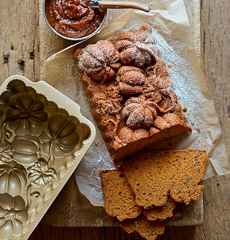
This Nordic Ware loaf pan makes plain cake look lovely. Photo courtesy Williams-Sonoma.
  With the disclosure that we love to eat cake, and can enjoy a slice a day, we actually prefer loaf cakes to elaborately iced and filled cakes. We can have our cake and eat it, too, because we convince ourself that a loaf cake is better for you.

(In fact, because there’s no extra sugar- and butter-laden filling and frosting, it is a bit better. A bit.)

That’s why we allowed ourself to buy another loaf pan. This intricately sculpted pan adds autumnal beauty to a banana bread, carrot cake, chocolate loaf, pound cake, pumpkin bread, spice bread, zucchini cake….

Not to mention, cornbread soda bread and other homemade loaves.

All you have to do is buy the pan and pour in the batter. The beautiful Nordic Ware pan—an exclusive to Williams-Sonoma—will take over.


You can top the cake with a simple glaze or a dusting of confectioners’ sugar, but we think the plain relief of pumpkins and vines is lovelier.

The pumpkin loaf pan is made of durable cast-aluminum, which ensures even baking. The nonstick finish guarantees your cake will release easily, and clean-up will be a breeze.

Get yours at Williams-Sonoma stores or online.
  

Comments off

Boston Cream Pie Recipe & History For National Boston Cream Pie Day

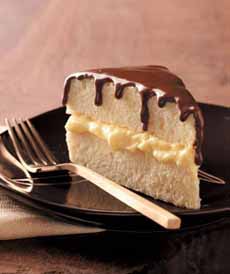
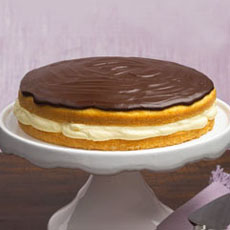
October 23rd is National Boston Cream Pie Day, but don’t let the name fool you. Boston Cream Pie is a layer cake: two layers of buttery sponge cake sandwiched with crème pâtissière (pastry cream or vanilla cream filling) or custard filling and topped with a glaze of chocolate ganache.

The history and recipe follow, but first:

> A brief history of cake and the different types of cake: a photo glossary.

> The history of sponge cake.

> The year’s 55 cake holidays.

> The difference beteween crème pâtissière, custard, and other custard-related desserts and fillings.

> The history of pie: a photo glossary.

> The year’s 31 pie holidays.

> How about a recipe for Boston Cream Cheesecake?
 
 
BOSTON CREAM PIE HISTORY

The modern Boston Cream Pie was created for the opening of the Parker House Hotel in Boston, in October 1856. An Armenian-French chef, M. Sanzian, sandwiched two layers of sponge cake with crème pâtissière, and topped the cake with a chocolate ganache glaze.

His recipe was a re-working of the early American pudding-cake pie. The first reference, a recipe published in 1855, calls it a “pudding pie cake.” It had a powdered sugar topping.

According to What’s Cooking America, the cake was originally served at the hotel with the name Chocolate Cream Pie or Parker House Chocolate Cream Pie. “Boston” came later.

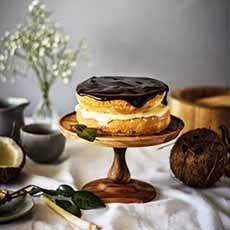
As a throwback to its origin, the ganache top of the cake is sometimes decorated with confectioners’ sugar, or icing designs can be made in the ganache, as in the second photo.

For a more festive cake, the bare sides can be covered with pastry cream and toasted almonds (which is how the cake is currently prepared at the Parker House—here’s their recipe).

According to Omni Parker House, what made the dessert so special was its chocolate icing. Back in 1856, chocolate was mainly consumed as a beverage or in puddings; the chocolate bar was yet to be perfected (here’s the history of chocolate timeline).

So chocolate icing was an innovative use of chocolate at the time. [Source]
 
 
But why is the cake called a pie?
 
The answer is most likely that, in the mid-19th century pie tins were more common than cake pans. The distinction between calling something pie or cake was more flexible than it is today. The cake might well have been baked in pie tins. (By the same token, cheesecake is not a cake, but a cream cheese-flavored custard pie.)
 
 
How About Cream Pie Vs. Creme Pie?

What’s the deal with two different spellings, cream, and creme?

Cream is the appropriate spelling in the U.S. Crème, pronounced KREHM, is the French spelling.

To make things appear more fancy or exclusive, some Americans began to use the French spelling without the accent, pronouncing creme as KREEM.

It may be pervasive, but it isn’t correct.

Boston Cream Pie was declared the official dessert of Massachusetts in 1996. The pie beat out other iconic Massachusetts desserts, including Fig Newtons, Toll House Cookies, and Indian Pudding.

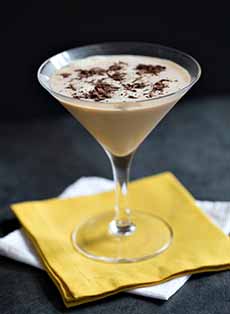
The combination of flavors are such a hit that you can find Boston cream angel cake, bar cookies, cupcakes, donuts, ice cream, even cocktails (photo #11)!

Check out photos #7 to #11 for recipes.

Trivia: You may have noticed that éclairs and cream puffs share a very similar flavor profile, substituting choux pastry for Boston’s sponge cake. The combination of pastry cream and chocolate icing makes them close cousins to the Boston cream pie concept.

All three recipes emerged in the mid-19th century.
 
 
RECIPE: BOSTON CREAM PIE

This recipe was sent to us by GoBoldWithButter.com. It was developed by Taylor Mathis of TaylorTakesATaste.com. Prep time is 30 minutes, cook time is 40 minutes.

For a different twist, here’s a Boston Cream Cheesecake recipe (actually a pie).
 
Ingredients For A 9-Inch Cake
 
For The Sponge Cake

  • 1 cup milk
  • 3 tablespoons unsalted butter (plus extra for the baking pans)
  • 2 teaspoons vanilla
  • 1/4 teaspoon almond extract
  • 2 cups all-purpose flour
  • 2 teaspoons baking powder
  • 1/4 teaspoon salt
  • 5 large eggs, room temperature
  • 1-3/4 cup granulated sugar
  •  
    For The Vanilla Cream Filling

  • 5 large egg yolks
  • 4 tablespoons all purpose flour
  • 2/3 cup granulated sugar
  • 1/8 teaspoon salt
  • 2 cups milk
  • 3 tablespoons unsalted butter
  • 1-1/2 teaspoon vanilla
  • 1/8 teaspoon almond extract
  •  
    For The Chocolate Glaze

  • 1 cup semi-sweet chocolate chips*
  • 1 cup bittersweet chocolate chips*
  • 1/2 cup milk
  • 1/8 teaspoon salt
  • 6 tablespoons unsalted butter
  • 1 teaspoon vanilla
  •  
    Preparation

    1. PREHEAT the oven to 350°F. Butter and flour two 9-inch round cake pans and set aside.

    2. SIFT together the flour, baking powder, and salt in a medium bowl. Set aside.

    3. BRING the milk to a boil in a small saucepan. Remove from the heat and add the butter, stirring until the butter melts. Add the vanilla and almond extracts, stir and set the pan aside.

    4. BEAT the eggs on medium-high speed in the bowl of an electric mixer, for 7 minutes. Add the sugar and mix for an additional 8 minutes.

    5. REDUCE the mixer speed to low. Add 1/3 of the flour mixture. After the flour has been mixed in, add 1/2 of the milk mixture and blend. Add the next 1/3 of flour and blend. Add the remaining milk mixture and blend. Add the remaining 1/3 of the flour and blend. Turn off the mixer and scrape the batter down from the sides of the mixing bowl.

    6. DIVIDE the batter equally between the two prepared pans. Bake for 25 minutes, remove from the oven and let the layers cool in the pans for 5 minutes. Invert the cakes and cool completely on a wire rack.

    7. PREPARE the vanilla cream filling: In a medium bowl, combine the egg yolks, flour, sugar, and salt. Stir with a fork until the flour and sugar are well mixed with the egg yolks. Set aside.

    8. BRING the milk to just boil in a large, heavy-bottomed saucepan. Remove the pan from the stove. Add 1/3 of the hot milk to the egg mixture; stir to blend. Pour the egg mixture into the saucepan with the remaining 2/3 of the milk; stir to blend. Return the saucepan to medium-high heat, stirring constantly. When custard begins to boil…
     
    9. REDUCE the heat to low and cook, stirring constantly, until the pastry cream thickens. Remove the pastry cream from the heat and pour it into a bowl. Add the butter and stir until well incorporated. Add the vanilla and almond extracts; stir to blend. Cover the pastry cream with plastic wrap and refrigerate until cool.

    10. PREPARE the chocolate glaze: Place chocolate chips, milk, and salt into a heatproof bowl. Set the bowl over a pan of simmering water and stir the chocolate until melted and well blended with milk. Remove from the heat. Add the butter to the chocolate, 1 tablespoon at a time, stirring well after each addition. Add the vanilla and stir to blend. Set chocolate glaze aside.

    11. ASSEMBLE the cake: Place 1 sponge cake layer on a cake plate. Generously cover with chilled vanilla pastry cream. Top the cream with the second layer of cake. Cover with chocolate glaze. Some of glaze should run over the sides of the cake. Refrigerate the cake until the glaze sets, about 30 minutes. Serve.
     
    _______________

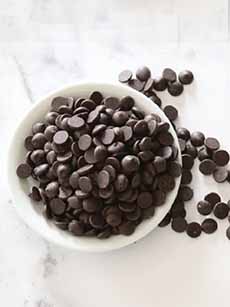
    *Try a better brand liken Guittard or Callebaut (photo #10) chocolate chips. You can also chop up a bar of good chocolate, of 70% cacao.


    CHECK OUT WHAT’S HAPPENING ON OUR HOME PAGE, THENIBBLE.COM.


    boston-cream-pie-taylortakesataste-goboldwithbutter-230
    [1] Boston Cream Pie. Of course it’s a layer cake, not a pie (photo © Cara Fealy Choate | Wikipedia).

    Boston Cream Pie
    [2] If you like, make the icing fancier (photo © Mackenzie Ltd).


    [3] Show it off for special occasions (photo © Raw Spice Bar).

    A slice of Boston Cream Pie
    [4] A luscious Boston Cream Pie, begging for you to take a a bite (photo © Taylor Mathis | Taylor Takes A Taste for Go Bold With Butter).

    boston-cream-pie-wiki-230b
    [5] We love the chocolate ganache top and sides (photo © Wikipedia).

    Boston Cream Pie
    [6] Simple, but just as tasty (photo © Kraft).

    Boston Cream Angel Cake
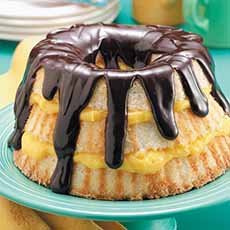
    [7] Boston cream pie x angel cake! Here’s the recipe (photos #7, #8, and #9 © Taste Of Home).

    Boston Cream Donuts
    [8] Boston Cream Donuts. Here’s the recipe.

    Boston Cream Cupcakes
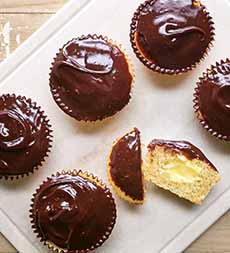
    [9] Boston Cream Cupcakes. Here’s the recipe.

    A Bowl Of Chocolate Chips
    [10] Callebaut (in photo) and Guittard make the best-tasting chocolate chips that are easy to find (photo © Cocoa Dolce).

    Boston Cream Martini
    [11] How about a Boston Cream Martini? Here’s the recipe (photo © The Drink Kings).


    Comments off

    The Types Of Asian Noodles & The Noodles-Pasta Difference

    Pasta originated in China. Scholars credit the Chinese with making noodles from rice flour as early as 1700 B.C.E., the 17th century before the common era (or before Christ, if you still use the old system).

    The pasta-centric Italians believe pasta dates back to the ancient Etruscans, who inhabited the Etruria region of Italy (the central-western portion of Italy, what now are Tuscany, Latium, and Umbria). They occupied the area from the Iron Age into Roman times (the 11th century B.C.E. to the 1st century B.C.E.).

    Around 400 B.C.E., the Etruscans began to prepare a very wide, lasagna-type noodle made of spelt, an early version of wheat.

    The Romans who followed made what they called lagane, a kind of lasagna, from a dough of water and flour. However, both the Etruscans and the Romans baked their noodles in an oven; boiled pasta had yet to be born in Italy. Here’s more on the history of pasta.

    But let’s circle back to Asia. What happened to pasta in that large region?

    It’s called noodles, and it’s plentiful. Different Asian cuisines developed different types of noodles; not just from wheat, as in Italy, but from other starches that happen to be gluten-free, such as rice, sweet potato, arrowroot starch, bean curd skin, potato starch, and tofu. You can feast on Asian noodle dishes in a splendid variety.

    Below:

    > The different types of Asian Noodles.

    > The difference between noodles and pasta.

    > A recipe for Chicken Chow Mein.
     
     
    Elsewhere on The Nibble:

    > 15+ noodle recipes.

    > The history of noodles.

    > The year’s 20 pasta holidays.

    > The year’s 15 Chinese food holidays.
     
     
    ABOUT ASIAN NOODLES

    We’ve done our best to put together the list of different noodle types below. You may see some familiar names, but there are a lot of Asian noodle types to get to know. You can find them in Asian markets and of course, online.


    asian_noodle_bowl_with_seared_tempeh_lightlife-230
    [1] Asian rice noodle salad with pan-fried tofu. Cook the noodles and tofu, toss with vegetables of choice, rice vinegar, a bit of oil (we like sesame oil) and cilantro. Add an optional sprinkle of toasted sesame seeds or shichimi togarashi, a Japanese mixture of dried chiles and other spices (photo © Lightlife).

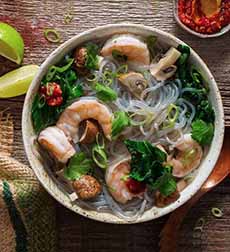
    Lemongrass Shrimp Soup With Rice Noodles & Recipe
    [2] Thai lemongrass shrimp soup with glass noodles. Here’s the recipe (photo © Sunbasket).

     
    The one challenge is that there is no standardization. Spellings will vary by region, as will the width of the noodles. We’ve included analogous Italian pasta names to give you an approximate visual.
     
     
    The Differences Between Asian Noodles, Italian Pasta, & Other Noodles

    Although they may look similar, Asian noodles and Italian pasta have key differences. Most pasta is designed to be cooked to an al dente texture, but Asian noodles vary widely: Some are meant to be eaten soft; others have a firm bite. Some are chewy, others are springy.

    A second difference: Italian pasta is boiled in water or broth (even baked pasta is boiled first). Chinese noodles can be boiled in water, cooked in soup or stir-fried. And third, unlike Italian pasta, most Asian noodle dishes do not have a sauce on top. If there’s a sauce, they are tossed in it. Asians also add noodles to salads, a treatment not typically found in the West.

    Unlike the short cuts developed in Italy (bowties, elbows, tube pasta, etc.), all Asian pasta is a strand or ribbon pasta. Finally, some Chinese noodles contain eggs, but the majority of Asian noodles do not.

    Other European Noodles

    The distinction between Italian pasta and other European noodles is more about culinary tradition and technique than strict ingredient differences, though there are some key variations:

  • Italian pasta is made from durum wheat semolina and water and with added eggs for fresh egg pasta like tagliatelle. The use of high-protein durum wheat gives pasta its characteristic firm texture and ability to be cooked “al dente.”
  • German Spätzle is made from soft wheat flour, eggs, and milk or water. The batter is softer and is pressed or scraped through a sieve directly into boiling water, creating irregular, dumpling-like shapes.
  • Eastern European Noodles (e.g., Polish kluski, Hungarian csipetke) use all-purpose flour with eggs and sometimes sour cream, milk, or potatoes. They softer and more tender than Italian pasta.
  • Egg noodles, popular in Germany and Eastern Europe, are egg-enriched using soft wheat pasta. They are typically wide and flat. German egg noodles are commonly used in soups, served as a side with butter and breadcrumbs, or as a base for dishes like goulash. Hungarian egg noodles (tészta) are similar, often served with cottage cheese and sour cream, or alongside paprikash. Polish egg noodles (makaron) are used with savory foods, but also in sweet applications like noodles with poppy seeds and honey. Jewish egg noodles are used in soups, as sides, and in savory and sweet kugel (noodle pudding).
  •  
     
    TYPES OF ASIAN NOODLES

  • Wheat Noodles: Chow Mein (Chinese, like spaghetti but often cut and stir-fried), La Mien (Chinese, hand-pulled, like spaghetti or spaghettini), Lo Mein (Chinese, flat like linguine), Mee Pok (yellow and flat like fettuccine, a Chinese-style noodle used in Malaysia, Singapore and Thailand), Misua (salted Chinese noodles from Fujian, very thin like angel hair), Naengmyeon* (Korean long thin handmade noodles like spaghettini), Ramen (Japanese soup noodles, often the thickness of spaghetti**), Soba (Japanese buckwheat noodles), Udon (thick Japanese soup noodles, like spaghettoni), Wonton Mee (a Chinese soup noodle like spaghetti, not the same as wonton dumplings).
  • Rice Noodles: Chee Cheong Fun (a Cantonese rolled rice noodle), Chow Fun (wide, flat Chinese noodles like pappardelle), Mi Xian (a Yunnan rice noodle made from ordinary [non-glutinous rice], generally sold fresh), Kway Teow (rice cake strips from Malaysia and Singapore), Lai Fun (or bánh canh, long or short Vietnamese noodles the thickness of spaghettoni [there is also a wheat-based Chinese version]), Rice Paper Noodles (these are the thin rectangles used to roll Vietnamese spring rolls), Rice Sticks (thin, flat Thai noodles the thickness of linguine), Rice Vermicelli (thin, flat noodles the width of angel hair, used in almost all Asian cuisines), Silver Needle (like Lai Fun, but with a tapered end), Tteok (Korean rice cakes made with glutinous rice flour, like gnocchi).
  • Other Starches: Jap Chae (Korean sweet potato noodles the shape of spaghetti), Mung Bean Threads (cellophane noodles), Shirataki (spaghetti-like Japanese noodles made from the konjac yam).
  •   
    Hungry? How about a stellar version of the Americanized chicken chow mein? This recipe is from Melissa’s The Great Pepper Cookbook, now available in paperback.


    Chicken Chow Mein
    [3] Chicken Chow Mein, the way it should be (photo © Melissas.com).

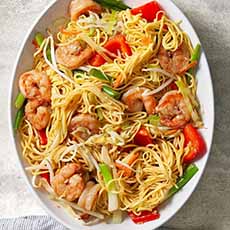
    Shrimp Chow Mein
    [4] If you’d rather have shrimp, check out this recipe for Shrimp Chow Mein (photos #4 and #5 © Taste Of Home).

      RECIPE: CHICKEN CHOW MEIN
     
    National Noodle Day is celebrated on October 6th, a great day to celebrate dishes like chow mein, Lo Mein, and other noodle-based recipes.

    Chow mein is a Cantonese term that literally means “fried noodles.” The dish comprises stir-fried noodles mixed with vegetables, protein (beef, chicken, pork, shrimp, tofu), and a savory sauce. Chow main is characterized by its crispy, texture, distinguishing it from lo mein, which is boiled and soft.

    Ingredients

  • 1/2 cup soy sauce, divided
  • 3 tablespoons hoisin sauce, divided
  • 3 teaspoons oyster sauce, divided
  • 1/2 teaspoon chili oil
  • 1/2 teaspoon toasted sesame oil
  • 3/4 pound skinless, boneless chicken thighs
  • 1 pound dried chow mein noodles
  • 3 tablespoons peanut oil divided
  • 1 tablespoon unsalted butter
  • 1/4 pound (1 cup) button mushrooms, quartered
  • 3 garlic cloves, minced
  • 4 green onions, trimmed and sliced diagonally
  • 1/2 pound fresh cherry belle† chile peppers, stems and seeds removed,thinly sliced
  • 1/4 pound sugar snap peas, strings removed, halved crosswise
  • Salt and freshly ground black pepper
  •  
    Preparation

    1. COMBINE 1/4 cup soy sauce. 1 tablespoon hoisin sauce, 1 teaspoon oyster sauce, and chile and sesame oils in a large bowl. Add the chicken and cover the bowl with plastic wrap. Place in the fridge and let marinate, stirring often, for 1 hour.

    2. PREPARE the noodles according to package directions. Rinse with cold water; drain.

    3. PREHEAT the oven to 350°F. Heat 1 tablespoon peanut oil and the butter in a large wok or ovenproof skillet. Add the chicken and cook 2 minutes per side. Transfer to the oven and bake until the chicken is completely cooked through and a meat thermometer inserted into the thickest part reads 165°F, about 15 minutes. Cool the chicken until it can be handled, then shred it.

    4. HEAT the remaining 2 tablespoons of peanut oil in a wok or large skillet over high heat. Add the mushrooms and cook, stirring occasionally, for 2 minutes.

    5. ADD the garlic and the remaining 1/4 cup soy sauce, and the remaining hoisin and oyster sauces, the noodles, green onions, chiles and sugar snap peas. Cook, stirring constantly, until the vegetables are crisp-tender.

    6. ADD the shredded chicken to the pan and cook until heated through. Stir in the salt and black pepper to taste. Serve.
     
    How To Shred Chicken

    1. COOL the cooked chicken until you can handle it; it should still be warm. Remove any skin.

    2. USE one hand or a fork to steady the chicken. With the other hand, use a second fork to scrape and tear the flesh into shreds. When the fork gets clogged with chicken shreds, use your fingers or another fork to move them into a bowl.
     
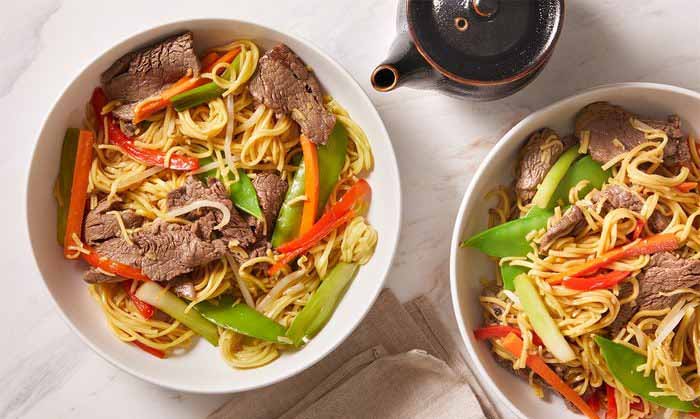
    Beef Chow Mein
    [5] Beef chow mein. Here’s the recipe.
     
    ________________

    *They can be made from buckwheat, but also from potatoes and sweet potatoes.

    **We’re talking real ramen, not the instant fast food.

    †Substitute any cherry pepper or mild to medium chile.


    CHECK OUT WHAT’S HAPPENING ON OUR HOME PAGE, THENIBBLE.COM.


    Comments off


    © Copyright 2005-2026 Lifestyle Direct, Inc. All rights reserved. All images are copyrighted to their respective owners.