THE NIBBLE BLOG: Products, Recipes & Trends In Specialty Foods


Also visit our main website, TheNibble.com.

Eat The Rainbow Gift For Home Cooks & Regenerative Farming

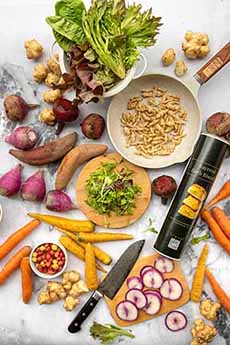
Assorted vegetables from The Chefs Garden
[1] The splendid Eat The Rainbow box from Farmer Jones Farm (photos #1, #2, #3, #4 © Hannah Kaminsky | Bittersweet Blog).

Oca and sunchokes from The Chefs Garden
[2] Oca and sunchokes. Oka, cultivated by the Incas like potatoes, are an underground stem tuber that originated in the high altitudes of the Andes Mountains. Sunchoke, also called Jerusalem artichoke, is a tuber, the root of a species of sunflower native to central North America. Both can be cooked, eaten raw in salads and slaws, or pickled.

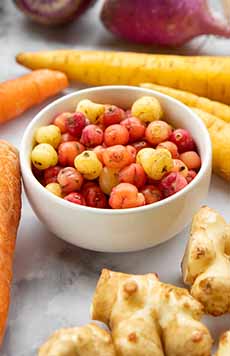
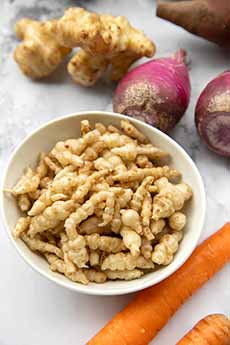
A bowl of crosnes, a.k.a. Chinese artichoke and Japanese artichoke
[3] Crosnes (pronunced “crones”), also known as Chinese or Japanese artichoke, is a root vegetable that can be eaten raw, pickled, dried or cooked. Here’s more about them.

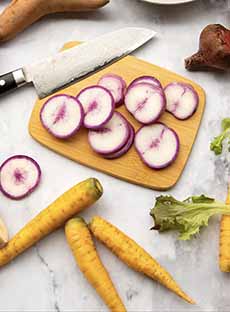
Purple daikon radishes, sliced
[4] Purple daikon radish is more rare than the conventional long white Japanese radish. Both can be enjoyed raw, pickled, or cooked.

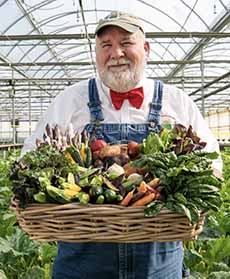
Farmer Lee Jones with a large basket of produce
[5] Farmer Lee Jones (photos #5 and #6 © Farmer Jones Farm).

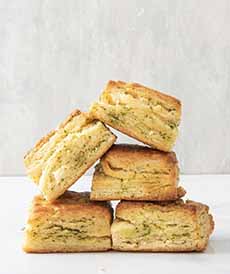
Flaky biscuits made with fresh herbs
[6] Buttery biscuits to eat with your veggies. With each flaky bite, you’ll find earthy notes of fennel, parsley, chervil, and chives.


With Mother’s Day and Father’s Day on the radar, here’s an exciting gift for any cook who knows the difference between good and great: The “Eat The Rainbow” box from Farmer Jones Farm.

For more than 40 years, The Chef’s Garden has been growing fine and specialty* vegetables—heirloom varieties, herbs, microgreens, and more.

Their produce has been sold exclusively to top chefs at the world’s most discriminating restaurants.

It’s now available for home delivery from the Jones Family Farm to you and to any lucky home cooks you would like to gift.
 
 
BETTER FLAVOR & BETTER NUTRITION!

You’ll delight not only in the freshest vegetables—pulled from the earth to fill your order—but in those that taste even better than those a home garden.

The vegetables are grown to taste better, by a devoted team under the guidance of “Farmer” Lee Jones (photo #5) and Bob Jones, Jr. They helm both The Chef’s Garden and the Jones Family Farm.

How are they are grown to taste better…and be more nutritious, too?

Following in the footsteps of their father, Bob Jones, Sr., the farms employ traditional regenerative farming methods combined with innovative technology.

A dedicated research center at the farm tests everything—seeds, soil, water, and other factors—to exact the finest tastes.

While everything is grown to maximize flavor, the efforts have delivered a huge bump in nutritional value as well: 30%, 50%, even 100% increase over the USDA averages.
 
 
REGENERATIVE FARMING MAKES A DIFFERENCE

There’s more about regenerative farming below, but in a nutshell, it involves using special techniques to create healthy soil, which in turn grows healthy crops that provide the maximum in flavor and nutrition.

The crops are grown slowly and gently in full accord with Mother Nature.

Regenerative farming is at the heart and soul of Farmer Jones Farm and The Chef’s Garden.
 
 
GET YOUR “EAT THE RAINBOW BOX”

Head to FarmerJonesFarm.com.

You can make a one-time purchase or have a box sent weekly or monthly for as long as you like.

The box will always include the best of the week, a mix of the most delicious “familiar” vegetables plus something new to try. A recent box we had included:

  • Bull’s Blood Beets
  • Carrots (two heirloom varieties, orange and yellow)
  • Crosnes (photo #3)
  • Microgreens
  • Mixed sweet potatoes
  • Peruvian Oca (photo #2)
  • Purple daikon (ninja radishes—photo #4)
  • Red leaf lettuces
  • Sunchokes (Jerusalem artichokes)
  •  
    Plus:

  • A cylinder of handmade herbed biscuits—with a QR code to the recipe so you can make more (photo #6)
  •  
    While you’re on the website, check out these farm-made goodies:

  • Carrot Marmalade
  • Pepper Marmalade
  • Tomato Marmalade
  • Viola and Champagne Jelly
  •  
     
    WHAT IS REGENERATIVE FARMING?

    Traditional regenerative farming methods comprise a variety of practices aimed at restoring and enhancing the health of soil and the agricultural ecosystem overall, while promoting sustainable food production. Some of these methods include:

  • Crop Rotation: Different crops have different nutrient needs and growth patterns. Rotating them can help prevent soil depletion and pest buildup while improving soil fertility.
  • Cover Cropping: Planting cover crops, such as legumes or grasses, between cash crops (those that will be sold) helps to protect and improve soil health. Cover crops reduce erosion, suppress weeds, and add organic matter to the soil when they decompose.
  • No-Till or Reduced Tillage: Tillage is the agricultural preparation of soil by mechanical agitation such as digging, stirring, and overturning. Traditional agriculture often involves intensive tillage, which can lead to soil erosion, loss of soil structure, and decreased soil fertility. No-till or reduced tillage minimizes soil disturbance, preserves soil structure and promotes the activity of soil organisms.
  • Agroforestry: Integrating trees and shrubs into agricultural systems can engender improved soil health, increased biodiversity, and enhanced resilience to climate change.
  • Composting and Mulching: Recycling organic matter through composting helps to increase soil organic carbon, which in turn improves soil structure, fertility, and moisture retention. Mulching with organic materials such as straw, leaves, or crop residues helps to suppress weeds, conserve soil moisture, and regulate soil temperature.
  • Integrated Pest Management: IPM involves using a combination of biological and mechanical methods to manage pests, diseases, and weeds, minimizing reliance on synthetic pesticides and herbicides. This is done through the use of natural predators and beneficial organisms as preventatives.
  • Water Management: Water conservation techniques such as rainwater harvesting, drip irrigation, and contour farming help to reduce water usage, minimize soil erosion, and improve water quality.
  • Livestock Integration: Integrating livestock into cropping systems provides multiple benefits, including nutrient cycling, weed and pest control, and diversification of farm income. Managed grazing systems, rotational grazing, and mixed crop-livestock systems are examples of livestock integration practices.
  •  
    These traditional regenerative farming methods focus on working with natural processes to enhance soil health, biodiversity, and ecosystem resilience while promoting sustainable food production for current and future generations.
     
     
    > The history of agriculture.
    ________________
     
    *Specialty vegetables are those introduced or reintroduced that are native to Africa, the Caribbean, Europe, Latin America, and the Pacific Basin. Examples include the crones and oca shown in the photos, cipolines, daikon, elephant garlic, Japanese eggplant, squash blossoms, and heirloom varieties of traditional vegetables. Specialty fruit examples include cherimoya, currants, dragonfruit, gooseberries, lingonberries, litchi, and startfruit, among others.


    CHECK OUT WHAT’S HAPPENING ON OUR HOME PAGE, THENIBBLE.COM.


    Comments off

    The History Of Chicago Deep Dish Pizza & Stuffed Pizza

    April 5th is National Deep Dish Pizza Day, one of 12 annual pizza holidays. That’s a lot of pizza parties, but for today: the history of Chicago-style pizza, also known as deep dish pizza.

    The differences between Chicago deep dish pizza, stuffed pizza, and Detroit-style pizza follow.
     
     
    > A year of 12 pizza holidays.

    > 40 different types of pizza.

    > The history of pizza in Italy.
     
     
    THE HISTORY OF CHICAGO-STYLE DEEP DISH PIZZA

    Chicago deep-dish pizza, also called Chicago-style pizza, is a pizza cooked in a pan with high edges, instead of on a baking tray or a flat pizza peel.

    The deep pan affords a pie of several times the toppings/fillings of conventional pizza, and a crust almost as thick as a tart crust (and much taller—photos #1 and #2).

    The layers are different, too. Because the deep dish needs to bake longer, the sauce layer is on top so the cheese doesn’t burn.

    Thus, the fillings are layered in an inverted order, with the cheese at the bottom, meat and poultry, seafood, vegetables, and fruits (chiles, olives, pineapple) in the middle, and lastly, the sauce.

    You should select the fillings that meet your fancy, including leftover meats and even leftover pasta!

    Deep-dish pizza sauce is often chunky, not the smooth marinara that tops a regular slice. While the tastes are familiar, the experience is delightfully different.

    Pizzeria Uno’s founder, Ike Sewell. is often credited with inventing Chicago deep dish pizza, in 1943. But the reality is slightly different.

    According to Tim Samuelson, Chicago’s official cultural historian, there is not enough documentation to determine with certainty who invented Chicago-style deep-dish pizza. A 1956 article from the Chicago Daily News asserts that Uno’s original pizza chef Rudy Malnati developed the recipe.

    And Michele Mohr from the Chicago Tribune reports that, according to the descendants of Saverio Rosati, the menu at Rosati’s Authentic Chicago Pizza has included deep-dish since the restaurant opened in 1926 [source].

    Regardless, we’re glad it made out out of Chicago so the rest of us can have our share.
     
     
    The Differences Between Chicago Deep Dish Pizza & Chicago Stuffed Pizza

    Stuffed pizza was also invented in Chicago, but with differences. It is a variant of deep dish pizza created by Rocco Palese, owner of Guy’s Pizza and Nancy’s Pizza, based on his mother’s recipe for scarciedda.

    A savory Italian Easter cake, scarciedda is stuffed with ricotta cheese, meats and other fillings (here’s a recipe).

  • The Crust. Deep-dish pizza has a crust that rises up the sides of the pan, to a height of two inches or so. Stuffed pizza is even deeper. Scarciedda, which inspired it, has an additional layer of crust, like the top crust on a pie (photo #3).
  • The Cheese. Deep-dish pizza has more tomato sauce and less cheese in comparison to stuffed pizza. Stuffed pizza is a cheese lover’s delight, loaded with much more cheese (several ounces!) and less sauce.
  • The Density. Stuffed pizzas fillings are typically much more dense—pressed as closely together as a frittata (photo #3 and #4).
  •  
    Stuffed pizza was created by Rocco Palese’s wife, Nancy Palese, in 1974 at the eponymous Nancy’s Pizza. It had a completely different taste than deep-dish, with more crust and loaded with even more ingredients.
    Here’s more about it.
     
     
    The Differences Between Chicago Deep Dish Pizza & Detroit-Style Pizza.

    Pizzerias in Detroit, Michigan, created their own version of the Chicago deep-dish pizza, called, unsurprisingly, Detroit-style pizza (photo #4).

    Instead of a round pizza, Detroit chose a rectangular pan 8″ x 10″ x 2.25″. It has a lighter crust with an exterior crunch.

    Brick or white Cheddar cheese is added to the mix of mozzarella and romano. Here’s a recipe.

    As with Chicago-style pizza, Detroit uses an inverted-layers approach with cheese on the bottom, then meats and vegetables, with the sauce on top.

    Here’s a fun idea for a pizza dinner: One of each pie!


    Chicago Deep Dish Pizza with cheese dripping from a slice
    [1] Make this deep dish pizza at home, with five suggested toppings. Here’s the recipe (photo © Ambitious Kitchen).

    A slice of Chicago Deep Dish Pizza
    [2] Here’s another Chicago deep dish pizza recipe (photo © The Recipe Critic).

    A slice of Scarciedda, a savory Easter pie with both bottom and top crusts, that inspired stuffed pizza
    [3] Scarciedda, the savory Easter pie that inspired stuffed pizza (photo © Nancy’s Pizza).

    Detroit Pizza Side View Of The High Crust
    [4] The side crust view of a Detroit-style pizza (photo © Joy Ride Pizza).

    Nono's Stuffed Pizza with Pepperoni
    [4] A tall stuffed pizza (photo © Nono’s Stuffed Pizza).


    CHECK OUT WHAT’S HAPPENING ON OUR HOME PAGE, THENIBBLE.COM.


    Comments off

    RECIPE: Cheesecake Celery Sticks For April Fool’s Day

    A plate of Cheesecake Celery Sticks
    [1] Crunchy cheesecake bites (photos #1 and #2 © Duda Fresh).

    A bag of Dandy celery stalks
    [2] Start with celery stalks.


    So…you’d think that Cheesecake Celery Sticks are an April Fool’s Day joke.

    After all…can crunchy celery sticks, a savory snack, be turned into a dessert with cheesecake filling and chocolate sauce?

    Well…yes. April Fools!

    > The history of April Fool’s Day.

    > The history of cheesecake.

    > The history of celery.

    > More ways to use celery.
     
     
    RECIPE: CHEESECAKE CELERY STICKS

    Is it a snack? Is it a dessert? You decide!
     
    Ingredients For 6 Servings

  • 8 ounces cream cheese, softened to room temperature
  • 4 teaspoons powdered sugar
  • 1/2 teaspoon vanilla extract
  • 6 Dandy® Celery sticks, cut in half crosswise
  • 2 Graham crackers, crumbled
  • Garnish: Chocolate sauce, for garnish
  •  
    Preparation
     
    1. COMBINE in a bowl the cream cheese, powdered sugar, and vanilla extract. Stir well.

    2. SPREAD 1 tablespoon of the cream cheese mixture evenly down the center of each celery stick.

    3. TOP each with a sprinkle of graham cracker crumbles.

    4. GARNISH with a drizzle of chocolate sauce.


    CHECK OUT WHAT’S HAPPENING ON OUR HOME PAGE, THENIBBLE.COM.


    Comments off


    © Copyright 2005-2026 Lifestyle Direct, Inc. All rights reserved. All images are copyrighted to their respective owners.