THE NIBBLE BLOG: Products, Recipes & Trends In Specialty Foods


Also visit our main website, TheNibble.com.

PRODUCT: Facundo Baccardi Premium Rum & A Chocolate Banana Cocktail Recipe

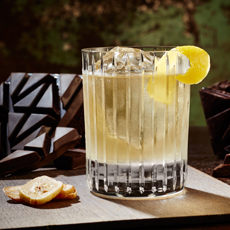
Chocolate Banana Rum Cocktail
[1] Chocolate banana cocktail. The recipe is below (photos #1, #2 and #3 © Bacardi).

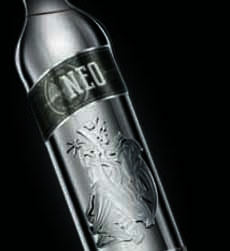
Facundo Neo Rum
[2] Ready for its close up: Facundo Neo rum.

Facundo Rum Collection
[3] The Facundo Bacardi Rum Collection.

  Weekends are a time for testing new cocktail recipes. The Chocolate Banana Cocktail Recipe below is from the Facundo Rum Collection, a luxury portfolio.

If we were lucky enough to have a bottle, we’d sip it straight as the rum was intended, and substitute another white rum in the cocktail.

Bacardi’s Facundo Bacardi Rum Collection, introduced in 2013, is the distiller’s commitment to the emerging category of premium sipping rums. The rums are made from the company’s private rum reserve: the finest batches of rum aged for very long times.

The line was championed by Facundo L. Bacardi, who strongly felt that the company should be a player in the emerging category of premium rums.

The four expressions range from $45-$250 a bottle. They are made in different styles and produce a wide range of flavor experiences.

For example, the first rum in the collection, Facundo Neo, is a blend of rums that have been aged for up to eight years.

It’s not exactly your basic quality brand white rum, used to make a Mojito or Piña Colada. Regular white rum is aged for a year, sometimes more.

The result of the extra aging and the fact that the “best” barrels were aged: Neo’s flavor profile is beautifully balanced, with notes of banana, almonds, and freshly cut grass. To experience them, sip them neat or on the rocks.

If you’re a person for whom money is no object, you can use whatever rum you like in mixed drinks. But truth to tell with the recipe below, after you mix vermouth and two liqueurs with the rum, only the most professional palate could articulate the difference.
 
 
A NOTE ABOUT AGED RUM

It’s easy to understand the age categories of tequila, scotch, and other spirits. The producing countries have laws that govern, among other things, how long the spirit has been aged prior to bottling.

For example, Mexican laws govern how many months a tequila can be aged in order to be called silver, reposado, anejo, extra anejo tequilas (details).

With rum, aging can last from one to thirty years or more, but you often won’t find a number on the bottle*. There are exceptions, such as Appleton (the top expression is 50 years old!) and Flor de Cana.

The Facundo expressions include Facundo Neo Rum, Facundo Eximo Rum, Facundo Exquisito Rum and Facundo Paraiso XA Rum. Each is aged longer than the next. But as with most rums, don’t expect to know how long that aging period was.

That’s because, unlike other spirit-producing areas, Caribbean countries did not stake their claim to exclusivity by passing appropriate laws to protect their rights, i.e., that only alcohol distilled in the Caribbean can be called rum. (Scotch can only be produced in Scotland, bourbon can only be produced in the U.S., tequila in Mexico, etc.)

 
As a result, rum has no consistent standards among countries. Beyond the Caribbean, rum is now produced in Australia, India, Reunion Island, South America, and elsewhere around the world.

That makes any rules and regulations hard to enforce. Even proofs vary (40 proof vs. 50 proof for white rum, for example).

Thus, Mexico requires white rum to be aged a minimum of 8 months. The Dominican Republic requires one year. Venezuela requires two years.

Naming standards also vary. Argentina defines rums as white, gold, light, and extra light. Barbados calls them white, overproof, and matured. The U.S. defines the categories as rum, rum liqueur, and flavored rum [source].

Some distillers use the word “premium” to describe their best-aged spirits. Another common description is the word “anejo,” old. “Gran anejo” is even older.

But none of these terms tells you how long the rum has aged. It’s the blender or distiller who decides what to call it.

In their marketing literature, you’ll find terms like aged, aged even longer, and aged extensively—without explanation. Here’s an article that tries to explain what cannot be explained.

So don’t try to figure it out: Just enjoy it.
 
 
RECIPE: BANANA CHOCOLATE COCKTAIL

Beyond the Banana Daiquiri: a banana-chocolate cocktail for those who like to drink their dessert.

Ingredients

  • 1½ parts Facundo Neo rum (substitute other white rum)
  • ½ part dry vermouth
  • ¼ part Giffard Banane du Brésil (or other banana liqueur)
  • ¼ part Giffard Crème de Cacao white (or other white crème de cacao)
  • Garnish: lemon peel for garnish and dried banana chips
  •  
    Preparation

    In a mixing glass, stir all the ingredients with plenty of ice. Strain into a rocks glass with a large ice cube. Garnish with a dry banana chip and a lemon peel.

    ________________

    *Age is beginning to appear in some rum bottles, such as Appleton and Flor de Cana aged rums. But again, statements of age may vary by country. For example, a Scotch may be a blend of ages from 8 to 15 years, but by law it has to specify the youngest Scotch in the blend, e.g., 8 Year Old. It’s too soon to tell what will happen with the rum category as a whole.


    CHECK OUT WHAT’S HAPPENING ON OUR HOME PAGE, THENIBBLE.COM.


    Comments off

    TIP OF THE DAY: Quick & Easy Paella Recipe For National Paella Day

    March 27th is National Paella Day. Many people think that paella is a complex, time-consuming dish—and classic recipes can be.

    But you can make this simplified version from Good Eggs easily on any weeknight.

    After 20 minutes of prep time, 20 mins active time plus 40 minutes simmer time.

    RECIPE: SPRING SHRIMP PAELLA

    Ingredients For 4 Servings

  • 1 pound shrimp, peeled and cleaned
  • Optional: 1/2 pound mussels or clams
  • ¾ cup arborio rice, rinsed
  • 1 yellow onion, diced
  • ¼ teaspoon (generous) saffron threads
  • 4 cloves garlic, crushed or minced
  • 12 ounces fresh spring peas or snap peas, cut on a diagonal (or a mix)
  • 1¼ cups chicken broth
  • 1 lemon, zested and juiced
  • 2-3 tablespoons olive oil
  • 1 teaspoon sea salt, more as desired
  • Garnish: 1/3 cup fresh parsley, roughly chopped (save the stems*)
  •  
    Preparation

    1. PLACE a large pan over medium heat (a skillet or roasting pan will do). Add in 2-3 Tbsp of olive oil, and add the onions. Crush the saffron threads between your fingers and sprinkle over the onions. Cook, stirring occasionally until softened. Add in the garlic and cook for another minute.

    2. ADD the rice, broth, lemon juice and zest, and stir until well combined. Turn the heat to high and bring liquid the to a boil. Cover, turn the heat to low, and simmer for 25 minutes.

    3. ADD the peas and 1 teaspoon salt, and stir to blend. Cover and simmer another 10 minutes. Taste and season with more salt if desired.

    4. PLACE the shrimp in an even layer on top of the mixture. Don’t stir, but cover and cook another 10 minutes.

    5. REMOVE the cover and turn the heat to medium. Continue to cook without stirring until the shrimp are fully cooked. Watch carefully to avoid burning the bottom, although a golden-brown crunchy, crusty rice bottom crust—called soccorat—is ideal.

    ________________

    *Save the parsley stems: They add excellent flavor to soups and stews. Parsley stems also prevent artichokes from browning. Just drop them in a bowl of water with the cut artichokes. You can store the stems in the freezer.
     
    MORE ABOUT PAELLA

  • Paella History & Types
  • Paella On The Grill
  •  
     
    WHAT IS ARBORIO RICE

    If you want a creamy risotto or paella, you need to use Arborio rice.

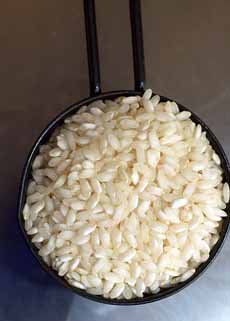
    This medium-length, round-grained rice is named after the town of Arborio, in Italy’s Po Valley, where it is grown. The grains have a more beige color with a characteristic white dot at the center of the grain.

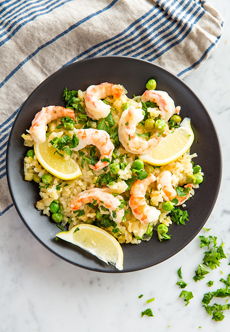
      Easy Shrimp Paella

    Shrimp Paella

    Scoop Of Arborio Rice
    [2] You don’t need a special paella pan like this one; but here’s why it helps—plus other uses for it (photo courtesy Imusa). [3] Arborio rice: more beige, and much more creamy when cooked (photo courtesy A Sassy Radish).

     
    Developed to create creamy risottos, Arborio rice develops its creamy texture around a chewy center (the creaminess comes from a high starch content). It has an exceptional ability to absorb flavors.

    Arborio is a cultivar of japonica rice, the same variety that produces the other “sticky rices” including mochi and sweet rice.

    Pricier, creamier rices developed by Italians for their beloved risotto are canaroli rice and vialone nano.

    Rice pudding fans: These three rice varieties make creamier rice pudding, too.

    Here are the different types of rice.
      

    Comments off

    TIP OF THE DAY: Fried Oysters On Greens, A First Course

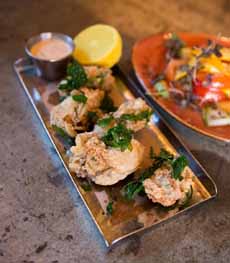
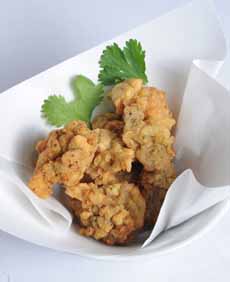
    Fried Oysters
    [1] We enjoyed these at a rooftop restaurant in Manhattan (photo © McKittrick Hotel | NYC).

    Fried Oysters
    [2] Just a taste, from Tsunami Sushi in Lafayette, Louisiana (photo © Tsunami Sushi).

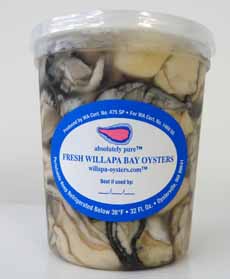
    Shucked Oysters Quart
    [3] A quart of oysters from our favorite oyster grower, Willapa Oysters. They’re grown in the cleanest waters in the USA (photo courtesy Willapa Oysters).

      Every so often we pass a quart of shucked oysters in our fish store, and think: Do we have time to fry oysters tonight?

    We like to serve fried oysters as a first course, on a bed of greens with remoulade sauce, which also dresses the salad.

    There are different approaches to fried oysters. Some people dredge them in flour, then an egg wash, then bread crumbs.

    If the oysters are good, they should release their flavor as close to your palate as possible. No extra layer of breading is required…or desired.

    That’s also why we won’t turn the oysters into a po’ boy: The bread gets in the way of tasting the gems of the sea.

    The remoulade recipe is a spicier variation of the French classic: a version you’d find served with fried oysters in New Orleans.
     
     
    RECIPE: FRIED OYSTERS

    Ingredients Per Quart Of Oysters (32 Meats*)

    For The Oysters

  • 1 quart shucked medium-large oysters
  • 1 cup whole milk or buttermilk
  • 1 teaspoon garlic powder
  • 1 teaspoon paprika
  • Dash hot sauce
  • 1 cup all purpose flour
  • 1 cup cornmeal (or use 2 cups all purpose flour)
  • Salt and pepper to taste
  • Canola oil for frying
  • Fresh parsley
  • Lemon wedges

  • For The Louisiana Remoulade Sauce

    You can make the remoulade 1 to 2 days in advance to let the flavors meld.

  • 1 cup mayonnaise
  • 1-2 tablespoons Dijon or Creole mustard
  • 1 tablespoon sweet paprika
  • 2 teaspoons prepared horseradish
  • 1-2 teaspoons Cajun or Creole seasoning†
  • 1 teaspoon pickle juice or apple cider vinegar
  • 1/2 teaspoon paprika
  • 1/4 teaspoon garlic powder
  • Hot sauce to taste
  • Salt to taste
  •  
    For Serving

  • Mesclun or other salad mix
  •  
    Preparation

    You can use a pot or a deep skillet to fry.

    1. MAKE the remoulade sauce: Combine the ingredients and refrigerate until ready to serve.

    2. DRAIN the shucked oysters. Season the milk with garlic powder, paprika and hot sauce, and soak the oysters for 30 minutes before frying.

    3. PREHEAT the canola oil to 350°F. While the oil is heating…

    4. WHISK together the flour, cornmeal, salt and pepper together in a separate casserole dish. When ready to fry, drain the oysters and dredge through the flour mixture, coating completely. Tap off the excess flour.

    5. FRY in batches of 4 or 5 (the oysters need space between them), using tongs to place the oysters in the hot oil. Cook until golden brown, about 2 minutes (“rare” is better for juicy, succulent oysters).

    6. DRAIN for a minute on a paper towel-lined plate. Serve hot atop the greens with a lemon wedge and ramekin of remoulade sauce.

    ________________

    *There are approximately 32 medium-large shucked oysters per quart (4″ across in the shell before shucking).

    †Creole seasoning is a mix of paprika, cayenne pepper, oregano, dried sweet basil and other spices, depending on the producer. Cajun seasoning is a mix of garlic powder, paprika, black pepper, onion powder, cayenne pepper, oregano, thyme, and red pepper flakes. If you don’t want a spicy remoulade you can leave it out; or mix some of the ingredients you have to get the 1-2 teaspoons for the recipe.


    Comments off


    © Copyright 2005-2026 Lifestyle Direct, Inc. All rights reserved. All images are copyrighted to their respective owners.