THE NIBBLE BLOG: Products, Recipes & Trends In Specialty Foods


Also visit our main website, TheNibble.com.

Summer Fruits & Vegetables: What’s In Season

Following our recent article on spring produce, here’s what’s in season for summer. Not everything may be available in your area, but what is there should be largely American-grown—not imported from another hemisphere.

Some of the items are harvested for only a few weeks; others are around for months. So peruse the list, note what you don’t want to miss, and add it to your shopping list.

The list was created by the Produce For Better Health Foundation. Take a look at their website, FruitsAndVeggiesMoreMatters.org for tips on better meal planning with fresh produce.

SUMMER FRUITS

  • Acerola/Barbados Cherries
  • Apricots
  • Asian Pear
  • Black Crowberries
  • Black Currants
  • Blackberries
  • Blueberries
  • Boysenberries
  • Breadfruit
  • Cantaloupe
  • Casaba Melon
  •    
    lychee-baldorfood-230

    If you’ve never had fresh lychees, this is the season to get your fill! Photo courtesy Baldor Food.

  • Champagne Grapes/Corinthian Currants/Zante Currants
  • Crenshaw Melon
  • Durian
  • Elderberry
  • Fig
  • Galia Melon
  • Grapefruit
  • Grape
  • Honeydew Melon
  • Jackfruit
  • Lime/Key Lime
  • Loganberry
  • Longan
  • Loquat
  • Lychee (photo above)
  • Mulberry
  • Nectarine
  • Olallieberry*
  • Passion Fruit
  • Peach
  • Persian Melon
  • Plum
  • Raspberry
  • Rose Apple†
  • Sapote/Sapodilla
  • Strawberry
  • Sugar Apple
  • Watermelon
  •  
    *Olallieberries, developed in 1949 by the U.S. Department of Agriculture at Oregon State University by crossing a loganberry with a youngberry. They are two-thirds blackberry, one-third European red raspberry.

    †Rose apples are not related to European apples (family Rosaceae), which originated in Turkey. They are members of the myrtle family, Myrtaceae. Native to the East Indies, they are also known as plum roses and Malabar plums.


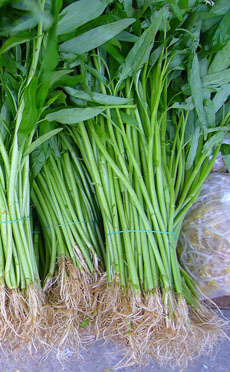
    ong-choy-water-spinach-Eric-inSF-Wiki-230
    Ong choy, Chinese water spinach. Photo by Eric | Wikimedia.
     

    SUMMER VEGETABLES

  • Anaheim Chile
  • Armenian Cucumber‡
  • Beet
  • Bell Pepper
  • Butter Lettuce
  • Chayote Squash
  • Chanterelle Mushrooms
  • Chinese Long Bean
  • Corn
  • Crookneck Squash
  • Cucumber
  • Eggplant
  • Endive
  • French Bean
  • Garlic
  • Green Bean
  • Green Soybean (Edamame)
  • Heart of Palm
  • Jalapeño Chile
  • Lima Bean
  • Okra
  • Ong Choy Water Spinach (photo above)
  • Pea
  • Radish
  • Shallot
  • Sugar Snap Pea
  • Summer Squash
  • Sweet Onions
  • Tomatillo
  • Tomato
  • Winged Bean
  • Yellow Squash
  • Yukon Gold Potato
  • Zucchini
  •  
    Enjoy the feast!

     
    ‡The Armenian cucumber, Cucumis melo var. flexuosus, is a long, slender fruit which tastes like a cucumber and looks somewhat like a cucumber inside. It is actually a variety of muskmelon, a species closely related to the cucumber. However, cucumbers and melons are botanical first cousins. Both are from the binomial order Cucurbitales, family Cucurbitaceae and genus Cucumis, differing only at the species level. Watermelon rind is edible and tastes like cucumber. That’s why it is often turned into pickles, like cucumbers.
      

    Comments off

    TIP OF THE DAY: Lavender For Summer

    Today is the first day of summer. When we think of summer, we think of lavender.

    Lavender is a flowering plant, a genus of 39 species that originated in the Mediterranean, northern and eastern Africa and southwest Asia, including India. The most widely cultivated species is English lavender, Lavandula angustifolia. Though not native to England it has long been the preferred variety grown there.

    As noted in Wikipedia, the names “English lavender,” “French lavender” and “Spanish lavender” are “imprecisely applied.”

    The word lavender may be derived from Latin livere, “blueish.”

    It is grown as an ornamental flower, and also as a culinary ingredient. The oil is used to scent beauty and household products. Medicinally, it was used as a disinfectant and antiseptic by ancient herbalists. It became a cosmetic herb and a tonic due to its popularity with the English royalty.

    The different lavender types vary in the potency and flavor of the flowers and oils. English lavender is the sweetest and the most commonly used.

    If you look for lavender recipes, you’ll find almost every food embellished with lavender. We can’t possibly narrow the selection, so look for what you like.

    What we will do is tell you how to infuse lavender in alcohol and simple syrup, and make lavender cocktails.


    lavender-cocktail-drysoda-230

    Lavender makes a summer soft drink or cocktail. Photo courtesy DrySparkling.


    INFUSING LAVENDER IN ALCOHOL

    When lavender buds are steeped in alcohol, the essential oils are extracted from the flowers and infused into the alcohol.

    Add sprigs of to a bottle of gin, vodka or tequila, let it infuse in a warm, dark place for a week or two, then put the bottle in the freezer so it will be chilled and ready for summer drinks.

    Note that you need organic lavender: You don’t want pesticides in your food.

    Our favorite is lavender-infused gin. Lavender is a great match with the botanicals in the gin.

    Lavender is a great pairing with lemon, so don’t hesitate to add lavender to a bottle of lemon vodka. of gin and lavender make an absolutely fabulous gin and tonic! A sprig of lavender in a martini with a twist of lemon is another intriguing synergy.


    dry-soda-grouping-230
    Dry Sparking is a delicious soft drink or mixer. It’s a non-alcoholic pairing for cheese, grilled fish, hazelnuts, pork tenderloin, salted caramel and tiramisu. Photo courtesy Dry Sparkling.


    LAVENDER MARTINI

    Ingredients Per Drink

  • 2 ounces gin
  • 1/2 ounce dry vermouth
  • 1/2 ounce lavender simple syrup
  • 2 dashes orange bitters
  • Garnish: lavender sprig
  •  
    Preparation

    1. COMBINE the ingredients into a cocktail shaker filled with ice.

    2. SHAKE well and strain into a chilled cocktail glass. Garnish with the lavender sprig.
     
    LAVENDER SIMPLE SYRUP

    Infuse lavender buds in this simple syrup recipe. Use 1 tablespoon dried lavender buds per each cup of water.

     
    LAVENDER SUGAR RIM

    Put a lavender rim on any cold or hot beverage where you’d like the extra flavor. Try it with iced tea!

    Ingredients

  • 4 tablespoons dried lavender flowers
  • 3 cups sugar
  •  
    Preparation

    1. PLACE the lavender and sugar in a food processor and pulse to mix evenly. Flecks of lavender should be evenly distributed throughout the sugar.

    2. MAKE the rim by dipping the glass rim in water, about 3/8″ deep. Twist the glass in a dish of lavender sugar to make the sugar rim.

    3. STORE unused sugar in an airtight jar, out of direct light.
     
     
    MORE LAVENDER IDEAS

    We’ve enjoyed lots of lavender products, including:

  • Lavender cheese
  • Lavender chocolate bars
  • Lavender honey
  • Lavender marshmallows
  • Lavender salt caramels
  • Lavender tea
  • Lavender white hot chocolate
  • Lavender lemonade
  • Lavender iced tea
  • Lavender scones
  • Lavender whipped cream
  • Lavender water
  • Blackerry Lavender Fizz
  •   

    Comments off

    TIP OF THE DAY: Uses For Cream Liqueur

    Introduced in 1974, Baileys Irish Cream was the first cream liqueur on the market. Rich and, of course, creamy, it was a hit, and created the category of cream liqueur.

    Dozens of cream liqueurs have debuted since, from the familiar (chocolate, coffee, maple) to the exotic (amarula, the fruit of the African marula tree).

    A new contender is SomruS, which tastes like vanilla liqueur with exotic notes. It is made from “pure Wisconsin dairy cream and hand-crafted Caribbean rum mixed with the flavors of cardamom, saffron, almonds, pistachios and rose.”

    SomruS is called “The Original Indian Cream Liqueur” by its producer, bringing “the flavors, history and culture of the Indian sub-continent.”

    It is manufactured in the U.S. by SomPriya Fine Spirits of Chicago.

    Introduced last October, SomruS quickly racked up some prestigious citations, including Cream Liqueur of the Year from New York International Spirits Competition and a place on the Top 50 Spirits List of the Wine Enthusiast.

       
    somrus-indian-liqueur-230

    The bottle is fashioned after an ancient Indian decanter. Photo courtesy SomruS.

     
    The website says that it was created to complement Indian cuisine and represent “the vibrant culture that encompasses some one-fifth of the world’s population.”

    The one problem we have is with the marketing. Calling it the “Nectar of the Gods” is a bad call of the over-enthusiastic and under-informed.

    The nectar of the gods, as most of us learned in grade school, is mead—an alcoholic beverage created by fermenting honey with water. In ancient times, it was consumed throughout Europe, Africa and Asia (and by all the Greek gods).

    We would also argue that “the original Indian cream liquer” is Voyant Chai, introduced ten years ago and also made in the USA. What’s more Indian than chai?

    Are we too nitpicky, or simply focused on accuracy?


    vanilla-kulfi-somrusFB-230
    Drizzle cream liqueur over a dish of ice cream. Photo courtesy SomruS.
      WAYS TO USE CREAM LIQUEUR

    That doesn’t take away from the fact that SomruS is delicious, rich and nuanced. It’s a versatile liqueur for:

  • Straight sipping
  • Cocktails (there are many on the SomruS Pinterest stream)
  • Coffee, hot or iced
  • Tea, ditto
  • In dessert recipes: puddings, cream pies and tarts
  • As a topping for ice cream
  • In homemade vanilla ice cream
  • To flavor whipped cream (instead of vanilla extract)
  • In cake icing
  • In an adult milkshake
  • As an alcoholic alternative to pancake and waffle syrup
  •  
    It’s a handsome gift option, too.


    Check out the SomruS website. If you can’t find it locally, SomruS is available for online orders from PassionSpirits.com, which ships to 46 states and overseas. The suggested retail price is $24.99 for a 750ml bottle.


    Comments off

    RECIPE: Burger Eggs Benedict

    Another good idea for Father’s Day brunch: this mashup of Eggs Benedict and a burger. that’s filling enough for lunch or dinner as well.

    The recipe is courtesy Gina of Running to the Kitchen, via Safest Choice pasteurized eggs. Gina used pasteurized eggs for the blender hollandaise sauce, which is not cooked. Pasteurized eggs ensure that there are no dangerous pathogens in the raw eggs.

    Gina serves the recipe open face; but we toasted both halves of the English muffins and served the top on the side. Alternatively, you can use the muffin tops for another meal.

    Prep and cook time is 20 minutes.

    Here’s the history of Eggs Benedict.

    Here’s a Surf & Turf Eggs Benedict Recipe with filet mignon and lobster.

    Here are substitutes for the English muffin.
     
     
    RECIPE: BURGER EGGS BENEDICT

    Ingredients For 4 Burgers

  • 1 tablespoon extra virgin olive oil
  • 5 ounces baby spinach
  • 1 clove garlic, minced
  • 1 tablespoon lemon juice
  • 1 pound ground beef
  • Salt and pepper to taste
  • 4 English muffin bottoms
  • 4 eggs
  • 2 teaspoon Dijon mustard
  • Optional garnish: chives, chopped
  •  
    Ingredients For The Hollandaise Sauce

  • 2 pasteurized egg yolk(s)
  • 1 tablespoon lemon juice
  • 6 tablespoons butter, melted
  • Dash of cayenne pepper
  •  
    Plus

  • 4 English muffins
  •  
    Preparation

    1. HEAT a large skillet over medium-high heat. Add the olive oil, spinach, garlic and lemon juice; cook until wilted. Transfer the spinach to a small dish and set aside.


    open-faced-burger-eggs-benedict
    [1] This Eggs Benedict variation substitutes a burger for the Canadian bacon (photo © Safe EggsSafe Eggs.

    Baby Spinach
    [2] Add a layer of baby spinach (photo © Good Eggs).

    Chopped Chives
    [3] Unless you have great knife skills, it’s easier to snip chives with a kitchen scissors than chop them (photo © A Way To Garden).


    open-faced-burger-eggs-benedict-safeggs230

    Are you hungry yet? Photo courtesy SafeEggs.com.

      2. COMBINE the beef, salt and pepper in a bowl. Mix together until incorporated and form into 4 patties. Cook the burgers in the same skillet used for spinach on medium-high heat for about 4-5 minutes per side until desired doneness. Set the burgers aside.

    3. TOAST the English muffins.

    4. MAKE the hollandaise sauce: Combine the egg yolks, lemon juice, butter and cayenne in a blender. Blend until smooth and well combined. Season to taste with salt and pepper.

    5. ASSEMBLE: Place the burger on top of the English muffin. Place the spinach on top of the burger and a poached egg on top of the spinach. Spoon the hollandaise sauce over the top, sprinkle on the optional chives and serve while warm.


    WHY IT’S FATHER’S DAY, NOT FATHERS’ OR FATHERS DAY

    While Mother’s Day became an official holiday in 1914, Father’s Day wasn’t declared an official holiday until 1972. President Richard Nixon signed a proclamation making Father’s Day a federal holiday that falls on the third Sunday in June.

    At the state level, though, the tradition began much earlier. In Washington State, Sondra Smart Dodd, inspired by a Mother’s Day sermon she attended in 1909, believed there should be a corresponding holiday to celebrate fathers. She gained support for her idea, and the first Father’s Day was celebrated by Washington State in 1910 in June, the month of her father’s birthday.

    Some people wonder why Father’s Day has an apostrophe before the “s.” The quick answer is that Mother’s Day set a precedent. The apostrophe before the “s,” a singular plural, means that Father’s Day (and Mother’s Day) “belongs” to each individual father (and mother).

    If the apostrophe fell after the “s,” the possessive plural, it would be a holiday “belonging” to all fathers as a collective.

    So why does April Fools’ Day take the possessive plural rather than the singular plural? Perhaps because the individual fool doesn’t matter in the same way that each individual parent matters to his/her children.


    Comments off

    DELICACY: Maatjes Herring From The North Sea

    If you like the herring that comes in jars, in wine or cream sauce, we’ve got something so much better for you: nieuwe maatjes herring.

    Through Friday, July 3rd, New York City’s Grand Central Oyster Bar and Restaurant is celebrating the Holland Herring Festival.

    For 35 years, this has been the first American tasting of the season of nieuwe maatjes haring, the wonderful Dutch herring.

    Herring lovers wait all year for the delivery of the cream of the catch to the Oyster Bar. The herring arrives air-expressed from Scheveningen, The Netherlands, a town on the North Sea where the herring fleet makes its home.

    This year, fans had to wait an extra week for the catch, due to stormy North Sea waters that made fishing difficult, and herring with very low fat content. An absence of adequate sunlight meant that there was not enough plankton for the herring feed on, so fishermen waited for conditions to change.


    nieuwe-maatjes-herring-brined-takeaway-wiki-230

    A dish of nieuwe maatjes herring fillets. Photo courtesy Takeaway | Wikipedia.


    But arrive they finally did; the Oyster Bar began serving them yesterday. We were invited to taste them, and we’ll be going back this weekend for more! The catch is limited: Even in The Netherlands, the fish are only available for a month.


    brined-herring-fudder.de-230
    Herring soaking in brine. Photo courtesy Fudder.de.
     

    Succulent and toothsome delicacy known as nieuwe maatjes herring. At the Oyster Bar, Chef Sandy Ingber serves the herring filets with hard-boiled egg, chopped sweet onion and chives.

    The herring filets are priced at $7.00; the herring with garnishes is $7.95 per order. You can walk in and enjoy yours in the bar area, or reserve a table at 212.490.6650.
     
    WHAT IS MAATJES HERRING?

    Nieuwe, pronounced NEE-wuh, means new in Dutch. Maatje, MAH-tyeh, means fermented or brined. The Dutch word for herring is haring.

    After the herring is caught, it is brined* for up to two days, typically in oak barrels. Then, for delivery to the Oyster Bar, it is gutted and the head is removed, The result is a fillet, about five inches long, consisting of both sides of the fish, attached on the non-slit side.

     
    *It is brined in salt water. Raw herring pickled in vinegar is called a rollmop.


    Comments off

    The Nibble Webzine Of Food Adventures
    RSS
    Follow by Email


    © Copyright 2005-2026 Lifestyle Direct, Inc. All rights reserved. All images are copyrighted to their respective owners.