THE NIBBLE BLOG: Products, Recipes & Trends In Specialty Foods


Also visit our main website, TheNibble.com.

FOOD FUN: Make Art With Your Food, Then Eat It

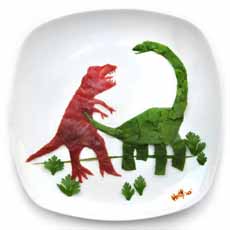
Prosciutto Dinosaur
[1] Get some prosciutto and basil or spinach, and start working (photo courtesy Red Hong-Yi).

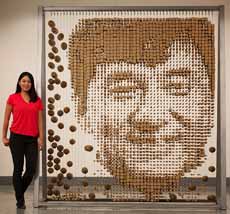
Jackie Chan In Chopsticks
[2] Jackie Chan commissioned this portrait, made from 64,000 chopsticks (photo courtesy Red Hong-Yi).

  Looking for a rainy day project, or to jump-start a new hobby? A fun get-together with friends?

Take inspiration from the edible collages by Malaysian artist Red Hong-Yi, created on dinner plates [photo #1].

She calls them “painting without a brush.”

In 2012, Red Hong-Yi, was an architect designing residential towers on a computer screen. Then she decided to take a right turn, and transitioned to handmade art.

She created massive portraits:

  • Ai Weiwei’s face from 20,000 sunflower seeds, a tribute to his porcelain Sunflower Seeds installation.
  • Jackie Chan commissioned a portrait, made from 64,000 chopsticks (photo #2).
  • Chinese filmmaker Zhang Yimou’s portrait was made with 2000 socks.
  • Aung Saan Su Kyi’s portrait was created with 2000 dyed carnations, evoking the way she ties flowers in her hair.
  • Singer Adele was created with thousands of melted tea light candles as a tribute to her song, “Set Fire to the Rain.”
     
    The artist then scaled down, creating art on dinner plates, the images made entirely from food.

    She has peeled cucumbers into landscapes, turned ice cream bars into ice floes topped by polar bears, created chickens from egg shells.

  • See more of her dazzling work here.
  • Check out her portfolio, here.
  • See her working on YouTube.
  •  
    Thanks to AtlasObscura.com. Its Gastro Obscura “covers the world’s most wondrous food and drink.”


    Comments off

    TIP OF THE DAY: Pork Combination Plate

    It’s less than a month to Father’s Day. If you’re looking for something special and Dad is a pork lover, we love this idea:

    Consider a gourmet combination plate—a pork version of a pu pu platter*.

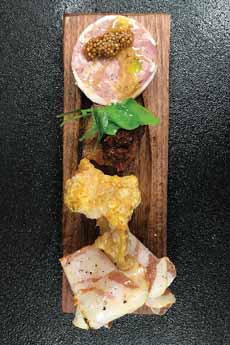
    This idea was inspired by steakhouse Rare Steak and Seafood in Washington, D.C. (photo #1).

    Executive Chef Marc Hennessy serves a Pork Tasting charcuterie board that highlights nose-to-tail cuisine. He turns heritage pork from the Shenandoah Valley in Virginia into a pork-four-ways plate, celebrating some of the different textures and flavors of pork cuisine:

  • Chicharrón (pork rinds), the skin with dried yellow chile.
  • Lardo, pork fat with salt.
  • Pork belly with black peppercorns and mustard.
  • Pork pâté with nutmeg and brandy (pâté campagnola in Italian, pâté campagne in French).
  •  
    The combination provides four different texture and flavor experiences.
     
     
    CREATE YOUR OWN PORK EXPERIENCE

    You can serve a pork variety plate as a first or second course, depending on the size of the portions. You can also purchase some of the ingredients, such as bacon jam, dumplings, fried pork rinds, meatballs pork sausage and pulled pork, among others, can be purchased.

    While there are many, many pork dishes, select four or five that can easily be served in neat portions on a combination plate. Pulled pork sliders work, pork stew doesn’t, unless you serve it in a ramekin to hold in the juices.

    Here are some ideas for your combination plate.

  • Apricot-prosciutto bites (recipe)
  • Artisan slab bacon
  • Bacon jam (recipe)
  • Bacon quiche or strata (recipe)
  • Bacon-wrapped link
  • BBQ deviled eggs (recipe)
  • BBQ pork butt (pulled pork—recipe)
  • Carnitas
  • Chinese egg roll (recipe)
  • Chinese pork bun (bao)
  • Chinese-style pork dumpling (recipe)
  • Choucroute garnie
  • Cracklings
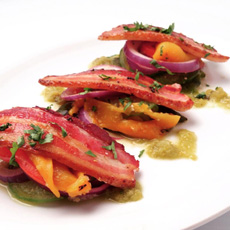
  • Pork belly (photo #4) (lettuce wraps (recipe)
  • European air-cured hams: Bayonne, prosciutto, serrano (plain or wrapped around melon or asparagus)
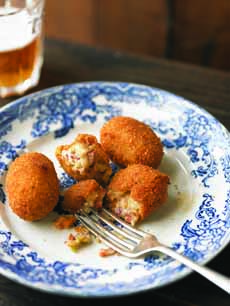
  • Ham croquettes or fritters (photo #6)
  • Ham/ham skewers
  • Homemade pork rinds (recipe)
  • Pork chops (smaller chops from a crown roast of pork)
  • Pork fried rice
  • Pork liver mousse
  • Pork loin
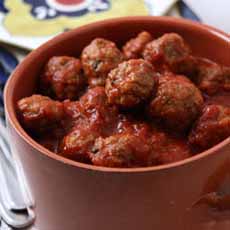
  • Pork meatball (photo #3)
  • Pork pie
  • Pork rillettes
  • Pork rinds (recipe)
  • Pork sausage/bratwurst
  • Pork skewers
  • Pork spring rolls (recipe)
  • Pork taco (recipe)
  • Prosciutto-wrapped figs
  • Potato skins (photo #5)
  • Pulled pork slider (recipe)
  • Ribs
  • Suckling pig
  • Wild boar slider
  •  
     
    PORK RECIPES

  • Apricot Jam-Glazed Pork Tenderloin Roast
  • Baked Ham With Mojo Sauce
  • Bánh Mì Sandwich
  • Barbecue Pork Butt
  • Cayenne-Cinnamon Ribs With Maple Glaze
  • Cocoa Chile Baby Back Ribs
  • Frizzled Ham & Brussels Sprouts
  • Glazed Ham With Dried Cherries & Caramelized Onions
  • Grilled Mango Pork Loin
  • Grilled Pineapple Baby Back Ribs
  • Honey Rosemary Stuffed Pork Chops
  • Pork & Pear Pasta
  • Pork & Potato Stew
  • Pork Chops With Orange-Cherry Sauce
  • Pork Loin With Fontina, Prosciutto & Sundried Tomato Sauce
  • Pork Ramen Soup
  • Pork Tenderloin With Honey-Pomegranate Marinade
  • Pork Tenderloin With Rosemary-Plum Coulis
  • Pulled Pork
  • Spicy Pulled Pork In Tart Cherry Sauce
  • Spinach-Stuffed Pork Roast
  • Tofu gnocchi with minced pork
  • Vietnamese Pork & Shrimp Pancakes
  •  
     
    CHECK OUT OUR PORK CUTS GLOSSARY.


    ________________

    *A pu pu platter is an assortment of Chinese restaurant appetizers, is fun—and sounds so much more interesting than “assorted appetizers.” Here’s more about it.

    †Pork loin and pork tenderloin are not cut from the same part of the animal, and in fact, look really different — pork tenderloin is thin and small, while a pork loin is wide enough that you can cut steak-like pieces from it.


    Pork Combination Plate
    [1] Gourmet pork combination plate from Rare Steak and Seafood in D.C.: pork pâté, slow-cooked pork belly, chicharrón and lardo.

    Pork Kebabs
    [2] Pork skewers (photo courtesy National Pork Board).

    Pulled Pork Sliders
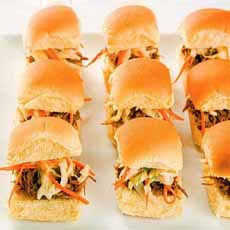
    [3] BBQ Pork Sliders (photo courtesy Pig Of The Month).

    Pork Meatballs
    [4] Pork meatballs (photo courtesy Frontier Fiesta).

    Pork Belly Appetizer
    [4] Pork belly on spicy tomatillo salad (photo courtesy Chef Eric B. LeVine).

    Pork Belly Potato Skins
    [5] Bacon or pork belly potato skins (here’s the recipe from Idaho Potato Commission)

    Ham Croquettes
    [6] Ham croquettes (photo courtesy Kyle Books).


    Comments off

    FOOD FUN: Re-Flavor & Re-Shape Your Food

    Fusion Tuna Poke
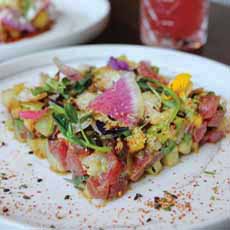
    [1] The poke square, a creative version of the poke bowl (photo by Allison Tong for Rooh | Flavor And The Menu).

    Poke Bowl
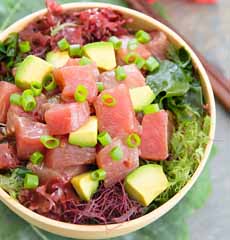
    [2] A more traditional poke bowl. Here’s how to customize your own from Kirbie Cravings.

      Over the past few years, poke bowls have swept west from Hawaii to the East Coast.

    Poke is a raw fish and vegetable dish served as an appetizer or salad course in Hawaiian cuisine.

    A relative of ceviche, crudo, tartare and tataki, poke is a combination of raw fish and vegetables, served as a light lunch or appetizer.

    Poke is Hawaiian for “to section” or “to slice or cut.” The most popular recipe, ahi poke, is made with yellowfin tuna marinated in sea salt, plus soy sauce, roasted crushed candlenut (inamona), sesame oil, limu seaweed and chopped chili pepper.

    You can customize poke however you like, using local or seasonal ingredients. For vegetarians, here’s a tofu poke recipe.
     
    HOW DO YOU PRONOUNCE POKE?

    Actually pronounced poe-KEH, it is mis-pronounced POE-key or POE-kay by enough people that the latter pronunciation is becoming an accepted alternative outside of the Hawaiian Islands.

    Poke is Hawaiian for “to section” or “to slice or cut.” Here’s more about it.
     
    HOW DO YOU RIFF ON POKE?

    Sujan Sarkar, Executive Chef at Indian bistro Rooh in San Francisco, re-shapes poke as Tuna Bhel, an Indian-seasoned version of the dish.

    Inspired by bhel puri, a traditional Indian chaat* made from puffed rice, vegetables and tamarind sauce, Chef Sarkar took the traditional poke base of ahi tuna and mixed it with puffed black rice, crunchy chickpea snack, boiled potatoes, red onion, green apple and green mango, baby radish and avocado.

    He then seasoned the medley with seasoned with chaat masala, chutney, and a sprinkle of the Japanese chile-based spice mix, shichimi togarashi, on the plate.

     
    He not only uses Indian ingredients; he elevated the eye appeal from a bowl to a plate, elegantly shaped with a square egg ring.

    You, too can create a designer poke dish (or apply the lesson to any other conventional food preparation).

    Take this poke recipe from Kirbie Cravings (photo #2) and think of what flavors you’d like to add.

    Avocado and scallions are popular, but how about:

  • Fruit: apple, grapes, mandarin, mango, papaya, pineapple.
  • Herbs: chives, cilantro, green tea leaves, lemongrass.
  • Salmon cubes instead of—or in addition to—the tuna cubes.
  • Spices: Chinese five spice, black and white sesame seeds, red chile flakes, shichimi togarashi.
  • Traditional Japanese ingredients: edamame, daikon radish, gari (pickled ginger), nori (seaweed) strips, oshinko or tsukemono (pickled vegetables), ponzu for dressing, tobiko caviar.
  • Traditional Chinese ingredients: baby bok choy, bean sprouts, snow peas, tofu cubes, water chestnuts.
  •  
    Let the sky be your limit: orange zest, castelvetrano olives, rice sticks. We might hold the line at potato chips and pretzels, but you don’t have to.

    In his presentation, Chef Sarkar garnishes with watermelon radishes and edible flowers. Here, you can use something fun and crunchy (freeze-dried edamame?).

    ________________

    *Chaat are savory snacks that originated as Indian street food. They are now served as hors d’oeuvres or first courses in Indian restaurants. The word derives from Hindi for tasting. More about chaat.


    Comments off


    © Copyright 2005-2026 Lifestyle Direct, Inc. All rights reserved. All images are copyrighted to their respective owners.