RECIPE: Eggs Benedict & Eggs Benedict History
|
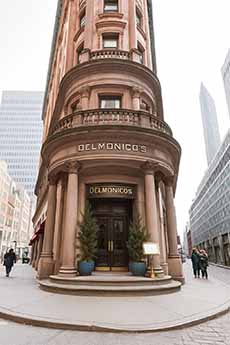
April 16th is National Eggs Benedict Day. Credit for this recipe is given to Chef Charles Ranhofer of Delmonico’s Restaurant in New York City—which also happened to be the first restaurant opened in the U.S., starting with a small pastry café in 1827 and expanding into a restaurant two years later. At that time there were no public dining rooms or restaurants. Men could stop into a tavern for a beverage and what amounted to “bar food.” People ate all their meals at home or, if traveling, at the inn or hotel. Otherwise, hungry people got food from street vendors. Which leads us to the creation of Eggs Benedict. Below: > A brief history of Eggs Benedict. Elsewhere on The Nibble: > The year’s 116 breakfast holidays. In the 1860s, a regular patron of Delmonico’s, Mrs. LeGrand Benedict, arrived for lunch and found nothing appealing on the menu. She discussed her tastes with the chef, who created on the spot what would become an iconic recipe. In his cookbook, The Epicurean, published in 1894, he called the recipe called Eggs à la Benedick, inadvertently misspelling her name. The recipe is relatively easy: toasted English muffins topped with a round of cooked ham “an eighth of an inch thick and of the same diameter as the muffins one each half.” A poached egg is placed atop each muffin half, and the whole is covered with Hollandaise sauce. Over time, Canadian bacon, which already comes in a round shape so doesn’t waste ham trimmings, replaced the ham in many recipes (photo #5). Here’s an updated version of the Eggs Benedict recipe, substituting a portabella mushroom for the English muffin (photo #1). Here are substitutes for the English muffins, ham/bacon and hollandaise: |
 [1] Portabella Eggs Benedict is a vegetarian variation (photo © Mushroom Council).
|
|
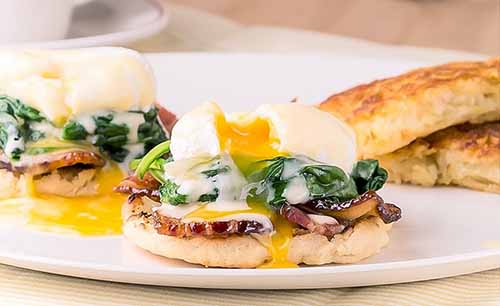 [4] Add sautéed spinach for Eggs Benedict Florentine (photo © Hill and Bay | NYC). 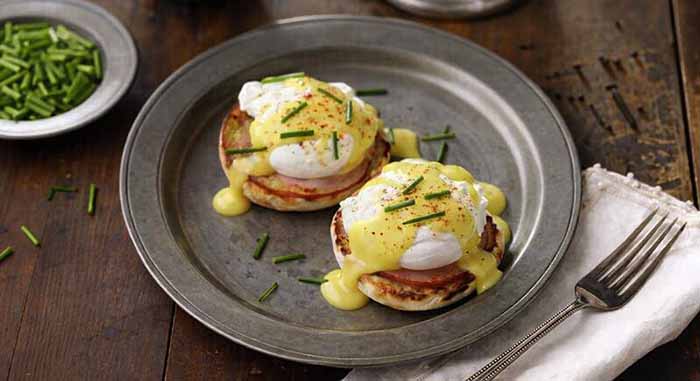 [5] Classic Eggs Benedict Canadian bacon builds ham, poached eggs, and a topping of Hollandaise sauce on toasted English muffins. CHECK OUT WHAT’S HAPPENING ON OUR HOME PAGE, THENIBBLE.COM.
|
||