THE NIBBLE BLOG: Products, Recipes & Trends In Specialty Foods


Also visit our main website, TheNibble.com.

Types Of Custard: Creme Brulee, Creme Caramel, Pot de Creme

May 5th is Cinco de Mayo. This year, it’s also the Kentucky Derby and National Hoagie Day. What’s a holiday-focused food writer to do?

We can recommend that you use the Holidays & Occasions pull-down menu at the right and peruse the content for both holidays. But we’re going to focus on custard.

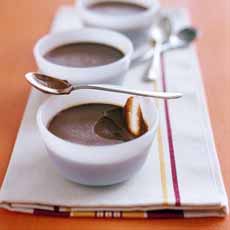
Why custard? Well, May 5th is National Chocolate Custard Day (photo #5).

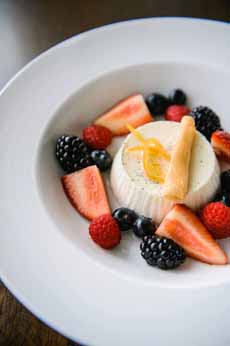
As we were served a panna cotta dessert (photo #1) yesterday, we thought of how it has replaced a richer custard, crème brûlée, on restaurant menus; and how decades earlier, crème brûlée replaced plain baked custard, scented with nutmeg or cinnamon.

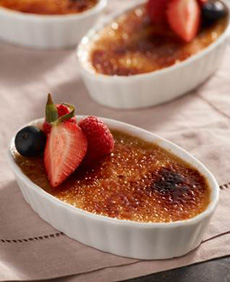
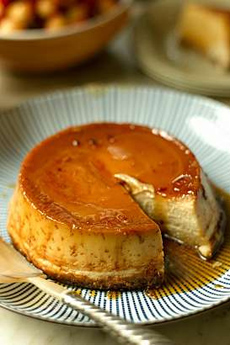
Every culinary student studies the three classic French baked custards: crème brûlée (photo #2), crème caramel (photo #3), and pot de crème. All three are made of eggs, milk and/or cream, and sugar, in different proportions, along with a flavoring such as vanilla.

  • Crème brûlée is made of all heavy cream and egg yolks and is topped with a brittle layer of caramelized sugar (brûlée is French for burnt, crème brûlée means “burnt custard”)
  • Crème caramel (called flan in Spanish) is the lightest of the three, made with whole eggs and a blend of milk and cream.
  • Pot de crème is made from equal parts of cream and milk and an extensive amount of egg yolks—e.g., 6 yolks per 2 cups of cream/milk, which make it a softer custard.
  •  
    Our mother made that classic baked custard scented with nutmeg. It was so rich and eggy—even though she used milk instead of cream. We hesitate to bake it today because you can’t bake just one or two ramekins—and we have no restraint.
     
     
    TYPES OF CUSTARD

    There are more than 50 additional custard dishes and terms in our Custard Glossary, one of 100 NIBBLE glossaries that give you a great understanding of each category of food.

    See the difference between custard and pudding below.
     
     
    THE HISTORY OF CUSTARD

    Custard as we know it dates back to the Middle Ages when it was used as a filling for a flan or a tart.

    The word custard is derived from “crustade,” a tart with a crust. A popular tart filling was what we came to call custard.

    After the 16th century, fruit creams became popular, and it was about this time that custards began to be made in individual dishes or bowls rather than as fillings for a crust.

    Yet, as things move the full circle, today custard is used to fill tarts, Danish pastry, cream puffs, and éclairs. It is mixed into trifles and turned into savory sides, like mushroom custards.

    It is turned into desserts like Bavarian creams, bread puddings, charlottes and Floating Island.

    Mousse is a custard whipped into an airy froth.

    Custards are prepared in two ways: stirred or cooked on top of the stove, or baked in the oven.

    Stirred custards (also called crème anglaise, custard sauce, and soft custard) are cooked over low heat or in a double boiler to a thickened yet fluid consistency.

    The custard is then refrigerated where it will continue to thicken. The repeated stirring prevents the custard from firming up. Instead, stirred custards are used as fillings, sauces, or ice cream bases.
     
     
    THE DIFFERENCE BETWEEN CUSTARD & PUDDING

    What Americans call pudding is a creamy, sweetened milk mixture thickened with cornstarch, then cooked.

    These are found mostly in the form of chocolate pudding, vanilla pudding, butterscotch pudding, and lemon pudding. They do double duty as pie fillings.

    When a recipe is exceptionally smooth and light, it is often called silk pudding.

    American puddings contain no eggs. In the U.K. and Europe, they are known as blancmange.

    In the U.K. “pudding” refers to any dessert. It also refers to sweet, cake-like baked, steamed and boiled puddings, usually made in a mold.

    Savory puddings, such as corn pudding, are so-called because they contain milk and eggs, which thicken the mix; and savory “puddings” can be custards (we won’t go into the details at the moment).

    Other foods that are called pudding include black pudding or blood pudding (which is a sausage) and Yorkshire pudding (baked batter, served as a side).

    By the way, August 17th is National Vanilla Custard Day. June 26th is National Chocolate Pudding Day.

    Custard and pudding tips to follow!


    Panna Cotta
    [1] Panna cotta (photo © Davio’s | Boston).

    Creme Brulee
    [2] Crème Brûlée (photo © David Venable | QVC).

    Creme Caramel
    [3] Crème caramel (photo © Suvir Saran).

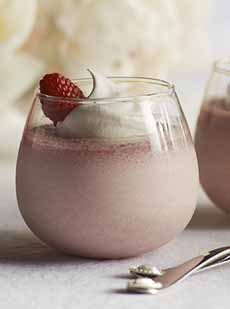
    Raspberry Pot de Creme
    [4] Raspberry pot de crème. Here’s the recipe from Driscoll’s (photo © Driscoll’s).

    Chocolate Pot De Creme
    [5] For National Chocolate Custard Day, make this pot de crème. Here’s the recipe (photo © Martha Stewart).


    CHECK OUT WHAT’S HAPPENING ON OUR HOME PAGE, THENIBBLE.COM.


    Comments off

    FOOD FUN: May The Fourth Be With You

    Princess Leia Cookies
    [1] Turn milk and cookies into Princess Leia for Star Wars Day (photo courtesy Bourbon House | NOLA).

    Mallomars Box
    [2] The current and original Mallomars packages (photo courtesy NPR.org).

    Homemade Mallomars
    [3] Bake your own Mallomars with this recipe from Saveur.

      Star Wars Day, May 4th, celebrates George Lucas’ Star Wars films. (“May the forth be with you”—get it?)

    Treat yourself to milk and cookies, Princess Leia-style.

    You’ll need soft cookies to adhere to the rim of the glass. We used Mallomars (photo #2). They’re probably sold out by now (the season ends in April), but like all Mallomars fans, we keep extra boxes on hand until they reappear in stores in the fall.

    Or, bake your own with the recipe below.

    Or, bake any chocolate cookie (to evoke Princess Leia’s brunette hair buns) and notch them while they’re still warm.
     
     
    MALLOMARS HISTORY

    Nabisco’s Mallomars are a very popular cookie in Metropolitan New York City, the original home of Nabisco.

    A graham cracker circle is topped with marshmallow, then coated with a dark chocolate. The result is a puffy, sink-your-teeth-in delight.

    The cookies were introduced in 1913, the same year as the southern Moon Pie—a cookie which has similar ingredients, but a different flavor. According to Wikipedia, the first box of Mallomars was sold in West Hoboken, New Jersey (now Union City).

    They are sold only from October through through April, following a tradition that began of necessity, before refrigerated trucks.

  • Eighty-five percent of all Mallomars are sold in the New York metropolitan area.
  • The cookies are produced at a factory in Scarborough, Ontario, Canada.
  •  
    The concept spread. In the U.K., chef Boyd Tunnock created Tunnock’s Teacakes in 1956, using Italian meringue on a biscuit (cookie) base, covered with milk chocolate.
    They look like Mallomars’ fraternal twin.

    See the chocolate-marshmallow cookie variations in different countries.
     
     
    HOMEMADE MALLOMARS RECIPE

    Want to make your own? Here’s a recipe from Saveur (photo #3).


    Comments off

    GIFTS: Asobu Cold Brewer & Drinkmate Spritzer

    Looking for Mother’s Day gifts? Want to get the jump on Father’s Day? Want to treat yourself?

    Here are two kitchen items that got our attention—and given how many products we see each year, that’s hard to do!
     
     
    ASOBU COLDBREW INSULATED PORTABLE BREWER

    For lovers of cold brew coffee, this beauty from Asobu very efficient.

    It brews your coffee into an insulated thermos, so you can keep cold brewed coffee with you all day, anywhere. Or, you can pour a cup and give it a quick zap in the microwave.

    Just add coarse coffee grounds and cold water to the mesh cone and let it slowly drip. The resulting coffee is what you’ve come to expect from cold brew. Remove the top portion, add the leak-proof lid, and you’re ready to go—or stay.

    The brewing carafe top is clear Tritan, an extremely durable BPA-free plastic that is used in the finest water bottles and food containers.

    There are four color choices:

  • Black/Black
  • Copper/Black
  • Silver/Black
  • White/White
  •  
    The brewer is $50.00. You can buy it online at AsobuBottle.com.
     
     
    DRINKMATE SPRITZER

    What will you sparkle next? asks the box of the Drinkmate Spritzer.

    Unlike devices that carbonate water only, Drinkmate lets you carbonate anything, anywhere.

    It’s a fun device for lovers of sparkling beverages.

    The easily-portable system consists of a DrinkMate Spritzer gun, a BPA-free half-liter reusable carbonating bottle and two CO2 carbonator cylinders (for a total of 32 bottles of sparkling beverages).

    Easy to operate, easy to clean, no electricity or batteries are used.

    What can you carbonate? Any liquid. Water, of course, but also unleash your creative mixologist with:

  • Cocktails
  • Juice
  • Soda
  • Tea
  • Wine
  •  
    You can also re-carbonate sparkling wine or beer that has gone flat.

    The kit is $90 at Home Depot and other e-tailers/retailers, in black, red or silver.

      Asobo Cold Brewer
    [1] Asobu Coldbrew, in four elegant colors (photo courtesy Kettle And Cord).

    Drinkmate Spritzer
    [2] Drinkmate Spritzer turns almost any liquid into a carbonated beverage (photos #2 and #3 courtesy Drinkmate).

    Drinkmate Spritzer
    [3] The Drinkmate kit.


    Comments off


    © Copyright 2005-2026 Lifestyle Direct, Inc. All rights reserved. All images are copyrighted to their respective owners.