THE NIBBLE BLOG: Products, Recipes & Trends In Specialty Foods


Also visit our main website, TheNibble.com.

TIP OF THE DAY: Make Delicious Charred Vegetables

Some recipes specify charring bell peppers to make it easy to remove their skins and purée them. But we char them just to enjoy the charred flavor.

Charring is a step beyond simple grilling. If you haven’t discovered the joy of charring vegetables on the grill—or haven’t ventured beyond corn, mushrooms and potatoes—let us whet your appetite.

Charring creates contrasting flavor and textures, caramelized sweetness, and toasty, smoky notes. When the skin gets blackened and blistery, the the flavor is intensified. The skins soften while the flesh stays crisp.

You don’t need a grill (ideally, with wood chips) to char vegetables. You can also do it:

  • On the stove top, in a dry cast iron pan
  • Under the broiler in your oven
  •  
    All you need are raw vegetables tossed in olive oil, a sprinkling of kosher salt or coarse sea salt, and the heat source. Grilling tips are below.

    WHAT VEGETABLES ARE BEST FOR GRILLING

    Some of our favorite things to char—in addition to corn, mushrooms and potatoes:

  • Asparagus: Trim the tough ends, toss the spears in olive oil and salt and grill for 4-5 minutes over medium-high heat. Then turn and grill another 4-5 minutes.
  •    
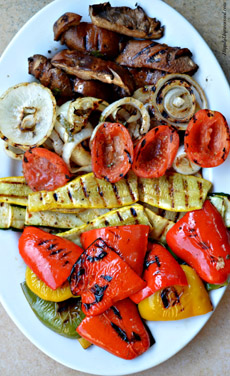
    assorted-grilled-vegetables-happilyunprocessed-230r

    A delicious platter of grilled veggies, from HappilyUnprocessed.com, with mushrooms, onions, tomatoes, yellow squash and bell peppers. Here’s their recipe for Balsamic Grilled Vegetables.

  • Baby potatoes: Potatoes, dense and hard, need to be pre-cooked. Leave the skins on and place the potatoes in a pot. Cover with one inch of salted cold water and bring to a boil over high heat. Reduce heat and simmer until just tender, 12 to 15 minutes. Toss in olive oil, sprinkle with salt and skewer (for a gourmet touch, skewer on soaked rosemary twigs) and grill for 3 to 4 minutes total, turning occasionally.
  • Bell peppers, Hatch or other chiles: Remove the core and seeds, then slice the each pepper in half (or in quarters for large bells). Toss with olive oil and salt and grill over a medium-high heat for 4-5 minutes. Then turn and grill 4-5 minutes longer.
  • Cabbage or lettuce: Cut the head in half and slice each half into 1-inch-thick slices; skewer to keep the leaves together. Toss with olive oil and salt. Grill over a medium-high heat for 10 minutes, then turn and grill for another 10 minutes. (If cabbage and lettuce seem like strange grilling veggies, try them—they’re delicious!)
  • Cauliflower: Use large florets only; save the smaller bits for other uses. Toss in olive oil, salt and skewer. Grill over medium-high heat, turning frequently for about 10 minutes, until lightly charred.
  • Corn: Remove the husks; otherwise, you just steam the corn. Oil and salt them, then grill over medium heat for 4-5 minutes, turning frequently.
  • Eggplant: Cut into 1/2-inch slices, place on a wire rack and sprinkle liberally with salt. Leave for 30 minutes, then rinse under cold water and pat dry with paper towels (this process removes the bitterness). Toss with oil (you can add some balsamic, too), salt and cook over medium-high heat for 4-5 minutes. Then turn and grill another 4-5 minutes.
  • Green onions/scallions: Toss in oil and salt and grill on medium-high for about two minutes, until distinct grill marks appear. Then turn and cook for 1 minute more.
  •  

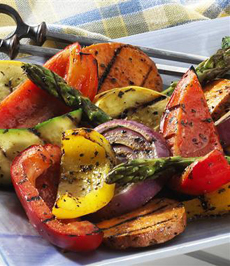
    grilled-vegetables-mccormick-230
    Mixed grilled vegetables. Photo courtesy McCormick.
     
  • Mushrooms: Toss whole mushrooms with olive oil and salt; then skewer and cook over medium-high heat for 7-8 minutes, turning frequently. Grill whole portobello mushroom caps directly on the grill. Toss in oil (we also use some balsamic), salt and grill for four minutes; then turn and grill another four minutes.
  • Onions: Sweet and red onions are best. Peel, cut into ½-inch slices, toss in olive oil and kosher salt and grill over medium-high heat for 2-3 minutes. Then turn and grill 2-3 minutes longer. A skewer will hold the onion layers together.
  • Tomatoes: Skewer cherry tomatoes and grill over medium-high heat for 3-4 minutes, turning frequently. Cut plum or other tomatoes in half lengthwise, remove the seeds and grill for four minutes over medium-high heat. Then turn and grill for four more minutes.
  • Zucchini or yellow squash: Cut into ½-inch pieces lengthwise, toss in olive oil, salt and cook over medium-high heat for 4-5 minutes. Then turn and grill another 4-5 minutes.
  •  
    We also love grilled romaine, especially in a grilled Caesar salad.

     
    GRILLING TIPS

  • Heat. Most vegetables need a medium-high heat. With a gas grill, this is 400°F to 425°F. With a charcoal grill, think “4 by 5”: You should be able to hold your hand four to five inches above the grill for for four to five seconds. For delicate vegetables, use medium heat—350°F or hold your hand four to five inches above the grill for six or seven seconds.
  • Skewers. When grilling smaller vegetables that might fall through the grate, use skewers. They also make it easy to turn the vegetables. We use stainless steel skewers; but if you’re using bamboo, remember to soak them for 30 minutes.
  •  

    USING THE BROILER TO CHAR VEGETABLES

  • Set the broiler to HIGH. If the broiler is inside your oven, place the oven rack to within 4-5 inches of the broiler flame.
  • Since there are no grates to fall through, you don’t need to skewer.
  • Toss with olive oil and salt and spread the the vegetables on a sheet pan. Softer vegetables will cook faster than harder, denser ones like onions, so keep the individual vegetables together so you can remove them as they finish cooking.
  • Broil for five minutes, then turn and stir. Leave the oven/broiler door open during broiling to vent the steam.
  • Continue to broil and turn every five minutes. The vegetables will gradually start to char on the outside. All vegetables will be ready in 20-25 minutes, depending on how crunchy or soft you like them.

     
    NO OVEN OR BROILER?

    Use your toaster oven on the highest setting. It isn’t exactly the same, but the results are still delicious. Lightly brush the veggies with olive oil, or drizzle mushrooms with balsamic vinegar.


  • Comments off

    RECIPE: Blueberry Mango Chile Smoothie

    July is National Blueberry Month and today is Smoothie Saturday. The U.S. Highbush Blueberry Council recommends with this great-looking Blueberry Mango Chile Smoothie, a layered smoothie with a capsaicin kick.

    There’s another smoothie holiday, too: October 3rd, Global Smoothie Day. All the world loves a smoothie!
     
     
    RECIPE: BLUEBERRY MANGO CHILE SMOOTHIE

    Ingredients For 2 Smoothies

  • 2 cups blueberry compote (recipe below)
  • 12 ounces (1-1/2 cups) low-fat vanilla Greek yogurt, divided
  • 1 large mango, peeled, pitted, chopped (about 1-1/2 cups)
  • 1/2 teaspoon chili powder
  • 1/4 teaspoon cayenne
  •  
    Ingredients For The Blueberry Compote

  • 16 ounces frozen (unthawed) blueberries
  • 2 tablespoons sugar
  • 2 teaspoons cornstarch
  •  
    Preparation

    1. MAKE the blueberry compote, cover, and chill.


    bluebery-mango-smoothie-blueberrycouncil-230
    [1] Have you seen a more vivid smoothie? (Both photos courtesy Blueberry Council).


    frozen-blueberries-mango-blueberrycouncil-230sq
    [2\ Blueberry compote, made with frozen blueberries. .
      2. PLACE 6 ounces of the yogurt, the mango, chili powder, and cayenne in a blender; blend until smooth. Divide the mango mixture between two 16-ounce cups; set aside.

    3. RINSE the blender and place the Blueberry Compote and remaining yogurt in the blender; blend until smooth. Check the consistency and dilute with water or milk if needed.

    4. SLOWLY POUR half of the blueberry mixture on top of each of the mango smoothies for a two-layer effect.
     
    Preparation: Blueberry Compote

    1. TOSS the blueberries with the sugar and cornstarch in a large saucepan. Bring to a boil, stirring; reduce the heat to low and simmer until the blueberries are heated through and the sauce is slightly thickened.

    2. TASTE and add more sugar if needed. Allow to cool, cover, and chill.


    CHECK OUT WHAT’S HAPPENING ON OUR HOME PAGE, THENIBBLE.COM.


    Comments off

    TIP OF THE DAY: The History Of Independence Day (& What They Ate)

    THE HISTORY OF INDEPENDENCE DAY

    A federal holiday, Independence Day—also known as July 4th or the Fourth of July—commemorates the adoption of the Declaration of Independence by the Continental Congress, which met in Carpenter’s Hall in Philadelphia.

    The legal separation of the Colonies from Great Britain occurred on July 2, 1776, the day that the Second Continental Congress voted to approve a resolution declaring the United States independent from Great Britain’s rule.

    Congress declared that the 13 American colonies were now a new sovereign nation, the United States of America, and no longer part of the British Empire.

    The Declaration of Independence, a statement comprising 1137 words, authored largely by Thomas Jefferson, was officially adopted by Congress on July 4th after two days of debate and revision.


    raw-steak-cut-as-usa-esquaredhospitality-230
    Happy Independence Day. God Bless America! Photo courtesy ESquared Hospitality.

     
    Nearly a month would go by, however, before the signing of the document took place.

  • On July 4th, only 12 of the 13 colonies voted to approve the Declaration. New York’s delegates didn’t officially give their support until July 9th, because their state assembly hadn’t yet authorized them to vote in favor of independence.
  • It took two weeks for the Declaration to be engrossed on parchment. Engrossing is the process of preparing an official document in a large, clear hand. Timothy Matlack, a Pennsylvanian who had assisted the Secretary of the Congress, Charles Thomson, was probably the engrosser.
  • Most of the delegates signed on August 2nd, but several signed on a later date. Two others never signed at all! (Source)
  • Thomas Jefferson, John Adams and Benjamin Franklin all later wrote that they had signed on July 4th!
  • If you were a member of the Second Continental Congress in 1776, you were a rebel and considered a traitor by the King of England. You knew that a reward had been posted for the capture of certain prominent rebel leaders, and that signing your name to the Declaration meant that you pledged your life, your fortune, and your sacred honor to the cause of freedom.
  •  
    The Revolutionary War was a long, hard, and difficult struggle that began on April 19, 1775 with the battles of Lexington and Concord. It ended officially on September 3, 1783, when a peace treaty with Great Britain was signed. If you’ve forgotten your high school history, here’s a recap.

    From the outset, Americans celebrated their independence on July 4th, preferring to honor the approval of the Declaration of Independence over the July 2nd vote for independence.


    kurobuta-bone-in-ham-WS-230
    Baked ham was a colonial mainstay. Photo courtesy Williams-Sonoma.

      WHAT DID THE DELEGATES EAT?

    Since THE NIBBLE focuses on food, we investigated what the delegates might have eaten.

    Working long hours, the delegates would have stepped out for nourishment at coffee houses, taverns and publick houses. These destinations were not known for their cuisine, but were venues for exchanging ideas, sharing news and conducting business (the restaurant business as we now know it developed later).

    People who could afford to eat meals in these establishments were generally of the wealthier classes. The food was often served buffet-style, on a sideboard. As was common into the 20th century, the food came free with the drinks. (Source)

    At the time, colonial Philadephia was a melting pot of English, French and West Indian cuisine influences.

  • Meals often featured baked ham with warm potato salad, meat pies (chicken or pork), oysters, stew and soup, including the traditional Philadelphia PepperPot Soup.
  • Also popular: terrapin (turtle) and tripe (animal stomach, typically from cows or pigs).
  • The bread included corn muffins, white and whole wheat rolls—buttered, of course.
  • Dessert could be fruit pies, sugar cookies, gingerbread, Sally Lunn (a pound cake) or ice cream. The confectionery in Philadelphia, including ice cream, was considered the best in America.
  • Beverages included beer, hard cider, rum, and other alcoholic beverages; alcohol was considered healthful. City water supplies were dangerously polluted; only rural folk drank water from clean sources, and bottled it to sell in the city. In 1790, government figures showed that annual per-capita alcohol consumption for Americans over age 15 included 34 gallons of beer and cider, five gallons of distilled spirits and one gallon of wine. (Source)
  •  
    Would you give up the modern July 4th standards for a colonial-era meal? If yes, start planning for next year!


    Comments off

    TOP PICK OF THE WEEK: Kenny’s Krumbs

    If only Cosmo Kramer had focused on selling the tops of crumb cake crumbs instead of muffin tops, he’d have had a hit.

    Now, everyone who has delighted in the crumbs on top of a crumbcake can revel in jumbo crumbcake crumbs from Kenny’s Krumbs.

    Kenny has transformed the streusel (the crumb topping—see section below) into crunchy, cookie-like nuggets of cinnamon goodness. They’re crumb cookies—there’s no cake involved, although you can use Kenny’s Krumbs on any cake you like.

    OUR TOP 10 WAYS TO ENJOY KENNY’S KRUMBS

  • Snacking straight from the bag.
  • For your coffee break (or with other favorite beverage—tea, milk, hot chocolate).
  • As a garnish with whipped cream on pound cake or other uniced cake.
  • To garnish an iced cake.
  • Krumb-topped cheesecake.
  • On ice cream, along or with your favorite dessert sauce.
  • As mega-crumbs on a fruit crisp, a deep-dish baked fruit dessert made with a crumb topping.
  • On a cobbler, replacing the biscuit topping (the difference between crisp, crumb, cobbler, etc.)
  • To top chocolate or custard tarts.
  • As a pie topping (see our article on crumb tops for pies).
  •    

    plated-230r

    Who needs cake. Here, crumb cake topping baked up as cookie-like “crumbs.” Photo courtesy Kenny’s Krumbs.

     
    Instead of butter, Kenny’s Krumbs uses margarine to create the crumbs. The other ingredients include enriched bleached flour, malted barley flour, sugar and spices.

    Kenny’s Krumbs sells them packaged in 12-ounce resealable bags. Four bags of Krumbs are $28.00, 12 bags are $72.00, plus shipping.

    You can also buy Krumbs in large metal gift buckets and smaller tins from Hahn’s Old Fashioned Cakes ($27.50 to $30.00).

    Kenny’s Krumbs and Hahn’s deliver anywhere in the continental U.S. Plan ahead: These crumb cookies are a great teacher gift or stocking stuffer.


    Picture 656
    Bring them to friends and teachers, stuff stockings, snack on. Photo courtesy Kenny’s Krumbs.
      CRUMB TOP = STREUSEL

    Long popular as the topping on Streuselkuchen, Germany’s crumb-topped yeast cake, streusel (pronounced SHTROY-zul) is a topping made from butter, flour and sugar. It can also contain chopped nuts or rolled oats.

    The word derives from the German “streuen,” meaning to sprinkle or scatter. The original Streuselkuchen was very flat, with crumbs equal to the height of the cake (think one inch of cake topped with one inch of crumbs).

    Note that all crumbcakes are coffee cakes, but not all coffee cakes are crumbcake. Another popular coffee cake, also a yeast cake, can be strewn with raisins and nuts and drizzled with a variation royal icing* (and we wish we had a piece right now).

    The crumb cake is believed to have originated in Silesia, which today is in western Poland (if you’ve read James Michener’s Poland, you know the borders changed regularly).

    The original recipe engendered variants with tart fruits (apples, gooseberries, sour cherries, rhubarb), poppy seeds and pastry cream.


    Today, Americans can enjoy their crumbcakes with with a layer of fruit (apple, apricot, raspberry), chocolate and other flavors.

    Or, those who have discovered Kenny’s can simply enjoy the crumbs!

     
    *To make coffee cake icing, mix until smooth 1 cup confectioner’s sugar, 2 tablespoons warm milk and 1/2 teaspoon vanilla.
      

    Comments off

    MEMORIAL DAY & JULY 4th: Red, White & Blue Ice Pops Recipe

    Popsicle and other brands make red, white and blue ice pops. But we’re not in grade school, and we want something more flavorful (and natural!) on a hot summer day.

    So we trotted out our ice pop molds to make our own red, white and blue “firecracker” pops. The recipe is courtesy of Brown Eyed Baker, who adapted it from Everyday Food.

    The layers are made from strawberries (red), sweetened plain yogurt (white) and blueberries (blue). Very little sugar is added. Instead, a bit of lime juice heightens the flavors.

    Prep time is 2 hours. You can make them up to a week in advance.
     
     
    RECIPE: RED, WHITE & BLUE “FIRECRACKER” ICE POPS

    Ingredients For 6 Three-Ounce Pops
     
    For The Red Layer

  • 2 cups halved, hulled strawberries (or whole raspberries)
  • 2 tablespoons granulated sugar
  • 1½ tablespoons fresh lime juice
  •  
    For The White Layer

  • ¾ cup full-fat plain yogurt
  • 4½ tablespoons heavy cream
  • 3 tablespoons granulated sugar
  • 3 tablespoons fresh lime juice
     
    For The Blue Layer
  • 2 cups blueberries
  • 2 tablespoons granulated sugar
  • 1½ tablespoons freah lime juice
  •    

    firecracker-popsicles-browneyedbaker.230s

    Delicious homemade red, white and blue ice pops (photo © Brown Eyed Baker).


    berries-box-WS-230
    Fresh fruit purée makes the best ice pops. Photo courtesy Williams-Sonoma.
     

    Preparation

    1. MAKE the red layer: In a blender, combine the strawberries, sugar and lime juice. Purée, scraping down the sides as needed. Pour through a fine-mesh sieve into a bowl, pressing the juice from the solids; then discard the solids. Fill the ice-pop molds 1/3 of the way. Freeze until firm, about 30 minutes. You may have some purée leftover—use it as a topping the next time you have a container of yogurt.

    2. MAKE the white layer: Whisk together the yogurt, cream, sugar and lime juice in a small bowl. Remove the molds from the freezer and top with the yogurt mixture, filling each another 1/3 of the way. Freeze until firm, about 30 minutes.

    3. MAKE the blue layer: In a clean blender, purée the blueberries, sugar and lime juice, scraping down sides as needed. Pour through a fine-mesh sieve into a bowl, pressing the juice from the solids; then discard the solids.

     
    4. REMOVE the molds from the freezer and insert the ice pop sticks through the white layer. Top with the blueberry purée (again, you may have some leftover), leaving ¼-inch of free space at the top of the molds. Freeze until solid, 3 hours or more. Just before serving, briefly run the molds under hot water to release the pops.


    CHECK OUT WHAT’S HAPPENING ON OUR HOME PAGE, THENIBBLE.COM.


    Comments off

    The Nibble Webzine Of Food Adventures
    RSS
    Follow by Email


    © Copyright 2005-2026 Lifestyle Direct, Inc. All rights reserved. All images are copyrighted to their respective owners.