The Different Types Of Cognac & A Special Gift: X.O. Cognac
|
|
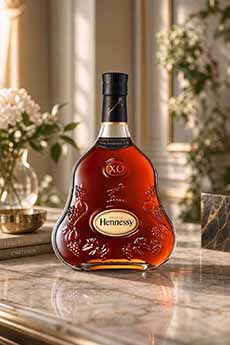
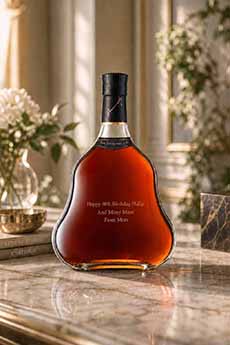
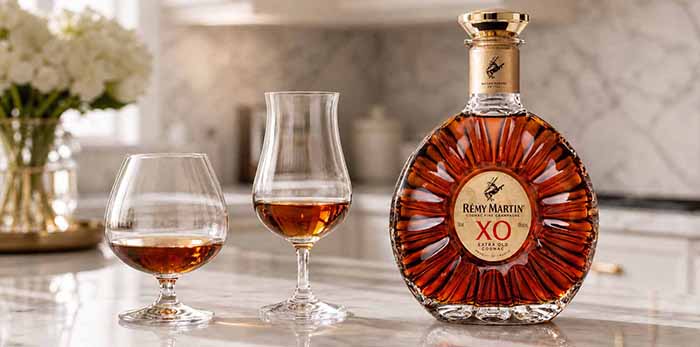
Updated June 2026 National Cognac Day is June 4th, so we’ve done a recap of the five categories of Cognac, with a shout-out to our favorite, X.O. It stands for Extra Old, and bears no relation to the X.O. that is short for a hug and a kiss. Since we love a digression into tangential information, we had to ask: What’s the history of signing notes with XOXO? Why not HKHK for hugs and kisses? But first, the Cognac. Below: > The 5 categories of Cognac: VO, VS, VSOP, XO, Extra. > The year’s 8 brandy and Cognac holidays. > What about those X’s and O’s? Elsewhere on The Nibble: > The history of Cognac. This style of Cognac was created in 1870 by Maurice Hennessy, to be enjoyed with his circle of friends. The bold, intense and complex flavors are based on much longer aging. Some of the 100 eaux-de-vie* assembled to create X.O were aged for 30 years. M. Hennessy gave it the name X.O to signify “extra old.” It’s a Cognac for connoisseurs, served neat, on ice or with a splash of still or sparkling water. Don’t even think of mixing it in a cocktail! Deliver your hugs and kisses with a bottle of X.O. Cognac. In addition to Hennessy, it is made by a number of Cognac houses including Camus, Courvoisier, Martell, Rémy Martin and others. The bottles cost $150 and up. You can get a custom-engraved bottle directly from Hennessy. Your message is engraved on the back of the bottle, making it a lovely keepsake (see the photo #2). It was Maurice Hennessy, great-grandson of company founder Richard Hennessy, who created the Cognac classification‡ system. He used varying numbers of stars to designate different quality, first producing Hennessy’s Three Star Cognac, today known as V.S (Very Special). His classification system was adopted by the entire industry. When he was the Prince of Wales, King George IV of Great Britain asked Hennessy to create a “very superior old pale Cognac.” It was designated V.S.O.P—Very Superior Old Pale—and since then, a letter system evolved to replace the stars. |
|
 [6] The snifter was the glass of choice for centuries. More recently, the tulip glass has become the preferred style (photo: The Nibble). THE COGNAC SNIFTER & THE TULIP GLASS Snifter: Several sources agree that the balloon shaped glass now known as the snifter predates Cognac as a spirit style. The snifter shape appears in Europe at least by the 16th century, and it was in clear use for brandy/Cognac (see the difference in the †footnote) by the 19th century. Yet, the specific English word “snifter” for the bulbous brandy glass doesn’t appear until 1937. Tulip Cognac glass: The tulip/copita form is newer as a Cognac-drinking preference, though related tulip-shaped glasses have existed for centuries in Spain as sherry glasses (“copita” translates to little or small glass in Spanish. It began to become the favored Cognac tasting glass among connoisseurs around the turn of the 21st century. The benefits of the shape are: The Tulip Cognac glass is just one of five tulip shapes used for different spirits. Others include: 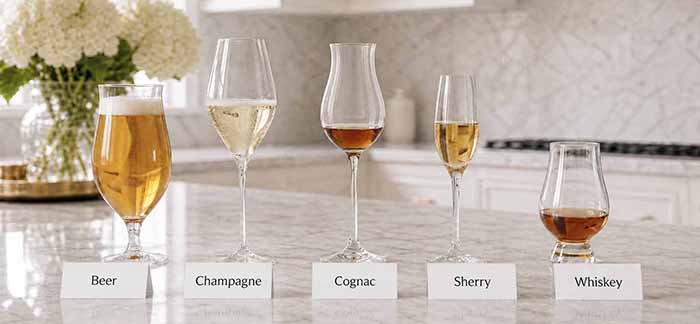 [7] The different tulip styles used for wines and spirits (photo: The Nibble). THE YEAR’S 8 BRANDY, COGNAC, & RELATED HOLIDAYS The abbreviation for “hugs and kisses,” XOXO, has been used for centuries to express love or good friendship at the end of a written letter or card (and these days at the end of an email or text message). The X stands for kiss and the O for hug. The custom of placing X’s on envelopes and at the bottom of letters notes, signifying kisses, dates back to the Middle Ages. At that time, a Christian cross was drawn on documents or letters to indicate faith, honesty and sincerity. A kiss, indicated with an X, was then placed upon the cross by the signer as a display of his or her sworn oath. A similar practice dates back to early Christian history. Since most people could neither read nor write, an X was used as their signature on documents, and an actual kiss was placed upon it as a show of sincerity. [Source] What about the “O?” Current speculation is that it is of Jewish derivation, since Jews would not use the sign of the cross. In terms of how the two symbols came together in the very non-legal “hugs and kisses”: Alas, dear reader, the answer is lost to history. But we send you X’s and O’s nevertheless. *Eau de vie (eaux is the plural), pronounced oh-duh-VEE (ohs for the plural), is French for “water of life.” It’s a clear, colorless fruit brandy. After the brandy is aged in wood, it takes on its amber color. Cognac is an area in northern France; Cognac is a town in the Charente department of the Nouvelle-Aquitaine region. The other department of the Nouvelle-Aquitaine where Cognac can be made is Charente-Maritime. Generic “brandy” can be produced anywhere. †The difference between brandy and Cognac: Cognac is a premium brandy made specifically in the Cognac region of France. Production is strictly regulated, using specific white grapes (predominantly Ugni Blanc), double copper-pot distillation, and French oak aging. It is name-protected, as are two other regional French brandies: Armagnac, France’s oldest brandy, produced in Gascony in a column still that produces a heavier, more rustic, and robust flavor; and Calvados, an apple (or pear) brandy produced in Normandy, a vibrant, fruit-forward spirit. > Cognac, Armagnac, and Calvados are all legally protected as Appellation d’Origine Contrôlée (AOC) in France and Geographical Indications (GI) within the European Union. Internationally, these designations are strictly protected under global trade agreements, meaning only brandies produced in their exact, historic regions can use these names. These rigorous legal protections guarantee the origin, quality, and production methods of the spirits. > Brandy is an umbrella term for any spirit distilled from fermented fruit, made anywhere in the world, e.g., applejack in the U.S., grappa in Italy, and pisco in Peru. French also produces grape-based brandy in different regions, labeled simply as French Brandy. ‡Category vs. Classification: The industry typically uses classifications to describe the legal system managed by the Bureau National Interprofessionnel du Cognac (BNIC), but they are also frequently called age categories because the distinction is based purely on the minimum age of the youngest eau-de-vie in the blend. CHECK OUT WHAT’S HAPPENING ON OUR HOME PAGE, THENIBBLE.COM. |
||