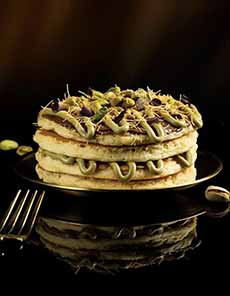
By now, the global Dubai chocolate craze that began in 2023 has resulted in many copycats of the original layered chocolate bar, plus a porting of the flavors to brownies, cakes, cheesecakes, cookies, croissants, iced coffee, pancakes, pistachio butter cups, and dozens more (see the ††footnote). There are even Dubai chocolate beers!
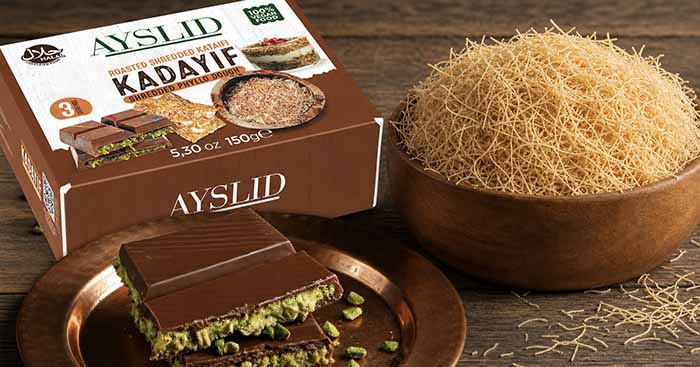
The marvelous chocolate bar sought by so many is filled with chopped pistachio nuts, tahini (sesame paste) mixed with pistachio cream, and knafeh, a crispy, flaky, traditional Middle Eastern pastry made from shredded phyllo dough* (photo #20).
Chocolate combined with pistachio isn’t a new idea, but the crunchy nature of the knafeh and tahini-pistachio cream filling have created something unique and wonderful.
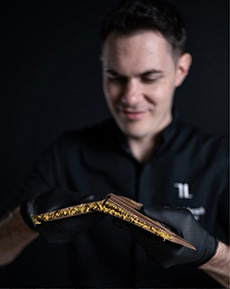
We acknowledge that we’ve never had the original Dubai chocolate created by Sarah Hamouda (photo #6), a British-Egyptian entrepreneur living in Dubai, United Arab Emirates.
Her atelier, FIX Dessert Chocolatier, can only make 500 bars a day, and even if you get to Dubai, they are only available via Deliveroo.
You can’t walk into a store to buy one, except for two pop-up-type locations at the Dubai Airport. (But warning: See the sad airport story in the ***footnote below.)
Otherwise, an order window opens twice a day in the online store, and the bars are usually sold out within a few minutes. [source].
You can order online, shipped from Dubai. As of this writing the bars are $20 U.S. on the website. We
plan to host a mega-tasting of all† of Sarah’s products this fall.
The bar that launched 1,000 likes (well millions, actually) debuted in 2022 (see the history below).
Sarah did not call it Dubai chocolate. That name was bestowed by Tik-Tok.
However, since the craze began, we’ve tasted every Dubai chocolate we could get our hands on: brands from the U.S., Europe, and Turkey.
Will the original bar best the current leader in our tastings, Dubai chocolate from Swiss chocolatier Läderach?
LOVE AT FIRST BITE
Since we had our first bite of Läderach’s Dubai chocolate, we’ve scoured America and beyond to find the best—and it’s not surprising that we found it from…drum roll…
Läderach! It’s the best Dubai chocolate by far, and it’s our Top Pick Of The Week.
Given how much we love pistachio, chocolate, and phyllo, we’d go so far as to call it our Top Pick Of The Year.
Before we extol the glory of Läderach, we’ll start with the origin of Dubai chocolate.
Below:
> The history of Dubai chocolate.
> What makes one bar better than the next?
> Our favorite Dubai chocolate from Läderach.
> Pairing wine with Dubai chocolate.
> A recipe to make your own Dubai chocolate.
Elsewhere on The Nibble:
> The history of chocolate.
> The history of pistachios.
> The different types of chocolate: a photo glossary.
> The year’s 69 chocolate holidays.
> Pairing wine with chocolate.
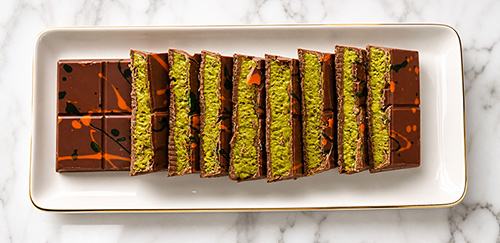
[13] The original Dubai chocolate bar by Sarah Hamouda, made in Dubai, U.A.R., is called “Can’t Get Knafeh Of It,” punning on the crunchy knafeh inside the bar.
THE HISTORY OF DUBAI CHOCOLATE
Like some other culinary creations (Fettuccine Alfredo being the best-known), Dubai chocolate was born from pregnancy cravings.
As a high-end chocolatier, Sarah had plenty of crave-worthy treats from which to choose, but she wanted a chocolate bar with the flavors and textures of traditional Middle Eastern desserts.
She first imagined the bar in 2021, while she was pregnant. She and her husband Yezen Alani, co-owner of FIX, started to develop the bar the following year, while maintaining their corporate jobs.
The first bars were milk chocolate, followed by dark and white chocolate versions.

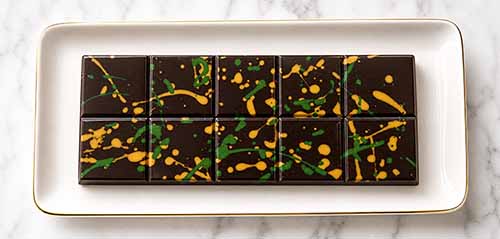
[14] Popularity of the original led to a dark chocolate Can’t Get Knafeh Of It.
The Anatomy Of The Bar
The name of the original FIX bar is Can’t Get Knafeh Of It, a chocolate bar filled with:
Chopped pistachio nuts.
Tahini (sesame paste) mixed with pistachio cream.
Knafeh, a crispy, flaky, traditional Middle Eastern pastry made from shredded phyllo dough†.
Couverture chocolate, a premium chocolate that creates the shell of the bar.
Here’s a surprise: Sarah Hamouda did not call her creation “Dubai Chocolate.” The soon to be world-famous bar was called “Can’t Get Knafeh Of It.”
She applies punny names to all* of her bars.
The layered ingredients create a unique texture contrast between the smooth chocolate exterior and the crunchy, nutty filling.
What started as a local Dubai delicacy quickly exploded into an international phenomenon when videos of people biting into the chocolate bars went viral on social media.
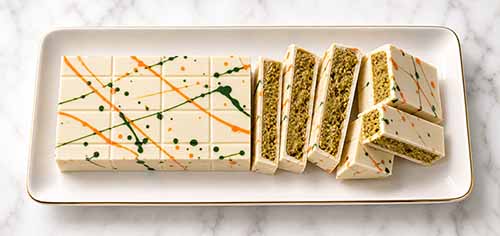
[15] The third in the triad: white chocolate Can’t Get Knafeh Of It.
The Origin Of The Name “Dubai Chocolate”
The name “Dubai chocolate” name evolved from a TikTok post that went viral in late 2023, after a food influencer, Maria Vehera, posted a video of herself eating one of the bars.
Thousands, and then millions, of viewers began searching for “that chocolate from Dubai” and it became a global sensation (one source cites 100 million views!). The visual appeal of the green pistachio filling against the chocolate and the hand-painted splash design on top made it perfect for exploding on social media.
“Dubai chocolate” became the catch-all search term, and the name for the thousands of copycats that followed—not just in chocolate, but in everything from pastry to beer.
Not surprisngly, FIX Dessert Chocolatier’s handmade bars sold out as fast as they could be created.
How Can You Get One?
The scarcity drove even more interest, with people traveling to Dubai specifically to try the chocolate or having friends bring bars back from trips.
Ever if you’re in Dubai, it can be tough to get your hands on FIX’s Can’t Get Knafeh of It.
The bars are only available via Deliveroo at specific times in Dubai.
Not surprisngly, Fix Dessert Chocolatier’s original bars selling out constantly and commanding premium prices. This scarcity drove even more interest, with people traveling to Dubai specifically to try the chocolate or having friends bring bars back from trips.
The viral success prompted chocolate makers worldwide to create their own versions of Dubai chocolate, leading to variations that incorporate different nuts, flavors, and textures while maintaining the core concept of kunafa-filled chocolate.
Alas, since ingredients can’t be copyrighted, Sarah may never receive the wealth and glory she deserves from her marvelous creation.
At best, a number of fanatics (like us) will order from her website for delivery overseas, and Dubai will become a tourist mecca.
And our best advice: Order the Dubai chocolate from Läderach.
Copycat Bars
As you can imagine, the quality of the bars varies with the overall quality of the producer.
Chocolate is categorized by‡:
Mass Market, e.g. Hershey’s, Nestlé
Commercial Premium, e.g. Ghirardelli, Green & Black’s, Lindt
Gourmet/Fine Chocolate, e.g. (Moonstruck, Norman Love, Vosges Haut-Chocolat)
Artisan/Bean-To-Bar, e.g. Amedei, Callebaut, Michel Cluizel, Valrhona)
There are also small bean-to-bar artisan chocolatiers. In the U.S., these include Amano, Askinosie, Dandelion, Fruition, Mast, Raaka, Taza, and Theo, among others.
After we tried the first 20 mass-market and commercial brands, and those from one level above, we decided to try only those of our favorite chocolatiers.
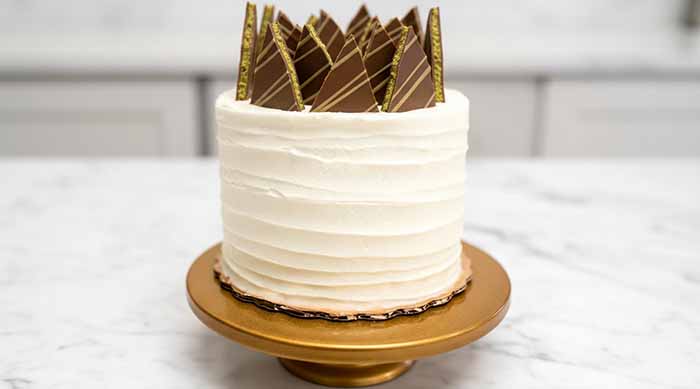
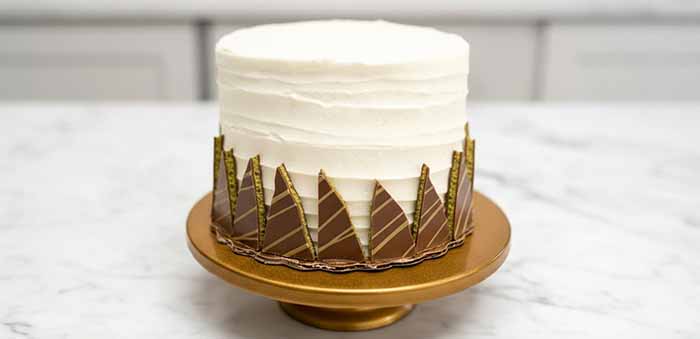
[16] You can have your cake, and a piece of Dubai chocolate, too (this is Läderach). Or, if you prefer:
WHAT MAKES ONE BAR BETTER THAN THE NEXT?
It’s the quality of the ingredients, of course, but also the preparation and the proportion.
“Proportion” turned out to be rather important.
Starting with the ingredients:
|
|
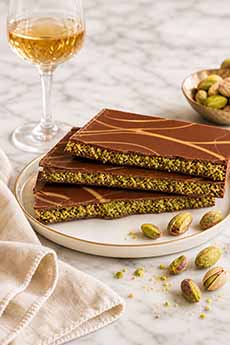
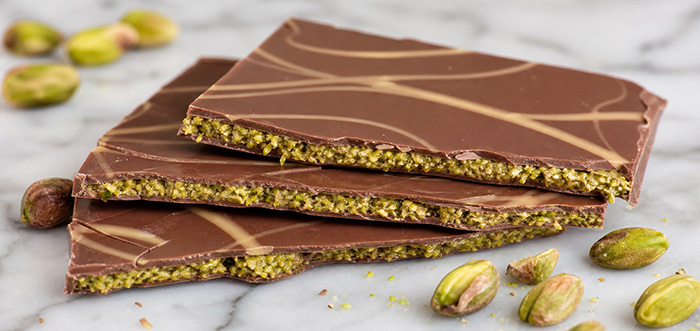
[1] Worth every cent—and calorie—is Läderach’s version of Dubai chocolate (photo: The Nibble).
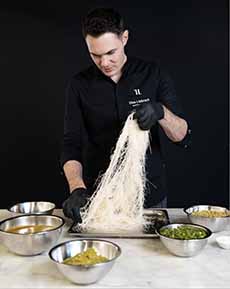
[2] The ingredients. The thin white strands are the kataifi (photos #2 through #5 and #18 © Läderach).
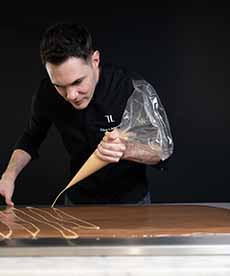
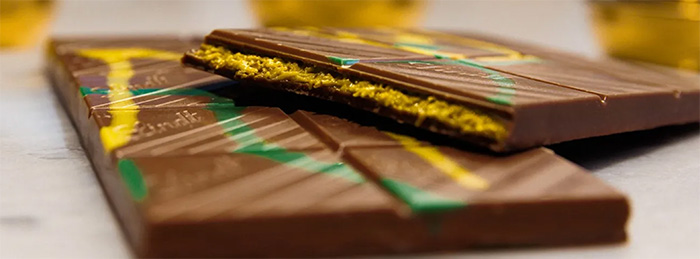
[3] With all ingredients now incorporated into Läderach’s chocolate slab, a contrasting color of chocolate is used for a zigzag design.
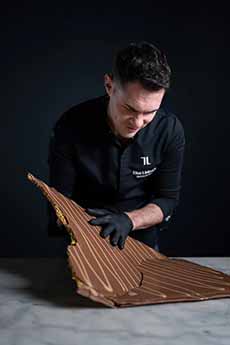
[4] The huge slab is broken down into sizes for sale.
[5] Yes, we’ll take both pieces!
[6] Sarah Hamoudi, creator of what became known as “Dubai chocolate” (photo © FIX Dessert Chocolatier).
Everybody gets into the act:
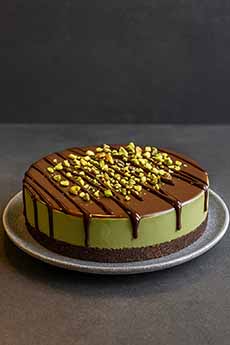
[7] Dubai cheesecake (photo © Recipes By Mama | Chat GPT).
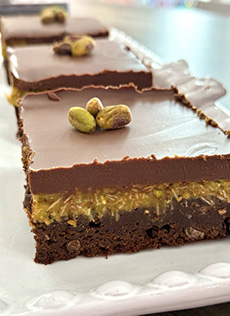
[8] Dubai brownies (photo © Dolce Bakes).
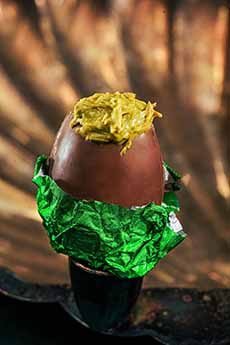
[9] A Dubai chocolate Easter Egg from a top Los Angeles chocolatier (photo © Compartes).
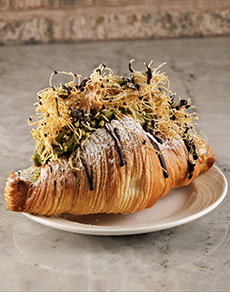
[10] Not just any pain au chocolate: a Dubai chocolate croissant (photo © Cocorico Boulangerie | Instagram).
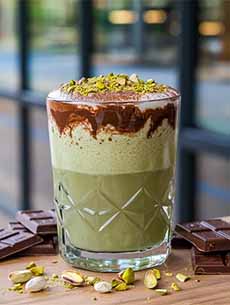
[11] Dubai chocolate iced coffee to go with the croissant above. Here’s the recipe but you’ll need to run it through Google Translate (photo © Coffees GR).
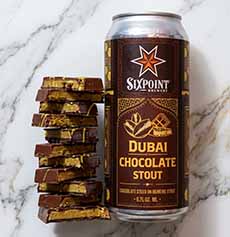
[12] One of a number of craft brew Dubai chocolate beers (photos #12, #13, #14, #15, #16, #17, and #18: The Nibble).
[12b] IHOP’s Dubai chocolate pancakes, a limited-time offer (photo © IHOP).
|
|
The kataifi preparation. Lower-end brands skip the butter-toasting step, leading to a chewy or soggy interior instead of the signature crunch of the threads.
The tahini ratio. Lower-end bars often leave out the tahini entirely, missing the savory balance that makes the FIX version more than just a sugar bomb.
The couverture quality. If the shell isn’t high-quality tempered chocolate, the chocolate can feel waxy. (What is couverture? The scoop.)
The splatter or drizzle. While it has nothing to do with the flavor, a decorated top has eye appeal and a certain joie de vivre. Läderach’s is a bit dull, but we gladly sacrifice eye appeal for palate appeal.
To this standard list, we have to add:
Proportion of filling to shell. We ordered bars from several of our favorite artisan chocolatiers. These are typically 3.5-ounce/500-gram bars and can be a half-inch thick or more. FIX’s bars appear to be this standard thickness.
But we far preferred Läderach’s thin, slab style, about half as thick.
With the bars, there’s a big mouthful of chocolate to taste through until you get to the filling.
With the slab, it’s about 1/3-2/3 proportion of chocolate to filling.
We personally find that proportion to be perfection, a luscious blend of flavors on the tongue.
The Lindt 5.3 ounce bar (photo #19, below) has a greater proportion of filling to chocolate, and the 40g bar is essentially pistachio filling enrobed in chocolate.
[17] Our Top Pick Of The Week (and Top Pick Of The Year): Läderach’s Dubai chocolate.
THE HISTORY OF LÄDERACH & FRISCHSHOGGI CHOCOLATE
Läderach was founded in 1962 in a small village in the central-eastern part of Switzerland. Founder Rudolf Läderach Jr. came from a local family of bakers.
In 1970, Rudolf patented a revolutionary process for manufacturing thin-walled, hollow chocolate balls to be filled for truffles. Chocolate truffle shells were difficult and messy to produce. His invention enabled chocolatiers to fill the premade shells efficiently, fundamentally changing professional truffle production.
For decades, Läderach operated primarily as a B2B supplier, providing the shells and other high-quality chocolate products to pastry shops and hotels. In 1981, Läderach expanded to Dillenburg, Germany and began to export overseas.
It wasn’t until 2004, following the acquisition of a retailer of premium chocolates, pralines, and confectionery—the Swiss confectionery chain Merkur Confiserie AG—that Merkur’s chain of retail chocolate boutiques enabled Läderach to become a global consumer brand, rebranded with the Läderach name.
Twenty years later, by 2024, Läderach employed some 2,000 people in 20 countries. The company has 220 boutiques, 100 of which are located in Europe; and as of early 2026, 40 to 45 boutiques across the U.S.**. It also sells online.
The FrischSchoggi Line
The FrischSchoggi line (Swiss German for “fresh chocolate”), of which their Dubai is part, was launched in 2004. It was a deliberate attempt to move away from the boxed chocolates that had been around since the Victorian age.
(Richard Cadbury is credited with the invention of boxed chocolates in 1861, with his “Fancy Box.” Prior to then, chocolates were sold in simple paper bags or plain tins. Richard, who was also an artist, designed a highly decorative box featuring a painting of his own daughter holding a kitten.)
Back to FrischSchoggi:
The chocolate was made in slabs like bark, but the key selling point was freshness. The chocolate is produced in Switzerland and shipped to global boutiques within days.
The customer experience was also exciting: large, hand-broken slabs behind glass display cases. Customers specify the exact weight or piece they want, and it is packaged in transparent bags to showcase the texture. There are numerous flavors. (We frequently give them as impressive little gifts). These are currently available in the U.S.:
Nut-Based: Hazelnut Milk, Hazelnut Dark, Macadamia Milk, Almond Dark, Pistachio Dark, Pistachio Salé (Salted) Dark.
Fruity & White Chocolate: Raspberry-Blackberry White, Mixed Fruit White, Blueberry Mascarpone.
Caramel & Spice: Milk Chocolate/Honey Croquant, Salted Caramel, Hazelnut Cinnamon.
Dark Chocolate: Classic Dark, Orange-Almond Dark, Single Origin Brazil 70%, Florentine Dark.
Specialty: Dubai Milk (pistachio/kunafa)‡‡, Espresso Macchiato, Stracciatella White-Dark.
When Läderach first launched Dubai FrischSchoggi, it was so coveted they had to implement a “one slab per person” rule in stores to prevent “chocolate scalping.”
> Get yours at Laderach.com.
> Take a look at all the FrischSchoggi flavors. You’ll want to bite every one!
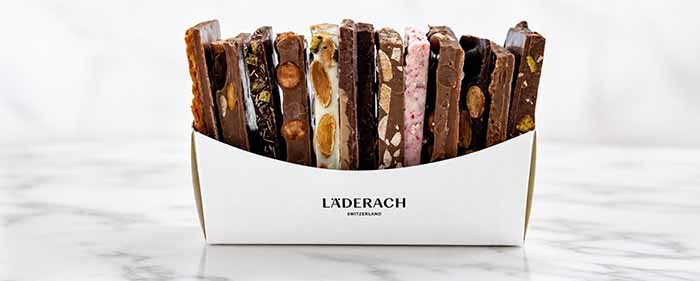
> Läderach makes itx easy with curated assortments. There are 12 flavors in this large “boat”:
[18] It’s a FrischSchoggi festival! Get yours and invite your chocolate-connoisseur friends. Check out the wine pairings below.
PAIRING WINE WITH DUBAI CHOCOLATE
Pairings With Milk Or White Chocolate
Red Wines
Light-to-medium-bodied red wines, specifically Pinot Noir (best choice), Grenache, or Merlot, which have fruity, low-tannin profiles that complement the creamy texture.
Sweet or fortified dessert wines like Banyuls, Brachetto d’Acqui (sparkling), or Ruby Port have a sweetness to match the chocolate’s sugar.
White Wines
Off-dry Riesling
Moscato d’Asti
Sparkling: Demi-sec Champagne or Crémant
Pairings With Dark Chocolate
Since dark chocolate has more tannin, bitterness, and intensity, it pairs better with wines with a heavier weight:
Amarone della Valpolicella
Cabernet Sauvignon (ripe, New World style)
Maury or Rivesaltes (like Banyuls but darker in style)
Pedro Ximénez Sherry
Tawny Port
Zinfandel
A RECIPE TO MAKE YOUR OWN DUBAI CHOCOLATE
Thanks to Lindt for this recipe (photo below).
[19] Make plenty: Everyone will want some (photo © Lindt).
________________
*The FIX bars currently include Butter to Be Safe Than Salty, Baklawa 2 The Future, Can’t Get Knafeh of It, Cereously Chewsy, Honey I’m Comb, Jam or Go Nuts, Mahalabi Or Not To Be, Mind Your Own Speculoos, Pick Up A Pretzel, and Time To Mango.
**Current U.S. Läderach locations: California (Bay Area, Los Angeles, San Diego, San Francisco), Florida (Boca Raton, Ft. Lauderdale, Miami, Orlando, Palm Beach, Tampa Bay), Massachusetts (Boston, Braintree), New Jersey (Paramus, Short Hills), New York Metropolitan Area (Manhattan, Long Island, Central Valley), Texas (Houston, Dallas), and the Washington D.C. and Northern Virginia Area (Arlington and Tysons Corner).
***From FIX’s Instagram page: “So upset I came dubai for 2 hours to catch flight to uk but cant find ur stall there 😔 u should have stall both gate A n gate B but how i go to ur stall then go my gate not possible” [source].
†Kadayif (kataifi) refers specifically to the shredded, angel-hair-like pastry dough, ingredient. It’s also called kadayıf in Turkish). It looks like thin, pale noodles or shredded wheat and is made by drizzling batter through a fine sieve onto a hot surface, creating wispy strands that are typically toasted in butter until crunchy. It’s an ingredient in different desserts or savory dishes. Kadayif and kunafa is the term used in Turkey and Arabic regions, while kataifi is the common Greek term.
Knafeh (kunafa) is a classic Middle Eastern/Levantine pastry, the final, cream- or cheese-layered dessert made using shredded kataifi dough as its base and topping, soaked in syrup.
In the context of Dubai chocolate, the Can’t Get Knafeh of It chocolate bar from FIX Dessert Chocolatier uses toasted kataifi strands mixed with pistachio cream and tahini, all enveloped in chocolate. Thus, the filling is inspired by knafeh’s flavor profile and uses knafeh’s signature ingredient, kataifi, in a deconstructed, no-syrup, chocolate-bar format.
[20] Shredded phyllo is known as kadayif or kataifi (photo © Aslid | Amazon).
††More Dubai-flavored products:
> Baked goods: babka, brioche, brownies, cakes, cheesecakes, cinnamon rolls, cookies, crêpes, cronuts/donuts, croissants, éclairs, macarons, muffins, tarts/tartlets.
> Beverages: cappuccinos/lattes, hot chocolate, iced coffee drinks, matcha drinks, milkshakes, smoothies.
> Frozen foods: ice cream/gelato/Frozen yogurt, ice cream bars/rolls/sandwiches.
> Spreads and confections: brittle/bark, caramels, chocolate bars/chocolates/truffles, fudge, pistachio butter cups, pistachio knafeh spread (like Nutella and Speculoos).
> More: granola, oatmeal, overnight oats, pancakes/waffles, popcorn, protein bars/energy bites, yogurt/yogurt parfaits.
‡These are just examples of companies in the categories, and does not mean that all of them produce Dubai chocolate.
‡‡No one in the U.S. can explain why only the milk chocolate Dubai is available here. While it’s our favorite, we have pals who bring the dark and white Dubai back from Europe. Dubai pralines (bonbons) are available in dark, milk, and mixed dark/milk boxes.
CHECK OUT WHAT’S HAPPENING ON OUR HOME PAGE, THENIBBLE.COM.
|