|

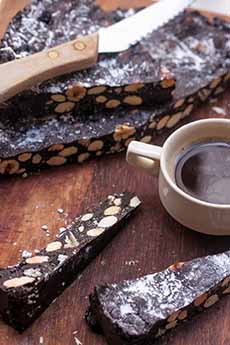
[1] Chef David Lebovitz baked his own panforte for Christmas (here’s the recipe), but you can buy one (photos #1 and #2 © David Lebovitz).
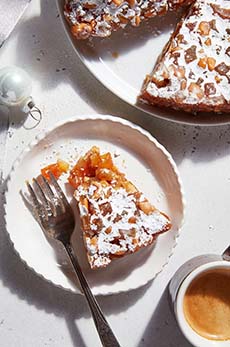
[2] A panforte Margherita, or panforte bianco (white panforte). The original nero (dark) version was lightened up in 1876 for Queen Margherita of Italy (next photo). Here’s the recipe (photo © King Arthur Baking).
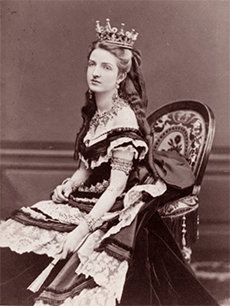
[3] Queen Margherita of Italy. Born Princess Margherita of Savoy, she became Queen of Italy upon marrying King Umberto I (photo public domain).
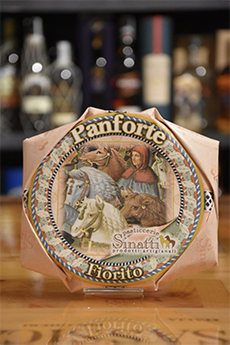
[4] Panforte is usually beautifully wrapped with Christmas art. This panforte fiorito is from Enoteca Alessi in Florence, Italy (photo © Enoteca Alessi).
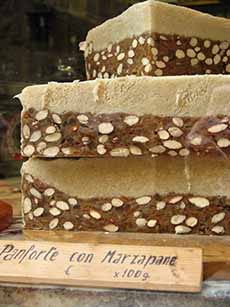
[5] Panforte fiorito has a thick layer of marzipan on top. This stack is at a shop in San Gimignano, Italy (photo JW | License-CC-BY-SA-2.0).
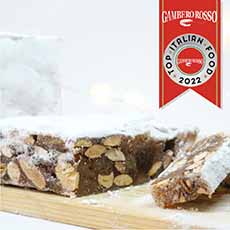
[6] This artisan panforte, a Margherita was awarded 1st place in a recent ranking by Gambero Rosso, one of the most quoted Italian food magazine (photo © Fratelli Lundari).
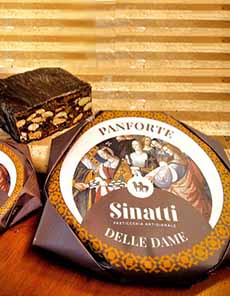
[7] Before the Margherita arrived, chocolate panforte was created, in 1820. Panforte di cioccolato (chocolate panforte) is also known as panforte delle dame (panforte for the ladies) (photo © Pasticceria Sinatti).
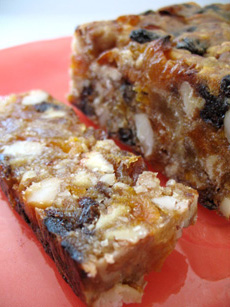
[8] A modern recipe, tropical panforte uses coconut, dried mango, pineapple, and sometimes other tropical fruits, instead of the European standards (photo © The Nibble).
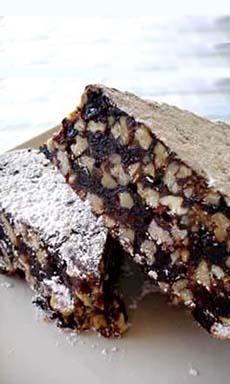
[9] Different bakers change the proportions of inclusions to reflect personal tastes. This nut-heavy panforte nero was created by Sophia’s Sweets in Texas (alas, now closed (photo © Sophia’s Sweets).
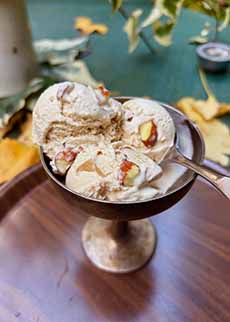
[10] David Lebovitz’s panforte ice cream is largely made with candied fruits. Here’s the recipe (photo © David Lebovitz | Substack). See our own panforte ice cream recipe below.
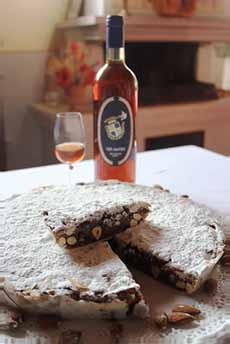
[11] Panforte Margherita with a glass of vin santo, a sweet white Italian dessert wine from Tuscany, is made from a blend of grapes††. It’s typically served with biscotti. There’s also a red variety, made in much smaller amounts, largely from the Sangiovese grape (photo © Cinelli Colombini).
|
|
If you receive—or pick up—a panforte for Christmas, there’s lots you can do with it. This article is all about panforte, a medieval Christmas bread that’s now enjoyed year-round as a dessert.
Although always referred to as “bread,” it’s a sweet bread or cake, like banana bread, zucchini bread, and so many others.
It’s a relative of English fruitcake—dense and packed with fruits and nuts—but with a different flavor profile.
The key ingredients in a traditional panforte include:
Fruits: candied citron, orange peel, and sometimes, candied melon and dried figs.
Nuts: toasted whole almonds and hazelnuts.
Spices: black pepper, cinnamon, cloves, coriander, nutmeg, and sometimes, cardamom.
Sweeteners: local honey and sugar, combined to create a syrup.
Binder: a small amount of flour.
There’s a plentiful supply of panforte on offer right now, both online and at specialty food stores—maybe even your local supermarket.
If you want to make panforte from scratch, here’s Chef David’s Lebovitz’s recipe (photo #1).
> The history of panforte is below.
> Also below, the different types of panforte.
> Also below, how to serve panforte and wine pairings.
> Also below, our recipe for panforte ice cream. Delicious!
> Types of Christmas breads.
> The difference between panettone and pandoro, two better-known Italian Christmas breads.
> The different types of bread: a photo glossary.
> The different types of cake: a photo glossary.
THE HISTORY OF PANFORTE
Panforte, a dense, sweet, and spicy Christmas dessert bread, originated in Siena, a city in the Tuscany region of Italy, in the 12th or 13th century.
The name means “strong bread” (pan forte), for its dense texture and spicy flavors.
The dessert was originally baked by nuns, monks, and apothecaries. It was considered both a delicacy and a medicinal item (now there’s an excuse for eating cake!).
Too expensive to be eaten by the nuns and monks themselves, it was given as an offering to religious institutions or gifted to clergy and nobles, particularly during festivals and special occasions.
Wealthy families and religious institutions funded the use of exotic spices imported from the East, making the dessert as a luxury item (source: ChatGPT, 2024-12-22).
Only the rich could afford the exotic imported spices. The high concentration of nuts and dried fruits added to the expense.
Why a medicinal item? The spices—cinnamon, coriander, and nutmeg, for example—were highly valued for their perceived medicinal properties. Honey was also valued for its therapeutic qualities*.
It was initially also called panpepato (peppered bread) reflecting the strong presence of costly black pepper in early recipes.
But its origins date back to a simpler, affordable honey and fruit sweet bread made in local monasteries, called panmelato, “honeyed bread.” Panmelato was:
Primarily made with honey and flour.
Had a softer, less dense, more bread-like consistency than the final panforte.
Contained some dried fruits and fewer nuts and spices than panforte.
But if the panmelato was not consumed reasonably quickly, the fresh fruit would ferment in warm weather, so early versions began to be baked only on the coldest days.
Sooner or later, someone thought to substitute candied fruits for the fresh ones, creating a dessert with a long shelf life year-round.
Panepepato—Subsequently Called Panforte—Is Born
The evolution from panmelato to spiced panforte is attributed to the spice trade boom in the Middle Ages, when Siena became an important trading center.
Now a dense mixture of almonds and candied fruit, still sweetened with honey but richly flavored with spices, it was originally called panpepato con miele (peppered [spiced] bread with honey). Still baked by nuns, it became a traditional Christmas bread.
The delightful recipe spread beyond Tuscany.
In 1400s Venice, preference was for the classic panforte prepared in “the ancient Siena way” for important celebrations.
In the archives of Genoa, on the opposite [west] coast, it’s referenced as one of the best-known desserts of Italy.
Over the centuries many variations of the original recipe developed, as new ingredients became available in Italy. For this and other reasons, the panforte menu diversified.
The Different Types Of Panforte
Panforte nero. The original medieval version, panforte nero (black panforte—photos #1 and #9) is dark in color due to spices and black pepper, which also give it an intense flavor profile. The top is dusted with black pepper rather than the sugar used on panforte bianco (white panforte), for even more of a spicy kick.
By the 18th century, panforte was exported across Europe, contributing to Siena’s economy. Its long shelf life made it perfect for traveling, and the Siena bakers guild carefully guarded the original recipes, helping maintain a monopoly.
Panforte al cioccolato. Another century later, in 1820, panforte al cioccolato (chocolate panforte—photo #7), also known as panforte delle dame (panforte for the ladies) was created by Giovanni Parenti, the founder of the first panforte factory.
The ingredients include cocoa, blanched almonds, candied melon, and figs or dates, covered with a thin layer of chocolate fondant [source].
Panforte Margherita. In 1879, panforte Margherita (photos #2, #6, and #11) was created to celebrate a visit to Siena by Italy’s Queen Margherita (photo #3), who arrived in the summer to watch the Palio di Siena horse race. (The pizza we now know as Margherita was renamed in her honor when she visited Naples in June 1889—see the footnote** [source].)
A lighter, milder version, panforte Margherita uses vanilla instead of some of the stronger spices, and is dusted with powdered sugar. Today it’s also called panforte bianco (white panforte).
This less intense version became so popular that it’s now the preferred panforte of many, with panforte nero, the original, in second place [source: Claude AI, 2024-12-22].
Panforte fiorito. Another, sweeter variation followed: panforte fiorito (flowered panforte)—photos #4 and #5. Flower essences in the batter and a layer of marzipan on top.
Other Panforte Versions
There are also regional variations from other parts of Tuscany, each with slight differences in spice blends or fruit-to-nut ratios.
And other countries add their own spines. For example, we really enjoy the modern tropical panforte (photo #8), which appears to have been developed in the U.S.
It has a slightly different mix of fruits: dried coconut, pineapple, and mangoes, plus macadamia nuts, candied ginger and spices. We find this combination of flavors to be pretty exciting.
Panforte fichi e noci (figs and nuts) is an alternative version of the classic panforte nero. It replaces the almonds with walnuts, and eschews other fruits in favor of dried figs.
Panforte Today
Panforte is now enjoyed year-round. In modern times, some bakers are inspired to create new versions, incorporating:
Fruits and nuts from other parts of the globe, such as macadamia and pistachio nuts, candied or crystallized ginger‡, even red chile powder.
Dried fruits instead of candied ones.
Alcohol: amaretto, brandy, orange liqueur, Port, rum, Sherry, whiskey.
Pumpkin or sunflower seeds.
Savory ingredients, from coffee and saffron to Tuscan herbs.
Whether old-style or new-style, there’s a lot of affordable, factory produced panforte.
It will cost more, but look for artisanal producers. They still follow traditional methods, making panforte by hand using age-old recipes.
HOW TO SERVE PANFORTE & WINE PAIRINGS
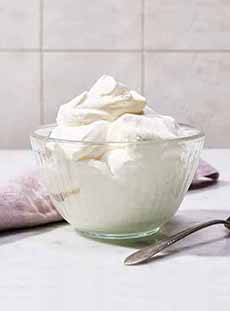
Rich and dense, panforte is typically served in thin slices. We personally serve it in a non-traditional way, with whipped cream or ice cream (vanilla or rum raisin).
In Siena, they often serve it with a small glass of vin santo, a sweet Tuscan dessert wine that complements the spicy flavors. You can also pair other Italian dessert wines† and sparklers such as Asti Spumante, Brachetto d’Acqui, Moscato d’Asti, Prosecco, and sparkling Lambrusco.
In addition to its place as part of Christmas seasonal fare, it can be served year-round:
As a dessert course after dinner.
With afternoon coffee or tea.
On a cheese board, particularly with aged Italian cheeses like pecorino.
At room temperature, which is how it best expresses its flavors
Like England’s Christmas puddings, panforte is known for its exceptional shelf-stability. If properly stored, it can last 3-6 months, sometimes even longer.
Don’t refrigerate or freeze leftovers, as the cold can affect the texture and dry out the cake.
Wrap it in parchment paper, then aluminum foil and/or in an airtight tin.
Store it in a cool, dry place.
If the surface becomes too dry, you can improve its looks with a light dusting of powdered sugar, a glaze of powdered sugar and water (add some brandy or orange liqueur), and a side of crème anglaise, ice cream, or whipped cream.
> The different types of French crèmes.
RECIPE: PANFORTE ICE CREAM
We were inspired by this recipe from Chef David Lebovitz to make panforte ice cream (photo #10).
His recipe consists largely of the candied fruits he had left over from making actual panforte. We took a different approach, using most of the classic panforte ingredients.
1. START with this honey ice cream recipe.
2. SELECT the inclusions and proportions you prefer. We tried to follow the classic ingredients as much as possible, with some variations.
Fruits: We’re not keen on candied citron, but we do love candied lemon peel and orange peel. So we made batches of them with this recipe (you don’t have to coat the peel in chocolate for this ice cream, unless you want to).
We also borrowed a page from the panettone recipe and threw in a touch of the raisins, sultanas, and dried cherries we had on hand.
We also included chopped dried figs from the classic recipe.
Nuts: We chose almonds. We thought about including pecans pistachios, and will try the mix of three next time.
Spices: We like flavor-forward spice, so we used a total of 2 teaspoons in our quart of ice cream. This allowed the spices to be noticeable without being overwhelming, but you can limit the spices to 1.5 teaspoons if you want a lighter touch.
We used 3/4 teaspoon ground cinnamon, 1/4 teaspoon ground nutmeg, 1/4 teaspoon ground ginger, 1/8 teaspoon ground cloves, and 1/8 teaspoon of black pepper.
If you’re concerned about the pepper (we liked it just fine), you can eliminate it and use 1 teaspoon of cinnamon. You can also use pepper from a jar, which we never use because we prefer the kick of freshly-ground peppercorns.
Chocolate: We used chocolate sauce as a garnish, to create our “panforte ice cream for the ladies.” Next time we might instead add chocolate chips to the ice cream.
Cake: We didn’t do it this time because we didn’t have a panforte. But next time, we’ll get one and use a 1/2 cup of tiny dice. By “tiny” we mean the size of brownie chunks in brownie ice cream. They’ll be hard once frozen. If we love it, we’ll add more in the next batch.
3. PROCESS according to your ice cream maker’s instructions.
|
________________
*The medical properties of honey: antioxidants, cough relief, gastroenteritis, vitamins and minerals including (ascorbic acid, calcium, copper, iron, magnesium, manganese, niacin, pantothenic acid (vitamin B5), phosphorus, potassium, riboflavin, and zinc. Honey also has been used for millennia to heal burns and wounds, due to its antibacterial and anti-inflammatory properties. And long before there were better treatments, honey was used for neurological diseases: as an antidepressant/anti-anxiety treatment and an anti-convulsant.
**The origin of the Margherita pizza: While the name pizza Margherita may have been popularized because of the Queen’s visit to Naples in 1889, a pizza made with the same toppings (mozzarella, tomato, basil) was already present there.
In 1849 Emanuele Rocco recorded a pizza with those toppings. The mozzarella was thinly sliced, and arranged in a flower shape over the tomato sauce, along with the basil leaves. Confusingly, this may be the real origin of the name pizza Margherita, since margherita is the Italian word for daisy [source].
†Italian dessert wines include: Barolo Chinato, Moscadello di Montalcino, Moscato Bianco passito, Moscato Rosa/Rosenmuskateller passito, Ramandolo, Recioto della Valpolicella, Vin Santo (photo #11), and Zibibbo/Moscato di Alessandria/Moscato di Pantelleria. Passito is an Italian term that refers to a sweet dessert wine made from dried grapes.
††The vin santo grape blend diffesr according to location. Trebbiano Toscano from Tuscany (photo #11) combines two grapes, Malvasia Bianca Lunga and Trebbiano. Malvasia provides body, texture, and perfume, while Trebbiano adds acidity. Vin santo is also produced in other Italian regions, including Carmignano, Rufina, Trentino, Umbria, and Veneto.
These other regions make vin santo with their own local grapes. For example, Veneto producers use Garganega grapes, while Trentino producers use Nosiola grapes.
‡The difference between candied and crystallized ginger: Both begin with fresh ginger root. Candied ginger is boiled in a sugar syrup until tender and chewy. It is softer and juicier than crystallized ginger. It needs to be stored in syrup to prevent drying out. It can be used in baking, confectionery, glazes and marinades, salads and slaws, chutneys, and beverages, from tea to cocktails to mulled cider or wine.
Crystallized ginger is dried after being cooked in sugar syrup, then coated with granulated sugar. It is firm and crunchy with a chewy interior, and can be enjoyed as a spicy candy, in baked goods, or as a garnish for desserts. It can be stored as is.
CHECK OUT WHAT’S HAPPENING ON OUR HOME PAGE, THENIBBLE.COM.
|