THE NIBBLE BLOG: Products, Recipes & Trends In Specialty Foods


Also visit our main website, TheNibble.com.

Roasted Chickpeas Recipe For National Chickpea Day

Chickpeas Garnish
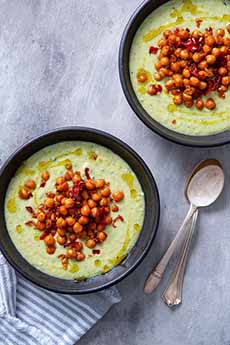
[1] Roasted chickpeas garnish a bowl of spicy avocado soup (photos #1 and #2 © DeLallo).

Roasted Chickpeas
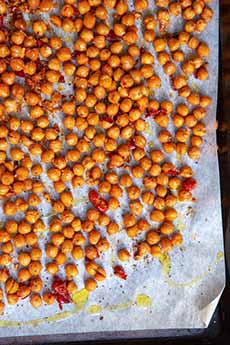
[2] Roasted chickpeas.

Fresh Chickpeas
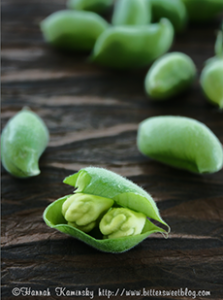
[3] Fresh chickpeas, a.k.a. green chickpeas, in their pods (photo © Hannah Kaminsky | Bittersweet Blog).


Who needs empty-calorie croutons when you can substitute nutritious*, roasted chickpeas—as in the roasted chickpeas recipe below?

In photo #1, DeLallo serves it as a garnish for avocado soup (here’s the recipe for the soup).

But roasted chickpeas an be used as a general garnish for:

  • Bruschetta/crostini
  • Fish
  • Hors d’oeuvre
  • Pasta and pizza
  • Rice & grains
  • Salads
  • Savory pancakes and waffles
  • Soups
  • Stews
  • Vegetables
  •  
    The history of chickpeas is below.

    April 21st is National Chickpea Day.
     
     
    RECIPE: ROASTED CHICKPEAS

    Ingredients

  • 2 cans (14 ounces each) DeLallo Imported Chickpeas (or substitute)
  • 6 DeLallo Calabrian Chili Peppers, finely chopped (or substitute)
  • 1 teaspoon DeLallo Extra Virgin Avocado Oil (substitute olive oil or other cooking oil)
  • 1 teaspoon oil from the DeLallo Calabrian Chili Peppers jar (or substitute)
  • 1 teaspoon paprika
  • 1 teaspoon kosher salt
  •  
    Preparation

    1. HEAT the oven to 400°F. Line a baking sheet with parchment paper.

    2. COMBINE the chickpeas, chopped chiles, oils, paprika, and salt in a medium bowl. Toss well to combine and spread evenly onto the prepared baking sheet.

    3. ROAST for 20-30 minutes until slightly crisp, stirring every 5 minutes. Set aside to cool.
     
     
    MORE CHICKPEA RECIPES

    In addition to falafel and hummus—two chickpea-based Middle Eastern staples that have been embraced by Americans, try:

  • Almond Hummus
  • Baked Sweet Potato With Chickpeas, Tahini, & Sauerkraut
  • Chickpea Fries
  • Chickpea Salad
  • Chickpea Salad In Tomato Sauce With Salame
  • Chickpea Succotash
  • Composed Salad (Salade Composée)
  • Dukkah: Egyptian Seasoning Blend
  • Farinata: Chickpea Snack Pancakes
  • Green Hummus With Crudités
  • Hummus Salad Dressing
  • Moroccan Chicken Salad
  • Moroccan Chickpea & Vegetable Tagine
  • Orzo Salad With Chickpeas & Kalamata Olives
  • Panzanella Salad With Chickpeas
  • Leblebi: Tunisian Chickpea Soup
  • Pumpkin Burger With Chickpeas
  • Shepherd’s Pie With Middle Eastern Accents
  •  
    THE HISTORY OF CHICKPEAS

    Chickpeas were among the first crops cultivated by man, which are known as the eight founder crops of the Fertile Crescent.

    They are one of the earliest cultivated legumes: 7,500-year-old remains have been found in the Middle East (which means, chickpeas have been eaten since long before the beginning of recorded history).

    Cicer arietinum, the chickpea genus and species, is a legume in the family Fabaceae. Fabaceae is known variously as the bean, legume or pea family.

    You may know chickpeas by one of their other names: ceci or cece (Italian), chana or Kabuli chana (Northern India), Egyptian pea, garbanzo (Spanish), gram or Bengal gram (British India).
     
    How The Chickpea Got Its Name

    The word chickpea in English came from the French chich, from cicer, Latin for chickpea.

    Chich is found in print in English in 1388. It took another five centuries for “chick-pea” to appear in print in England, in the mid-18th century.

    Fun fact: The Roman cognomen Cicero came from cicer. Yes, the great orator Roman Marcus Tullius Cicero—also a consul, constitutionalist, lawyer, philosopher, political theorist and politician—was a member of the Chickpea family.

    A cognomen was the third name of a citizen of ancient Rome—the hereditary name that we call a surname, which passed from father to child. The second name—the family name or clan name—identified a particular branch within a family, or family within a clan.

    The Oxford English Dictionary lists a 1548 reference to chickpeas that reads, “Cicer may be named in English Cich, or ciche pease, after the Frenche tonge.” By the mid-18th century, ciche peas evolved to chick-peas.
     
    What About Garbanzo?

    The word “garbanzo” is a bit more obscure. It is first noted in English in the 17th century, as “calavance,” with a possible parent from the Basque word garbantzu, a compound of garau, seed and antzu, dry.

    In ancient Greece, chickpeas (called erébinthos) were consumed raw when young and eaten as a staple food, as well as a dessert.

  • The Romans roasted garbanzos as a snack and cooked them into a broth.
  • Many centuries later, in 18th-century Europe, roasted chickpeas were ground and brewed as a coffee substitute.
  • Today, halua, chickpeas in a sugar base that has some resemblance to peanut brittle, is a popular sweet dish in Bangladesh.
  •  
    Thanks to Americans’ interest in Middle Eastern foods like hummus, and plant-based protein, many chickpea recipes now enliven our diet.
     
     
    IS THE CHICKPEA A BEAN OR A PEA?

    Peas and beans are both legumes and seeds, both members of the Fabaceae botanical family. The chickpea, also popularly called the garbanzo bean, is actually a bean. Some key differences:

  • Pea plants (genus/species Pisum sativum) have hollow stems. Beans (genus/species Cicer arietinum) have solid stems.
  • Peas have leaf tendrils which they use to twine. In general, beans lack tendrils.
  • The taller varieties of both peas and beans need trellises to support them as they grow. Most beans just twine themselves over their supports while peas use their tendrils to climb. At each node along their stems, they generate two or three one-inch-long tendrils, which grab and then wind themselves around something, such as a narrow trellis.
  •  
    Read more about the differences on DifferenceBetween.net.

    Check out the different types of beans and legumes in our Bean Glossary.

    _______________

    *One cup of roasted chickpeas contains 269 calories: 45 g of carbohydrate, 15 g of protein, 13 g of dietary fiber, 4 g of fat but zero cholesterol. They contain good amounts of B vitamins, fiber, folate, iron, phosphorus, and zinc.


    CHECK OUT WHAT’S HAPPENING ON OUR HOME PAGE, THENIBBLE.COM.


    Comments off

    FOOD FUN: Mashed Potato Pizza

    September is National Potato Month, and our contribution to the festivities is Mashed Potato Pizza.

    Our favorite baker, The Baker Chick, made it with leftover mashed potatoes.

    She used slow cooker mashed potatoes, but you can make the mash however you like.

    For a Thanksgiving Leftovers pizza, you can substitute mashed sweet potatoes and top with your leftover veggies: green peas, squash, etc.
     
     
    RECIPE: MASHED POTATO PIZZA

    Ingredients For 1 14-Inch Pizza

  • ½ batch of pizza crust (substitute premade crust)
  • 1½ cups mashed potatoes
  • 8 slices of cooked bacon, crumbled
  • 1 cup of sweet corn
  • 3 scallions, sliced thin
  • 1½ cups shredded mozzarella cheese
  •  
    Preparation

    1. PREHEAT the oven to 500°F and heat the pizza pan or stone along with it for at least 30 minutes.


    Mashed Potato Pizza
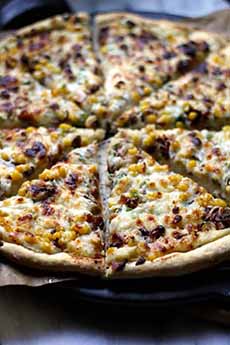
    [1] Creamy mashed potatoes, bacon, corn, scallions and mozzarella: That’s some pizza! (photo © The Baker Chick)

     
    2. PLACE a sheet of parchment paper on the work surface and place the dough ball in the middle. Using olive oil-coated hands…

    3. ROLL and spread the dough until it is thin and shaped. Form a thin crust ridge around the edge. A bit of extra oil can make it easier to spread and actually make thin.

    4. SPREAD the mashed potato on top of the shaped dough (but not the edge). Sprinkle the bacon, corn and scallions on top of the potatoes and then top with the cheese.

    5. USE a cutting board or pizza peel to help transfer the pizza to the hot stone. Bake for 10-12 minutes, or until golden and crisp.

    Turn it into a festive lunch with a green salad and a glass of cider.
     
     
    The History Of Potatoes

    The History Of Pizza


    Comments off

    The Newest Chocolate In 80 Years: Ruby Chocolate (Cacao)

    Ruby Chocolate
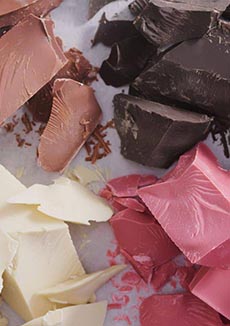
    [1] Ruby chocolate joins the familiar dark, milk and white varieties (photos 1-3 © Barry Callebaut).

    Ruby Chocolate
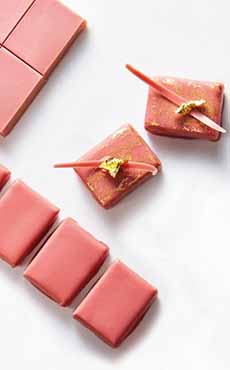
    [2] Make confections and desserts with ruby chocolate, from bonbons to mousse.

    Ruby Chocolate
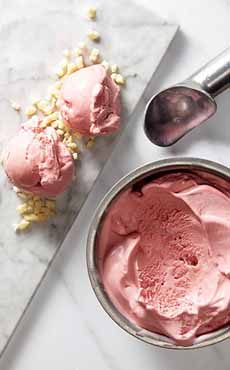
    [3] Ruby chocolate ice cream.

    Choco Leibniz Bahlsen Ruby
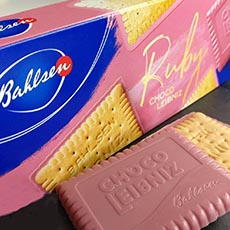
    [4] From Bahlsen: Choco Leibniz presents Ruby Cacao (photos 4-5 courtesy Foodschau | Facebook).

    Choco Leibniz Bahlsen Ruby
    [5] The top and bottom of Bahlsen’s ruby cacao Choco Leibniz biscuit.


    Dark, milk and white chocolate have a new sibling: ruby chocolate.

    The food scientists at Swiss* cacao producer Barry Callebaut created the new chocolate type they call ruby.

    It’s named for its rosy color (photo #1)—and possibly because many people might think that “pink chocolate” was for kids.

    To the eye it is a lovely shade of pink (photo #1). On the palate it delivers berry and citrus flavor notes. It’s a bit tart, in a pleasant way.

    In fact, it has none of the flavors typically associated with chocolate, just the creamy mouthfeel.

    So people who don’t like dark, milk and white chocolate might like ruby—and vice versa.

    The story follows.

    Elsewhere on The Nibble:

    > The history of chocolate.

    > The different types of chocolate: a photo glossary.

    > The year’s 69 chocolate holidays.
     
     
    THE ORIGIN OF RUBY CHOCOLATE

    According to Barry Callebaut, the chocolate is made from a cacao bean they’ve dubbed the ruby cacao bean. The color and flavor of the couverture are all from nature: No flavoring or color is added (sugar is added by whomever is transforming the couverture into a finished chocolate product).

    The naturally-occurring ruby cacao bean has properties that allow it to be processed into pink, fruity ruby chocolate.

    Cacao, like wine grapes and other fruits, can be widely affected by their terroir. Ruby cocoa beans grow under particular levels of humidity, sunshine and temperature and can be found in the Côte d’Ivoire, Brazil and Ecuador.

    The new chocolate arrives some 80 years after white chocolate was introduced to the market by Nestlé, in the 1930s.

    Ruby chocolate began development in 2004.

    According to the company:

    “More than 10 years ago, one of our cocoa† experts discovered that components of certain cocoa beans could produce a cacao† taste experience with an exceptional flavor and color. Since then, we’ve been unraveling the secret behind this, leading to the discovery of the ruby cocoa bean and creation of a totally new flavor experience.”

    Barry-Callebaut’s process is, of course, proprietary.

    However, we know that in 2009 the company registered a patent for “cocoa-derived material” from unfermented cocoa beans (or beans fermented for no more than three days) that become red or purple after treating them with an acid (citric acid) and then defatting with petroleum ether.”

    After harvesting, beans are traditionally washed (“lavado”), then fermented (“fermentado”) for four days. They are then dried in preparation for roasting.

    Beans that are only washed can have a natural red-pinkish color.

    Industry speculation is that ruby chocolate is made with unfermented cacao beans that are washed but not fermented.

    The citric acid that engenders the pink color also provides the slight tart taste [source].

    The percent of cacao in ruby chocolate is less than milk chocolate, which as 30% or more cacao‡.
     
    The First Sale To Consumers

    Ruby chocolate was first available for sale to consumers in January 2018.

    It was introduced in a new, premium flavor of Kit Kat bar in Japan and South Korea (Kit Kats are sold there in a wide variety of flavors.

    The ruby Kit Kat bar was next rolled out in Canada, Germany, the U.K., Australia and New Zealand.

    And now, it’s in the U.S. The first products we’ve seen so far are:

  • Bahlsen Choco-Leibniz Biscuits (limited edition, see below)
  • CacaoHolic Ruby Chocolate Chips
  • Callebaut Ruby Couverture Callets
  • Chocolove chocolate bars
  • Trader Joe’s Ruby Wafers
  •  
    Most assuredly, products like these, plus ruby cacao bonbons and desserts, are making their way to your neck of the woods.
     
    Ruby Cacao Beverage Pairings

    According to Barry-Callebaut, ruby cacao pairs extremely well with rosé Champagne, Belgian Kriek beer, salty caramels and blue cheese.

    To these, THE NIBBLE adds a fruity red like Beaujolais, dessert wines like demi-sec and sec Champagnes, Port and these dessert wines.

    Here’s more information from Barry Callebaut.


    BAHLSEN RUBY CACAO COOKIES

    Here’s a great way to try ruby cacao and help support breast cancer (October is Breast Cancer Awareness Month).

    They’re limited-edition biscuits from Bahlsen, the world’s largest family-run biscuit [cookie] producer in the world, since 1889.

    The company’s first innovation, in 1891, were the delectable cookies known in the U.S. as Choco Leibniz (Leibniz Keks in Germany): a buttery biscuit on one side, a bar of chocolate on the other.
    The limited edition, available in September and October, is officially called Choco Leibniz presents Ruby Cacao (photos #4, #5 and #6).

    A portion of sales benefits PLAY for P.I.N.K., which donates 100% of proceeds to advance the world’s most promising research.

    “Cookies for a Cause” will be available from September 1st through October 31st, 2019, for $4.99 at select grocers and specialty markets including Cost Plus World Market, Earth Fare, Ingles, Jungle Jim’s, ShopRite and Stop & Shop.
     
    Choco Leibniz Ruby Cacao Biscuits
    [6] Get your ruby biscuits at while supplies last (photo © Barry Callebaut).
    _________________

    *The company is currently based in Zürich, Switzerland. It is a 1996 merger of Belgian chocolate producer Callebaut and French producer Cacao Barry.

    †Cocoa and cacao are often used interchangeably. “Cocoa” was actually a typo on a ship’s manifest in the 1700s. The Nibble uses cacao to refer to the bean, cocoa to refer to the drink (a.k.a. “drinking chocolate”), and chocolate for “eating chocolate.”

    ‡Most “newsstand” milk chocolate contains 30% cacao. The higher the percentage of cacao, the more chocolatey the flavor. Artisan producers often produce up to 45% milk chocolate, and products called “dark milk chocolate” can contain up to 70% cacao. Here’s more information.
     

    CHECK OUT WHAT’S HAPPENING ON OUR HOME PAGE, THENIBBLE.COM.


    Comments off


    © Copyright 2005-2026 Lifestyle Direct, Inc. All rights reserved. All images are copyrighted to their respective owners.