THE NIBBLE BLOG: Products, Recipes & Trends In Specialty Foods


Also visit our main website, TheNibble.com.

TIP OF THE DAY: A Rainbow Of Vegetables In Unusual Colors

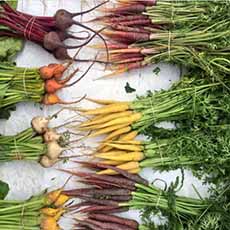
Colored Carrots & Beets

[1] Different colors of beets and carrots (photo © The Chef’s Garden).

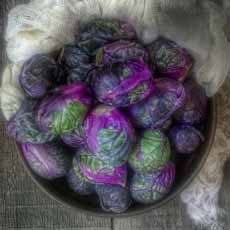
Purple Brussels Sprouts

[2] Purple brussels sprouts (photo © Frieda’s Specialty Produce).

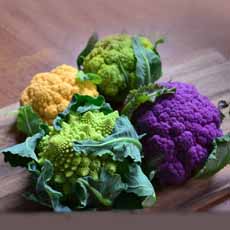
Multicolored Cauliflower
[3] Cauliflower in the conventional white, plus orange and purple. In the front is romanesco, a variation of cauliflower that has spikes (photo © Nourish The Roots).

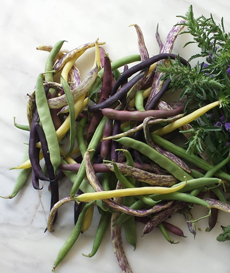
Multicolored Green Beans
[4] Green beans don’t have to be green photo © The Pines Restaurant | Brooklyn).

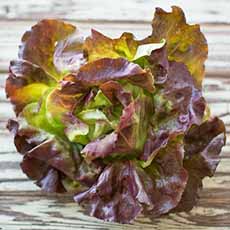
Red Leaf Lettuce
[5] Red butterhead lettuce is just one of several red leaf lettuces (photo © Good Eggs).

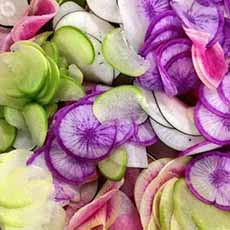
Colored Radishes
[6] Colored radishes (photo © The Chef’s Garden)


September is National Fruits & Vegetables Month. You know that fruits come in a rainbow of colors, but how about veggies?

Sure, you can find multicolored baby carrots, bell peppers, chiles and heirloom tomatoes.

But there’s much more to look for.

So today’s tip is: Keep an eye out and treat yourself to whatever is new and different.

Grocers know that customers want new options, so even if there’s no farmers market near you, keep looking.

It’s not just about fun; there are nutritional benefits as well. Colored foods tend to be more antioxidant rich than pale and white foods.

For example, orange cauliflower contains high levels of beta-carotene; purple cauliflower contains anthocyanin, an antioxidant that gives purple color to a variety of foods, including red cabbage and red onions. Green cauliflower just happens to have more protein than the other colors.

Some of the veggies below are natural mutations (as was red grapefruit and many other foods); some are cross-bred. None are GMO.

  • Asparagus: Look for purple and white in addition to green.
  • Beets: Beyond red beets, look for orange, yellow and white (photo #1). Chioggia beets have red skin, but a surprise interior of concentric red and white circles.
  • Bell Peppers: Beyond the familiar green and red are black (purplish), orange, yellow and white bell peppers (photo). They all start out green, and ripen into the different colors.
  • Brussels Sprouts: Look for the pretty purple variety (photo #2).
  • Cabbage: You may use green and red/purple cabbages, but have you tried the beautiful Savoy cabbage with its crinkled leaves? It’s green, as are bok choy and Chinese cabbage, but don’t don’t overlook them when you’re looking for variety.
  • Cauliflower: White cauliflower is now joined by orange, purple and pale green (photo #3).
  • Chiles: A nice accent for those who like heat, different varieties are available beyond the familiar red and green, to brown, orange, purple and yellow.
  • Carrots: The original carrot was white, like a turnip. The other colors—orange, purple, red, yellow—were mutants (photo #1). Here’s the story.
  • Cauliflower: The familiar white cauliflower is joined by heads of green, orange and purple, all natural mutants of white cauliflower (which itself was bred to be whiter). Green cauliflower, also called broccoflower, has a lighter green cousin.
  • Endive: Pale green endive has a variety with purplish-red-tipped leaves. It’s the color of radicchio, which is a cousin of endive.
  • Eggplant: Beyond the familiar dark purple, also grows green (Thai eggplant), lavender, orange (Ethiopian, scarlet or Turkish eggplant), pink, and striped purple and white (graffiti eggplant) and white eggplant. The lighter colored eggplants tend to be less bitterness than the dark purple.
  • Green Beans: These are a mutation where the skin of a regular green bean grows violet (photo #4). Alas, they are only purple when raw; cooking engenders the familiar green skin. But they sure are impressive crudités! (Photo and more information.) And don’t forget the yellow wax beans. A mix of green and yellow is interesting, and much more available.
  • Lettuce: Look for red lettuces, including red butter lettuce (photo #5), red oak leaf lettuce and red romaine.
  • Kale: Kale leaves are largely green, but look for Red Russian Kale, with some reddish leaf tinge and a purple spine.
  • Microgreens: These tiny sprouts are often green, but some varieties—beet and daikon, for example—are red. In any color, they’re a delightful accent to foods.
  • Onions: Red onions and shallots are familiar vegetables, but remember to use them for color accents.
  • Radishes: Most of us know the red skin with white flesh, but look for black radishes (black or brown skin, white flesh), candy stripe radishes (red skin, red and white striped flesh), Easter radishes (orange, pink, purple or white or white skin, white flesh), green radishes (skin and flesh), purple radishes (purple skin, purple and white center), watermelon radishes (green flesh, green flesh with a rosy center)(photo #6).
  • Red leaf lettuce: There are quite a few varieties of red lettuce. Two of our favorites for “prettiest” are red fire lettuce (scroll past the green lettuce) and the beautifully spotted freckles lettuce.
  • Romanesco: Also called Romanesque cauliflower, Romanesco broccoli and Romanesque cabbage, there’s a reason for the different names. Professional plant taxonomists can’t decide precisely where this exotic beauty belongs. A natural vegetable first discovered in Italy, it is one of the most beautiful vegetables imaginable (photo #3, plus a closer look here).
  • Sweet Potatoes: The skin of sweet potatoes can be brown, purple, red, white, or yellow; and the flesh can be orange, purple, white or yellow.
  • Sweet Red Corn: Look for it during the summer corn season. (Photo.)
  • Swiss Chard: Long familiar in green with red accents, check farmers markets to find it in vivid orange, pink, purple, yellow and white. (Photo.)
  • Tomatoes: Anyone who has visited a farmers market has seen the lush colors beyond red: brown, green, orange, purple, striped, yellow, white. While they’re summer produce, you can find mixed color cherry tomatoes year-round.
  •  
    Isn’t nature grand?


    Comments off

    TIP OF THE DAY: Smoking Cocktails & More Uses For A Smoke Gun

    A couple of years ago, we began to notice smoking cocktails on the menus of some fine restaurants we patronize.

    These are not the dry-ice-generated smoke of Halloween, but flavored smoke made with wood chips or other agent that provide heavenly aroma.

    You don’t want the bouquet to dissipate. It’s like the alluring scent of a burning log added to a great drink.

    When the smoking cocktail is brought to the table (photo #1) and the waiter removes the dome that’s keeping the smoke inside (photo #2), the whole table gets to enjoy the aroma.

    The smoke not only excites the nose, but it adds a delightful depth of flavor.

    We couldn’t head to the restaurants every time we wanted a smoked cocktail, so we asked the mixologists at Wall Street Grill, a sophisticated restaurant in Manhattan’s Wall Street area, to help us.

    Their recipe for a Smoking Rosemary Fizz is below. The restaurant happens to be kosher, but its fine food can be enjoyed by everyone.

    You can make it at home by investing in a smoke gun (photo #3 and #4, for as little as $20) and a glass dome, which has other uses for baked goods, cheese, etc. Just head to Amazon.
     
     
    WHAT TO DO WITH A SMOKE GUN (A.K.A. SMOKE INFUSER OR SMOKING GUN)

    While a smoke gun is a great addition to the kitchen, first note that a smoke gun doesn’t smoke food in the manner of a backyard smoker, over many hours of cooking.

    Rather, it gives a 30-second infusion of smoke flavor to cooked food or a drink, or to ingredients you’ll use to make a recipe.

    Like a kitchen torch (and of a similar size), a smoke gun is a small tool that delivers big flavor. You add wood chips or other flavor agent (there’s a list below), and the gun converts the chips, cinnamon, herbs, etc. to smoke.

    The gun blows the smoke into your food or drink, infusing it with smoke flavor.

    Far from being exotic, it is easy to use with your everyday foods. You can:

  • Smoke cocktails or straight spirits. How about a smoky Bloody Mary or Margarita?
  • Smoke and freeze water into ice cubes for extra smoke.
  • Smoke coarse sea salt and dried spices.
  • Smoke butter and condiments: mayonnaise, oil, pesto, vinaigrettes.
  • Smoke ingredients to make smoked ice cream, pasta and more.
  •  
    And of course, you can add smoke to cooked meats and fish. See the video on this page, showing all the different things you can smoke.

    Here are more videos specific to cocktails.

  • Dome: Smoking with a dome.
  • Decanter: You can use a decanter instead of a dome, but it doesn’t allow for a rising-smoke presentation (see this video).
  • Hose: Instead of a dome, you can use the hose of the smoke gun to blow smoke directly into the cocktail. This is also how you infuse smoke onto cooked food.
  •  
    A smoking gun can cost as little as $20, like this ChefHut model, which gets five stars on Amazon. There are units for $80 and more.
     
     
    OTHER FLAVORS TO INFUSE

  • Cinnamon sticks: Provides a lighter smoke flavor with subtle sweetness.
  • Citrus peels: Use as a garnish to deliver some smoky flavor.
  • Herbs and spices: Experiment with your favorites, including tea leaves and saffron.
  • Oak chips: These accentuate the charred wood notes from barrel aging.
  • Pecan chips: These provide a nutty flavor.
  • Other wood chips: Experiment with whatever you like: apple, hickory, maple, mesquite, orange, etc.
  • Rosemary sprigs: herbaceous flavor
  • Vanilla beans: light, sweet smoke
  •  
     
    RECIPE: SMOKING ROSEMARY FIZZ


    Smoking Cocktail
    [1] Smoke infusing the cocktail under the dome (photo © Wall Street Grill).

    Smoking Cocktail
    [2] The big reveal at the table (photo © Wall Street Grill).

    Infusing Food With Smoke
    [3] Infusing chicken breasts with smoke, using a $20 Chefhut infuser (photo © Chefhut).

    Infusing Ribs With Smoke
    [4] Spraying smoke atop ribs with the hose of the Breville smoke gun (photo © Breville).

    Smoked Cocktail
    [5] A smoked Manhattan cocktail at Ocean Prime (photo © Ocean Prime).

     
    You may also need a glass dome, a smoke gun, a smoking agent (e.g. wood chips), and ideally, a jumbo ice cube (it works better than regular cubes).

    Ingredients Per Cocktail

  • 2 ounces Makers Mark bourbon (or substitute)
  • 2 ounces Grapefruits Juice
  • 1 ounce made rosemary simple syrup
  • 2 dashes orange bitters
  • Ice
  • Garnish: rosemary sprig
  •  
    For The Rosemary Simple Syrup

    You can also use this syrup in iced tea, hot tea or lemonade, on fruit salad, as pound cake glaze and sorbet topping, and of course, to flavor sophisticated snow-cones.

  • 1 cup water
  • 1 cup sugar
  • 4 fresh rosemary sprigs
  •  
    Simple Syrup Preparation

    1. MAKE the simple syrup. Combine the water and sugar in a small saucepan. Bring to a boil over medium-high, whisking occasionally until the sugar dissolves. Then simmer for a few more minutes until liquid is completely clear. Remove the saucepan from the heat.

    2. ADD the rosemary and let it infuse in the simple syrup for 30 to 60 minutes, until the mixture is thick and syrupy.

    3. REMOVE the rosemary from the pan and pour the syrup into a glass jar. Refrigerate, tightly capped. It will keep for at two weeks (twice as long for unflavored simple syrup).
     
    Cocktail Preparation

    1. SHAKE all the ingredients with ice and strain into a rocks glass with a jumbo ice cube. Garnish with rosemary.

    2. SMOKE with hickory wood with a smoke gun under a glass dome.

    3. BRING to the table still covered. Remove the dome in front of the guest (or yourself) so everyone can enjoy the aroma.


    Comments off

    PRODUCTS OF THE WEEK: Honey Stinger, Nature’s Bakery

    Honey Stinger Waffle Crackers
    [1] Nature’s original energy food, honey, is sandwiched between thin, crisp waffle cookies (photos #1 and #2 © Honey Stinger).

    Honey Stinger Waffle Crackers
    [2] You can purchase individual waffles or 12-packs.

    Nature's Bakery Fig Bars
    [3] If you’re looking for a better Fig Newton-type bar, look here (photos #3 and #4 © Nature’s Bakery).

    Nature's Bakery Fig Bars
    [4] These fig bars have less added sugar and more natural flavor than big brands.


    Our products of the week can be enjoyed by eaters of any age, and are easy grab-and-go foods.

    They are better-for-you snacks, and energy-providing substitutes for morning toast.
     
     
    1. HONEY STINGER: GLUTEN FREE, ORGANIC ENERGY SNACKS

    Honey Stinger was established more than 60 years ago, targeted to outdoors enthusiasts seeking nutrition that abetted performance.

    The company created snacks based on the original energy food, honey.

    You don’t have to be a hiker or an athlete to enjoy these better-for-you treats. Couch potatoes like us are happy to nibble away.

    Their popular Energy Waffles snacks are now made in an expanded number of flavors, including Caramel, Chocolate, Gingersnap, Honey, Lemon, Strawberry and Vanilla.

    A thin layer of honey, infused with the flavor of choice, is sandwiched between two thin, crisp waffles. The cookie pairs beautifully with coffee, tea or milk.

    The individually-wrapped snacks are just as enjoyable by themselves: cookie satisfaction without cookie guilt.

    While you’re at it, try the Cracker Bars, sandwiched with nut butter that delivers 5g of protein.

    The nut butters are mixed with organic honey and sandwiched between two multigrain crackers. The bars are then covered in dark or milk chocolate. All this tastiness has just 9g-12g of sugar.

    Varieties include Almond Butter & Dark Chocolate, Cashew Butter & Milk Chocolate, Peanut Butter & Milk Chocolate.

    The entire product line is USDA Certified Organic, certified gluten free and certified kosher-dairy by OU.

    The bars are available at natural foods and nutrition stores, and online at a number of e-tailers, including HoneyStinger.com.
     
     
    2. NATURE’S BAKERY: A BETTER FIG BAR

    Lovers of Fig Newtons have a better option: fig bars from Nature’s Bakery.

    We often have one of these for breakfast, the soft “Newton-size” bars, two in a pack, flouting their healthy ingredients as soon as they hit the palate.

    The flavors include:

  • Whole Wheat Fig Bars in Apple Spice, Blueberry, Lemon, Original Fig, Peach Apricot, Pumpkin Spice, Raspberry and Strawberry.
  • Gluten Free Fig Bars in Blueberry, Original Fig, Pomegranate and Raspberry.
  •  
    The Nature’s Bakery line is Non-GMO Project verified, plant-based, soy-free, dairy-free, and includes certified vegan and gluten-free varieties.

    The company also makes Oatmeal Crumble Bars (another of our breakfast favorites), Honey & Oat Bars and Double Chocolate Brownie Bars.

    Discover more at NaturesBakery.com.


    Comments off


    © Copyright 2005-2026 Lifestyle Direct, Inc. All rights reserved. All images are copyrighted to their respective owners.