|
If you like fine tea, have you tried Darjeeling tea?
January is national Hot Tea Month. We’ve written tons and tons about tea, including this Tea Glossary, that explains tea terminology.
But celebrating National Tea Month doesn’t mean simply brewing a tea bag from your cupboard.
ABOUT DARJEELING TEA
Darjeeling is grown in West Bengal, India in the Darjeeling District, which is situated at the foothills of the Himalayas in the northeast corner of the country.
Called “the champagne of teas,”* Darjeeling is the name of the district, the town, and the tea that is produced there.
Darjeeling is a medium-bodied style of black tea, renowned for its complex, captivating aromas and nuanced flavors.
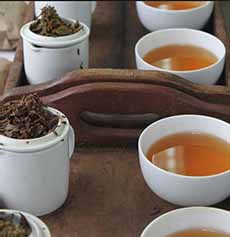
The liquor, or brewed tea, is much lighter than most other black teas, as shown in photos #1, #2 and #6.
While mass-marketed Darjeeling is available in supermarkets around the world, specialty tea shops carry a far superior version: first flush and second flush estate Darjeeling (more about them below).
You can see from the descriptions below how the flavors and aromas vary by estate† (similar to how the flavor of the same variety of grapes vary by vineyard).
An Official Certification
Darjeeling is one of few teas with an origin certification, like the European A.O.C. or D.O.P, attesting that the product was produced in Darjeeling. Since 1999, only teas made at the 87 registered gardens† in the district is allowed to be sold as Darjeeling.
Alas, “there is little policing, and counterfeits abound; much more tea is sold as Darjeeling than what those farms could conceivably produce,” say the experts at In Pursuit Of Tea.
To add to consumer confusion, in some countries to which Darjeeling is exported, blenders are able to call a any tea “Darjeeling” as long as 51% or more of the leaves comes from the Darjeeling district.
So if you want an authentic Darjeeling experience, go to the best purveyors. In Pursuit Of Tea’s Darjeelings include Darjeeling first flush and second flush teas from the finest estates.
Their current offerings include:
Arya’s Estate (flavors and aromas of chicory, licorice, sorrel)
Jungpana Estate (raw sugar, allspice, marigold)
Margaret’s Hope Estate (roasted walnut, cocoa powder, taro root)
Namring Upper Estate (bright, nutty, round)
Rohini Estate (Second flush cucumber, rosewater, toast
Singell Estate (First flush almond, cedar, broccoli leaf; second flush passion fruit, sweet orange, wood)
Snowview Estate (wintergreen, pine resin, soft)
How do you choose what to try?
Read the descriptions on each tea’s page (start here).
If you can afford it, buy small amounts from different estates to compare.
WHAT ARE FIRST FLUSH & SECOND FLUSH?
Flush refers to the time of harvest: first flushes are the first picking of the plants, second flushes are a subsequent picking, and so on.
In the Darjeeling region:
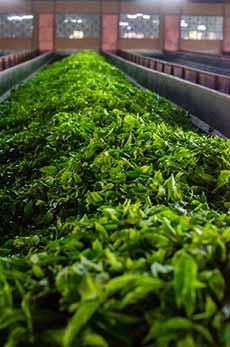
The first flush of the year is harvested in mid-March or early April, just after the spring rains. The tea has a lighter aroma and color, generally with mild astringency. These light-bodied, intensely fragrant teas are produced in small quantities for only a few weeks. As with all premium-grade teas, only the new growth buds and first leaves are harvested by hand, and they undergo a specialized withering process (photos #3 and #4) [source].
The second flush is the summer flush, harvested in June. It is bolder in flavor with a fuller body and deeper amber color. It is often said to have a muscatel‡ flavor. Some think that this winey quality engendered the phrase, “the champagne of teas.”* See photo #6 for a visual comparison of first and second flushes. It is deeper in aroma and liquor than the first flush, and the renowned muscatel flavor is pronounced in these teas.
The third flush is known as the monsoon flush or the rains crop, the largest crop due to the heavy rainfall. Picked from July through early September, it produces an inferior tea compared to the first two flushes. The aroma is not very expressive due to insufficient sunshine; the brew (liquor) is very dark with a dull character. Unfortunately, it has the right to be sold as “Darjeeling.”
The fourth flush, the autumnal flush, is harvested from the last week of September through the second week of November. This flush has the strongest liquor, due to the sunshine following the long monsoon season. The tea has a unique aroma.
Is one flush better than the other? As with most foods, it’s a matter of personal preference.
But for connoisseurs, it’s definitely a choice between the first and second flushes of estate teas.
DARJEELING TEA HISTORY
While tea was first discovered growing wild some 5000 years ago in China, it is indigenous to both China and India (the history of tea).
Tea, like other agricultural products, varies in flavor, aroma and appearance according to its terroir: the type of soil, the elevation (altitude) and the climate and microclimate of the area in which it grows, as well as the weather in each particular season.
The processing style of the particular estate also greatly influences the taste and appearance (photo #5).
While tea itself dates back thousands of years, Darjeeling tea began its rise to fame some 150 years ago, thanks to Dr. Archibald Campbell.
Campbell, a doctor in the Bengal Medical Service, was the first superintendent of the sanitarium town of Darjeeling.
A botany enthusiast, he is credited with the introduction of tea cultivation in Darjeeling [source].
As an experiment, he planted tea seeds from the native Chinese tea bush (Camellia sinesis var. sinesis) in his garden at Beechwood, Darjeeling.
He was successful in raising the tea plants, such that the British government, in 1847, decided to install tea nurseries in Darjeeling. The first commercial tea gardens were planted in 1852.
At that time, Darjeeling was a sparsely populated resort and sanitarium hamlet used by the army and affluent civilians. Tea, a labor intensive enterprise, required large numbers of people to plant, tend, pluck and manufacture the tea.
Locals from Darjeeling and from Nepal, just across the border, were recruited.
|
|

[1] Tea professionals compare the aromas and flavors of different estates or flushes by cupping: pouring small amounts of tea in shallow cups. (photos #1, #3, #4 and #5 © In Pursuit Of Tea).

[2] A different cupping, showing teas from different estates or flushes. You can see how the color of the liquor (the brewed tea) (photo © The Republic Of Tea).
[3] The teas are withered for a long time in troughs, creating the light Darjeeling style.
[4] The withered leaves, ready to be fired, where they turn from green to black.
[5] Visual differences in two second flush Darjeeling estate teas that have been fired and are ready to brew. The Rohini Estate (top) and Snowview State teas available from In Pursuit Of Tea.
[6] The difference in color between a first flush and second flush Darjeeling (photo © National Honey Board). |
The tea grew well in Darjeeling’s high elevation (average elevation 7,000 feet). In that early era of Darjeeling, the British plantation†s marketed it as “the champagne of teas,”* even though the steeped tea was heavy, dark and brisk.
In the 1960s, Indian processors began to experiment with producing a lighter Darjeeling tea. They created the modern style, lighter in color and more delicate (more accurately champagne-like).
The tea leaves are withered for a long time in heated troughs, and then fired for a shorter time than other black teas. The result is a more aromatic and flavorful tea with a lighter body and more astringency than the original Darjeeling teas [source].
Darjeeling produced the world’s best aromatic teas, and became a profitable venture. Today Darjeeling has 86 tea gardens which produce about 10 million kilograms of tea each year [source].
________________
*This seems to us to be a clever marketing move. The tea looked nothing in color like champagne (although some other teas are pale gold, like champagne). The closest reason for the comparison is that some people perceive the darjeeling aroma to have a winey aroma, specifically, muscatel grapes. The aroma is delicate and fruity, but there are plenty of wines that could fit this description. However, “the champagne of teas” does sound more beguiling than “the chianti of teas.”
†Estates are also called tea gardens and plantations. The term estate is used for single-origin teas that come from a single property (i.e., estate).
‡The muscatel quality in Darjeeling is described as “musky spiciness,” “a unique muscat-like fruitiness in aroma and flavor,” or “dried raisins with a hay-like finish” [source].
|