THE NIBBLE BLOG: Products, Recipes & Trends In Specialty Foods


Also visit our main website, TheNibble.com.

TIP OF THE DAY: Red-Veined Sorrel


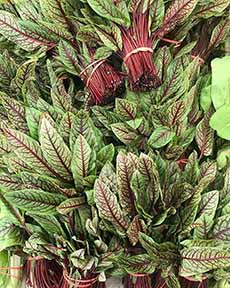
[1] Just-harvested red sorrel, ready for the evening’s menu at Union Square Cafe (photo © Union Square Cafe).


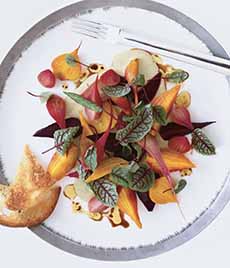
[2] Beet and Red Sorrel Salad with Pistachio. Here’s the recipe from Paul Liebrandt (photo © Anna Williams | Food & Wine).


[3] Even in a colorful dish, a leaf of red sorrel is eye-catching (photo of carrot spaghetti with scallop and kale © Augustine Fou | Unsplash).


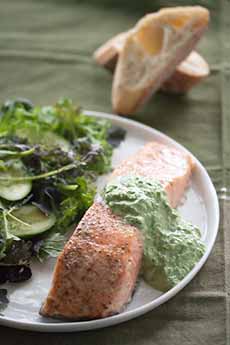
[4] Planked salmon with sorrel sauce. Here’s the recipe from Crumbblog.


[5] A field of sorrel (photo © Mariquita Farms).


The next time you’re at a farmers market or specialty produce store, look for red sorrel.

It’s a beauty that can garnish anything from a green salad to lemon sorbet to sparkling water.

It’s aesthetically pleasing, expressive, festive, and may we add, a great garnish for Valentine’s Day food and beverages.

Because we’re focused on the beauty of red-veined sorrel as a garnish, we’re not going to cover green sorrel today. As a recipe ingredient (soup, chutney, whatever), it tastes like the red sorrel variety.
 
 
SORREL BACKGROUND

Sorrel is a perennial herb with juicy stems arrow-shaped leaves. The leaves can be cooked or served raw in salads and as garnishes (the raw leaves add tartness).

As with all plants, there are numerous varieties—not only within red sorrel and green sorrel, but also

Our favorite variety has red veins (photo #1), which give it the glamour to garnish.

The name sorrel derives from the Germanic word sur and the old French surele, both meaning sour.

It is an ancient herb used by Egyptians and then, Europeans to impart acidity to dishes.

Depending on the variety, it can be refreshing, sharply acidic, or astringent; it can have a spinachlike taste with bitter notes or a milder, lemony taste (the dried leaves lose their lemony taste).

The younger the leaves, the earlier in the season (early spring to late fall), the less acidic. If the leaves are too bitter for you, blanch them for 10 seconds.

Another rule of thumb: enjoy small leaves raw, large leaves cooked.

There are three major varieties of sorrel:

  • Broad leaf/common sorrel (Rumex acetosa), with slender, arrow-shaped leaves.
  • French or buckler leaf sorrel (Rumex scutatus), with small, bell-shaped leaves.
  • Red-veined sorrel (Rumex sanguineus), with a slender, tapered leaf and bright red veins throughout.
  • Sheep’s sorrel (Rumex acetosella), is similar to common sorrel, but with smaller leaves. It is foraged rather than cultivated across much of the U.S.
  •  
    Another plant called sorrel is the unrelated Jamaican sorrel, from the Hibiscus or Mallow family, Malvaceae. It is used for beverages and preserves in Mexico and the Caribbean.

    Tea made from Jamaican sorrel is a homeopathic remedy to lower elevated blood pressure, bad cholesterol and as a general detoxifier.
     
     
    USES FOR SORREL

    Our first sorrel recipe, perhaps at age 10, was to help our Nana prepare the famed cold Russian soup, schav: sorrel combined with sour cream, lemon juice, chicken broth and egg yolks, and garnished chopped egg, sour cream and scallions.

    Schav (shtshav) is Yiddish for sorrel, and it was once a hugely popular summer soup—right up there with borscht.

    In European cuisines, sorrel brings lemony intensity to whatever it graces.

  • Avocado toast
  • Beverage garnish: club soda/mineral water, cocktail garnish, juice, iced tea*
  • Condiments: chutney, pesto
  • Cream sauces
  • Cured meats: charcuterie, prosciutto, serrano ham
  • Eggs and egg salad
  • Goat cheese and quiche
  • Fresh herb (substitute for parsley, thyme, etc.)
  • Fresh lemon substitute*
  • Gratins
  • Plate garnishes: cheese plates, dessert platters, pasta in EVOO, anything that needs a bit of green and red
  • Poached eggs
  • Poached fish, from salmon to white fishes
  • Pot herb (i.e., a cooked herb or as a vegetable side like spinach)
  • Salads (beet salad, green salad, fruit salad) and dressings
  • Sandwiches
  • Sauces (check out this recipe)
  • Savory yogurt
  • Smoked or oily fish
  • Soups and stews
  • Stewed and braised meats
  • Stir-fries
  • Spice blends: for green sauce, marinades, potato soup
  • Vegetables, especially onions, peppers and potatoes
  •  
    MINI TIP: To prevent sorrel from blackening and developing a metallic taste, use only stainless steel or other non-reactive pots and cooking utensils.

    MINI TIP: If you have too much fresh sorrel, saute them in butter until they wilt. Freeze in individual ice cube containers until you’re ready to defrost and add them to eggs, grains, vegetables, etc.

    How about 100 sorrel recipes?


    SORREL HISTORY

    Native to Europe and western Asia, sorrel grew wild in grassland habitats. It is commonly cultivated in France, Egypt, and parts of Europe and the U.S.—the areas where it is most popular in cuisine.

    The intense lemony tang is also embraced in cuisine from Nigeria to Scotland to Vietnam [source].

    Sorrel, Rumex acetosa, is a member of the Polygonaceae family of flowering plants, known informally as the buckwheat family and, outside the U.S., the knotweed family or smartweed.

    In addition to buckwheat, rhubarb is another well-known food in the family.

    Earliest known examples of cultivation include Egypt, where its tartness was used to offset rich foods [source].

    The Romans and Greeks followed suit, to aid digestion of rich foods. Homeopathically, it was used to treat liver ailments and for throat and mouth ulcers.

    Even today, it is used around the world to treat scurvy and chronic skin conditions, and to lower fevers. Both the fresh leaves and the flowers are high in calcium, magnesium, phosphorus, potassium and vitamins A and C†,

    Red sorrel is native to Europe and was likely brought to the United States with colonists, where it now grows throughout the country [source].

    You just don’t want to grow it in your garden: It’s what’s known as a spreading rhizome, an aggressive-spreading, hard-to-control perennial weed.

    ________________

    *If you steep the whole leaves in boiling water and add sugar or other sweetener, you get a lemon-less lemonade.

    †In addition to good nutrition, sorrel also contains oxalic acid, a naturally occurring compound found in greens like including kale and spinach. Oxalic acid is lethal in very high enough doses, but you’d have to eat almost 10 pounds of greens daily to be affected [source].


    Comments off

    TIP OF THE DAY: Beyond Avocado Toast, Middle Eastern Eggplant Toast

    Middle Eastern eggplant toast? We’ve done classic avocado toast, we’ve done fancy avocado toast, we’ve done mushroom toast. We’ve done sweet toasts:

    All delicious.

    But the palate wants the adventure to continue.

    Thus, today’s toast journey is inspired by the Eggplant Toast at Kismet restaurant in Los Angeles.

    Here’s a variation of their spiced eggplant recipe, with different garnishes: cherries, hazelnuts and tarragon.

    But the photo shows a piece of artisan toast topped with:

  • Brined, spiced eggplant, skillet-fried
  • , and lim

  • Crispy shallots
  • Spicy minty tahini
  • Toppings: pomegranate arils, mint leaves
  • Garnish: freshly-grated lime zest
  • Bread crust garnish: sesame seeds
  •  
    We’re not certain how the sesame seeds were affixed to the bread crust, but you can use tahini.

    We admit to using a bit of honey, which added a sweet element to the spice-seasoned stack.

    OK, it takes a bit more effort than mashed avocado; but it’s worth it for a change.

    July is National Eggplant Month, and August 17th is National (and World) Eggplant Day.

     
    THE HISTORY OF EGGPLANT

    Eggplant (Solana melongena) is a member of the Solanaceae or Nightshade family: There’s more information about this fascinating family in the footnote below.

    Eggplant is believed to be native to India, where its ancestor, called thorn or bitter apple (Solana incanum) stills grow wild.

    Originally a bitter, spiny, orange, pea-sized fruit, it has been cultivated in India and China for more than 1500 years, during which it was bred into its modern forms [source].

    It has been cultivated in southern and eastern Asia since prehistory, and an early mention appears in an ancient Chinese agricultural treatise from 544 [source].

    As trade routes developed, eggplant was introduced to Europe by Arab ships and transported to Africa by the Persians. The Spaniards carried it with them to the New World and, by the early 1800s, both white and purple varieties could be found in American gardens.

    Today, the plant is grown worldwide for its edible fruit: Yes, you can tell it’s a botanical fruit because the seeds are carried inside.

    Although it is considered a vegetable, it is a berry by botanical definition.

    There are many different words for eggplant:

  • Aubergine in Britain, France, Holland, and Germany.
  • Berenjena in Spanish.
  • Brinjal or brinjaul, in South Asia and South African English.
  • Melanzana in Italian, and so on, around the world.
  •  
    The name eggplant is usual in North American English and Australian English.


    [1] Imagine a warm and tranquil day, imagine the Mediterranean just beyond your Eggplant Toast.

    Mixed Eggplant
    [2] Assorted eggplant varieties (photo © Bleu Ribbon Kitchen).


    [3] Americans used the term “eggplant” after white cultivars that looked like hen’s eggs (photo © Burpee Home Gardens).

     
    First recorded in 1763, the word was originally applied to white cultivars, which look very much like hen’s eggs (photo #4).
     
    People the world over love eggplant: a versatile food that pairs with so many others.

    At some point in eggplant-loving China’s past, as part of her “bride price,” a woman had to have at least 12 eggplant recipes prior to her wedding day.

    Married or single, collect as many eggplant recipes as you like.

    ________________________
    *Nightshades are members of the Solanaceae family of flowering plants, many of which are edible, while others are poisonous (some have both edible and toxic parts). The name of the family comes from the Latin Solanum, “the nightshade plant.”

    Other edible members include capsicum (the chiles), Chinese lanterns, eggplants, garden huckleberry, ground cherry, naranjilla, pepinos, peppers, potatoes, and the tree tomato. One thing that sets these nightshades apart is their alkaloid content. Alkaloids are harmful nitrogen compounds that, in high quantities, are toxic, causing nausea, diarrhea with vomiting and headaches. In extreme cases, they lead to unconsciousness and convulsions to the point of respiratory paralysis.

    That’s why the tomato was considered poisonous by Europeans and not eaten for 200 years following its discovery. Alkaloids exist in tiny, non-harmful quantities in the nightshade foods we eat. Tobacco and the petunia are also members of the family, as well as the Datura or Jimson weed, the mandrake and the deadly nightshade or belladonna.


    CHECK OUT WHAT’S HAPPENING ON OUR HOME PAGE, THENIBBLE.COM.


    Comments off

    TOP PICK OF THE WEEK: Cookie Pop Popcorn With Oreo Pieces


    [1] The latest sweet treat to cross our desk: Cookie Pop Popcorn with Oreo pieces.


    [2] From the bag to the canister (both photos © Snax-Sational Brands).


    This may be a first for THE NIBBLE: Our Top Pick Of The Week is a junk food, a sugary snack.

    Snax-Sational, a snack food company, recently sent us samples of Cookie Pop Popcorn: a blend of popcorn and Oreo cookie pieces:

    The popcorn kernels have a sugary “creme” coating that tastes like Oreo stuffing.

    It’s a purely sweet treat: The sample we received didn’t have a salted popcorn profile. But there’s no reason you can’t toss some salt in the bag and shake it.

    Salt or not: Cookie Pop created a sensation in our office, with every coming back for additional handfuls.
     
     
    IS IT REALLY JUNK FOOD?

    The popcorn-Oreo blend is 150 calories per serving size of 1-1/4 cups. The total carbohydrate is 19g with 12g of total sugars.

    The snack is low in sodium and made with non-GMO corn. It has 1g of protein per serving.

    And yes: Popcorn is a whole-grain food with these benefits.

    It almost sounds like Cookie Pop Popcorn is a good snack choice, but make no mistake:

    This is junk food: glorious, sugary junk food. It’s also a fun food, waiting to garnish cupcakes, ice cream and hot chocolate.

    If you need a sugary jolt, treat yourself to a bag. Just pace yourself.
     
     
    THE BIRTH OF A SNACK FOOD

    The concept for Cookie Pop Popcorn came about when the founder added crushed Oreos to another snack food, popcorn. He thought he had a hit on his hands.

     
    He combined other sweet snacks with popcorn and produced a variety of flavors, of which Butterfinger Candy Pop Popcorn and Twix Candy Pop Popcorn join Cookie Pop in today’s line-up.

    You can purchase all of them on SnackPop.com.

    There’s also a store locator on the website.


    CHECK OUT WHAT’S HAPPENING ON OUR HOME PAGE, THENIBBLE.COM.


    Comments off


    © Copyright 2005-2026 Lifestyle Direct, Inc. All rights reserved. All images are copyrighted to their respective owners.