THE NIBBLE BLOG: Products, Recipes & Trends In Specialty Foods


Also visit our main website, TheNibble.com.

TIP OF THE DAY: Create A Spring Dinner

A few days ago, our wine collectors group had its scheduled team spring dinner, an annual event that celebrates the emergence of spring fruits and vegetables.

Problem is, nature isn’t cooperating. We’re still waiting for some of our favorite spring produce to show up in stores in the chilly Northeast.

Even though some of them are now available year-round, in our grandmother’s generation and before, people had no choice but to eat seasonally.

Hence, the popular roast leg of lamb with spring peas, and a delicate salad of butter lettuce, always on Nana’s menus.

Thus, when when have a dinner to honor spring, we go full-out locavore.

Here’s what you can choose from (we’ve left out the exotics; here’s the full list).
 
 
SPRING FRUITS & VEGETABLES

Because of imports from the southern hemisphere where the seasons are reversed, Americans have year-round access to what locally has been seasonal.

There’s always someplace on earth that grows asparagus, for example.

Spring Fruits

  • Apricots
  • Blackberries
  • Black mission figs
  • Honeydew
  • Mango
  • Oranges
  • Pineapple
  • Strawberries
  •  
    Spring Vegetables

  • Asparagus (for fun, look for the purple variety)
  • Belgian endive
  • Beets
  • Butterhead/butter lettuce (Bibb and Boston varieties)
  • Dandelion greens
  • Fava beans*
  • Fennel
  • Fiddlehead ferns
  • Garlic scapes
  • Morel mushrooms
  • Mustard greens
  • Nettles
  • Ramps
  • Red leaf lettuce
  • Spring (English) peas, snow peas, Chinese pea pods
  • Vidalia onions
  •  
     
    THE NIBBLE’S SPRING EDITORIAL DINNER

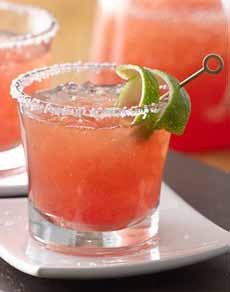
    COCKTAIL: Blood Orange Margarita, Mimosa or Screwdriver with fresh-squeezed blood orange juice, or this Cherry Blossom cocktail.

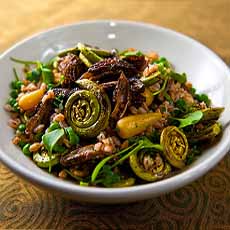
    FIRST COURSE: Spring sauté: asparagus, fiddleheads, garlic, morels and ramps, sautéed in good butter and swerved with a sprinkle of salt. It’s simple, yet memorable.

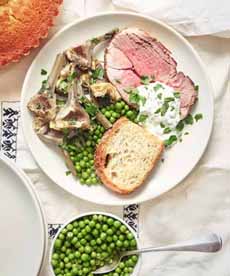
    MAIN COURSE: Leg of lamb, spring peas, baby potatoes. We like to cook a leg for leftovers: lamb salad† and lamb sandwiches. See our Lamb Glossary for the different cuts and types of lamb.

    SALAD COURSE: Belgian endive, butter lettuce (Bibb or Boston), fennel, snow peas and garlic scapes, dressed with a Dijon and sherry vinaigrette and garnished with fresh parsley.

    CHEESE COURSE: Spring cheeses with black mission figs. We can find bucheron and charollais affine (goat), coulommiers (cow) and Pyrénées brebis (sheep), plus cheeses from local American artisan cheese makers. Ask your cheesemonger what he/she has that’s newly arrived in spring.

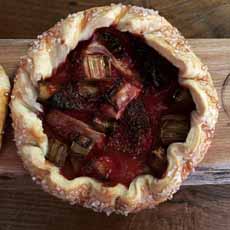
    DESSERT: Rhubarb, any way you like it; blood oranges supreme, or in sorbet. Since strawberries, now available year-round, are a traditional spring fruit, a strawberry-rhubarb pie or galette (photo #5) does the trick.

    Of course, there will be more than one spring dinner.

    We’ll feature more of the menus as we make them, and look forward to any contributions from you.
     
     
    ________________

    *Fava beans require a level of patience to shell, which we lack. Should you be come across shelled fava beans, it’s worth paying the premium for the labor involved.

    †Recipes: lamb, cucumber and watercress salad, lamb niçoise salad and Thai lamb and asparagus salad.

      Blood Orange Margarita
    [1] Blood Orange Margarita. Here’s the recipe via Betty Crocker (photo © Betty Crocker).

    Sauteed Ramps, Morels
    [2] A spring sautée. Here’s the recipe from Honest Food (photo © Honest Food).

    Leg Of Lamb
    [3] Leg of lamb with spring peas. Here’s the recipe from Good Eggs (photo © Good Eggs).

    Spring Bibb Lettuce Salad
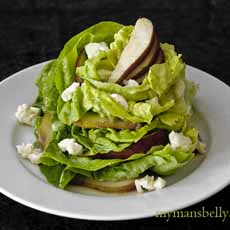
    [4] We love how the bibb lettuce is stacked in this salad recipe from My Man’s Belly (photo © My Man’s Belly).

    Lille Cheese Vermont Farmstead
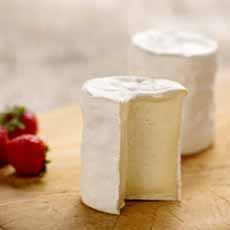
    [5] Lillé, a cheese from Vermont, is the American-made version of French Coulommiers (photo © Vermont Farmstead).

    Strawberry Rhubarb Galette
    [6] A strawberry rhubarb galette is the perfect seasonal pie. Here’s the recipe from Hewn Bread (photo © Hewn Bread | Chicago).


    Comments off

    FOOD FUN: Easter Toast

    Easter Toast

    Arla Blueberry Cream Cheese
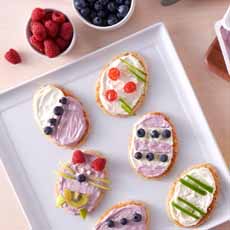
    Easter egg toast. Use the same concept for Christmas, St. Patrick’s Day, Valentine and other “holiday toast” (photos courtesy Arla USA).


    Make Easter egg toast as a holiday treat.

    These were made with blueberry cream cheese from Arla USA, maker of cream cheese spreads in blueberry, herbs & spices, peppercorn, original and lite.

    You can bring these toasts ready-made to the table, or bring the individual ingredients for an assemble-your-own activity.

    Use the same concept for Christmas toast, Independence Day Toast, St. Patrick’s Day toast, Valentine toast, and so on.
     
    RECIPE: EASTER TOAST

    Ingredients

  • Toasted bread of choice*
  • Cream cheese(s) of choice, e.g. plain and flavored, room temperature
  • Fruits of choice, e.g. apple slices, blueberries, grapes, raspberries
  • Vegetables of choice, e.g. bell pepper strips, chives/scallions, grape tomatoes
  •  
    Preparation

    1. SLICE the fruits and vegetables into halves, coins or matchsticks, as desired.

    2. CUT the toast into ovals using a large, sharp scissors. You can buy oval cookie cutters, but we printed out an oval template, cut out and placed over the toast as a guideline.

    3. ASSEMBLE and serve.

     
    USES FOR THE TOAST TRIMMINGS

    Don’t toss the toast trimmings. If you’re not the type to nibble as you cook, then:

  • Pulse them into breadcrumbs.
  • Use as croutons to top soups and salads.
  • Toss into omelets or garnish scrambles.
  • Make a savory parfait: cottage cheese and/or plain yogurt layered with toast bits and herbs.
  • Top an open-face sandwich.
  • Feed birds.
  •  

    ________________

    *Avoid thick slices or dense breads stuffed with dried fruits and nuts. They’re not as easy to cut into neat ovals.
      

    Comments off

    TIP OF THE DAY: Decorate Snacks With Candy Melts

    With Easter coming, you may want to get a bit craftsy.

    We’re not suggesting that you mold your own chocolate bunnies, make rocher nests of almonds and chocolate filled with your own truffles, or take on homemade Peeps.

    Rather, just decorate some of your everyday favorite snacks with drizzled candy melts in seasonal colors.

    It is as simple as:

  • Heating a drizzle pouch or two of candy melt drizzle (photo #1) in the microwave.
  • Laying cookies, potato chips, pretzels or other snacks on a baking sheet.
  • Snipping off a corner of the pouch and drizzling the color(s) over the snacks.
  • Chilling until set, about 5 to 10 minutes.
  •  
    That’s it!

    As with chocolate, candy melt brands vary by quality and price. Merckens* and Wilton are two quality brands.

    You also want to use fresh melts—nothing that’s been sitting in a cupboard (or on a retailer’s shelf) for a year.

    Here are some examples of colors to play with:

    WILTON CANDY MELTS

    Colors – Vanilla Flavor*

  • Bright Green
  • Bright Pink
  • Bright White
  • Red (vanilla flavor)
  • Turquoise
  •  
    Other Flavors† & Colors

  • Light Cocoa flavored (dark brown)
  • Mint Chip flavored (lighter green)
  • Peanut Butter flavored (light brown)
  • Salted Caramel (light brown)
  •  
    Wilton drizzle is $1.99 for a 2-ounce/56g pouch. One package covers 3 dozen mini pretzels, as shown in photo #1.

    You can buy them online or check the Wilton store locator for a retailer near you.

    Don’t buy candy melts way in advance to keep until you need them: Fresh candy melts work better.
     
     
    ________________

    *All colors of Merckens wafers are flavored with artificial vanilla, as are the vanilla-flavored colors from Wilton. Candy melts are great for decorating, and people, and some people melt the wafers into colored bark and other candy. But flavor-wise, they are no substitute for chocolate—or for hand-tinted white chocolate.

    †These are artificial flavors as well. The chocolate varieties are flavored with cocoa.

    ________________


    Pretzels With Candy Coating

    Drizzled Chocolate Potato Chips
    Homemade Cracker Jacks

    Flower Bites With  Pretzels & M&Ms
    Recipes for [1] [2] and [3] from Wilton: drizzled pretzels, drizzled potato chips and colored peanuts-and-popcorn. [4] Flower bites made with pretzels and Easter M&Ms, bound together with white candy melts. Here are instructions from Two Sisters Crafting.


    Merckens Candy Melts

    Merck's Candy Melts
    [5] Candy melts come in a rainbow of colors, that can be blended together to make still other colors. [6] These may look like chocolate wafers from a fine chocolatier, but they’re candy coating—candy melts—without any cocoa butter (both photos courtesy Merckens).

      WHAT ARE CANDY MELTS?

    Candy melts are not quite chocolate, but they look like it.

    They are made in two formats: disks/wafers to melt and then use to decorate confections (used to adhere the M&Ms in photo #4 and larger projects like these), and microwaveable pouches to drizzle (the used in photos #1, #2 and #3).

    Candy melts have several other names: compound coating, confectionary coating, decorator’s chocolate, pâté glacée and summer coating.

    Candy melts are an imitation chocolate product that substitutes vegetable oil for all or part of the cocoa butter in chocolate. In milk chocolate-flavored melts, whey powders, whey derivatives and dairy blends can be used instead of powdered milk.

    Thus, the flavor of candy melts is not as fine as chocolate. If you bite into a piece of “chocolate” that doesn’t taste as rich or velvety on the tongue, it may well be made from candy melts.

    People who think they “hate white chocolate” may have experienced white candy melts instead: artificial chocolate flavored with artificial vanilla. Sometimes, the most beautiful creations are crafted from candy melts that don’t taste as good as they should.

    In the U.S., commercial products made with confectionary coating must be designated “chocolate-flavored.”

    Why do people use candy melts if it isn’t as tasty?

  • It is significantly less expensive than chocolate (and kids likely won’t notice the difference).
  • For color, it is easier than tinting white chocolate.
  • It does not require tempering, but melts easily.
  • It can be thinned out to make as delicate a decoration as the user wants.
  • It hardens quickly, and once hardened, does not melt in the heat like chocolate.
  •  
    Before universal air conditioning, chocolatiers used confectionary coating to create their summer wares, including chocolate-dipped fruit.

    The white coating was often tinted pastel pink, blue and green. The products were called “summer chocolate,” not artificial chocolate.

    Again, that’s why so many people dislike white “chocolate.” Give the best white chocolate a try.
     
     
    TIPS

    There are plenty of videos on YouTube and online articles that explain how to work with the disks. However, since the ideas above use only the drizzling pouches, not much instruction is needed except: Start with a very small cut in the pouch or your drizzle may wider than you’d like.

    Here’s how to read the freshness code on candy melts bags.


    Comments off

    20 Spinach Recipes & Spinach History For National Spinach Day

    These 20+ spinach recipes give you more than enough ideas for celebrating the year’s 7 spinach holidays:

  • January 17: Popeye The Sailor Man Day
  • March 26: National Spinach Day
  • June 17: National Eat Your Vegetables Day
  • July 16th: National Fresh Spinach Day
  • September, 2nd Full Week: National Folic Acid Awareness Week
  • October: Spinach Lovers Month
  • November: Spinach And Squash Month
  •  
    There’s so much to love about spinach. We’ll get to the top two recipes in a moment, and you’ll also find below:

    > Spinach mashed potatoes, a great idea (photo #4).

    > Many more spinach recipes.

    > The history of spinach.
     
     
    RECIPE #1: SPINACH SALAD WITH PAN-SEARED SALMON, ORANGES, RED ONION & AVOCADO

    This colorful, nutritious recipe (photo #1) makes a nice lunch or dinner. The fresh spinach, orange segments, peppers, and red onion make a colorful base for salmon or other fish fillets, as well as seafood and poultry.

    The recipe, sent to us by the California Avocado Commission, is from Salmon: A Cookbook, by Diane Morgan (photo #3).

    Prep time is 10 minutes, and cook time is 10 minutes.

    Ingredients For 4 Servings

  • ¼ cup extra-virgin olive oil
  • 1 tablespoon balsamic vinegar
  • 1 teaspoon whole-grain mustard
  • ½ teaspoon sugar
  • ½ teaspoon kosher or sea salt
  • Fresly gound pepper
  • 7 cups (about 6 ounces) lightly packed baby spinach leaves
  • 1 cup thinly sliced red onion
  • 1 red bell pepper, halved lengthwise, seeded, de-ribbed, and cut into long, thin slices
  • 2 navel oranges, peeled and white pith removed, cut into segments
  • 4 Copper River or other salmon fillets (about 5 ounces each), skin and pin bones removed
  • Kosher or sea salt and freshly ground pepper, to taste
  • 3 tablespoons olive oil
  • 1 ripe avocado, seeded, peeled, and cut into 16 thin wedges*
  • ________________

    *Brush the exposed avocado with olive oil or cover tightly with plastic wrap to prevent oxidation (browning). As with all fruits and vegetables, wash the avocado before cutting.
    ________________
     
    Preparation

    1. COMBINE the olive oil, vinegar, mustard, and sugar in a small jar with a tight-fitting lid, with salt and pepper to taste. Cover tightly and shake vigorously to blend. Taste and adjust the seasonings; set it aside.

    2. PLACE the spinach, onion, and bell pepper in a large salad bowl. Put the orange segments in a separate, small bowl.

    3. SEASON the salmon on both sides with a bit of salt and pepper. Place a large, heavy skillet over medium-high heat. When the skillet is hot, add the remaining olive oil and swirl to coat the pan. Add the salmon, skin-side down, and cook until the skin is crisp about 4 minutes.

    4. CAREFULLY TURN the salmon and cook until the fillets are almost opaque throughout, but still very moist—or an instant-read thermometer inserted in the center registers 125°F to 130°F—about 4 minutes. Transfer to a warm plate and set aside while you toss the salad.

    5. TO SERVE: Add the orange segments to the salad bowl, give the dressing a last-minute shake, and pour it over the salad. Toss gently. Arrange the salad on 4 dinner plates. Place a salmon fillet in the center, on top of the salad; garnish each salad with 4 slices of avocado, and serve immediately.
     
     
    RECIPE #2: SPINACH & MASHED POTATOES

    What a great idea! Sunchokes add another dimension to the recipe, but if you can’t find them or don’t want them, leave them out.

    In fact, here’s a very easy preparation for spinach mashed potatoes:

    Simply make mashed potatoes. Cook frozen spinach and press out the water. Blend with the mashed potatoes. Add butter or cream, garlic, salt, and pepper to taste. Roasting a head of garlic (photo #7) and mashing it into the potatoes and spinach is a delicious idea.

    Ingredients For 4-6 Servings

  • 2 pounds Idaho/russet potatoes, washed but unpeeled
  • 1 head garlic
  • ½ pound sunchokes (Jerusalem artichokes—photo #6)
  • 1 head (bulb) of garlic, unpeeled but with a half inch removed from the top
  • 1 tablespoon olive oil
  • 1 teaspoon sea salt
  • ½ teaspoon fresh cracked pepper
  • 1½ cups heavy cream, divided into ½ cup measure and 1 cup measure portions
  • 4 tablespoons butter
  • 3 cups packed baby spinach (photo #5)
  • Ice water bath for blanched baby spinach
  • Additional salt and pepper to taste
  •  

       
    Spinach Salad With Seared Salmon
    [1] Top a spinach salad with a salmon fillet (photo © California Avocado Commission).

    Spinach Just Picked
    [2] Pick up some perky, fresh spinach (photo © The Chef’s Garden).

    Salmon: A Cookbook
    [3] This recipe is from Salmon: A Cookbook (photo © Chronicle Books).

    Spinach Mashed Potatoes
    [4] Recipe #2, below: mashed potatoes and spinach (photo © Idaho Potato Commission).

    Fresh Baby Spinach In A Produce Bag
    [5] More beautiful spinach, from the grocer’s (photo © Good Eggs).

    Basket Of Sunchokes
    [6] Sunchokes, one of our favorite underappreciated veggies. Here’s more about them (photo © Melissa’s Produce).

     
    Preparation

    1. COOK the potatoes: Place the potatoes in cold water and heat the water to just below boiling. The water will be steaming but not moving. Cook the potatoes in the steaming water until fork tender, about 1½ hours.

    2. HEAT the oven to 350°F. Toss the sunchokes in olive oil and salt and pepper. Rub the garlic head with olive oil and wrap it in foil. Place the sun chokes and garlic on a sheet pan. While the potatoes are cooking…


    Roasted Garlic Bulbs, Halved
    [7] Roasted garlic bulbs (photo © Lucero Olive Oil).

    Spinach Stuffed Portabella Mushrooms
    [8] Portabellas stuffed with spinach. Here’s the recipe (photo © Healthy Recipes Blogs).

    Baked Spinach Chips
    [9] Baked spinach chips. Here’s the recipe from from Hungry Couple (photo © Hungry Couple).

    Spinacia tetranda, wild spinach
    [10] Spinacia tetranda, wild spinach, the wild ancestor of modern Spinacia oleracea), thrives in the varied, often semi-arid landscapes of Anatolia, also called Asia Minor, the peninsula in West Asia that makes up the majority of the land area of Turkey (Gemini photo).


    3. ROAST the sunchokes and garlic until soft, 35 to 45 minutes. Remove them from the oven and turn down the oven temperature to 325°F. Squeeze the cloves from the garlic and set aside. Remove the cooked sunchokes from the oven and puree with 1/2 cup cream, using an immersion blender or food processor.

    4. REMOVE the fork-tender potatoes from the water. Place in the to dry the potato skins. While potato skins dry…

    5. HEAT a second pot of water to boiling, to blanch the spinach. While waiting for the water to boil, melt the butter in a small saucepan, and blend in the remaining cup of cream until hot. Set aside.

    6. PREPARE the ice bath (ice cubes in a bowl of water). Prepare the spinach in boiling water for two minutes. Remove it with a strainer and plunge it into the ice water. Squeeze out the water and purée the spinach with a food processor or immersion blender. Set aside.

    7. REMOVE the potatoes from the oven. Leave the skins on. In a large pot, smash the potatoes with a potato masher, adding small amounts of the hot cream/butter mixture as you go, until the potatoes are fluffy. Squeeze in the garlic cloves and sunchoke purée and continue to smash. Fold in the puréed spinach. Adjust seasoning, adding salt and pepper to taste.
     
     
    THE HISTORY OF SPINACH

    Spinach (Spinacia oleracea), is native to central and western Asia (think ancient Persia). It is a member of the botanical family Amaranthaceae, which also includes amaranth, beet, chard, lamb’s quarters (mache), and quinoa, plus numerous flowering house and garden plants.

    It likel6 originated from Spinacia tetranda (photo #10), which still grows wild in Anatolia. The plant, which does not like heat, was successfully cultivated in the hot and arid Mediterranean climate by Arab agronomists through the use of sophisticated irrigation techniques.

    The first known reference to spinach dates to between 226 and 640 C.E., in Persia. Over trade routes, spinach was introduced to India and Nepal and then to China around 647 C.E., where it was (and still is) called “Persian vegetable.”

    It became a popular vegetable in the Arab Mediterranean, and in 827 was brought to Italy by the Saracens. It arrived in Spain by the latter part of the 12th century, and in Germany by the 13th century.

    The first written reference to spinach in the Mediterranean are in three 10th-century texts. It became popular vegetable in Provence, and by the 15th century was common in Provençal gardens. It traveled north, and Europe became a spinach-loving continent.

    Spinach first appeared in England and France in the 14th century and quickly became popular because it could be harvested in early spring when other vegetables were scarce.

    Spinach was supposedly the favorite vegetable of Catherine de’ Medici (1519-1589), wife of King Henry II of France. Dishes served on a bed of spinach are known as “Florentine” after her birthplace, Florence.

    “Florentine” dishes are sometimes served with Mornay sauce*, a béchamel sauce with cheese (usually Gruyère or Parmesan).
     
     
    MORE SPINACH RECIPES

  • Artichoke & Spinach Stuffed Potato
  • Beet, Spinach & Apple Salad
  • Cheese Tortellini Recipe With Spinach & Wild Mushrooms
  • Creamed Spinach Without The Cream
  • Curried Spinach Tart
  • Grill-Wilted Spinach With Tzatziki
  • Kansas City Crab Grass Dip (warm crab and spinach dip)
  • Mushrooms, Ramps & Spinach Tart
  • Penne Pasta Salad With Spinach
  • Portabella Mushrooms With Spinach Stuffing
  • Pxali, Georgian spinach dip with walnuts
  • Savory Spinach Bread Pudding
  • Shrimp & Grilled Spinach Pizza
  • Spanakopita, Greek spinach pie
  • Spinach & Artichoke Dip
  • Spinach Dip: 13 Ways To Use It
  • Spinach & Grapefruit Salad With Dijon-Honey Vinaigrette
  • Spinach-Stuffed Pork Roast
  • Turkey & Peanut Butter Club Sandwich With Spinach
  • Warm Spinach & Mascarpone Dip (also great on baked potatoes)
  •  
    ________________
     
    *The sauce said to be named after Philippe de Mornay (1549-1623), Seigneur du Plessis-Marly, a French writer and diplomat. The chronological problem is that modern Mornay sauce is secondary sauce of a mother sauce, a variation of Béchamel sauce.

    However, the Béchamel sauce in its current, formalized form was not well-documented until later (in the 17th century, and formalized by Escoffier in the early 20th century). A cheese sauce from Mornay’s time would likely have been based on a different mother sauce, like Velouté.

    The earliest reference to a sauce resembling Mornay first appeared in the 1820 edition of Le Cuisinier Royal. Philippe de Mornay and his chef, if it was the latter who created the first Mornay sauce, lived in the 16th and 17th centuries and no record has been yet found that references the sauce in their lifetimes. For now, we must conclude that the modern version of the sauce was named in his honor after his lifetime.

    Here’s the modern Mornay recipe.


    CHECK OUT WHAT’S HAPPENING ON OUR HOME PAGE, THENIBBLE.COM.


    Comments off

    PRODUCTS: 5 Beverage Favorites

    1. ANGRY ORCHARD: ORCHARD’S EDGE KNOTTY PEAR
    Hard apple cider is hot, but what about perry?

    Pears are also turned into hard cider, called perry in the U.K.; but perry is not as well known in the U.S.

    American cider makers tend to label their perries as pear cider. And there are far fewer of them.

    We’ve had all of Angry Orchard’s 13 apple ciders, but these days it’s their one perry—a.k.a. Orchard’s Edge Knotty Pear—that has our attention.

    It’s available nationwide, and will open your eyes to the joys of pear hard cider. We need for more American cider lovers to try it and convince Angry Orchard that there is a market for more perry.

    The term perry comes from the Old French word for pear, peré (PEH-ray), from the Latin word for pear, pirum.

    As with apples, the pear varieties used to make cider tend to be sour, and aren’t pleasant eating.

    Next step: Look for Knotty Pear cider and buy it. If you find several brands, buy them all and have a perry tasting.

    Discover more about Angry Orchard ciders.
     
     
    2. COFFIG: ROASTED FIG COFFEE SUBSTITUTE

    We’ve tried caffeine-free coffee substitutes: Thanks but no thanks. But Coffig has succeeded in making a natural coffee alternative from roasted figs.

    We didn’t believe it until we tried it. It really does substitute for coffee, hot or iced. If you’re looking for an alternative, try it.

    We think you’ll like it. And there’s a 100% Money Back Customer Satisfaction Guarantee if you don’t.

    Coffig comes in convenient, individually wrapped “tea bags” for single cups; as well as in pouches of powder for making larger batches. The product is 100% roasted black figs.

    You can buy them on the website: Coffig.com, and on Amazon.
     
     
    3. SAMUEL ADAMS: GRAPEFRUIT REBEL IPA

    In 2014, Samuel Adams introduced Rebel IPA, their take on a West Coast IPA (India Pale Ale).

    West Coast-style IPAs use hops from the Pacific Northwest, which have different flavors than European hops, and generally have more hop intensity.

    We liked Rebel IPA. So did a lot of other people. It did so well in these IPA-happy times that siblings began to arrive: Rebel Rouser Double IPA, Rebel Rider Session IPA, Rebel Juiced IPA, Rebel White Citra IPA and our favorite, Rebel Grapefruit IPA.

    We are fans of wines with grapefruit notes, like French Sauvignon Blancs, and love it in beer, too. Rebel Grapefruit IPA is brewed with real grapefruit in the mash, for a prominence of flavor that complements the citrus of the hops.

    See it, try it. Find details at SamuelAdams.com.

    Find more beer types and terms in our Beer Glossary.


    4. SEALAND BIRK: ORGANIC BIRCH WATER

    First came coconut water, then maple water, and now birch water.

    The producer, Sealand Birk (birk is Danish for birch), advises: Drink your water from a tree—just like the Vikings used to…the people of the Nordic regions rejuvenate their body and soul after long, harsh winters with the uplifting spring tonic of birch tree water.

    Birch water has become “the detox ingredient de jour” thanks to its antioxidant- and mineral-rich nutrient profile. It won the drink category of the 2016 Nature & Health Natural Food Awards.

    We had the opportunity to drink the line at a trade show, and proclaimed every flavor (blueberry, cranberry, elderflower, gooseberry, mango, raspberry rhubarb) and the unflavored original winners.

    So where can you buy it? Write to info@sealandbirk.com with your zip code.


    Angry Orchard Knotty Pear

    Coffig

    Samuel Adams Rebel Grapefruit IPA

    Birch Water, Blueberry Flavor

    Sprite Cherry Cola
    [1] Knotty Pear from Angry Orchard is a perry: pear cider (photo courtesy Angry Orchard). [2] Coffig is a coffee substitute made from figs (photo Pinterest). [3] Our new favorite beer from Samuel Adams: Rebel Grapefruit IPA (photo Boston Brewery). [4] Refreshing, nutritious water tapped from birch trees, available plain or flavored (photo Sealand Birk). [5] Sprite’s first new entry in 56 years: Cherry Sprite (photo Coca-Cola).

     
    Amazon lists three flavors (original, blueberry, raspberry) but they are “currently unavailable.”

    Hopefully they’re coming soon. You can ask to be emailed when they arrive.

    The company’s main website is based in Australia, and has e-commerce; but the U.S. website currently does not.

    Otherwise, you may just have to tap a birch tree.

    One could do worse than be a tapper of birches.
     
     
    5. SPRITE: CHERRY SPRITE & CHERRY SPRITE ZERO

    Lemon-lime Sprite was introduced to the U.S. in 1961 as a competitor to 7 Up. Why has it taken this long to come up with a line extension, Cherry Sprite?

    The answer is vending machine technology; specifically, Coca-Cola Freestyle, the touch screen soda fountain that has changed drink dispensing in movie theaters and other soda-thirsty locations.

    The machine features 165 different variations of Coca-Cola products: Coke, Diet Coke, Dr. Pepper, Sprite and the company’s other brands. Consumers can add flavors to their base drink of choice.

    Upon review of purchase data, cherry was the number-one flavor added to Sprite. Thus, you can now buy Sprite Cherry and Sprite Cherry Zero in 20-ounce bottles in stores nationwide. The new flavor was a long time coming, but worth the wait.

    Theatre fans note: Formulations for the Freestyle dispenser and the bottled versions of Sprite Cherry and Sprite Cherry Zero vary a bit. The most obvious difference is that Sprite with added cherry flavor from the Freestyle produces a red-tinted drink, whereas bottled Sprite Cherry and Sprite Cherry Zero is clear.

    And LeBron James drinks it. See him at Sprite.com.
      

    Comments off

    The Nibble Webzine Of Food Adventures
    RSS
    Follow by Email


    © Copyright 2005-2026 Lifestyle Direct, Inc. All rights reserved. All images are copyrighted to their respective owners.