|
September 5th is National Cheese Pizza Day.
Pizza is one of America’s favorite foods, tied at the top with hamburgers. In the U.S., there are more than 70,000 pizzerias.
A standard visit to a pizzeria will get you a layer of mozzarella on top of the crust, plus toppings of choice.
But what if your toppings of choice included additional types of cheese? If you’re a real cheese lover, you owe it to yourself to experiment.
A few years ago, we went to the annual trade show for pizzeria owners (it was pizza paradise!). A large cheese company had set out all of its cheeses, and would top a slice with the cheese(s) of your choice.
We tried blue cheese, colby, goat cheese and Swiss (and then we had to sit down and rest). It was fun, delicious, and a lament that we couldn’t go into a real pizzeria and do the same.
For National Cheese Pizza Day, we have numerous cheesy options.
Let’s take a look, starting with the most popular pizza cheeses, mozzarella, Parmesan, provolone, ricotta and yes, Cheddar.
> The year’s 16 pizza holidays.
> The year’s 30 cheese holidays.
> The history of pizza.
> 40 different types of pizza, including Detroit, Grandma, and Sushi pizzas.
1. CONVENTIONAL PIZZA CHEESES
MOZZARELLA CHEESE PIZZA
Mozzarella, creamy and stretchy, is the basic cheese option for Italian pizza. The classic Margherita pizza is simply red sauce, mozzarella and fresh basil.
If your pizzaria is high end, you may get bufala mozzarella—Americans spell it buffalo—a tastier version. If it’s ultra-gourmet, you’ll find burrata on top of the mozzarella.
Things to know about mozzarella:
You can use freshly-made mozzarella, the kind that is handmade and should be used within a day of being made. Because of its high-moisture content, it creates a true soggy-in-the-middle Neapolitan pie that Italians love. You might be tempted to spend more for that ball of mozzarella, but wait until the next bullet.
Commercial mozzarella is low-moisture, and is further soured after it’s made, for a longer shelf life. It’s saltier and more flavorful than high-moisture mozzarella, and melts more easily. Most of us use this to make pizza; and the pizzerias buy it in bulk. If you have a choice, go for full-fat mozzarella. It’s much more luxurious than the part-skim or skim versions: The higher the fat, the better the melt.
Smoked mozzarella has even less moisture than skim milk mozzarella. It melts, but not as well. Add it sparingly on top of conventional mozzarella, in a proportion of about 25%. If you like the smokiness, you can add more next time.
Here’s more about mozzarella.
CHEDDAR CHEESE PIZZA
Every cheese-eater is familiar with cheddar, which is made in different levels of sharpness, plus orange or white color (the orange color is the addition of annatto.
While you may not think of pairing cheddar and pizza, it’s an ingredient in a lot of pizza cheese blends.
Cheddar is also commonly used on specialty pies like buffalo chicken, cheeseburger and chicken bacon ranch.
Since cheddar has low elasticity, it doesn’t melt as easily as mozzarella. Use it on top of the mozzarella.
White cheddar will surprise people who bite into it, not expecting the sharp flavor. Orange cheddar adds color to the pie.
You can add whatever you like as a topping. Photo #1 is orange cheddar topped with roasted vegetables; photo #5 is a white cheddar pizza with bacon and walnuts.
For fun, make a ham and cheese pizza or a cheeseburger pizza with crumbled cooked ground beef or little meatballs.
Here’s more about cheddar.
PARMESAN CHEESE PIZZA
Parmesan, or parmigiano-reggiano for the authentic Italian cheese, is a “finishing cheese,” meaning that it’s added when the pie comes out of the oven.
This hard grating cheese, and/or other aged Italian hard cheeses like asiago and grana padano, can be shaved or grated atop the pizza.
Never blend parmesan into a cheese mix: It’s too dry to melt in the oven, and heat ruins its umami taste.
Here’s more about parmigiano-reggiano and how it differs from generic parmesan.
PROVOLONE CHEESE PIZZA
Provolone is a semi-hard Italian cheese and the cheese that’s most often blended on a pizza with mozzarella. You’ll find it in a shredded mix, although you can shave or shred it on top of the mozzarella or the toppings (provolone doesn’t grate well).
Provolone can be mild or strong, depending on how long it’s been aged. Start with a younger provolone: It’s sweeter, creamier and less expensive.
If you like the result, try it with an aged provolone, which is sharper.
Or, buy some of each and use half and half on your pizza.
Here’s more about provolone.
RICOTTA CHEESE PIZZA
Ricotta is the base cheese used for white pizza, but can also garnish red sauce pizza (photo #2). The ricotta is typically blended with mozzarella, or, for a deeper flavor, with fontina, gorgonzola or gruyère.
Some people like their white pizzas topped with standard toppings—sausage and vegetables, for example, or fresh tomatoes and pesto.
Go one step further and add caramelized onions; or sliced tomatoes, basil and other herbs, shallots, cracked red pepper plus mozzarella and parmesan cheeses (here’s a recipe).
Because the ricotta base is bland, you can add anything to the canvas: chicken, shrimp, smoked salmon, the works. Our favorite is sliced potato, smoked salmon and red caviar (added when after baking).
Here’s more about ricotta.
2. UNCONVENTIONAL PIZZA CHEESES
BLUE CHEESE or GORGONZOLA CHEESE PIZZA
When we had our first slice of blue cheese pizza, it was made with average-quality cheese and could have been better. When we sprang for pricey roquefort, we used too much and it was way too “blue.” The lesson: Sprinkle rather than slather the pie with it. Try:
Buffalo chicken pizza with diced chicken, sliced celery, crumbled blue cheese and a drizzle of ranch dressing or hot sauce.
Pear, walnut and gorgonzola is an elegant combination.
Try the gorgonzola, potato, caramelized onion and rosemary recipe in photo #6.
Here’s more about blue cheese.
FETA CHEESE PIZZA
Like Greek salad? Make a Greek pizza (photo #4).
Add red onion, bell peppers, cherry tomtatoes and pitted kalamata olives.
If you want to add the lettuce component, garnish with some shredded lettuce when the pizza comes out of the oven.
Don’t forget the oregano and thyme.
Here’s more about feta cheese.
GOAT CHEESE PIZZA
Goat cheese lovers can enjoy it on top of a red or white pie. Although goat cheese doesn’t melt flat like mozzarella and provolone, it softens up when baked. Cut circles from a log of fresh goat cheese, or use a spoon to pull it into small chunks. Place either option across the pie’s.
Pair goat cheese with fresh tomatoes and, when it comes out of the oven, fresh basil and a drizzle of balsamic glaze.
For a more gourmet pizza, add caramelized onions and sliced figs.
Sundried tomatoes are another favorite.
Here’s more about goat cheese.
GOUDA CHEESE PIZZA
This semi-hard Dutch cheese is good complement to pizzas with barbecue chicken, pulled pork or sausage. It’s available in traditional or smoked. Pick the variety that goes best with the toppings (photo #8).
Here’s more about gouda cheese.
GRUYÈRE CHEESE PIZZA
Gruyère is a higher form of what American think of as Swiss cheese. It’s a good melter and adds nutty and earthy flavors.
Almost any topping works with gruyère is great on pizzas with almost any topping. How about:
Sliced waxy or fingerling potatoes, cooked (photo #3), with picholine olives and rosemary and/or thyme.
Prosciutto, serrano or bayonne ham, for a ham-and-cheese pizza.
Caramelized onions or plain mushrooms and sausage.
Green veggies: asparagus, broccoli, zucchini, etc.
Here’s more about gruyère.
|
|

[1] Cheddar cheese pizza with roasted vegetables. Here’s the recipe from A Latte Food.
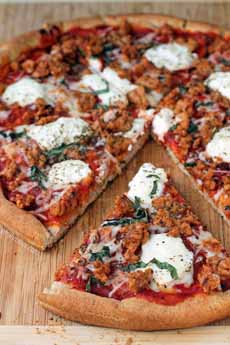
[2] Ricotta is used as the base for white pizza, but can also top a red pizza. Here’s the recipe for this ricotta and sausage pizza from Emily Bites.
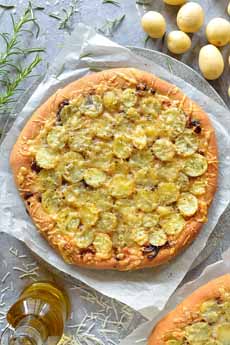
[3] Gruyère pizza with new potatoes, caramelized onions and rosemary. Here’s the recipe from Domestic Gothess.
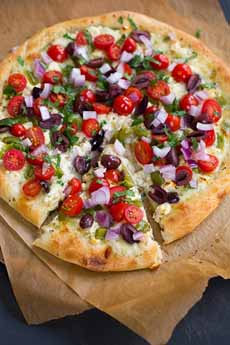
[4] Greek pizza, with feta cheese and other Greek salad ingredients. Here’s the recipe from Cooking Classy.

[5] White cheddar pizza with bacon and walnuts (photo courtesy Wisconsin Milk Marketing Board).
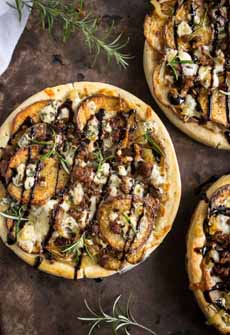
[6] We’ve got the blues: gorgonzola, potato, caramelized onions and rosemary. Here’s the recipe from Port And Fin.

[7] Turn wings into pizza: Buffalo chicken pizza with blue cheese, mozzarella and hot sauce. Add some sliced celery if you like. Here’s the recipe from The Optimalist Kitchen.
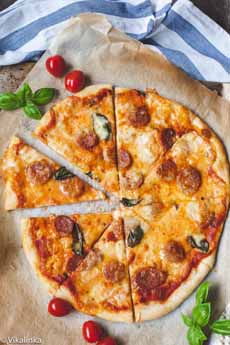
[8] Gouda and chorizo pizza. Here’s the recipe from Vikalinka.
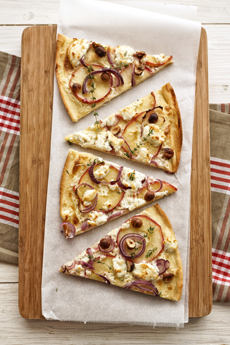
[9] Goat cheese and grilled onion pizza (photo © Urban Accents).
|
HISPANIC MELTING CHEESES
Several Hispanic cheeses that are commonly available in the U.S. are great melters, and can be used on pizza. Look for asadero, queso manchego, queso oaxaco, queso de papa and queso quesadilla.
Here’s more about Hispanic melting cheeses.
3. OTHER INTERESTING PIZZA CHEESES
Soft-Ripened Cheeses: Cheese board favorites like Brie and Camembert have naturally runny centers. They also have subtle mushroomy notes, so are delicious topped with sautéed mushrooms on pizza or a burger. Soft-ripened cheeses are uncooked, unpressed cheese, which, as a result, are creamy or even runny when fully ripe. They melt very easily. You don’t need to trim off the rind—it’s considered a choice part by cheese connoisseurs.
Semisoft Cheeses: These cheeses, springy to the touch, melt easily. Some we’ve already mentioned.
Brick, fontina and port salut are popular examples, as are blue cheeses, butter käse, edam, young gouda, havarti, limburger, some monterey jacks, muenster, young provolone, yeleme and some tilsits.
More Cheeses To Try
Colby, edam and emmental, along with Cheddar, Gruyère, mozzarella and provolone, are recommended based on a scientific study of the perfect combination of cheeses based on each type’s elasticity, free oil, moisture, water activity and baking temperature.
Here’s the scoop.
Thanks to Webstaurant Store for some of these recommendations.
CHECK OUT WHAT’S HAPPENING ON OUR HOME PAGE, THENIBBLE.COM.
|