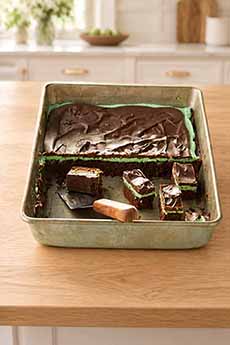
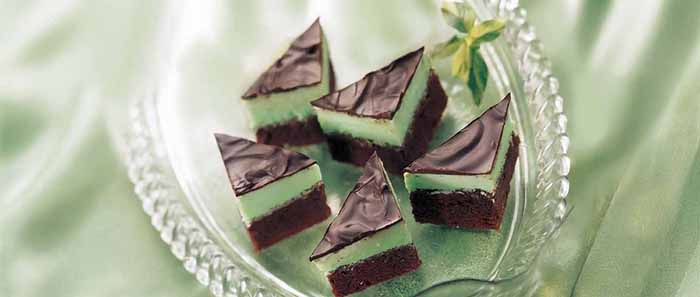
[9] These grasshopper bars contain crème de menthe as well as crème de cacao. Here’s the recipe (photo © Betty Crocker).
4. CRÈME DE MENTHE HISTORY
As with many other liqueurs, crème de menthe was developed as a digestif, sipped from a small glass after a big meal.
One of the best-known origin stories credits Émile Giffard, a pharmacist in Angers, in the Loire Valley, in 1885‡.
He researched the digestive and refreshment qualities of mint, then crafted the liqueur into the colorless (white) variety.
In those days, liqueurs were commonly drunk after dinner to help with digestion. Giffard made his mint liqueur available to the Grand Hotel in Angers. It was a great hit with the guests [source].
5. WHY IS A RECIPE CALLED “CRÈME DE MENTHE” WHEN IT CONTAINS NO CRÈME DE MENTHE?
It is frustrating for serious food writers and bakers who value accuracy, that more than a few recipes are called by a name that doesn’t reflect what’s in the recipe. The practice is widespread, and it comes down to a mix of nostalgia, marketing, visual shorthand, and search engine optimization.
Here’s why it happens:
Mid-Century Recipe Lineage & Nostalgia
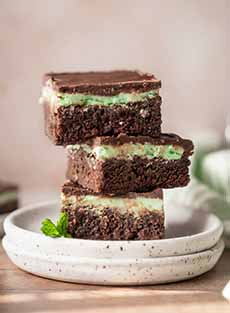
In mid-20th-century America—especially across community cookbooks, church bake sales, and Midwest food culture—three-layer brownies featuring a rich chocolate base, a vivid pastel-green buttercream filling, and a glossy chocolate glaze became wildly popular under the name “Crème de Menthe Brownies.”
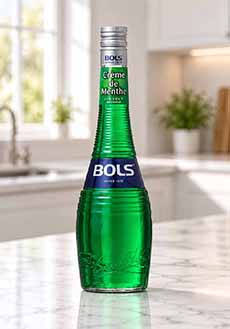
Originally, many of these recipes did call for a splash of green crème de menthe liqueur (like Bols or Hiram Walker), which was a common staple in home cocktail carts for Grasshoppers and Stingers. Over decades, home bakers and community recipe editors swapped the liqueur for standard mint extract plus a few drops of green food coloring so the recipe would be family-friendly, alcohol-free, and reliant on basic baking cupboard staples. Yet the evocative vintage name stuck because that was how people remembered and asked for them at potlucks.
“Crème de Menthe” as a Flavor and Visual Archetype
In casual American culinary parlance, “crème de menthe” often shifted from referring strictly to the bottled liqueur to describing a specific flavor profile and appearance: sweet, gentle spearmint or peppermint paired with a distinct bright green color. Unlike “peppermint” (which conjures sharp candy canes and holidays) or “mint” (which can imply garden mint, spearmint leaves, or savory pairings), “crème de menthe” immediately signals a smooth, creamy, confectionery green mint layer sandwiched between dark chocolate. Recipe writers rely on that established shorthand.
SEO and Reader Search Behavior
Digital recipe publishing is heavily driven by search volume. Far more people search Google for “Crème de Menthe Brownies” or “Crème de Menthe Brownie Recipe” than for “Minty Chocolate Brownies” or “Layered Mint Brownies.” If a digital publication titles the dish “Mint Brownies,” they miss out on the large volume of search traffic.
Perceived Elegance and Click Appeal
“Crème de Menthe” implies French, sophisticated, and festive. “Minty Chocolate Brownies” or “Chocolate Mint Brownies” sound pedestrian in comparison.
Lifestyle magazines and recipe sites (such as Taste of Home, Betty Crocker, and food blogs) know that culinary French or cocktail-inspired naming elevates a recipe’s perceived value, generating higher click-through rates and social shares.
OTHER MISNAMED RECIPES
Food history and popular recipe writing are filled with dishes where the title promises an ingredient, spirit, or classical culinary technique that is completely absent from the actual instructions. These usually fall into two main categories: recipes borrowing fancy technique terms to sound elevated, and recipes borrowing luxury or cocktail ingredients to evoke a flavor mood without using the real thing.
Recipes That Misuse The Name Of The Technique
“Soufflé” Dishes That Aren’t Soufflés
Classical culinary technique defines a soufflé (from the French verb souffler, “to puff” or “blow up”) as a base such as béchamel, purée, or pastry cream lightened by folding in whipped egg whites and baked so trapped air expands and rises dramatically.
Yet throughout mid-century community cookbooks and diner menus, recipes like “Sweet Potato Soufflé,” “Corn Soufflé,” and “Squash Soufflé” are almost invariably casseroles or puddings. They call for whole eggs or canned condensed milk beaten directly into the mash without whipping or folding any whites, producing a dense, baked casserole rather than an aerated puff.
“Brioche” Made Without Enriched Dough Technique
True brioche is a yeast dough enriched with high percentages of butter and eggs, worked meticulously through prolonged kneading to build an elastic gluten matrix capable of suspending the fat.
In many lifestyle magazines and quick-baking blogs, one finds “No-Knead 30-Minute Brioche” or “Quick Brioche Bread” that relies on chemical leaveners like baking powder, or simply stirs melted butter into standard batter without developing the signature brioche crumb structure.
“Risotto” Made Without Short-Grain Rice or Starch Agitation
Authentic risotto is defined by a specific cooking method using high-amylopectin short-grain rice (such as Arborio, Carnaroli, or Vialone Nano) cooked by gradually adding warm stock while stirring constantly to rub starch off the grains and form an emulsified, creamy sauce without added heavy cream. “Oven-Baked Risotto” or “Cauliflower Risotto” uses neither the technique nor, in the latter case, the rice. Most recipes simply simmer ingredients covered or bake them like a pilaf, then stir in heavy cream or cream cheese to artificially fake the creaminess that stirring was supposed to produce.
“Confit” That Is Just Quick-Roasted in a Little Olive Oil
Confit derives from the French confire, “to preserve,” and historically requires curing an ingredient (usually duck or pork) and slowly poaching it fully submerged in rendered animal fat at very low temperatures (under 200°F) for hours until tender and shelf-stable.
Recipes titled “Garlic Confit” or “Cherry Tomato Confit” frequently instruct cooks to toss whole cloves or tomatoes in a modest drizzle of olive oil and roast them on a baking sheet at 375°F for 25 minutes. That is simple roasting, not confit!
Recipe Names Missing Key Ingredient or Spirit Names
Amaretto Cookies and Desserts With No Amaretto
Countless recipes titled “Amaretto Cookies,” “Amaretto Pound Cake,” or “Amaretto Fudge” contain zero amaretto liqueur (such as Disaronno). Instead, the ingredient list calls solely for almond extract.
While amaretto liqueur itself is flavored with apricot kernel oil or bitter almonds, marketing a recipe as “Amaretto” implies the rounded sweetness, alcohol notes, and vanilla warmth of the Italian cordial.
“Champagne” Cupcakes and Frosting Made With Ginger Ale or Extract
Weddings and bridal showers routinely feature recipes for “Champagne Cupcakes” or “Pink Champagne Cake.” An inspection of the recipe reveals either plain lemon-lime soda, ginger ale, or artificial “sparkling wine flavor drops” substituted because the writer assumes home bakers do not want to open a bottle of sparkling wine.
The title trades entirely on the glamour of the word Champagne.
Bourbon or Rum Glazes Without Spirits
Bottled sauces and online sheet-pan recipes frequently tout “Bourbon-Glazed Salmon” or “Spiced Rum Pork Chops,” yet call only for molasses, apple cider vinegar, Worcestershire sauce, and smoked paprika.
The recipe developer relies on the cultural association of bourbon with charred oak and caramel, bypassing the spirit completely.
“Kahlúa” or “Irish Cream” Brownies and Cheesecakes
Just like the crème de menthe brownie, many “Irish Cream Cheesecake” and “Kahlúa Brownie” recipes rely entirely on powdered instant espresso granules, cocoa powder, and imitation vanilla or almond extract.
The recipe borrows the famous branded liqueur names to imply “coffee liqueur” or “cream liqueur,” even when there is not a drop of Bailey’s or Kahlúa in the mix.
Crab Rangoon Without Crab
The beloved American Chinese restaurant appetizer (not an authentic Chinese dish, by the way) is traditionally made of cream cheese, scallions, and crabmeat (or surimi) wrapped in a wonton skin.
One can find “Crab Rangoon Dip” or “Air Fryer Crab Rangoon” where the author outright states that it contains no crab, for vegetarian, seafood allergy, or other reasons. If the recipe uses only cream cheese, Worcestershire sauce, and garlic powder without crab or any seafood analogue, it is simply fried cream cheese.
Does any of this make a hill of beans difference?
Only if you want to be accurate, correct, and properly informed.
*Homemade Crème De Menthe Recipe. Ingredients: 1-1/2 cup fresh mint leaves, 1-1/2 cups vodka, 1-1/2 cups sugar, 1 cup water. Preparation: (1) Measure out 1 cup of the mint leaves, tear them into quarters, and add them to a 750 ml glass jar with a tight cap (for the jar, note that a 750 ml bottle of vodka is 25 ounces). Pour the vodka on top. Shake and let steep for 12 hours; then strain the mint leaves and return the infused vodka to the jar. Note that because the leaves have not been commercially macerated, the color will be more yellowish than green. You can adjust it with food color later. (2) Bring the water and sugar to a boil and simmer for 5 minutes. Remove from heat, cool, and add to the vodka. Tear the remaining 1/2 cup of mint leaves and add them to the jar. Shake and let steep for 10 hours. Strain twice to remove all pieces of mint leaves. You’re ready to enjoy your crème de menthe.
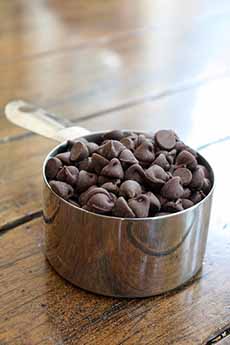
†If you can’t find mint chocolate chips, place 2 cups (12 ounces) of semisweet chocolate chips and 1/4 teaspoon peppermint extract in a plastic bag. Seal and toss to coat. Allow the chips to stand for 24-48 hours.
‡Crème de menthe’s exact origins are debated. Émile Giffard, founder of the Giffard company, is widely credited with creating Menthe-Pastille, a mint liqueur, in Angers in 1885. Crème de menthe as a category predates this and includes other producers. Bols, for example, was founded far earlier in the Netherlands.
CHECK OUT WHAT’S HAPPENING ON OUR HOME PAGE, THENIBBLE.COM.
|