|
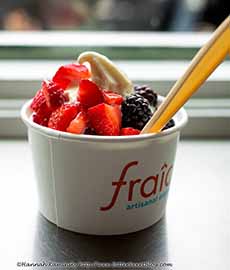
February 6th is National Frozen Yogurt Day (June is National Frozen Yogurt Month). From a DIY frozen yogurt bar to a variety of frozen yogurt pies and cakes, ice cream sandwiches, and frozen yogurt pops.
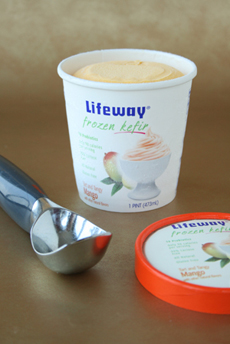
If you like frozen yogurt, try frozen kefir (photo #4).
Kefir is a probiotic drink, like buttermilk (here’s the difference). Unlike buttermilk, it is available sweetened and flavored. The next step was to freeze it into a dessert.
When yogurt (or kefir) is frozen, do the probiotics stay alive? Here’s the scoop on the live cultures in frozen yogurt.
While frozen yogurt seems ubiquitous today, it is only some 40 years old. The first brand, Frogurt, was a soft-serve introduced in New England in the early 1970s by H. P. Hood.
Here’s the history of frozen yogurt.
FROZEN YOGURT RECIPES
While we mostly pick up a soft-serve cone or purchase a pint of frozen yogurt of kefir, here are some of our favorite frozen yogurt recipes.
Frozen Yogurt Pie
Frozen Yogurt Pops With Berries
Frozen Yogurt Sundae Toppings
Homemade Yogurt Pops
Maple Bacon Frozen Yogurt
THE HISTORY OF YOGURT
Way back in 2005, we created a glossary of the different types of yogurt, which starts with a brief history of yogurt. Here’s more of the story.
It’s believed that milk products were incorporated into the human diet between 10,000 and 5000 B.C.E., with the domestication of milk-producing animals: camels, cows, goats, horses, sheep, water buffalo, and yaks.
Fresh milk spoils easily. When herdsmen in Central Asia (the broader Middle East and North Africa) stored their extra goat’s milk in containers made out of animal stomachs to preserve it while on the go. Some of the milk stored in these skins, to their surprise, became thick and tart.
More importantly, it was still edible — even after a surprisingly long period of time in the hot sun. Voilà: yogurt!
The milk in contact with the wild bacteria in the goatskin, the warm temperatures, plus the agitation of the milk in the pouch when walking or riding, caused spontaneous fermentation. The milk is curdled into yogurt.
(The origin of cheese was the same—here’s the history of cheese.)
As a fermented food, yogurt was a great way to preserve milk since the acidity slows the growth of harmful bacteria. Yogurt was a well-known food in the Greek and Roman empire and has played a major role in Mediterranean cuisine since 800 BCE.
The exact origin of yogurt is uncertain, but it is thought to have appeared in Mesopotamia around 5000 B.C.E.
Ancient Mesopotamia included the modern lands of Iraq, southeast Turkey, west Iran, northeastern Syria, and northern Kuwait.
The word “yogurt” is believed to have come from the Turkish yoğurmak, to thicken, coagulate, or curdle.
Yogurt is mentioned from ancient times.
The Turks were the first to evaluate yogurt’s medicinal use for a variety of illnesses and symptoms—diarrhea, cramps, and to alleviate the discomfort of sunburned skin.
One of the oldest written documents is about the health-promoting properties of yogurt, which appears in Indian Ayurvedic scripts of about 6,000 B.C.E.
In the Bible’s Book of Job, written in the 6th century B.C.E., Abraham owed his longevity and fecundity to yogurt consumption. The reference to the “Land of Milk and Honey” is interpreted by many historians as a reference to yogurt [source 1, source 2].
References to yogurt appear in the records of ancient Greece, India, and Persia. These references often mention consuming honey along with yogurt. Even before yogurt, in Greece, oxygala, a distant ancestor of yogurt, was made from sour milk and sweetened with honey.
Yogurt was well known to the ancient Greeks and Romans, including a written Greek reference in 100 B.C.E. [source].
Pliny the Elder (23 C.E.-79 C.E.) remarked that certain “barbarous nations” knew how “to thicken the milk into a substance with an agreeable acidity” [source].
Yogurt was a part of the diet in many ancient civilizations. It has had a major role in Mediterranean cuisine since 800 B.C.E. [source].
It has been part of in nearly every culture that has kept animals for milk and it was likely discovered in similar ways in each region [source].
Medieval Turkish sources in the 11th century describe the use of yogurt by nomadic Turks. Sources suggest that Mughal Indian emperor Akbar’s (1605-1556) cooks would flavor yogurt with mustard seeds and cinnamon.
Yogurt became a staple of the Mongolian diet. Genghis Khan (1162-1227), the founder of the Mongol Empire, purportedly fed his warriors yogurt based on the belief that it instilled bravery.
In 1542, King François I of France (1494-1547) introduced yogurt to Western Europe after it cured him of severe diarrhea. No French doctor could help him, but his ally Suleiman the Magnificent of Turkey (1494-1566) sent a doctor, who cured the patient with Turkey’s remedy, yogurt.
Yogurt As A Modern Health Food
Until the 1900s, yogurt (also spelled “yoghurt” or “yoghourt”) was a staple in the diets of people in the Russian Empire, especially in Central Asia and the Caucasus, Western Asia, South-Eastern Europe/The Balkans, Central Europe, and the Indian subcontinent.
For centuries, yogurt was made only in homes for family consumption. That all changed in 1905 when Bulgarian microbiologist Stamen Grigorov (1878–1945) discovered Lactobacillus bulgaricus, the bacteria strain that ferments milk into yogurt.
When a medical student in Geneva, he undertook the first scientific study of yogurt. He examined the microflora of yogurt and described it as consisting of spherical and rod-like lactic acid-producing bacteria. In 1907, the rod-like bacterium was called Bacillus bulgaricus (now Lactobacillus delbrueckii subsp. bulgaricus).
The Russian biologist and Nobel laureate Ilya Mechnikov, of the Institut Pasteur in Paris, was influenced by Grigorov’s work and hypothesized that regular consumption of yogurt was responsible for the unusually long lifespans of Bulgarian peasants.
Believing Lactobacillus to be essential for good health, Mechnikov worked to popularize yogurt as a foodstuff throughout Europe.
Food scientists combined selected strains that would culture reliably for commercial creameries, making it possible for a manufacturer to make a consistent yogurt every time.
Yogurt Gets Industrialized
Mechnikov’s efforts worked. In 1919, Isaac Carasso, originally from the city of Salonica in the Ottoman Empire (today Thessaloniki, Greece), started a small yogurt business in Barcelona, Spain. He named the business Danone (“little Daniel”) after his son. The brand later expanded to the U.S. under the name Dannon.
Influenced by Élie Metchnikoff’s 1908 book, The Prolongation of Life; Optimistic Studies, yogurt was introduced to the U.S. in the first decade of the 20th century as a health food.
Yogurt was popularized by John Harvey Kellogg at the Battle Creek Sanitarium (1876 to 1943), and later by Armenian immigrants Sarkis and Rose Colombosian, who established Colombo and Sons Creamery in Massachusetts in 1929.
Yogurt’s popularity in the U.S. evolved in the 1950s and 1960s when it was presented as a health food by scientists like Hungarian-born bacteriologist Stephen A. Gaymont (1905-1994).
But it remained an item for health food stores and ethnic groceries, like the Greek-American brand Colombo. You wouldn’t find it in a supermarket until Dannon, a brand that had been selling classic tart yogurt to New York City’s immigrant communities.
How Modern Yogurt Is Made
Fresh milk or cream is pasteurized to eliminate bacteria. It is then homogenized to provide a smooth, creamy texture.
Lactic bacteria starters (cultures) are added to begin the fermentation process. Different brands may use a combination of different cultures, but all use Lactobacillus bulgaricus and Streptococcus thermophilus bacteria. These two strains are required by the FDA in order for a product to be called yogurt.
The yogurt is then kept at specific temperatures to stimulate bacteria activity.
The bacteria convert the lactose (the sugar naturally found in milk) to lactic acid, which thickens the milk and generates yogurt’s signature tangy yogurt flavor. The lactic acid produced by the fermentation process also acts as a preservative, helping the cultured milk stay fresh longer.
The cooled plain yogurt is packaged as is, or flavored first.
Sweetened Yogurt Emerges
Even though it could be drizzled with honey, plain yogurt proved too tart for the American palate.
So in 1966 Colombo sweetened its yogurt by adding fruit preserves, inventing the “fruit on the bottom” style of yogurt, later called sundae style in the industry. It was a big success, causing other brands like Dannon to do the same.
That, along with the health claims, convinced American tastebuds to add yogurt to their diets.
|