|
February 16th is International Syrah Day, a wine that most aficionados place in France’s Rhône Valley* and its wine-making region, called Côtes-du-Rhône. You may be familiar with wines from the Côte Rôtie, Hermitage, and Cornas appellations.
The best of the wines, from producers such as Chapoutier, Chave, Domaine Gerin, Guigal, Paul Jaboulet Aîné, Saint Cosme, Yves Cuilleron, are bold and rich with fine-grained tannins.
They have complex flavors of, variously, black raspberry, black currant, violet, and chocolate—along with savory hints of olive, bacon fat, white pepper, and charcoal smoke.
And these bottles will set you back a few bucks ($150 for Guigal Côte Rôtie, for example).
So in honor of the day, below are:
> Very affordable recommendations from other Syrah-growing regions around the world.
> Syrah and food pairings.
> The history of Syrah.
Elsewhere on The Nibble:
> The year’s 25+ red wine holidays.
> The year’s 22+ white wine holidays.
> The history of wine.
TERROIR & SYRAH
As with all wines and other agricultural products (cacao/chocolate, cheese, coffee, olive oil, oysters, tea. vanilla, etc.), the flavors of the wine depend on both the quality of the rootstock and the terroir†.
Each region in each country, plus microclimates within the region, will produce Syrah wines with different aromas and flavors. While its flavors vary depending on the terroir, all Syrah wines are rich, usually full-bodied, and always deep purple.
Let’s take a look at some wines to try. I’ve even included a few from France.
France is the world’s largest Syrah producer, followed by Spain and Australia. Syrah is the most widely planted Rhône varietal in California.
But who’d have thought ofƒmichigan Michigan? We found some serious Syrahs from that state.
At first, we held back on listing them was that they were not widely available for purchase. Still, I think they deserve a mention, and I’ve added them in the notes below.
— Kris Prasad, Wine Editor
AFFORDABLE SYRAH WINES TO TRY
Syrah, also known as Shiraz, is a red grape varietal grown throughout the world. It’s a cross between two obscure grapes from southeastern France, Dureza and Mondeuse Blanche.
It’s not the same as Petite Sirah, which is a cross between Syrah with Peloursin, a red grape believed to have originated in the northern Rhône-Alpes region.
Wineries far beyond France have found great success planting Syrah, Viognier, and other classic Rhône grapes. They typically deliver spicy, peppery, flavors with notes of black fruits and meat/bacon.
How about putting together a group of these and invite your friends to a tasting, be it wine and appetizers, a cookout or a potluck.
Australia
Best Great Western Bin#1 (<$20)
D’Arenberg Shiraz (also has 4% Viognier, ca. $25)
France
Alain Voge “Les Peyrouses” Syrah (ca. $17)
Domaine Faury (Colline Rhodaniennes) *ca. $30)
Yves Cuilleron “Les Vignes d’a Cote (<$20)
Michigan
Free Run Cellars (ca. $27)
Tabor Hill Winery (ca. $27)
South Africa
Fram Shiraz (Swartland) <$20
Reyneke Syrah (Stellenbosch) (ca. $30)
Washington State
Owen Roe Share Croppers Syrah (<$20)
Grammercy Cellars (Columbia Valley) Syrah (ca. $38)
SYRAH & FOOD PAIRINGS
One reason to try Syrah is if you’re a meat-lover. It’s great with grilled and roasted meats and poultry. So here’s an idea:
Beef: barbecue, braised, grilled, roasted, steaks and burgers
Cheese: bold cheeses go best: blues, aged Cheddar and Gouda, salty Italian grating cheeses (like Grana Padano, Parmigiano Reggiano), and washed rind “stinky” cheeses
Chocolate: dark chocolates (70% cacao or greater), dark chocolate desserts
Fish: grilled/seared tuna and other hearty fish
Lamb: chops, roasted leg, stew
Pork: chops, roast, sausage
Other meats: veal (including osso bucco), venison
Poultry: chicken, duck, turkey
Vegetables: grilled, mushrooms
You’ve got a lot to eat and drink. Have a great time celebrating International Syrah Day.
THE HISTORY OF SYRAH
Despite the exotic legends that have long circulated about Syrah, DNA testing in 1999 revealed that Syrah is the offspring of two obscure grapes from southeastern France: Dureza and Mondeuse Blanche.
The research, conducted by Professor Carole Meredith at U.C, Davis and Jean-Michel Boursiquot of L’Ecole Nationale Superiore Agronomique de Montpellier, proved definitively that Syrah originated in southeastern France, specifically, the Rhône Valley region.
Syrah first appears in the historical record in 1781, growing outside the Rhône village of Tain-l’Hermitage, where it is still planted today.
Long before then, however, in 77 C.E., Pliny the Elder wrote about wines from Vienne (today’s Côte-Rôtie area of the Northern Rhône) made from a dark-skinned grape that hadn’t existed 50 years earlier.
Some speculate could have been Syrah, a deliberate or accidental cross-breed.
For years, romantic legends claimed the grape came from the city of Shiraz in Persia (Iran), which by the 9th century had established a reputation for producing the finest wine in the world. However, the historical Shirazi wine of Persia was made from entirely different grapes, and there is no proven connection between the city of Shiraz and France’s Syrah grape.
James Busby brought Syrah to Australia in 1831, where it became known as Shiraz and is now considered Australia’s national grape.
The name gradually evolved from Syrah to Shiraz in Australia in the mid-19th century, and the country is now the world’s second-largest producer after France.
Why “Shiraz?” It’s been speculated to be a bastardization of the original word. Another explanation is that some way along the voyage to, or cultivation in, Australia, some labels were either misspelled or misread, giving birth to “Shiraz.”
Another thought is that a mixture of the Scottish and Australian accents on the continent contributed to a name that was easier to pronounce by the locals!
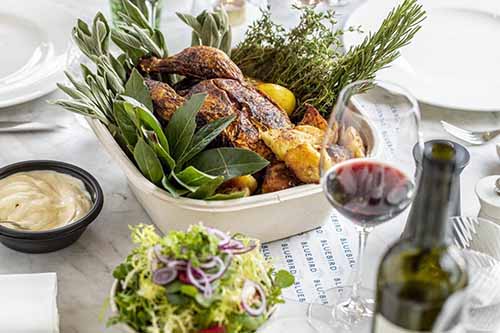
[10] Enliven roast chicken with a glass of Syrah (photo © D & D | London).
|
|

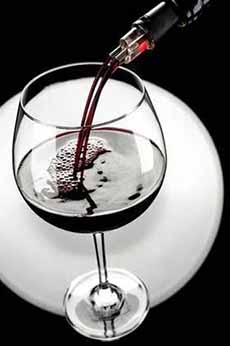
[1] Syrah has a deep ruby-red to purple hue, darker than Cabernet Sauvignon. When youthful, the wines can be inky and opaque (photo TRIbella Wine).
[2] In the U.S., California leads with 16,448 acres of Syrah. Washington comes in second at 4,572, and Oregon in third at 1,316. There are small plantings in Arizona, Colorado, Hawaii, Idaho, Michigan, Nevada, New York and Texas [source].
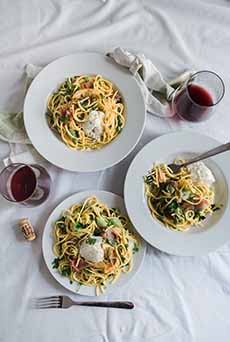
[3] Syrah and pasta pairings work well when there’s a meat sauce or other meat ingredient, as in this photo, which has prosciutto (photo © Brooke Lark | Unsplash).
[4] Syrah is a match with America’s favorite pizza, pepperoni (photo © Jordan Nix | Unsplash).
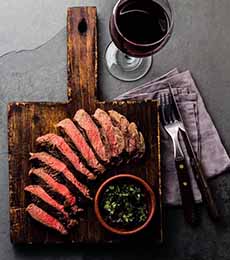
[5] Pour a glass with grilled or roasted meat and poultry (photo © Organic Beef Company | Facebook).
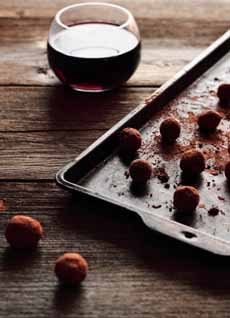
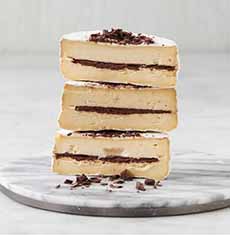
[6] For dessert, pair Syrah with a cheese course of bold cheeses. Or, go for chocolate truffles or a dark chocolate cake.
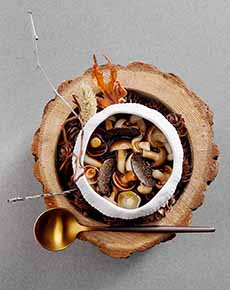
[7] Earthy mushroom dishes pair beautifully with Syrah (photo © Huso Restaurant | NYC).
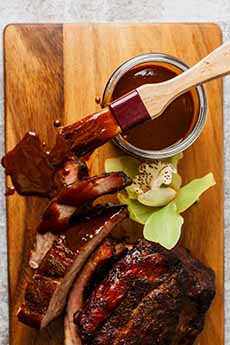
[8] Syrah is a winner with all forms of beef, from filet mignon to burgers and barbecue (photo © Koloa Rum).
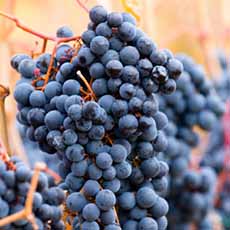
[9] Syrah grapes (photo © Liketoy Zab).
|
|
________________
*The indigenous grape varieties that grow in the region—Grenache, Mourvèdre, Roussanne, Syrah, and Viognier are the main ones—are often referred to as Rhône grapes.
†Terroir, pronounced tur-WAH, is a French agricultural term referring to the unique set of environmental factors in a specific habitat that affects a crop’s qualities. These include climate, elevation, proximity to a body of water, slant of the land, soil type, and amount of sun. These environmental characteristics give the wines produced from these grapes a unique character.
‡Free Run Cellars and Tabor Hill make excellent Syrah, in very different styles. The Tabor Hill 2018 was the richer and fuller of the two, but the Free Run Cellars 2018 Syrah was the more balanced, delicious, and ultimately preferred. Both are worth seeking out. They average around $27.
‡‡Syrah and Shiraz are the same grape varietal. In an effort to differentiate their wines from the French style of Syrah, Australian winemakers have called their wines Shiraz. Historically, the name Shiraz refers to the wine produced around the city of Shiraz in Persia (modern Iran). By the 9th century, the city of Shiraz had already established a reputation for producing the finest wine in the world. But modern Shiraz has no connection to that wine. In modern Iran, wine cannot be produced legally due to the prohibition of alcohol in Islam. Before the Islamic Revolution in 1979, there were up to 300 wineries in Iran; now there are none [source].
CHECK OUT WHAT’S HAPPENING ON OUR HOME PAGE, THENIBBLE.COM.
|