Preparation
1. PLACE a rack on the lower third of the oven, and preheat to 350°F.
2. PLACE the chocolate in a quart measuring cup (or equivalent) and add enough cream to reach the 1-1/2 cup mark. Pour the mixture into a saucepan and set over low heat, stirring occasionally until the chocolate has completely melted. Stir in the sugar.
3. ADD the egg and yolks to a bowl, and whisk just enough to blend. In a thin stream, gradually pour the egg mixture into the hot chocolate mixture, continuing to stir the chocolate mixture. Add the rum.
4. DIVIDE the mixture among the ramekins and place them in a baking dish. Tamp down any air bubbles on the surface of the chocolate mixture.
5. FILL the baking dish with water up to 2/3 the height of the ramekins. Cover the baking dish with aluminum foil to prevent a crust from forming on the custard.
6. PLACE the dish on the lower rack of the oven for about 20 minutes. The custards are done when they puff into slight domes but still quiver a bit. A toothpick stuck in the center should be slightly wet but not runny.
You can eat the custards hot or warm from the oven, or refrigerate them for 30 minutes or longer. They’ll keep in the fridge, individually covered with plastic wrap after they chill down, for up to five days.

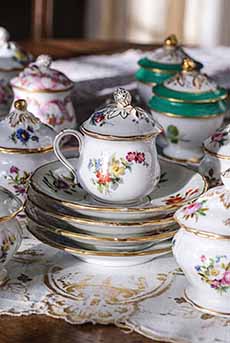
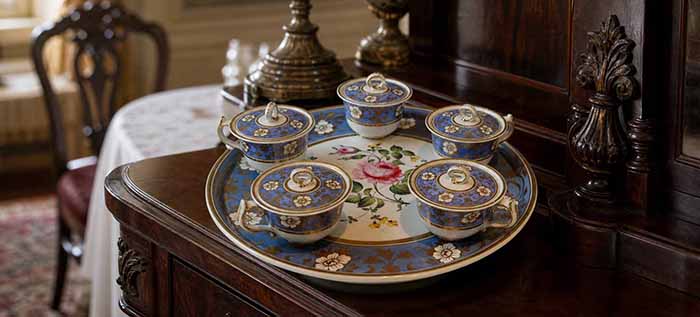
[10] Antique pots de crème, circa 1830–1840, porcelain with hand-painted decoration and gilding (Peabody Essex Museum) (photo © The Nibble via Creazilla).
4. THE HISTORY OF POTS DE CRÈME
Custards date back to the Middle Ages and were used as fillings for pies and tarts. In fact, the word custard derives from the French “croustade,” which is a tart with a crust.
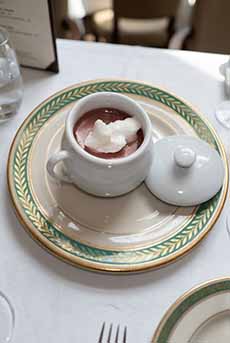
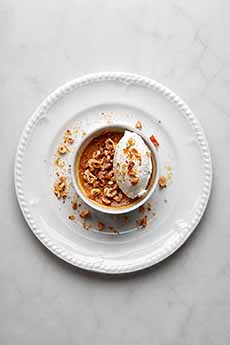
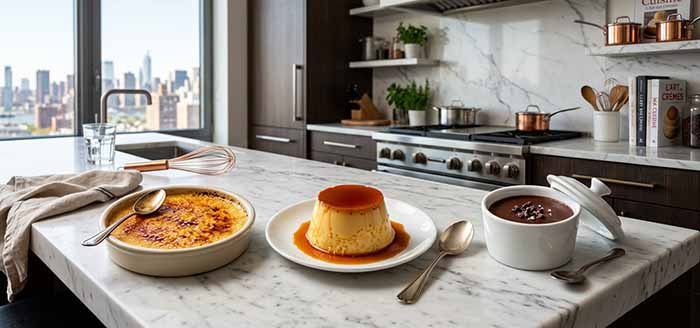
Similarly, pots de crème were originally custard fillings for pies. At some point, some observant cook or assistant decided to bake the filling alone, in individual small cups. A small cup with a lid and one handle evolved specifically for pots de crème (photos #2, #6, and #10).
Loose baked custards cooked in individual lidded porcelain cups (pots) originated in 17th-century France and were formally documented as early as 1651 in François Pierre La Varenne’s landmark cookbook, Le Cuisinier François.
The dessert also became known as petits pots, little pots, typically in chocolate*, fruit, and vanilla flavors.
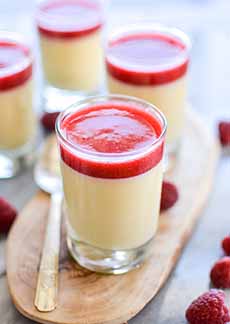
While today chocolate pots de crème are most often seen on restaurant menus, we see any and all dessert flavors: butterscotch, caramel, coffee, matcha, passion fruit, pumpkin, raspberry, and whatever is trending at the moment.
The Pots De Crème Cups
Small porcelain cups (about three inches tall—photo #10 above) with lids topped with finials, were in use by the 18th century. These pots de crème appeared on formal tables in both Europe and the U.S.
The small size of the cup dictated that the custard be eaten with a demitasse spoon.
You can buy the pots today, in both modern porcelain and antique sets. The latter usually included a footed porcelain tray, or even a three-tiered tray, on which the pots were brought to the table.
Styles, patterns, and colors vary widely; from fairly rustic to elegant and gold-enhanced.
From the mid-1700s to the early 1900s, some of the finest examples came from prestige porcelain houses such as Meissen, Sèvres, Wedgwood, and Worcester.
As an example of how elaborate dinnerware was for the well-to-do—think of all the different forks, knives, and spoons with which those tables were set. Think of all the specialty plates and serveware as well (chocolate was poured from a chocolate pot, different from tea pot and a coffee pot).
Cups of a similar size were used for both pots de crème and hot chocolate. But the chocolate pots typically had two handles! For the reason why, see the †footnote below.
Today, serve your pots de crème in whatever cups, dishes, or glasses you have. Your family and friends will be just as happy whatever the container.
________________
*Chocolate first came to France in 1615; it was a gift to the 14-year-old King Louis XIII from his 14-year-old bride-to-be, Anne of Austria. It was first served as a drink until French chefs expanded its use by adding the flavor to custard and other desserts. Here’s more about it.
†Why did pot de creme cups have one handle, but hot chocolate cups, the same size, have two handles? You’d think it would be the other way around. It comes down to 18th-century dining etiquette, function, and luxury culture.
The functrion was drinking vs. eating. Drinking chocolate was consumed by tilting the cup back to drink, often when still in bed. Two handles allowed the drinker to lift the cup symmetrically using both hands for stability. Pot de crème was eaten at the dinner table with a demitasse spoon. Because one hand was already occupied holding the utensil, you only needed one hand—and thus one handle—to steady or position the porcelain pot.
Additionally pot de crème pots were cooked directly in a water bath (bain-marie). The single side-handle functioned like a tiny saucepan handle, making it easy for cooks to place the pots in baking tins or lift them out when hot. Chocolate, on the other hand, was poured into the cup from a chocolate pot.
While both types of porcelain featured fitted lids to retain temperature, the single handle on a pot de crème made it easier to hold the cup with your non-dominant hand while using your dominant hand to remove the lid or spoon out the custard.
CHECK OUT WHAT’S HAPPENING ON OUR HOME PAGE, THENIBBLE.COM.
|