THE NIBBLE BLOG: Products, Recipes & Trends In Specialty Foods


Also visit our main website, TheNibble.com.

Fancy Snacking With Garnished Fresh Goat Cheese & Crackers

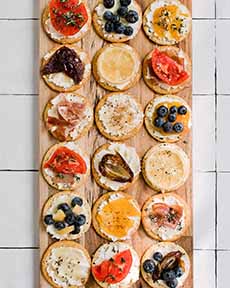
August is National Goat Cheese Month, so this past weekend, we grabbed a log of goat cheese and crackers for our guests. Although a log of fresh goat cheese is spreadable, it’s also crumbly. For the sake of neatness, we decided to pre-spread the crackers.

Then we had a tray full of boring-looking, white-topped crackers. We decided to get to work decorating them with whatever we had at hand.

We thus turned “goat cheese and crackers” into “hors d’oeuvre” to accompany cocktails, wine, and beer.

Whether you decorate the cheese-spread crackers in advance, or create a DIY, garnish-your-own option with ramekins of different toppings, it’s a tasty and fun snack.

Here’s what we had in our kitchen. We went overboard; you can choose just a few of these:

  • Blueberries, other berries, or a mix
  • Cherry tomatoes, halved, plain or marinated
  • Dates, pitted and sliced
  • Fresh chiles, sliced (or a shaker of crushed red pepper flakes)
  • Fresh figs, sliced
  • Fresh julienned basil or thyme leaves
  • Grapes, halved
  • Honey Bear for drizzling
  • Jam: apricot, blueberry, mango, peach, or whatever you have
  • Nuts
  • Olives, sliced
  • Peppadews
  • Prosciutto or other cured meat
  • Roasted red peppers (pimentos), sliced
  •  
    Plus:

  • Your favorite crackers
     
    > The history of cheese.
     
     
    THE HISTORY OF CRACKERS

    Crackers are made of flour, water, and salt. Some have other seasonings, but unlike bread, there is no leavening. There are different shapes of crackers—ovals, rings, rounds, squares, and triangles.

    And there are many styles, including cheese crackers and rice crackers for snacking; oyster crackers and saltines for soup; biscuits, cream crackers, crispbreads, and others to serve with cheeses and spreads; taralli and other cocktail nibbles; sweeter types like graham crackers; and so on.

    In American English, the term “cracker” typically refers to flat biscuits with a savory, salty flavor, as opposed to a cookie, which may be similar in appearance but is made with sugar.

    In the U.K., cookies are called biscuits and crackers are either crackers or savory biscuits.
     
     
    The First Crackers

    Long before crackers, the first flatbreads were made from ground grains mixed with water and cooked on hot rocks or griddles over fires. How soft or hard they were cooked, we do not know.

    Before “crackers” appeared, there were larger, crispy flatbreads like matzoh, lavash, and other soft flatbreads that were baked to a crispy texture.

    Matzoh dates to at least the 13th century B.C.E., when the Israelites fled Egypt with their unleavened bread. We don’t know how crisp it was or was not.

    Today’s hard, crisp, thin matzoh seems to have developed sometime in the 17th century, largely because the soft variety, like all fresh bread, would get moldy quickly, and the hard-baked form had a long shelf life [source].

    In Medieval times (1100–1200 C.E.) in central and southern Sweden, rye flour was baked into crispbread (knäckebröd, “bread which can be broken”)—also for a long shelf life. The rounds were baked with a hole in the middle so that they could be threaded over a beam and stored suspended from the ceiling. These flatbreads and crispbreads were baked only once or twice a year and kept dry in a storage chamber [source].

    For similar reasons, the modern cracker was invented close to the turn of the 19th century, in New England.

    A small, crisp bread alternative, the first cracker-like product was made in 1792 by John Pearson of Newburyport, Massachusetts, who mixed flour and water into “pilot bread” [source].

    The long shelf life was popular with sailors, who called it hardtack or sea biscuits.

    Years later, Pearson sold his business to the company that became Nabisco. Crown Pilot Crackers from Pearson’s recipe were made and sold in New England up until early 2008 (photo #2), and served with traditional chowder recipes.

    A big moment in the life of the cracker came in 1801 when another Massachusetts baker, Josiah Bent, burned a batch of biscuits in his brick oven. The crackling noise that emanated from the singed biscuits inspired the name “crackers.”

    Bent was a cracker visionary. Beyond selling the dry biscuits to sailors and other travelers, he saw the product’s snack food potential. By 1810, his Boston-area business was booming, and, in later years, Bent sold his enterprise to the National Biscuit Company, which now does business under the Nabisco name.

    Soda crackers, later known as Saltines, were described in The Young Housekeeper by William A. Alcott in 1838.

    In 1876, F. L. Sommer & Company of St. Joseph, Missouri began to use baking soda (a.k.a. bicarbonate of soda) to leaven its wafer-thin cracker, initially called the Premium Soda Cracker. They were later renamed Saltines because of the baking salt* component.

    The formulation quickly became popular and Sommer’s business quadrupled within four years [source].

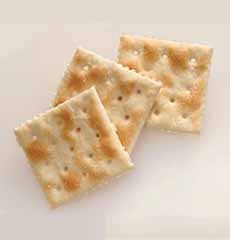
    Cracker trivia: Certain types of crackers contain tiny holes, known in the trade as docking holes (photos #2, #3, and #4). They are punched into the flat dough to stop large air pockets from forming in the cracker while baking.

    The Somer company merged with other companies to form American Biscuit Company in 1890. In 1898, after further mergers, American Biscuit Company became part of the National Biscuit Company, which changed its name to Nabisco in 1971.

    Nabisco lost its trademark for “Saltine” in 1907 after the term began to be used generically to refer to similar crackers. The word “saltine” appeared in the 1907 Merriam Webster Dictionary defined as “a thin crisp cracker usually sprinkled with salt” [source].

    Then, the brand began to call itself Premium crackers. Following a recent redesign, the current boxes are now labeled “The Original Premium Saltine Crackers.”

    Over the decades, cracker manufacturers have brought out creativity along with the crunch. Some of America’s favorite crackers (in alphabetical order): Carr’s Table Water Crackers, Cheez-It, Goldfish, Keebler Club Crackers, Mary’s Gone Crackers, Ritz, Toasteds, Town House, and brands we’ve never heard of, like Chicken in a Biskit [source].
     
     
    ________________

    *Baking soda, a chemical compound with the formula NaHCO₃, is a salt composed of a sodium cation and a bicarbonate anion.

  •  


    [1] Fancy snacking: a box of crackers, a log of goat cheese, and assorted toppings (photo © Roth Cheese | Facebook).

    Crown Pilot Crackers, descendants of the original cracker.
    [2] Crown Pilot Crackers (discontinued since 2008), descendants of the original cracker (photo © Doc’s Apple Market).

    Nabisco Saltines Crackers
    [3] Nabisco saltines, an American favorite. The term “saltine cracker” appeared in 1876 after F.L. Sommer & Company renamed its Premium Soda Cracker (photo Sternb23 | Wikipedia).

    Water Crackers Or Water Biscuits
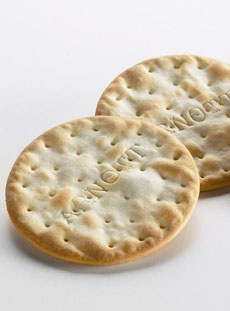
    [4] Water biscuits have long been a favorite to serve with cheese, although these days there are fancier crisps (photo © Pantry Packer [permanently closed]).

    Raincoast Crisps Dried Fruit & Nut Crackers For Cheese
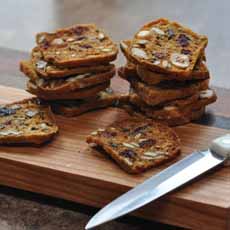
    [5] Artisanal crackers like these Raincoast Crisps, with different combinations of dried fruits and nuts, are now fashionable to serve with cheese (photo © Standard Market).

    Lavash Crispbread
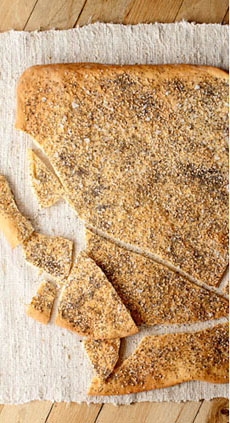
    [6] Today lavash is made in rectangular strips, but originally the large flatbread was broken by hand (photo © Hot Bread Kitchen).

    Knackbrod Swedish Flatbread
    [7] Knäckebröd, Swedish crispbread. Here’s an easy recipe (photo © True North Kitchen).


    CHECK OUT WHAT’S HAPPENING ON OUR HOME PAGE, THENIBBLE.COM.


    Comments off

    Sweet Tea Recipe & History For National Sweet Tea Day

    A glass of sweet iced tea, a.k.a. sweet tea.
    [1] Sweet tea with a lemon wedge (photo © Melissa Doroquez | Wikipedia).

    Bottle Of Pure Leaf Sweet Tea
    [2] Pure Leaf sweet tea (photos © Pure Leaf).

    Peach Iced Tea
    [3] How about a sweet summer peach garnish on your glass of sweet tea? It isn’t traditional, but it’s how we drink it in peach season (photo © The Nibble).

    A Bottle Of Arnold Palmer Vodka & A Glass Of Sweet Tea
    [4] Sweet tea is so popular that Seagram’s created a flavored vodka. You can spike your sweet tea, but it’s most commonly mixed with other ingredients like lemonade (to make a spiked Arnold Palmer a.k.a. “John Daly”), club soda, peach juice, or ginger ale (photo © Seagrams).

    A Glass Of McDonald's Sweet Tea
    [5] Sweet tea has moved from a southern specialty to national prominence. It’s even at McDonald’s (photo © McDonald’s).


    Updated August 2026

    August 21st is National Sweet Tea Day. For those who haven’t had the experience, sweet tea, also known as sweet iced tea, is more than an iced tea with sugar. It’s iced tea with lots of sugar.

    It’s a staple drink in the southern U.S. A 16-ounce glass of sweet tea has 42g to 44g of sugar. Let’s compare that to regular iced tea.

    A typical heaping teaspoon of sugar is 7.5 grams. If you added three heaping spoonfuls to a glass of plain iced tea—and that’s a lot of sugar*—it’s still just half the amount of sugar as in sweet tea.

    You can have your sweet tea plain, with a wedge of lemon, or accented with mint, peach, or raspberry. But no matter how you like it, nutritionists recommend that you have sweet tea as a special occasion drink, not your everyday, all-day beverage.

    Below:

    > Classic Southern sweet tea recipe.

    > Tea comes to America.

    > The rise of sweet tea.

    > Sugar comparison: regular tea vs. sweet tea.

    Elsewhere on The Nibble:

    > The history of iced tea.

    > The history of tea.

    > The history of iced drinks.

    > The different types of tea: a photo glossary.

    > The year’s 23 tea holidays.
     
     
    RECIPE: SOUTHERN SWEET TEA

    The recipe makes about eight cups of tea, so it provides:

  • 4 large servings of about 2 cups each
  • 8 standard 1-cup servings
  •  
    Because it’s usually served over ice, the final number of glasses will vary depending on glass size and how much ice you use.

    Ingredients

  • 8 regular tea bags or 4 family-size tea bags‡
  • 4 cups water
  • 1 to 1½ cups granulated sugar to taste, ¾ cup for a less sweet version
  • 4 cups cold water
  • Ice
  • Optional garnish: lemon slices wedges or wheels
  • Non-traditional optional garnish: fresh or frozen peach slices
  •  
    Luzianne and Lipton both make which makes family-size tea bags.
     
    Preparation

    1. BRING 4 cups of water to a boil. Remove from the heat. Add the tea bags and steep for 5–8 minutes.

    2. REMOVE the tea bags. While the tea is still hot, stir in the sugar until completely dissolved.

    3. POUR the sweetened tea concentrate into a large pitcher. Add 4 cups of cold water and stir. Serve over ice as desired.

    Tips:

  • Make the tea in advance and chill in the fridge for a colder drink. The cold water doesn’t produce cold tea.
  • To eliminate dilution, make a batch of sweet tea in advance and freeze it into ice cubes.
  •  
     
    TEA IN AMERICA

    A little pre-sweet-tea history:

    Tea was introduced to the Colonies by the Dutch—first-class world traders—in the late 1640s.

    By the time Dutch East India Company Director Peter Stuyvesant arrived in New Amsterdam in 1647 to become the city’s governor, serving tea—an expensive product—had become an established ritual in upper-class households.

    The British took control of New Amsterdam in 1664 and renamed it New York. As in England, tea continued to play the same important social role.

    Most people will be surprised to know that green tea was the predominant variety consumed in Colonial America.

    It was imported from China and Japan, both green tea cultures (even today, Japan produces only a handful of specialty black teas; China expanded into numerous styles of black tea).

    So it was mostly green tea that was dumped into Boston Harbor in 1773. (What you learned in school about the Boston Tea Party may not have been accurate. Here’s the real scoop.)

    But before then, in the 1760s, American colonists were drinking more than 1 million pounds of tea per year during the 1760s.
     
     
    Black Tea Becomes Prominent

    In 1839, which was the beginning of Britain’s Opium Wars with China, the British began to grow their own tea in India (American ships continued to bring green tea to the U.S.).

    Black tea† was the more popular style in India, and British tea merchants brought back Assam and Ceylon black teas to Europe and the U.S.

    By the first part of the 20th century, Americans were evenly split between green tea and black tea, drinking around 40% green tea, 40% black tea and 20% oolong† tea [source].

    World War II cut off trade with Japan and much of the tea—producing regions of China were occupied. The alternative was black tea from India and Ceylon.

     
    After the war, Americans continued to drink almost solely black tea: upwards of 99% according to the U.S. National Library of Medicine [source].

    While green tea reemerged in the U.S. with awareness of its antioxidant qualities some 20 years ago, America remains a black tea country to this day.

    (We love all varieties of black, green, and oolong teas, but truth to tell, we think milk and sugar taste a lot better in black tea.)
     
    Sweet Tea: Tray With Pitcher & Glasses
    [6] A tray of sweet tea on the buffet. Help yourself! (photo © The Nibble)
     
     
    THE RISE OF SWEET TEA

    The oldest known recipe for sweet tea was published in an 1878 community cookbook called Housekeeping in Old Virginia by Marion Cabell Tyree.

    Sweet tea could easily have been in fashion for numerous decades before then—among the wealthy.

    Sweet tea began as a luxury item: tea, sugar, and ice were all expensive (ice was possibly the most costly of the ingredients since it had to be stored and shipped from afar) [source].

    The Growth Of Sweet Tea

    Sweet tea earned its status as the quintessential Southern drink through a blend of climate, agricultural history, technological innovation, and deeply ingrained social traditions.

    The long, intensely hot, and humid Southern summers created a daily need for refreshing, hydrating beverages. Before climate control and air conditioning became widespread in the mid-20th century, iced drinks were a practical necessity for coping with the oppressive heat. Iced tea provided a brisk, cooling lift during the hottest parts of the day.

    The Expansion of Iced Tea

    Historically, iced tea began as an upscale novelty in the 19th century: both manufactured ice and refined white sugar were luxury goods.

    As commercial ice plants, refrigerated rail cars, and home iceboxes spread across the South in the late 19th and early 20th centuries, ice transitioned from an expensive status symbol to an everyday household staple.

    At the same time, the price of granulated sugar dropped, making a heavily sweetened beverage accessible to households across all economic backgrounds.

    Black Tea Becomes The Norm

    Early American iced teas in the 19th century were often made with green tea (frequently served in alcoholic punches).

    In fact, it was chests of green tea that the Sons of Liberty threw overboard at the Boston Tea Party!

    Over time, robust black teas—particularly orange pekoe and cut black tea blends—became the standard. Brands like Luzianne and Lipton developed tea blends specifically formulated to stay clear and hold up to melting ice without turning excessively cloudy or bitter, maintaining the deep amber profile associated with classic sweet tea.
     
    Bagua Tea Garden in Taiwan
    [7] In the mist, the famous Bagua Tea Garden, located in the mountain ranges of Zhushan Township, Nantou County, Taiwan The plantation gets its name from its signature concentric, terraced rows of tea bushes that gracefully curve around the hillside. When viewed from above, the configuration strongly resembles the shape of the traditional Chinese Bagua (Eight Trigrams) symbol.
     
    The Chemistry of the “Hot Steep” Brewing Method

    Unlike ordinary iced tea that is sweetened after pouring, Southern sweet tea is traditionally sweetened while the brewed concentrate is still steaming hot.

    Dissolving sugar at high temperatures allows for a much higher concentration of dissolved sugar than cold liquid could naturally hold (creating a simple syrup directly in the brew). This gives the beverage its signature rich body and smooth mouthfeel.

    In Southern culture, offering a guest a glass of sweet tea is an essential gesture of welcome and hospitality. A pitcher of sweet tea is a standard presence on dining tables for family dinners, Sunday lunches, church gatherings, barbecues, and front-porch visits.

    Over the generations, sweet tea evolved from a seasonal summer cooler into a year-round regional identity marker, often affectionately referred to across the South simply as the “house wine of the South.”
     
    How Sweet Is It?

    By volume, sweet tea made with the standard recipe contains approximately three to four and a half times as much sugar per 8-ounce serving as tea sweetened with two teaspoons of sugar.

    Here’s the math, using the sweet tea recipe of 1 to 1½ cups of sugar per 8 cups of brewed tea:

  • 1 cup sugar: 8 fluid ounces of sugar to 64 fluid ounces of tea = sugar-to-tea ratio 1:8.
  • 1½ cups sugar: 12 fluid ounces of sugar to 64 fluid ounces of tea = sugar-to-tea ratio 3:16.
  • In an 8-ounce serving, this equals:

  • 6 teaspoons of sugar with 1 cup of sugar in the recipe.
  • 9 teaspoons of sugar with 1½ cups of sugar in the recipe.
  •  
    By comparison, an 8-ounce cup of tea with 2 teaspoons of sugar has a sugar-to-tea ratio of:

  • 2 teaspoons sugar to 48 teaspoons tea [the number of teaspoons in 8 ounces] = 1:24.
  •  
    Sorry to end this sweet article on a down note. As a daily drink—including multiple glasses—these numbers do not tell a good story.

    The U.S. South consistently reports some of the highest daily consumption rates of sugar-sweetened beverages, a regional dietary preference that heavily mirrors the geographic distribution of obesity and type 2 diabetes in America. Southern states frequently lead national statistics for both conditions.

    While sweet tea is a staple of southern hospitality and culinary tradition, its high sugar concentration makes it a significant contributor to the daily added sugar intake that public health officials advise limiting.
     
    Thai Iced Tea
    [8] Another very sweet iced tea: Thai iced tea, sweetened with sweetened condensed milk. Here’s the recipe (photo © The Nibble).
     
    ________________

    *The American Heart Association recommends an added-sugar limit of no more than 100 calories per day (about 6 teaspoons or 24 grams) for most adult women and no more than 150 calories per day (about 9 teaspoons or 36 grams of sugar) for most men [source].

    Black tea is green tea that has been oxidized by fermentation for two to four hours, to a black color. The tea is then fully oxidized (oolong is half-oxidized) and dried slowly over a low heat charcoal fire, called panning or roasting. Black tea is the most common form of tea drunk worldwide (and tea is the second-most beverage drunk worldwide, after water). See more in our Tea Glossary.
     

    CHECK OUT WHAT’S HAPPENING ON OUR HOME PAGE, THENIBBLE.COM.


    Comments off

    The History Of Hawaiian Pizza For International Hawaiian Pizza Day

    OMG, it’s August 20th, International Hawaiian Pizza Day. When we first had a slice, it was considered a joke by serious pizza eaters. Now, it’s a thing.

    We first encountered Hawaiian pizza in a Brookline, Massachusetts pizzeria, way back in our college years. Scanning the menu, we found the concept of a cheese pizza—crust, tomato sauce and mozzarella—topped with ham and pineapple to be “fun.” We ordered a slice.

    Fun it was…but we went back to our “usual,” bell peppers, mushrooms, onions, and sausage. They went far better with tomato sauce and mozzarella. We don’t think we’ve had Hawaiian pizza since.

    Barbecue chicken pizza, goat cheese pizza, white pizza, whole wheat crusts, and the rest of what we consider “modern” and “artisan” pizzas were decades away.

    But Hawaiian pizza endured, and there is actually an International Hawaiian Pizza Day, August 20th, celebrating the pizza that originated in…Canada.

    It became popular locally and eventually became a menu staple of pizzerias worldwide.

    > The history of Hawaiian pizza is below.

    > So are creative enhancements to the traditional recipe.

    > The history of pizza.

    > 40 different types of pizza.

    > The year’s 16 pizza holidays.

    > The history of pineapple.

    > The history of ham.
     
     
    THE HISTORY OF HAWAIIAN PIZZA

    Sotirios “Sam” Panopoulos, a Greek-born Canadian, created the first Hawaiian pizza at the Satellite Restaurant in Chatham, Ontario, Canada in 1962.

    He owned the restaurant with his brothers Elias and Nikitas. They offered typical American items fare like burgers and fries, bacon and eggs, grilled cheese, club sandwiches, spaghetti and meat sauce, pizza, American Chinese dishes, and more—a full breakfast, lunch, and dinner menu, served daily.

    In New York, we call this style of restaurant a Greek diner.

    Some of the Chinese dishes mixed sweet and savory flavors. Inspired by the sweet-and-savory pairing, Panopoulos experimented with adding pineapple, ham, bacon, and other toppings to the pizzas.

    “We just put it on, just for the fun of it, see how it was going to taste,” Panopoulos told the BBC. “We were young in the business and we were doing a lot of experiments” [source].

    Hawaiian pizza also capitalized on the mid-century tiki trend, which popularized Polynesian-style cocktails, food and decor in North America.

    By the way, the name “Hawaiian” for the pizza was not a tribute to the Hawaiian Islands, which became America’s 50th state three years earlier. Rather, it was the brand name of the can of pineapples Panopoulos used.

    The Satellite Restaurant, still going strong today, proudly calls itself “Home of the Hawaiian Pizza.”

    Canadian Prime Minister Justin Trudeau is a fan of the dish.
     

    Modern cooks have elevated the recipe, using:

  • Caramelized pineapple rings (you can do it with canned rings)
  • Spicy marinara instead of traditional marinara.
  • Bacon or pepperoni in addition to ham.
  • Prosciutto or Serrano ham instead of American ham.
  • Or, the addition or substitution of Spam, a Hawaiian favorite.
  • Regular or pickled jalapeños, red chile flakes, or a drizzle of chile oil.
  • Slices of guava paste, often paired with ham.
  • A drizzle of extra sweetness: honey, balsamic reduction
  •  


    CHECK OUT WHAT’S HAPPENING ON OUR HOME PAGE, THENIBBLE.COM.


    The original Hawaiian Pizza from the Satellite Restaurant in Canada.
    [1] The original Hawaiian pizza from the Satellite Restaurant in Canada, has not released their recipe, but here’s something similar (photo © Satellite Restaurant).

    A Hawaiian Pizza For International Hawaiian Pizza Day
    [2] This Hawaiian pizza, modernized by Jacqueline Mearman, chef/owner of Kitsch Café  in Baltimore, elevates the classic ham and pineapple with the addition of pickled jalapeños and spicy barbecue sauce. Here’s a similar recipe (photo © Kitsch Café ).

    Hawaiian Pizza
    [3] This handsome pie is made with thick-cut ham steaks and garnished with fresh basil and a drizzle of honey (photo © Niman Ranch).

    Slices Of Guava Paste Shown With Fresh Guavas
    [4] For an exotic touch, add some thin slices of guava paste (not thick like these) under the ham. Guava and ham are a popular pairing (photo © Buy West Eat Best).


    Comments off


    © Copyright 2005-2026 Lifestyle Direct, Inc. All rights reserved. All images are copyrighted to their respective owners.