|
Sometimes in the business of discovering new food products, we come across true greatness. That’s how we feel about the gourmet ice pops from The Hyppo in St. Augustine, Florida. They are well worth sending for and will make a memorable gift to any lucky recipient of your largesse.
The brilliance is in not just in the quality, but in the combination of many flavors rarely seen in an ice pop (or in any dessert, for that matter). Your personal palate will prefer some flavors over others, but all are exciting!
The flavors are intense. A simple strawberry pop, for example, will be the most flavorsome strawberry pop you could hope to have, chock full of the most scrumptious strawberries.
We now have a new travel destination: St. Augustine, Florida. The city has many attractions and we will see them all—including, of course, an hour or so of daily tasting at The Hyppo.
After all, the stores (there are two in St. Augustine and others in Gainsville, St. Petersburg, and Tampa) carry some 40 flavors each week!
It’s been a privilege and a pleasure to taste these pops. We know we’ll be a regular customer. We’re already clearing out the freezer to make more space.
WHY THE HYPPO POPS ARE SO WONDERFUL
The Hyppo uses the freshest fruits—the season’s best, many from local farms on their sunny Florida home turf. There’s no middleman: It’s farm to freezer!
The fruits are not just seasonal and freshly picked; they’re luscious. The pops include all of the conventional frozen dessert flavors (Blood Orange, Blueberry, Coconut, Peach, Mango, Pumpkin, etc.), the less conventional ones (Kiwi, Persimmon, Prickly Pear, Starfruit), and those rarely seen north of the sub-tropics (Dragonfruit, Guanabana, Mamey [sapote], Sapodilla).
There are so many creative flavor combinations, and the wholes are truly greater than the sum of their parts.
With one of our first bites, the bright flavor of fresh-off-the-tree Key lime juice simply burst from a Cherry Key Lime pop, along with succulent cherries. We were hooked!
There are hundreds of these duos, and some trios. Just a few: Blackberry Clove, Cucumber Lemon Mint, Kale Apple Cucumber, Pear Prosecco Mascarpone, Red Chile Cantaloupe, Strawberry Basil, Watermelon Jalapeño Margarita.
And yes, there are more familiar combinations: Banana Chocolate, Blueberry Greek Yogurt, Caramel Apple, Coconut Chocolate Chip, Guava Mango, Maple Walnut.
But for people who only want a simple flavor: pick a “plain” pop in Apricot, Pineapple, Pink Grapefruit, Raspberry, and numerous others in the lineup.
Are you overwhelmed yet? Skip to the online store, or continue to the next section.
OMG: 500 FLAVORS!
While the company claims more than 500 flavors, the 210 flavors that are listed on the website are themselves awe-inspiring: How can one get to taste them all?
They’re seasonal flavors but even so: Divide 210 by the four seasons and you’ve still got 50 flavors per season.
That means that there’s always something new and exciting to try.
Imagine if you lived near The Hyppo in Florida, where each of the stores has between 30-40 different flavors in stock at a time. You could have a different pop every day of the month!
Don’t be daunted if the choices seem overwhelming: There are “only” 26 flavors from which to choose in the online store.
You have to look at all the flavors to get an idea of the riches-on-a-stick, but a couple of examples:
Blueberry: Blueberry, Blueberry Cheesecake, Blueberry Cinnamon, Blueberry Coconut, Blueberry Collins, Blueberry Datil, Blueberry Goat Cheese, Blueberry Grapefruit, Blueberry Grapefruit Gin, Blueberry Greek Yogurt, Blueberry Jon Boat, Blueberry Lavender, Blueberry Mule, Blueberry Pie, Blueberry Pineapple, Blueberry Pomegranate, Blueberry Rose, Blueberry Vanilla Cream.
Carrot: Carrot Cake, Carrot Chia, Carrot Ginger Juice, Carrot Mango Cayenne.
Chocolate: Banana Chocolate, Chocolate Cheesecake, Chocolate Orange. Chocolate Sea Salt, Chocolate Peppermint.
Watermelon: Watermelon, Watermelon Basil, Watermelon Basil Vodka, Watermelon.
Beyond Fruit: Cashew, Eggnog, Espresso, Horchata, Masala Chai Latte, Nutella, Peanut Butter Pie, Thai Coffee, Vanilla Bean, Vanilla Brownie.
You get the picture; and what a heavenly picture it is!
All flavors are made in limited quantities, “while supplies last.”
OUR FAVORITES
Our first shipment included 10 pops, which spanned a spectrum from Blackberry Goat Cheese to Pineapple Cilantro. All were winners.
We were asked to pick a favorite. Truth to tell, two flavors blew us away to the point where there were tears (almost) when the last bite was gone.
The seduction of the Strawberry Cheesecake pop—even better than a slice of strawberry cheesecake—and the Horchata, its cinnamon lingering on our palate long after the pop was devoured—drove us to ecstasy (well, ice cream ecstasy). The dairy-lover in us was overwhelmed by the creaminess of these pops.
We’d never seen sherbet-style pops before, with dairy ingredients that make them so smooth, creamy, and rich.
Which brings us to Food 101: a bit of food education.
SHERBET VS. SORBET
Some of the flavors are dairy-free (think sorbet), others have dairy added (think sherbet).
When dairy is added, it is no longer technically an “ice” pop. The difference:
An ice pop or sorbet has no dairy.
Sherbet (never sherbert, with an “r”—that’s just wrong!) contains dairy. A small amount of milk, cream, buttermilk, condensed milk, or plant milk is added for a richer, creamier consistency.
Sherbet vs. ice cream: While sherbet contains dairy, it is not ice cream. While both sherbet and ice cream can contain fruit and dairy products, the key difference is that sherbet’s main ingredient is fruit purée, fruit juice, or another flavor, while ice cream’s main ingredients are typically milk and cream.
HOW THE HYPPO GOT ITS NAME
Do not expect an adorable hippopotamus logo: The name of this brand has nothing to do with animals.
Rather, it pays homage to The Hyppo’s hometown, Saint Augustine, Florida. The town was named St. Augustine because the location was first sighted by a Spanish expedition on the day of the Feast of Saint Augustine of Hippo*.
Thus, the company is named after the city’s patron saint. Whether St. Augustine ever met a hippo during his residence in Africa, we’ll likely never know.
More hippo: The flagship store sits on Hypolita Street†, so founder Stephen DiMare named the company Hyppo with a ‘y’ instead of an ‘i.’
GET YOUR POPS FROM THE HYPPO
Head to the website.
The online store is here.
Also check out:
> The different types of frozen desserts.
> The history of sorbet.
> The history of ice cream.
HOW ABOUT AN ICE POP COCKTAIL?
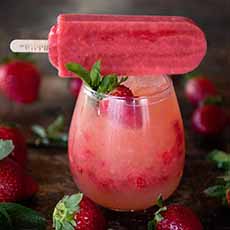
Make a Strawberry Mint Moscow Mule with fresh strawberries and mint, and combine it with a strawberry ice pop (photo #7). Use the pop as a stirrer and as a bite between sips.
Ingredients Per Drink
4 strawberries, stems removed and cut in half
2-3 sprigs fresh mint
2 ounces vodka
1/2 lime, juiced
5 ounces ginger beer
3-4 ice cubes
Optional garnish: whole strawberry
|
|
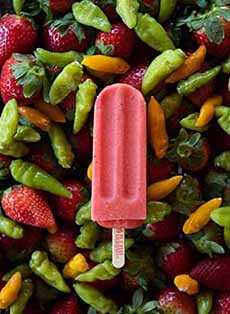
[1] Most of the pops are dual flavors. Here, strawberry is combined with datil, a very hot chile pepper grown in the St. Augustine area. The freshest fruits are a collaboration with local farms (all photo © The Hyppo).

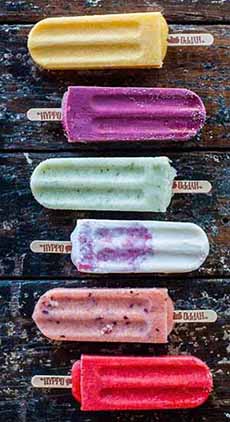
[2] There are more than 500 wonderful flavors. Here are half of them.
[3] Fall is coming. Look out for Pumpkin Cheesecake, Pumpkin Pie, or Pumpkin Stout pops.
[4] In The Hyppo stores, customers can have their pops dipped in chocolate. You can do it at home. Here’s how to do it at home.
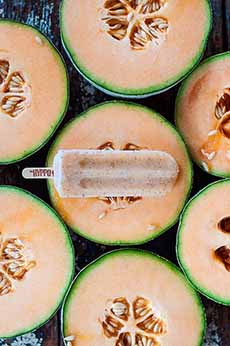
[5] An example of clever flavor combinations: cantaloupe and black pepper.
[6] A trio of flavors: Blueberry Lavender Lemonade.
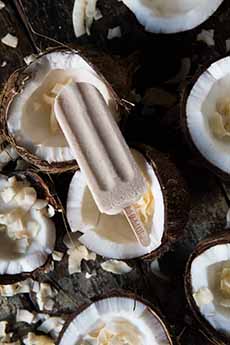
[7] Toasted Coconut.
[8] Use the pops to make “poptails,” dipping them in a cocktail. See the recipe at the left.
|