|

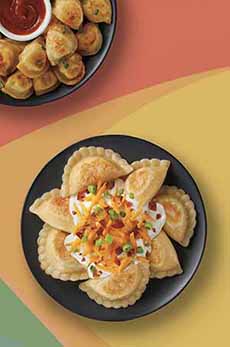
[1] Fully Loaded perogies with fully loaded toppings: sour cream, bacon, chives (all photos © Holy Perogy!).
[2] Fried pierogies on the snack tabled, along with dips and other snacks. It’s to serve them with sour cream, but you can substitute guacamole, Greek yogurt, salsa, or another dip.
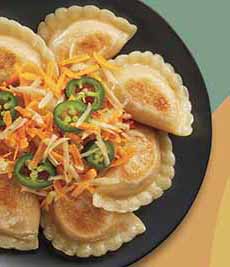
[3] Mexican-Ukranian fusion: Kickin’ Jalapeño perogies garnished with more jalapeño and shredded cheese.
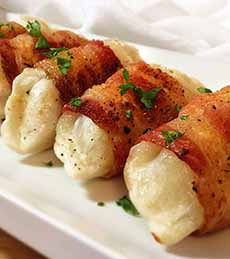
[4] Perogies wrapped in bacon.
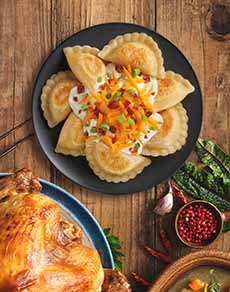
[5] You can serve perogi as a side with any main course (here, a roast chicken).
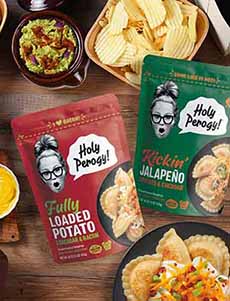
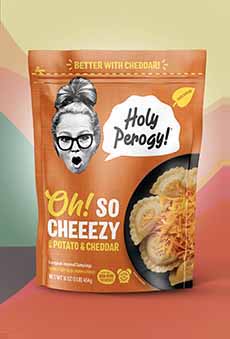
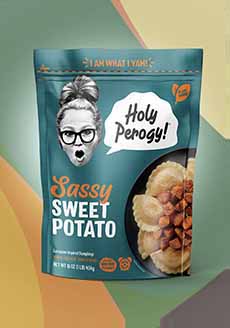
[6] The fun starts with the packaging.
[7] Finally, sweet potato perogi.
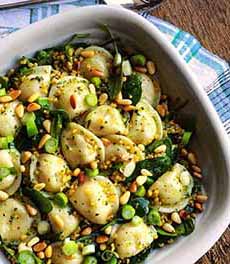
[8] Garnish your perogi with anything you like. Here, perogi are topped with bulgur wheat, spinach, chives, pine nuts, and melted butter . |
|
October 8th is National Pierogi Day, and our Top Pick Of The Week is Holy Perogy!, a line of premium frozen perogies. Why perogy, and not pierogi, you may ask?
It’s the difference between Polish and Ukrainian spellings.
The family behind Holy Perogy! immigrated to Canada from Ukraine in 1991 and decided to use the “perogy” for singular and “perogies” for plural.
Even though this spelling is less used in the U.S., they felt that it better reflected a proper English translation from the Ukrainian word pyrohy. (In Polish, the words are pieróg [singular] and pierógi [plural]. Pierogies with the added “es” on the end is an Americanization.)
Americans are used to the pierogi spelling because Polish immigrants originally introduced them to the U.S. with that spelling.
Canadians are accustomed to the spelling perogy because the dumplings were introduced there mainly by Ukrainian immigrants.
There’s more about this in the History Of Pierogies, below.
But spell it however you wish: Just treat yourself to the delicious perogy/pieróg experience it is!
HOLY PEROGI! DUMPLINGS & BITES
What sets Holy Perogy! apart is both the way the pierogies are made and the premium ingredients that are used.
Some pierogi brands are pre-cooked, which makes them doughy and rubbery when you heat them. Fillings are made with processed potato flakes and cheese powder rather than whole potatoes and cheese.
At Holy Perogy! the old family recipe specifies thin dough, packed with freshly-cooked mashed potatoes and other whole food ingredients.
The perogies are frozen uncooked in a resealable standup pouch (photos #2, #6, and #7) that maintains freshness in the freezer.
The two step process for preparing them at home takes minutes and results in authentic flavor and texture every time. You can taste the difference.
Each of the Holy Perogy! flavors is sure to be a crowd pleaser, including:
Kickin’ Jalapeño with Potato & Cheddar
Fully Loaded Potato with Cheddar & Bacon
Oh! So Cheesy with Potato & Cheddar
Sizzlin’ Fried Onion with Potato
Sweet Potato
Wild Mushroom
For those who want to serve perogies in smaller bites (see the comparison in photo #1), there are:
Cheeky Chicken Bites
Poppin’ Cheddar Bites
Whether standard size or bites, these perogies are comfort food for any occasion.
Serve them as an appetizer, main course, or snack. They’re great with a beer or a glass of wine.
Holy Perogy! can be found in the freezer aisle of a food market near you.
For more information, visit HolyPerogi.info.
PIEROGI / PEROGY HISTORY
For this history, we’re going to use the Polish spelling that’s more common in the U.S.
The history of pierogi can be traced all around China and Europe.
Food historians usually accept the fact that Marco Polo encountered stuffed dumplings while in China (think of Chinese potstickers), and brought the concept back to Italy when he returned from his 17-year voyage in 1295.
The concept he shared became ravioli, tortellini, and other stuffed pasta. (The history of pasta.)
A prototype of pierogi could have easily have come from China over another route, too.
One theory is that the Tatars brought the recipe from Russia to the rest of Eastern Europe.
There doesn’t have to be a single solution. But food historians do conclude that pierogies are descendants of the Asian dumplings.
The half-moon pierogi are made from unleavened dough that is stuffed with different fillings:
Cabbage, cheese, ground meat, mashed potatoes, mushrooms, sauerkraut, spinach, and grains or legumes (like lentils) are classics.
More modern fillings include blueberries and other fruits (how about smoked cheese and cranberries for Thanksgiving?), bison, duck confit, pulled pork, and sweet potatoes, among others.
Beyond dessert pierogi, fusion food pierogi are fun food. Think chili con carne pierogies and jerk chicken pierogies.
They are usually boiled, then fried in butter and served with sour cream or more butter. Caramelized onions are also classic, and in modern times, crumbled bacon, Greek yogurt, jalapeño, and shredded Cheddar cheese.
Look in the fridge. Do you have capers? Fresh herbs? Olives? Anything goes as a garnish for your pierogi (photo #8)!
Although identified as Polish cuisine in the U.S., claims of pierogi origins have also been made by Lithuanians, Romanians, Russians, Slovaks, and Ukrainians.
With the borders of the region shifting regularly over the centuries, it is possible that there may be multiple claims of “ownership” [source].
While it is believed that pierogi have been made in Poland since the 13th century, the word “pierogi” first appeared in Polish cookbooks and literature in the late 17th century. Pierogi is Poland’s national dish [source].
The first written pierogi recipe comes from the Compendium Ferculorum, a book published in 1682 by the renowned cook Stanisław Czerniecki. These pierogi were not filled with potatoes (which were not common in 17th-century Poland), but with chopped kidneys, veal fat, greens, and nutmeg [source].
The Polish word pierogi, which is the plural form of pieróg, is a generic term for filled dumplings. It derives from Old East Slavic pirŭ, and before that from Proto-Slavic *pirъ, meaning a feast.
In most of the Slavic languages, the word means “pie” [source].
Pierogi Legends
Pierogi has its own patron saint: Hyacinth of Poland, a Polish Dominican priest and missionary.
Some believe that he brought pierogi to Poland from Kievan Rus’, a state that existed in Eastern and Northern Europe from the late 9th to the mid-13th century [source]. (It is now part of Ukraine.)
Now for the legends:
In 1238, when Saint Hyacinth visited Kościelec, in the Gąsienicowa Valley of Poland, a storm came and destroyed all the crops.
Hyacinth told everyone to pray and the next day the crops had risen back up.
As a sign of gratitude for Hyacinth, people have been making pierogi from the crops ever since.
Another legend involving Hyacinth dates to 1241. When the invasion of the Tatars led to famine, Saint Hyacinth fed the people with pierogi. (Who made the pierogi is not specified.)
Pierogi Come To America
Pierogies came to America with immigrants and were served at home and in neighborhood restaurants.
The first documented sale of pierogi in the U.S. was in May 1928.
In the post-World War II era, pierogi became a staple of fundraisers by ethnic churches.
By the 1960s pierogi became a common frozen supermarket item in many parts of the U.S. and Canada [source].
And today: fusion pierogi with jalapeño, fully loaded pierogi with baked potato toppings, and so much more. A feast indeed!
|