THE NIBBLE BLOG: Products, Recipes & Trends In Specialty Foods


Also visit our main website, TheNibble.com.

PRODUCT: Chobani Bites, 100 Calorie Snack Or Dessert

As if Greek yogurt weren’t trending enough, companies like Chobani are upping the ante with tempting new variations on the theme.

The most recent is Chobani Bites, 3.5-ounce, 100-calorie yogurt cups that are perfect snacks or low-calorie desserts. Competitor Yoplait has launched Greek 100, the same concept in more conventional flavors (Lemon, Mixed Berry, Strawberry, etc.)

Sold in four-packs for $2.99, the initial flavors of Chobani Bites include:

  • Caramel With Pineapple
  • Coffee With Dark Chocolate Chips
  • Fig With Orange Zest
  • Raspberry With Dark Chocolate Chips
  •  
    All of the flavors are complex, elegant and luscious. We’re so enamored of the Raspberry With Dark Chocolate Chips that it has begun to replace our much-less-good-for-you dessert choices.

     
    Four yummy flavors, 100 calories each. Photo by Elvira Kalviste | THE NIBBLE.
     
    This is a guilt-free snack: Each all-natural serving contains eight grams of protein, which help keep hunger pangs at bay. We love it!

    DO YOU KNOW YOUR YOGURT?
    Check out our Yogurt Glossary, which features all the different types of yogurt. There’s a lot to discover!
      

    Comments off

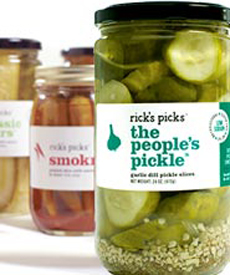
    TIP OF THE DAY: Pickle Vinaigrette


    Save that brine: It makes great vinaigrette.
    Photo courtesy Rick’s Picks.
      Here’s another condiment tip from chef Johnny Gnall:

    PICKLING BRINE + OIL = VINAIGRETTE

    It couldn’t be simpler: The next time you finish a jar of your favorite pickled treat, be it jalapeños, pepperoncinis or good, old-fashioned dill pickles, save the brine for vinaigrettes.

  • Depending on how much flavoring inclusions it contains (peppercorns, garlic cloves and so forth) you may want to strain the brine. Or you may like the rustic texture and the flavor they impart, in which case, keep them.
  • Then, substitute the brine for everyday vinegar and make a salad dressing with a unique and pleasing punch. Standard vinaigrette proportion: 1 tablespoon vinegar or other acid and three tablespoons oil.
  • Bear in mind, you may find more flavorful results with brines from smaller, more artisan brands. Typical supermarket brands use brines that are overly salty and lack the complexity of fresh herbs, peppercorns and other seasonings. I will say, however, that there is nothing wrong with a Vlasic vinaigrette.
  •  

  • Regardless of which you use, taste and/or season your vinaigrette dutifully as you make it: Different brands will have significantly different amounts of salt and pepper. Don’t be afraid to throw in a spoonful of honey, sugar or other sweetener to soften a particularly strong bite.
  •  
    MORE USES FOR PICKLE BRINE

    Here are five more ways to use pickle brine from our favorite artisan pickle-maker, Rick’s Picks.
    MORE CONDIMENT TIPS FROM CHEF JOHNNY
    Chef Johnny Gnall shows how easy it is to combine two ordinary condiments into a “gourmet” condiment.

  • Gourmet Condiments, Part 1
  • Gourmet Condiments, Part 2
  •  

    MORE OF OUR FAVORITE CONDIMENTS & CONDIMENT RECIPES


    Comments off

    FOOD HOLIDAY: Make Peanut Clusters For National Peanut Cluster Day

    March 8th is National Peanut Cluster Day. There is no documentation on the first appearance of the peanut cluster, but we know a few things, and below the peanut cluster history is an easy recipe to make your own. You’ll be delighted to bite into one with a cup of coffee, bring some as a hostess gift, or dig into your stash when you have a chocolate attack.

    Below:

    > Make your own peanut clusters with this super-easy recipe.

    > The history of peanut clusters.

    Elsewhere on The Nibble:

    > The history of peanuts.

    > The year’s 7 peanut holidays.

    > The year’s 60+ candy holidays.

    > The year’s 69 chocolate holidays.
     
    Chocolate Peanut Clusters
    [7] Don’t like peanuts? Substitute almonds or other favorite nut (photo domain no longer available ).
     
     
    RECIPE: EASY PEANUT CLUSTERS

    Aside from a fun time, what we like best about making peanut clusters is the ability to use three different types of chocolate. We split a double batch into dark, milk, and white chocolate.

    This recipe (photo #1) was adapted from one submitted to Taste Of Home by Joy Dulaney of Highland Village, Texas. The total prep time is less than 30 minutes.

    The original recipe called for confectionery coating*—a cheaper alternative to chocolate that became popular because it’s mace in so many different colors. But it isn’t real chocolate: It’s made with vegetable oil instead of cocoa butter, and if you have a palate you’ll notice the difference.

    You’ll get much better flavor from using a quality chocolate couverture (we used Guittard). You can also use real chocolate chips.

    You can use dark, milk, or white chocolate, or split the recipe in half or thirds and make some of each.

    The recipe also uses toffee bits, an easier recipe than making caramel peanut clusters. However, if you have caramels on hand, you can chop up an equivalent amount to substitute for the toffee bits. We took that route, and preferred the chewiness of the caramel.

    If you don’t want peanuts, use any nut(s) you like. You can also add dried fruits: cranberries, raisins, etc.

    Two of our favorite homemade nut clusters ares white chocolate with pistachios and dried cranberries, and dark chocolate with pecans and dried cherries.

    Ingredients

  • 1-1/2 pounds quality chocolate, coarsely chopped
  • 1 jar (16 ounces) dry roasted peanuts
  • 8 ounces toffee bits or chopped caramels
  • Optional garnish: coarse sea salt
  •  
    Preparation

    1. MELT chocolate in a double boiler or in a microwave-safe dish. Stir until smooth.

    2. STIR in peanuts and toffee bits. Drop by rounded tablespoonfuls onto waxed paper-lined baking sheets. If desired, garnish with sea salt. Let stand until set.

    3. Store in an airtight container. Yield: 5 dozen clusters.
     
    Variations

    You can substitute the toffee/caramel bits for more nutritious inclusions, or divide the eight ounces into equal portions of toffee/caramel and the following::

  • Dried fruit: Add raisins, dried cherries, blueberries or other favorite. We particularly enjoyed diced dried apricots.
  • Nuts: Add another type of nut, such as a peanut-almond mix. Or, if you don’t crave peanuts, substitute them completely.
  • Seeds: Seeds are as nutritious as nuts; some varieties even more so. Toss in some flax seeds, pepitas (shelled pumpkin seeds), or sesame seeds.
  • Spices: Make Mexican chocolate peanut clusters by adding a teaspoon of cinnamon and some chili heat.
  •  
     
    THE HISTORY OF PEANUT CLUSTERS

  • Peanuts. Peanuts, which originated in South America, were brought to West Africa by Portuguese and Spanish traders. Peanuts became a staple crop for West Africans, and came to the Southern U.S. with the slave trade around the late 1600s.
  • Chocolate. After some 3,300 years as a beverage, the first solid chocolate began to appear in Europe around 1840.
  • Chocolate With Fruits & Nuts. The first pressed chocolate tablets, pastilles, and figures were produced in Belgium. The chocolate was also used by confectioners to enrobe nuts and fruits. See our history of chocolate timeline.
  •  


    [1] Easy homemade peanut clusters. The recipe is below (photo © Taste Of Home).


    [2] Don’t want to make your own? Buy these from Harry & David (photo © Harry & David).


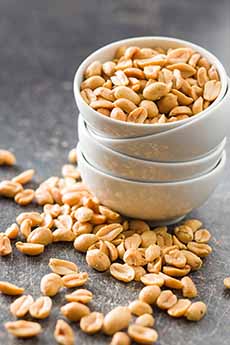
    [3] Peanuts (photo © The Nibble).


    [4] We chopped some caramels into our nut clusters (photo © Hammonds Candies).

    White Chocolate Dried Fruit & Nut Clusters
    [5] Fancy nut clusters: four different dried fruits plus almonds. Here’s the recipe (photo © Punchfork).

    Nut Clusters With Sprinkles
    [6] For a special occasion—holiday, game day, baby shower, whatever—add a garnish of theme-related sprinkles. This is a crockpot recipe (photo © She’s Not Cookin’

  • Peanut Clusters. We can deduce that sometime after that, American confectioners began to make similar confections, including enrobed peanut clusters. Previously peanut clusters without a chocolate coating were held together with caramel or honey.
  • Automation. Jumping ahead to the 1930s, American inventor Elmo Lanzi patented a Chocolate Peanut Cluster Dipping Machine, automating the slow process of hand-enrobing. “Think of turning out 450 pounds of luscious, attractive Chocolate Peanut Clusters,” the advertisement trumpets.
  • Turtles. One confectioner substituted pecans for peanuts in a caramel-nut confection and added four pecan halves as “feet” to the bottom of the oval-shaped candy. These became known as “turtles.”
  •  
    A Plate Of Chocolate Nut Clusters
    [8] These nut clusters have a garnish of mini chocolate shavings (photo © Lake Champlain Chocolates).
     
    _______________

    *Confectionery coating, also called compound coating and decorator’s chocolate, is a chocolate-type product that substitutes vegetable oil for all or part of the cocoa butter. Along with sugar and cocoa powder, traditional chocolate production techniques are used to create a less expensive coating that does not require tempering, melts easily, and hardens quickly. In milk chocolate-flavored coatings, whey powders, whey derivatives, and dairy blends can be used instead of powdered milk. Products made with confectionary coating must be designated “chocolate-flavored,” to indicate that they are not “real” chocolate.
     

    CHECK OUT WHAT’S HAPPENING ON OUR HOME PAGE, THENIBBLE.COM.


    Comments off

    EVENT: Coffee Cup Tasters Challenge

    How well do you know your coffee?

    Counter Culture Coffee wants you to get to know it better. You’re invited to take part in The Counter Culture Coffee Cup Tasters Challenge 2013, held on March 15 in:

  • Asheville
  • Atlanta
  • Boston
  • Chicago
  • Durham
  • New York
  • Philadelphia
  • Washington, D.C.
  •  
    Events in all regions start at 7 p.m. E.T., 6 p.m. C.T. in Chicago.

     
    Taste the coffee black to discover the differences. Photo courtesy Derby Pie.
     

    Known in the industry as “coffee cupping,” this is the process professionals use to assess different coffees—for example, to decide if and how to improve the roast or blend, or which beans should be served/sold by the establishment.

    The Counter Culture event, though, is a consumer contest for a regional title win. The overall winner gets a chance to go to the Specialty Coffee Association of America conference in Boston this April, to compete in the U.S. Cup Tasters Championship.

    For a $5.00 entry fee, participants get to taste delicious coffees: multiple sets (flights) of three cups each. To win, you’ve got to correctly identify which cup is different from the other two in each set.

    Ready to put your palate to the test? Registration information is at CounterCultureCoffee.com.


    Comments off

    French Onion Soup Fondue Recipe, A “Neighborly” Fusion Food

    [1] Voilà: a fusion of French onion soup and fondue (photo courtesy QVC).

    A Bowl Of French Onion Soup
    [2] French onion soup means a thick topping of Gruyère cheese (photo © Taste Of Home).

    A Pot Of Cheese Fondue
    [3] Fondue, on the other hand, is all cheese (photo © iGourmet).


    We love fusion cuisine—the art of combining ingredients or techniques from different cuisines to create exciting new flavors.

    Fusion cuisine typically combines foods from different countries or global regions (Japanese-Mediterranean, for example, or barbecue chicken pizza). But is it still a fusion when we combine two iconic dishes from neighboring countries?

    Here we have a fusion of French onion soup with cheese fondue, which originated in Switzerland. It’s more of a neighborly fusion than a combination of ingredients from different parts of the world. But cheese lovers won’t quibble over semantics.

    Who would have thought to fuse two dishes famous for luscious melted cheese?

    The answer is: chef David Venable of QVC.

    We think of this recipe as part of a romantic dinner or a weekend family special. But it’s crazy snowing here today, so we’re about to chop the onions and grate the cheese.

    The recipe uses everyday ingredients and is easy to follow. It takes mere minutes to prep. A quick timing tip from Chef Venable: Pop your second course in the oven before you sit down for the onion soup fondue.
     
     
    FRENCH ONION SOUP FONDUE RECIPE

    Ingredients

  • 2 tablespoons cooking oil
  • 2 large onions, diced
  • 1/2 pound Swiss cheese, grated
  • 1/2 pound Gruyére cheese, grated
  • 2 tablespoons flour
  • 3/4 cup beef broth
  • 1/4 cup cooking sherry
  • 1/2 tablespoons concentrated beef broth
  • Pinch of nutmeg
  •  
    Preparation

    1. POUR the oil into a medium-size sauté pan set to medium heat. Sauté the onions, tossing frequently, until brown and caramelized, about 15-20 minutes. Set aside.

    2. TOSS the cheeses with the flour in a medium-size mixing bowl until evenly coated; set aside.

    3. COMBINE the beef broth, cooking sherry and concentrated beef broth in a medium sauce pot over medium-low heat. Bring to a slight simmer. Whisk the cheese into the mixture in four batches, waiting between each addition for the cheese to melt. Don’t let the mixture come to a boil. When the final batch has melted completely, remove the pot from the heat and stir in the caramelized onions.

    4. TRANSFER the mixture to a fondue pot and sprinkle the nutmeg on top. Serve with French bread, or blanched asparagus spears, potatoes, broccoli, or cauliflower.

    Find more of Chef Venable’s recipes at QVC.com.

     
    MORE FONDUE FUN

  • The History Of Fondue
  • Classic Cheese Fondue Recipe
  • 18 Flavored Cheese Fondues
  • Fondue Dippers & Garnishes: Far Beyond Bread
  •  
     

    CHECK OUT WHAT’S HAPPENING ON OUR HOME PAGE, THENIBBLE.COM.


    Comments off

    The Nibble Webzine Of Food Adventures
    RSS
    Follow by Email


    © Copyright 2005-2026 Lifestyle Direct, Inc. All rights reserved. All images are copyrighted to their respective owners.