THE NIBBLE BLOG: Products, Recipes & Trends In Specialty Foods


Also visit our main website, TheNibble.com.

TIP OF THE DAY: Truffle Fries


Irresistible truffle fries. Photo courtesy Arch
Rock Fish Restaurant | Santa Barbara.

  There’s a neighborhood restaurant in New York City where steamed mussels are served in 20 different types of broth. Much as we’d like to work our way down the menu, we can never stop ordering our favorite: Thai mussels in a curry coconut broth flavored with lemongrass, kaffir lime, coriander, lime, ginger and garlic.

But the feast doesn’t end there: The must-haves along with this bowl of heaven include a fine craft IPA beer and a cone of truffle fries.

Ah, the truffle fries: so simple, so divine. So today’s tip is: Turn your French fries into truffle fries. All you need is some truffle oil.

The regular hand-cut fries at that restaurant are $6; with a sprinkle of truffle oil and Parmesan cheese the price almost doubles, to $11. At home: less than $1 per serving.

The following recipe is courtesy of a restaurant on the opposite coast: Arch Rock Fish in Santa Barbara, California, and its chef, Scott Leibfried.


TRUFFLE FRIES RECIPE

Ingredients

  • 4 Idaho or russet potatoes
  • 1 tablespoon black truffle oil or white truffle oil
  • Peanut oil for frying
  • 1/2 teaspoon salt
  • Fresh parsley, finely chopped
  • Optional: grated Parmesan cheese
  •  
    Preparation

    1. CUT potatoes lengthwise into thin strips, about ¼ inch wide. Fry the potatoes in peanut oil until golden brown (see tips below).

    2. SEASON with salt and truffle oil.

    3. TOSS with parsley.


    POTATO-FRYING TECHNIQUE

    We actually used our Actifry for this recipe—it requires only one tablespoon of frying oil! But for making French fries the old-fashioned way:

    1. SOAK the potatoes in ice water for an hour, drain, and pat completely dry between paper towels. You can skip this step, but it makes the fries crisper.

    2. PREPARE surface for draining by lining two baking sheets or large plates with paper towels.

    3. SELECT a large, deep pot and attach a candy thermometer with clip (the tip of the thermometer must not touch the bottom of the pot). Fill with 3 inches of peanut oil and heat over medium heat until temperature reaches 325°F.

    4. FRY potatoes (in batches) for 2-3 minutes until golden, stirring occasionally. Remove to paper towels to drain. and heat the oil to 375°F.

    6. RE-FRY potatoes For extra crispiness. Raise the temperature of the oil to 365°F and refry potatoes for 1-1/2 to 2 minutes per batch. Drain on fresh paper towels.

     
    Black truffle oil from La Tourangelle. Photo by Katharine Pollak | THE NIBBLE.
     
    7. TRANSFER fries to serving dish. Sprinkle with salt, toss with truffle oil, garnish with parsley and serve.
     
    OTHER USES FOR TRUFFLE OIL

    Now that you own a bottle, don’t let it languish on the shelf. Use it up while the truffle flavor and aroma are strong. But don’t heat it: Heat dissipates both flavor and aroma. Drizzle truffle oil on foods or otherwise add to:

  • Carpaccio or sashimi (with shaved Parmesan cheese)
  • Finishing oil on duck breast, filet mignon, grilled fish, lamb
  • Homemade potato chips (recipe)
  • Pasta and risotto (substitute all or part of the olive oil)
  • Popcorn (also add grated Parmesan cheese)
  • Macaroni and cheese (a favorite!)
  • Mashed potatoes (a favorite!)
  • Mushroom pizza
  • Mushroom soup (garnish)
  • Roasted or grilled vegetables
  • Sautéed mushrooms
  • Scrambled eggs
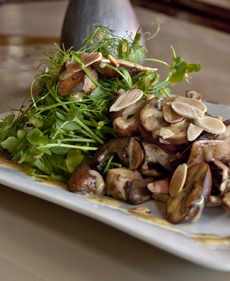
  • Vinaigrette for a sliced mushroom salad with arugula and shaved fennel
  •  
    ALL ABOUT TRUFFLES

    Here’s everything you need to know about truffles: the types of truffles, how to buy, store and cook truffles, and much more.
     
    HOW MANY TYPES OF POTATOES HAVE YOU HAD?

    Check out our Potato Glossary: the history of the potato and the different types of potatoes.
      

    Comments off

    PRODUCT: Lucky Spoon Gluten Free Cookies

    A stack of gluten-free chocolate chip cookies.
    Photo by Elvira Kalviste | THE NIBBLE.

      Gluten-free artisan bakeries typically pop up when a family member has gluten intolerance. In this case, its husband and co-founder of Lucky Spoon Bakery in Salt Lake City, Jim Schulte.

    Both Jim and wife Pam have MBAs and years of business experience; but Pam also had serious baking skills. So she set out to re-invent gluten-free cookies and muffins that were every bit as tasty as their fully glutenized counterparts.

    Lucky Spoon Bakery has succeeded in changing the way people think about gluten-free baked goods. The products are moist, fresh and delicious.

    “Gluten-free has always been code for ’taste-free’ or ‘you can eat it but you probably won’t like it,’” says Jim. But, as has been proved by other artisan bakers of gluten-free goods, if you spend enough time, money (on the best ingredients) and love, you can produce bread, cakes, cookies, muffins and other products that everybody loves to eat.

     
    To us, the compliment we bestow is, “No one would know it’s gluten free.”


    Gluten-Free Cookies

    Instead of wheat flour, the cookies are made with a blend of white rice flour, potato flour and almond meal; plus sugar, butter, eggs, quality chocolate or peanut butter, vanilla and other ingredients of good cookies.

  • Chocolaty Chip Cookies
  • Perfect Peanut Butter Cookies
  • Peanut Butter Chocolaty Chip Cookies
  • Simply Sugar Cookies
  •  
    Gluten-Free Muffins

    ?White rice flour and potato flour instead of wheat flour. As with the cookies, sugar, eggs, butter and quality flavorings combine to make moist, tasty muffins:

  • Cinnamony Streusel Muffins
  • Lemonlicious Muffins
  • Totally Maple Pecan Muffins
  • Utterly Almond Muffins
  •  
    Lucky Spoon Bakery is a find for the gluten-free nibbler.Photo by Elvira Kalviste | THE NIBBLE.
     

    To find Lucky Spoon products, check the store locator on the company website.
      

    Comments off

    TIP OF THE DAY: Chocolate Whipped Cream


    Chocolate whipped cream is a delicious
    change of pace. Photo courtesy
    VillageInn.com.
     

    Today’s tip is for chocolate lovers: Make chocolate whipped cream. It takes an extra step, but the novelty—and the delectable flavor—are worth it.

    Use chocolate whipped cream to garnish a cake or pie, frost a cake or cupcakes or use as a filling for cream puffs and other pastry. Top other desserts, hot chocolate or coffee.

    This recipe can be made up to 2 days in advance and kept, tightly covered, in the refrigerator. The recipe makes about 1-1/2 cups of whipped cream.

    CHOCOLATE WHIPPED CREAM RECIPE

    Ingredients

  • 4 ounces bittersweet chocolate, chopped
  • 1 cup whipping cream
  • 2 tablespoons confectioners’sugar
  •  
    Preparation

    1. PLACE chopped chocolate in a medium bowl.

    2. COMBINE cream and sugar in a small saucepan. Bring to a boil over medium heat

    3. POUR boiling cream over the chocolate; stir until smooth and the chocolate is melted. Cover and refrigerate for 4 hours, until thoroughly chilled.

    4. TRANSFER to a large bowl. Beat until the mixture develops soft peaks, or to the desired consistency for spreading or filling. Refrigerate for at least 1 hour before using.
     
    MORE FLAVORED WHIPPED CREAM RECIPES

    Try these flavored whipped cream recipes, including Bourbon Whipped Cream, Five Spice Whipped Cream, Lavender Whipped Cream, Holiday Spice Whipped Cream, Salted Caramel Whipped Cream and Savory Whipped Cream.


    Comments off

    FOCUS: So You Want To Be A Food Writer?

    This week we received an email from a young food blogger, who asked about writing opportunities at THE NIBBLE. She wanted to “gain industry experience.” We get frequent inquiries of this nature from people of all ages. Here’s our advice.

    There are limited career opportunities in food writing. If by “career” you mean an occupation with an income that can support you, the continued demise of magazines and newspapers has resulted in fewer and fewer full-time writing and editing jobs. The outlook is not good.

    There always have been many more people aspiring to earn a living as a writer, than there have been positions for them. Now, full-time jobs are drying up. Freelance writing is hard to get; the good jobs rely on connections, and even those pay less and less as the publishing industry profits erode. Many people think they can “pay their dues” by writing for a pittance, or even for free, and subsequently turn that experience into more profitable assignments. Those “dues” will rarely turn into properly paid work. We have colleagues who are highly respected and connected freelancers, with 20 years of experience; they are still offered a few hundred dollars for a large amount of work.

     
    Writing can be very satisfying, but it’s usually far from lucrative. Photo by C. Unie | SXC.
     
    The people we know who blog for different sites get $5 to $10 a blog post, whether it be restaurant reviews, product reviews, recipes or other types of food writing. Like pursuit of the creative arts (acting, music, painting, etc.), pursue the art you love but have a “day job” to pay the bills.

    That‘a the down side, the reality of the business. But if you want to give it your best shot, here’s what we suggest:

    Have a blog and expand it. If you already have readers, ask them what they’d like to see. Every time you research new content, you add to your professional expertise. Consider interviewing bakers, pastry chefs and industry executives for trends and tips. By interviewing people, you make connections that could lead you to other work.

    Ask for ideas and constructive criticism. Speak with people who read other food blogs and ask them for input on yours. Don’t respond directly to criticism; one can’t help but be defensive when one’s work of passion is being judged. Just “take it under advisement” and decide how to address the input.

    Get business cards with the title Food Writer or Freelance Food Writer and the link to your blog. You can do this inexpensively at Moo.com or Vistaprint.com. Every time the topic of food or your occupation comes up, hand out a card. You never know when a connection will be made, if not that day then down the road.

    Join industry associations. Not only will you meet people, but the memberships will strengthen your resume. Go to the meetings of local groups, participate in the message boards, attend conferences. Make friends and hand out those cards. Volunteer for committees, where you get to really know people and they see your skills in action. We think the best committee is the programming or speaker committee. It gives you the opportunity to call leaders in the industry and invite them to speak. You’ll get to introduce yourself to someone who would never take your call under other circumstances.

    Network, network, network. Take a class and/or read books on networking. Learn how to find leads in every encounter with everyone, from your hairdresser to friends’ parents. Then, give your “elevator pitch” to everyone you speak with (You’ll learn what that is).

    Build the skills you need to stand out. The key talent required for success in most fields is not the industry expertise itself, but the business skills: pitching, selling, deal-making. Read books or find a mentor who can help you to build the ability to sell yourself and your ideas.

    Get as close as you can to working in a food related business, in any capacity. It’s by meeting people and getting them to know and like you that other opportunities develop. Even if you had a clerical job at an ingredients manufacturer or a restaurant equipment distributor, for example, you could volunteer to do their blog or social media and build the credentials to move up to a job that focuses on writing. Often, a job that gives you the opportunity to write is not a full-time writing job.

    Get a certificate in food studies. See what‘s available in your area or online. This will seriously differentiate you from other job candidates. Many major media outlets require their entry-level people to have such a certificate, even if they are Phi Beta Kappa graduates of Harvard who edited the school paper.

    DO YOU HAVE ADVICE FOR ASPIRING FOOD WRITERS? ADD IT HERE!


    Comments off

    FOOD FUN: The Most Mispronounced Foods


    It’s broo-SKET-tuh, not broo-SHET-tuh.
    Photo by Vitalina Rybakova | IST.
      When we were young, there was a long-running ad for a self-improvement course that promised to make upwardly-aspirational Americans more cultured. One of the ads had this headline: “I’ll have a cup of expresso, please. And make it black.”

    There is no “expresso,” of course; and it it always black. Take the course, and you’ll never be embarrassed by such errors.

    While this ad began running in the early 20th century, the same mistakes are made today. Eat24.com, an online delivery and takeout service that delivers restaurant food in 950 cities nationwide, pulled together a list of most frequently mispronounced foods; and we’ve added a few.

    Have fun with it, and feel free to submit your own list.

    Beignet: Pronounced ben-YAY, the best of these French-style doughnuts we’ve ever had were at Café du Monde in New Orleans (worth a trip!). Here’s more information and a photo of beignets.

     
    Bruschetta: Pronounced broo-SKET-uh, this grilled bread with choice of toppings is a popular Italian appetizer and snack. Here’s a recipe and the difference between bruschetta and crostini.

    Chipotle: Pronounced chee-POHT-lay, these are dried, smoked jalapeño chiles. For some reason, it’s also misspelled by more than a few of the small producers who send us products. They insist on spelling it (and no doubt, pronouncing it) “chipolte.” These pineapple chipotle ice pops are truly delicious. More about chipotle.


    Crudités: Pronounced croo-dee-TAY (or in English, croo-dee-TAYS—the French don’t pronounce the “s” on the end), this is the French term for raw vegetables served in bite-size pieces with a dip. It’s one of our favorite low-calorie party foods and snacks. Serve it with this tzatziki recipe, made with nonfat Greek yogurt.

    Espresso: Pronounced: es-PRESS-oh. There is no “x.” See the different types of espresso drinks.

    Gnocchi: Pronounced NYAWK-kee. The most famous potato pasta, these small dumplings can be served plain or flavored. Here are tips for making gnocchi, a gnocchi recipe and a sweet potato gnocchi recipe.

    Gyro: Pronounced YEE-row or ZHEER-oh. If you must, say “hero,” but never JI-row or GY-row. Here’s how the hero sandwich got its name.

    Habanero: In Spanish, the pronunciation is ah-va-NEH-ro, but Americans can say hah-bah-NEH-row. That’s an “n,” not an “ñ,” in the center of the word. Here’s more about habanero chiles, the hottest in Latin America.

     
    Gnocchi, pronounced NYAW-kee. Photo by Neco Garnicia | SXC. .
     

    Pho: Pronounced FUH. This complex and luscious Vietnamese soup deserves to be pronounced correctly. Here’s a pho recipe.

    Quinoa: Pronounced KEEN-wah. One of the most nutritious foods on earth, “quinoa” means “mother grain” in the Inca language, Quechua. Serve it as a side instead of rice or potatoes, and try this quinoa tabouli recipe.

    Sriracha: Pronounced shree-RAH-cha, lovers of hot sauce should pick up a bottle. Made from hot red chiles, vinegar, garlic, sugar and salt, the sauce is named after the coastal city of Si Racha on the Sea of Thailand, where it was first produced and served at seafood restaurants. Try it in this Red Curry Shrimp recipe.

    Quesadilla: Pronounced kay-suh-DEE-yuh. Originating in Mexicao, a quesadilla is a flour or corn tortilla filled with a savory mixture containing cheese (queso) and other ingredients, then folded in half to form a half-moon shape. Here’s a ribeye quesadilla recipe from Bobby Flay. Or, try this American fusion peanut butter snack quesadilla.

    Worcestershire Sauce: Pronounce WUS-teh-SHEER. It is believed that a Captain Henry Lewis Edwardes (1788–1866) brought the recipe for the sauce home after travels in India. It is not known how the recipe got to Lea and Perrins, but John Wheeley Lea and William Henry Perrins, two dispensing chemists (pharmacists) in Worcester (pronounced WOO-ster), England, created a recipe that was first sold commercially in 1837. “The Original Lea & Perrins Worcestershire Sauce” is now owned by H.J. Heinz Company.

    DO YOU HAVE OTHER NOMINATIONS? Use the Contact Us link to send them in!


    Comments off

    The Nibble Webzine Of Food Adventures


    © Copyright 2005-2026 Lifestyle Direct, Inc. All rights reserved. All images are copyrighted to their respective owners.