THE NIBBLE BLOG: Products, Recipes & Trends In Specialty Foods


Also visit our main website, TheNibble.com.

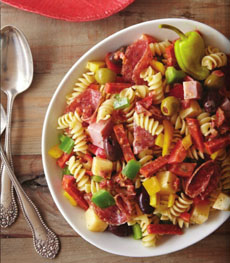
TIP OF THE DAY: Turn Leftover Pasta Into Antipasto Salad

antipasto-salad-melissas-230

For lunch or a light dinner: antipasto salad.
Photo courtesy Melissas.


Turn your leftover pasta into an antipasto salad.

You can boil the pasta from scratch, but whenever we make short cut pasta for a hot dish, we make extra for a cold pasta salad later in the week.

You can customize the recipe with your favorite ingredients, and use up leftover peas and other veggies. With this recipe from Melissa’s The Great Pepper Cookbook, prep time is 30 minutes, total time 50 minutes.

RECIPE: ANTIPASTO SALAD

Ingredients For 12 Servings (1-1/4 Cups)

For The Salad

  • 1 pound fusilli, rotini or other corkscrew pasta
  • 1/2 pound (about 2 cups) cooked ham, cubed
  • 5 ounces smoked mozzarella cheese, cubed
  • 4 ounces (3/4 cup) hard salami, cubed
  • 3 ounces pepperoni (3/4 cup), cut into strips
  • 1/2 cup pitted or stuffed green olives
  • 1/2 cup pitted black olives (Kalamata or Picholine)
  • 1 green bell pepper, diced
  • 1 red bell pepper, diced
  • 1 yellow bell pepper, diced
  • 1 small red onion or sweet onion, very thinly sliced
  • Salt and pepper
  • Optional Garnishes

  • Pickled garlic
  • Pepperoncini pickled peppers
  • Sundried tomatoes, julienned, or fresh tomatoes (wedges or halved cherry tomatoes
  •  


    For The Vinaigrette

  • 1/4 seasoned rice vinegar or wine vinegar
  • 1 tablespoon Dijon mustard
  • 2 teaspoons dried Italian seasoning, crushed
  • 1 sundried tomato, finely diced (about 1
    tablespoon)
  • 1 garlic clove, minced
  • 1/2 cup olive oil or canola oil
  •  

    Preparation

    1. COOK pasta per package directions; drain, rinse with cold water and cool to room temperature.

    2. MAKE the vinaigrette. Combine all ingredients, except for the oil. Drizzle in the oil while whisking, and continue to mix until well combined. Set aside.

    3. COMBINE the pasta with the remaining salad ingredients except optional garnishes; season with salt and pepper to taste. When ready to serve, toss with dressing and top with the garnishes.

    Here’s another antipasto salad recipe with a different set of ingredients.

      OLYMPUS DIGITAL CAMERA
    Be adventurous: Try different shapes like gemelli (juh-MELL-lee, meaning “twins”) instead of the more common fusilli in the photo above. Photo courtesy Barilla.
     

    WHAT IS SHORT CUT PASTA?

    Think of Italian pasta in these general categories:

  • Long Form Or Strand Pasta. This refers to any spaghetti-like that you can twist around your fork. These pastas are made in varying widths, from the thinnest angel hair to the plumpest bucatini. They can be round or flat (see ribbon pasta, next), solid or hollow, like bucatini.
  • Ribbon Pasta. A sub-category of long form pasta. These are the flat cuts: fettuccine, lasagne, linguine and tagliatelle, for example.
  • Short form pasta takes several forms:

  • Tubular Pasta. From tiny to jumbo, smooth or ridged (“rigati”), straight-cut or diagonally cut, this category includes elbows, manicotti, penne and rigatoni are well-known cuts. In this category, the seemingly same size pasta will have a different name if the ends are straight-cut versus diagonally cut—for example, penne, straight tubes cut on the diagonal, versus rigatoni, with square-cut ends.
  • Shaped Pasta. Farfalle (bow ties), fusilli (corkscrews), ruote (wagon wheels) are prominent examples. There are endless ways to twist and curl and shape pasta; hence, the hundreds of regional varieties.
  • Stuffed Pasta. This group includes agnolotti, mezzelune, ravioli, tortellini and “dumpling” pasta like gnocchi.
  •  
    See the different types of pasta in our Pasta Glossary.


    Comments off

    RECIPE: White Gazpacho, The Original Recipe

     
    GAZPACHO HISTORY

    A specialty of Spain and Portugal, gazpacho is a cold raw vegetable peasant soup originating in Andalusia, the southernmost region of Spain. Originally made from old bread, olive oil and garlic, the recipe was in use when the Romans conquered the Iberian Peninsula (218-19 B.C.E.).

    The name is of Arabic origin, and literally means “soaked bread”; the original recipe came from the Arabs who occupied much of Spain from the 8th through the 13th centuries.

    Although gazpacho is traditionally a textured soup—made in the days before food processors—today the term has become generic for any cold vegetable soup. But early on, it was a way for field workers to make lunch from the vegetables at hand, and stale bread was added to the recipes.

    Today, an Andalusian recipe typically includes stale bread, bell pepper, garlic, olive oil, onion, tomato, wine vinegar and salt.

    This “red gazpacho” is a relatively recent addition: The tomato, a new world fruit originally the size of the cherry tomato, was brought back to Europe from the New World by the Spanish conquistadors as a houseplant. It was not eaten until the 1800s*; the first documented tomato sauce recipe in Italy is from 1839.

    There are many variations of gazpacho, depending on local preferences. American recipes tend to leave out the bread, although some may garnish the soup with garlic croutons.

    White gazpacho is made with olive oil, sherry vinegar, bread, garlic and salt, and substitutes green grapes and almonds for the vegetables. We’ve included a white gazpacho recipe, ajoblanco, below.

    Gazpacho is a warm weather dish. In Spain it can be found in any bar or restaurant from May to September.

       
    gazpacho-addsomelife.com

    [1] Tomato-based gazpacho (photo courtesy Add Some Life | Facebook.


    BEYOND IBERIA

    According to Foods From Spain, Empress Eugenia (Eugenie) de Montijo was the first to popularize gazpacho outside of Spain. She insisted on serving it at her wedding banquet when she married Napoleon III in 1853.

    While we don’t know which recipe she requested, it was no doubt one of the many evolutions of the original gazpacho recipe.

    Flash forward to medieval times: Moor invaders (711 C.E.) added almonds to the recipe, giving birth to ajoblanco, the forerunner of modern gazpacho. Before tomatoes, peppers and cucumbers were brought back from the New World, gazpacho was white. (Ajoblanco means white garlic.)

    Spaniards then made that recipe their own by adding grapes, both blended into the soup and as a garnish.

    Over the centuries, gazpacho has evolved in many directions. The blender and food processor have enabled versions with creamy textures. The common ingredients remain olive oil, garlic and salt.

    You can find gazpacho in shades of green, red, white and yellow. You can find it made thickly, with the texture of a dip rather than a soup. The classic gazpacho of Seville is made with tomato, cucumber, garlic, onion, green pepper, bread, salt, a dash of sherry vinegar and olive oil, and is usually seasoned with cumin.
    _________________
    *A member of the Nightshade family of plants, the tomato was deemed poisonous until it was eaten out of desperation during a famine in the early 1800s in Italy. The original tomato was the cherry tomato, which made an attractive house plant. History of the tomato.


    ajoblanco-almond-garlic-foodsfromspain-230
    Ajoblanco, white gazpacho (photo © Foods From Spain).


    RECIPE: AJOBLANCO, COLD ALMOND & GARLIC SOUP

    In this recipe from Foods From Spain, prep time is 20-30 minutes, plus chilling time. For a wine pairing, consider a dry white Muscatel from Spain.

    Ingredients For 4 Servings

  • 4 garlic cloves, peeled
  • Pepper and salt to taste
  • 7 ounces/.875 cup almonds, peeled
  • 7 ounces/.875 cup white breadcrumbs
  • 1 cup extra virgin olive oil
  • 4-1/4 cups water
  • 3 tablespoons wine vinegar
  • 7 ounces/.875 cup white grapes
  • Garnish: 2-3 green grapes per person
  •  
    Preparation

    1. CRUSH the garlic cloves with the pepper and salt, preferably with a mortar and pestle (you can use a processor).

    2. SOAK the breadcrumbs in water, then drain and add with the almonds to the garlic mixture.

    3. CONTINUE to crush (or grind) as you gradually pour in the olive oil, working the mixture until it is is fluid and smooth. Gradually add the water until you achieve the desired density.

    4. ADD the vinegar and any extra salt if necessary. Chill in the refrigerator until ready to serve.
     
     
    MORE GAZPACHO RECIPES

  • Avocado Gazpacho Recipe
  • Melon Gazpacho Recipe
  • White Gazpacho With Grapes & Sour Cream Recipe
  • Yellow Bell Pepper Gazpacho Recipe
  •  
    Plus:

  • Gazpacho Sandwich Recipe—serve it with the soup!
  •   

    Comments off

    National Zucchini Day Recipes: Spiral Zucchini ‘Green Papaya’ Salad & Zucchini Pasta

    Whether served raw, roasted, baked, grilled, sautéed, pickled, or fried, zucchini is one of the most versatile vegetables and a seasonal summer favorite that’s abundantly available at farm stands and supermarkets.

    This summer squash is very low in calories—33 calories for a medium zucchini.

    There are many wonderful ways to serve zucchini:

  • Garnishes
  • Gratin
  • Grilled
  • Soufflé
  • Stir-fried zucchini ribbons
  • Zucchini and carrot slaw, “cole slaw” or salad
  • Zucchini pasta
  • Zucchini sticks, baked or fried
  •  
    Two of our favorite recipes are below. To make them, treat yourself to the new Microplane Spiral Cutter, a tool that quickly and effortlessly transforms zucchini—as well as carrots, cucumbers, radishes and other vegetables—into elegant spiral cuts and ribbons.


    sprial-grater-microplane-beauty-230L

    [1] Food fun with the new Microplane Spiral Cutter (photo © Microplane).

     
    Thanks to Microplane for announcing this gadget in time for National Zucchini Day, August 8th.

    Resembling an old-school manual pencil sharpener in both style and function, the Spiral Cutter has two razor-sharp (surgical steel!) slicing barrels to accommodate different vegetables—the small barrel for long, slim vegetables such as carrots, the large barrel for cucumbers, summer squash and other, broader vegetables.

    It debuts this month in Black and Green for a suggested retail of $14.95. Learn more at Microplane.com.

    Then, you’ll be set to whip up this delicious salad:
     
     
    RECIPE #1: SPIRAL ZUCCHINI RECIPE # 1: THAI-STYLE ZUCCHINI RIBBON SALAD (BASED ON SOM TUM, THAI GREEN PAPAYA SALAD)

    We love green papaya salad, som tum. We can easily eat two appetizer portions at our local Thai restaurant.

    Our favorite guest blogger, Hannah Kaminsky, agrees. “Served chilled, the tender yet crisp strands of unripe papaya are cooling, yet still popping with bursts of heat from abundant flecks of chili peppers. Brightly acidic, tangy, and slightly salty, with just a touch of sweetness to take the edge off, every component must be in perfect balance to achieve a successful, harmonious dish.

    “Of course, the key ingredient, green papaya, isn’t typically available in hometown grocery stores, which is why I took a page from the ever-popular zucchini noodles. They don’t stay crisp as long as papaya, so be sure to leave them undressed until the minute you’re ready to serve.

    If you can find green papaya, great. If not, substitute zucchini noodles. Or how about making both?


    thai-zucchini-salad-kaminsky-230
    [2] Zucchini Thai-style salad: zucchini replaces green papaya in the classic som tum recipe (photo © Hannah Kaminsky | Bittersweet Blog).
      “Even without the papaya, this recipe transports me to a delicious new world of flavor with every single bite.

    “The dish comes together very quickly, so prep all of your vegetables first, and you’ll zip right through the rest of the preparation.”

    Ingredients For 2-4 Servings

  • 1/4 cup lime juice
  • 2 tablespoons coconut sugar or dark brown sugar, firmly packed
  • 2 tablespoons fish sauce
  • 1 teaspoon soy sauce
  • 1 clove garlic, minced
  • 3-4 ounces (a big handful) haricots verts (skinny green beans), lightly blanched
  • 2 medium zucchini, spiralized or julienned
  • 1/2 cup halved grape or cherry tomatoes
  • 1/2-1 red Thai chile, thinly sliced
  • Handful skinny chives or scallions, thinly sliced
  • 2 tablespoons roasted and salted peanuts, coarsely chopped
  •  
    Preparation

    1. MAKE the dressing. Whisk together the lime juice, coconut sugar, fish sauce, soy sauce, and garlic. It will seem like a lot of liquid, but don’t worry: That’s exactly what you want. This isn’t like a traditional salad dressing; it should soak into the noodles a bit, and you will have a bit of a pool at the bottom when it’s in proper proportion.

    2. PLACE the green beans, zucchini ribbons, and tomatoes in a medium bowl. Pour the dressing on top and toss to coat. Add the chili, a bit at a time, until it’s spicy enough for your personal taste. Give it one more good toss to mix everything around and evenly distribute the ingredients before transferring everything to a serving dish.

    3. TOP with a generous handful of sliced chives and chopped peanuts. Serve immediately.
     
     
    SPIRAL ZUCCHINI RECIPE #2: ZUCCHINI “SPAGHETTI”

    You will love this dish, part of our repertoire since we began to fashion our own “cuisine minceur*” in high school. It does a great job emulating spaghetti, for very few calories and carbs.

    Ingredients

  • Zucchini ribbons
  • Sauce of choice—red, white, pesto, EVOO and garlic, etc.
  • Grated Parmigiano-Romano or other Italian grating cheese (for a texture change, consider shaving instead of grating)
  • Optional garnishes: capers, fresh herbs, green peas or other vegetables, panko bread crumbs, sautéed garlic slivers, sliced olives or any favorite pasta topper
  •  
    Preparation

    1. COOK zucchini briefly, to al dente. (We steamed them in the microwave for 30 seconds).

    2. PLATE with sauce. Garnish with grated cheese and any other ingredients.

    ________________

    *Cuisine minceur is a style of cooking created by French chef Michel Guérard. Guérard recreated lighter versions of traditional nouvelle cuisine dishes. Nouvelle cuisine, “new cuisine,” is an approach to cooking and food presentation in French cuisine. In contrast to cuisine classique, an older form of haute cuisine, nouvelle cuisine is characterized by lighter, more delicate dishes and an increased emphasis on presentation. It was popularized in the 1960s by the food critic Henri Gault, who invented the phrase, and his colleagues André Gayot and Christian Millau, in a new restaurant guide, the Gault-Millau, or Le Nouveau Guide. Here’s more about it.


    CHECK OUT WHAT’S HAPPENING ON OUR HOME PAGE, THENIBBLE.COM.


    Comments off

    PRODUCT: Tribe To Go, Hummus & Pita Chips Single Serve

    Hummus is the second-fastest growing category in the grocery aisles with the on-the-go segment experiencing the most growth. Sales of hummus “snack sets” have seen major increases, up more than 70% since last year.

    So it’s no surprise that Tribe Hummus, a leading brand, has entered the category with Tribe Humus & Pita Chips, a single-serve package that is launching now.

    Tribe sent us samples, and we’re here to report the good news…and the less good news.

     
    The Scoop: Good

  • Each pack contains two ounces of hummus—your choice of the two leading Tribe flavors, Classic or Sweet Roasted Red Pepper Hummus—plus seven ounces of pita chips. It’s just enough to take the edge off.
  • Hummus is a better-for-you snack. Tribe calls it “a nutritionally responsible snack, adhering to the dietitian-approved optimal snack equation of approximately 200 calories per serving.”*
  •  
    *Tribe To Go Sweet Roasted Red Pepper totals 200 calories and Tribe To Go Classic has 230 calories.

      tribe-single-serve-230ps
    “Snackers” are a fast-growing category of hummus. Photo courtesy Tribe Hummus.
     
    The Scoop: Less Good

  • The package must be refrigerated. You couldn’t keep it in the glove compartment, or tote it all day in a backpack. (There are shelf-stable hummus brands that let you do this.)
  • The chips are OK, but they could be better. They’re a bit greasy to the touch, and evoke Chinese noodles as much as pita. Plus, if you care to create a truly nutritious snack, why not make them from whole wheat rather than refined white flour?
  • There’s a lot of packaging headed for the landfill. If you’re not focused on sustainability, you wouldn’t think twice about this. But those who do will think about the heavy cardboard tube fitted with a metal bottom and a plastic top. Inside, there’s a plastic tub of hummus and a small bag of chips. The metal bottom is not easily pried off for dividing the garbage into paper and metal; we had to use a can opener.
  •  
    A Welcome Addition To Snack Choices

    Tribe’s To Go pack has a suggested retail price of $1.99-$2.99. It currently can be found at retailers and grocery stores such as Stop and Shop, Albertsons and Jewel, with plans of to expand to movie theaters, gas stations, airports and convenience stores by year-end.

    And that’s what we think is the best news: We’d love to find it at these latter venues, where it would most certainly be our snack of choice among the empty calories and tasteless fresh fruit.

    Can we also recommend newsstands, refrigerated vending machines and the snack concessions in office buildings? We’ll be there with cash in hand.

    Learn more about Tribe at TribeHummus.com.


    Comments off

    TIP OF THE DAY: Diet Ice Pops

    paletas-taza-2-230
    Turn diet soft drinks into ice pops. Photo
    courtesy Taza.
     

    Looking for something sweet, cool, and virtually non-caloric?

    You can buy sugar-free or no sugar added ice pops from Edy’s or Popsicle. Or, you can make your own from your favorite diet soft drink.

    It couldn’t be easier. Prep time is five minutes plus freezing time.

    RECIPE: DIET ICE POPS

    Ingredients

  • Diet soda, diet fruit beverage, tea (steeped to double strength, as with iced tea)
  • Ice pop molds
  • Optional: yogurt
  •  
    Preparation For 6 Ice Pops

    1. POUR 20 ounces of beverage into a large pitcher.

    2. POUR the mixture into the pop molds; freeze for 3 hours or until completely frozen.

     
    Variations

  • Tea. If you’re a tea fan, experiment with fruit teas, sweetened with noncaloric sweeteners or a bit of agave (which is twice as sweet as sugar or honey, so use half as much).
  • Mix-Ins. Add chopped fruit (fresh or frozen) or citrus zest; for example, diet raspberry soda with chopped raspberries or diet lemon-lime soda with lime zest.
  • Layers. Create layers of different flavors. Add the first flavor, freeze and add the next layer.
  • Yogurt. For a few extra calories, mix flavored, no sugar added yogurt with the beverage. Or, create a separate yogurt layer. We couldn’t find the No Sugar Added Creamsicles at our store, so we made our own with diet orange soda and vanilla yogurt.
  •  
    On a related note, you can also make flavored ice cubes by freezing your favorite diet beverage in an ice cube tray. Toss them into your drink instead of regular ice, and the melting cubes won’t dilute the flavor.


    Comments off

    The Nibble Webzine Of Food Adventures
    RSS
    Follow by Email


    © Copyright 2005-2026 Lifestyle Direct, Inc. All rights reserved. All images are copyrighted to their respective owners.