THE NIBBLE BLOG: Products, Recipes & Trends In Specialty Foods


Also visit our main website, TheNibble.com.

Homemade Hot Dog Rolls & The Difference Between Rolls & Buns

Hot Dogs & Buns
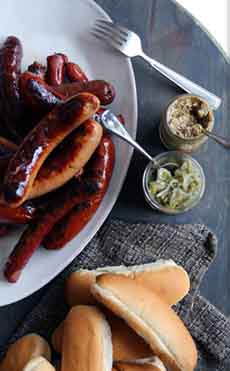
[1] Classic hot dog rolls have tapered edges (photo courtesy Murray’s Cheese).

New England Style Hot Dog Rolls
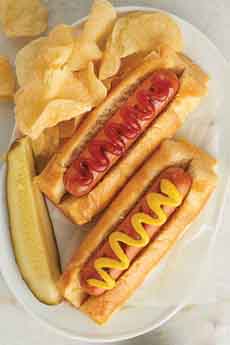
[2] New England-style hot dog rolls have straight edges, which get crisp when toasted (photo courtesy King Arthur Flour).

New England Hot Dog Pan
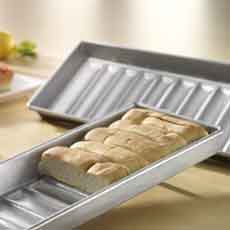
[3] A New England hot dog pan (photo courtesy USA Pan).< Slotdogs
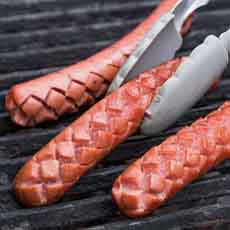
[4] Woo hoo: Slotdogs (photo courtesy Gadgetify).


Following up on yesterday’s homemade hamburger roll recipes, today we present the hog dog roll recipes from King Arthur Flour.

The hot dog is an American term for what initially was called a frankfurter, a style of sausage favored in Frankfurt, Germany. It was brought to the U.S. by German immigrants in the 1880s. Here’s the history of hot dogs.

While any hot dog or hamburger dough recipe works in any hot dog pan, you do need special baking pans to shape the rolls.

First, decide if you want to make rolls with classic rounded edges (photo #1) or the straight-edge New England style (photo #2).

We prefer the latter because it’s also the classic lobster roll style (lobster rolls originated in New England); and perhaps more importantly, the straight edges get crisp when toasted.

Next, decide on the size of the pan. We vote for the larger, 24-bun size. If you won’t use all of them, freeze the rest.

The difference between buns and rolls is below.

Also take a look at:

  • New England Hot Dog Pan (makes 8 rolls with straight sides)
  • Classic Hot Dog Pan (makes 24 rolls or 18 rolls)
  •  
     
    RECIPE #1: CLASSIC HOT DOG ROLLS

    This classic recipe can be used for hot dog or hamburger rolls.

    An egg wash places a shiny glaze on the rolls.
     
     
    RECIPE #2: BUTTERY HOT DOG ROLLS, NEW ENGLAND-STYLE

    While not exactly brioche, this recipe produces very buttery buns—also great for lobster rolls.

    Speaking of which: here are 20 other uses for hot dog rolls.
     
     
    RECIPE #3: NEW ENGLAND STYLE HOT DOG ROLLS

    Don’t want the extra butter of recipe #2?

    Whether you want your rolls classic- or New England-style, try this recipe.

    It’s different from recipe #1, in that it adds potato flour and an egg to enrich the dough. Recipe #1 uses the egg in an egg wash, to glaze the rolls; and only all-purpose flour.
     
     
    SLOTDOGS: ADD SOME PIZZAZZ TO YOUR DOGS

    While looking at hot dog pans, we came across SlotDogs (photo #4), a device that makes criss-cross cuts in the dog before grilling.

    They’re easy to make with the special Slotdog cutter.

    Kids may think they look like dragon scales; we just enjoy the geometrics.

    In addition to looking way cool, the cuts allow the smoky grill flavor to penetrate more deeply, and enables the juices to caramelize the edges.

    Plus, as with penne rigate and other pasta shapes with ridges, the toppings cling better, too.

     
    BUNS, ROLLS AND BISCUITS: THE DIFFERENCE

    We use the word roll instead of bun to denote hot dog-specific bread.

    There is no official difference: Both are single-serve breads, and the FDA only stipulates that buns and rolls weigh less than one-half pound (as opposed to loaves of bread, which must weigh one pound or more).

    Manufacturers and retailers use whichever term they want. However, the American Institute of Baking uses this distinction (but good luck getting people to change the words they use):

  • Rolls is the term generally used for individual breads that hold a filling—either pre-filled like cinnamon rolls or sandwich bread like Kaiser rolls. The notable exception is hot cross buns, which are filled with currants or raisins and thus should be hot cross rolls. However, the first recorded use of the term “hot cross bun” appears in 1733, when there was no distinction.
  • Buns typically do not contain a filling, but can be eaten plain, with a spread (butter, jam), or used as a sop, i.e., to wipe up a liquid food: gravy, sauce, soup, stews.
  • Bunne was the word used in Middle English. The use of roll to describe a small bread came much later. The oldest reference we could find is to Parker House rolls, in 1873.
  • Biscuits use a different leavening. Biscuits use baking powder to rise; buns and rolls use yeast.
  • Texture: Rolls can be hard (crusty) or soft, buns are soft, and biscuits are pillowy soft (from the baking powder).
  •  
    FUN HOT DOG RECIPES

  • Bacon Cheese Dogs
  • Cubano Dog
  • Gourmet Hot Dogs 1
  • Gourmet Hot Dogs 2
  • Italian Hot Dogs
  • Mini Corn Dogs
  • Tater Tot Hot Dog Skewers
  • Top 10 Hot Dog Toppings
  •  
     

    CHECK OUT WHAT’S HAPPENING ON OUR HOME PAGE, THENIBBLE.COM.


    Comments off

    TIP OF THE DAY: A Gift For Cookout Hosts ~ Homemade Burger Buns

    If you’re invited to a cookout over Memorial Day weekend or any other time during outdoor grilling season, you can make what will be a very popular contribution:

    Homemade burger buns.
     
     
    TWO BURGER BUN RECIPES

    King Arthur Flour has two recipes:

    RECIPE #1: Sesame Burger Buns

    Baker after baker commented on the website that these are “the best” burger buns (photo #1).

    Soft, gold yellow from the butter and egg, with a hint of sweetness, the flavor may remind you of King’s Hawaiian burger buns.

    Use them for burgers or any sandwich. You can switch the sesame for onion or garlic.

    Here’s the recipe.
     
     
    RECIPE #2: Cheesy Burger Buns

    The light cheese aroma of these alluring buns (photo #2) comes from adding grated cheddar or parmesan cheese to the no-knead dough.

    In fact, the light cheesy aroma and flavor create what you can bill as “double cheesy cheeseburgers.”

    Here’s the recipe.
     
     
    MAKE AS MANY AS YOU LIKE. YOU CAN FREEZE ANY EXTRAS.
     
     
    SPECIAL BURGER ROLL PAN

    This pan (photo #3) was commissioned exclusively by King Arthur Flour to make baking hamburger buns easier. Each pan bakes six large (4-inch) buns.

    It’s a versatile pan: Use it for individual pies or cakes, oversized scones, muffin tops, individual frittatas or miniature pizzas.

    The nonstick pan is $29.95 at King Arthur Flour.
     
     
    WHO CREATED THE FIRST HAMBURGER?

    It started with the Tatar armies of Ghenghis Khan!

      Homemade Sesame Burger Buns
    [1] You can top the buns with sesame seeds, or leave them off (all photos © King Arthur Flour).

    Cheddar Flavored Burger Buns
    [2] Add an extra hit of cheese to a cheeseburger by baking it into the bun.

    Pan For Homemade Burger Buns
    [3] Make perfectly-shaped buns with this special pan from King Arthur Flour.

     
    Here’s the history of the hamburger.
     
     
    WHY IS IT TARTAR SAUCE & TARTAR STEAK (STEAK TARTARE) INSTEAD OF TATAR?

    The Tatars (no “r”) were a Chinese nomadic tribe (ta-ta-er) conquered by Ghengis Khan.

    Tartar (with an “r”), the term used by Europeans, comes from the Greek Tartarus, the underworld.

    When Ghenghis Khan and his successors pillaged western Europe, the populace (a.k.a. victims) called them Tartars, meaning people from hell. The word referred to all Mongol invaders (no doubt, the nuances of tribes didn’t communicate over the maruading and murder).

    Coincidentally, this word was similar to Tatar, so the two were (and are) confused. Over time, the words became interchangeable in use [source].
     
     
    TOMORROW: HOT DOG BUNS!
      

    Comments off

    TOP PICK OF THE WEEK: Bela Sardines & Mackerel

    School Of Sardines
    [1] Close-up on a school of sardines (photo courtesy AP | Ventura County Star).

    Bela Olhao Sardines
    [2] Cleaned, cooked and canned by BELA Brands (photos #2, #3 and #4 courtesy BELA).

    Bela Olhao Sardines Open Can
    [3] Our favorite brand, Bela from Portugal.

    Bela Olhao
    [4] Open the can and…

    Sardine Tapas
    [5] Dig in (photo © Food52).

    Sardine Tapas
    [6] Easy tapas, with tomato or pimento on a baguette slice at Nomad in New York City.

      Earlier in our life, we did not care at all for sardines. We turned up our nose at this “cat food.” That’s because what was available in supermarkets then was of pretty low quality. Many Americans grew up eschewing sardines.

    Often, those undesirables weren’t even sardines, but sprats—a different genus, Sprattus in the same family as sardines. They are less tasty cousins of sardines.

    To add to the confusion, sprats are sometimes called brisling sardines, after a canned variety from Norway.

    The sought-after European sardine, also called the pilchard sardine (photo #1), is species Sardina pilchardus Walbaum. You won’t find those words on a can: You have to know the best brands.

    Now we’ve become a foodie nation, and grocers are offering the world’s best. In sardines, that’s the BELA brand. They’re a boon for Mediterranean and Paleo Diet followers, as well as for anyone wanting a quick meal with quality protein.

    Check out the way we enjoy them, below.

    And did we mention they’re just $3 a can?
     
     
    BELA SARDINES

    The premium quality “gourmet” sardines from Bela Brands (photos #2, #3 and #4) have found their way into many foodie homes.

    The company also sells premium canned mackerel fillets and skipjack tuna in jars; but given the number of words in this article alone, we’ll have to feature them another time.

    BELA Brand Seafood is a family-owned business which has been sustainably fishing the southern coast of Portugal, the Algarve, for generations.

    The large, juicy, delicious Portuguese sardines have been the main crop in this region for centuries. BELA lays claim to be the best canned sardine there is:

  • They’re the only Portuguese sardines packed within 8 hours of catch, for the finest flavor.
  • The fish are carefully washed and cleaned by hand and then cooked—one of the few brands of sardines that are cooked prior to canning.
  • In fact, they’re twice-cooked, which increases the proteins. One low-calorie serving delivers 11g of protein, omega-3s, vitamin D and calcium.
  • Full, premium fillets are packed fresh in organic extra virgin olive oil and organic sauces.
  • Sustainably wild-caught in nets, certified kosher (OU), gluten free and certified by the Marine Stewardship Council.
  •  
    And, you get to choose your flavorings, except in the spring water option. Otherwise, the sardines nestle in seasoned organic olive oil:

  • BELA Lightly Smoked Portuguese Sardines in Olive Oil.
  • BELA Lightly Smoked Portuguese Sardines in Lemon Flavored Extra Virgin Olive Oil.
  • BELA Lightly Smoked Portuguese Sardines in Tomato Sauce.
  • BELA Lightly Smoked Portuguese Sardines in Spring Water.
  •  
     
    HOW WE ENJOY BELA SARDINES

    You can eat them at every meal of the day.

  • Breakfast
    _Eggs Benedict à la Portugal.
    _On buttered toast or avocado toast.
  • Lunch
  • _On a grilled vegetable sandwich, with optional mozzarella.
    _A sardine Cobb salad, in addition to, or replacing, the chicken.
    _A Niçoise salad, in addition to or replacing the tuna; spinach salad with hard-boiled egg.
    _Chirashi-style, on a bed of sushi rice or regular rice, with an assortment of vegetables (raw, cooked or pickled, sliced radishes, seaweed or what you feel like. Photo #7, below, adds an egg for a super-protein bowl.
    _Place the fillets on top of the salad, or the salad on top of the fillets—for example, under a crown of arugula, mesclun or watercress.
    _On pizza: Who needs anchovies?

  • Tapas
    _With a glass of wine at brunch or cocktails (see photos #5 and #6).
    _We top Finn Crisp flatbread with sardines and pickled onions.
  • Happy Hour
    _Place pieces on toothpicks and serve with beer and wine.
  • Hors d’Oeuvre
    _Add a piece to a cucumber slice, cracker or toast point.
  • Dinner
    _First course: on an individual crudité plate, like a Greek mezze plate, along with pita, olives and optionally, hummus or babaganoush.
    _Salad: Toss pieces with a green salad, or create a sophisticated plating with endive and/or radicchio.
    _Main course: on pasta, with good olive oil as the sauce (add olives, scallions, parsley—anything else you like—and top with toasted breadcrumbs).
  •  
    A can of sardines is also a grab-and-go protein boost for backpacking and other energy-sapping pursuits.


    SARDINES HISTORY

    Sardines are small, oily fish within the herring family of Clupeidae, ray-finned fishes, important, nutrient-rich food fishes comprising, among others, herrings, sardines, shads and whitebait.

    They are also important for fish oil and fish meal—and as food for larger marine denizens.

    Sardines are found around the globe today, although all sardines originally came from somewhere in Europe.

    The name “sardine” first appears in English in the early 15th century. Some historians say it may be named for the Mediterranean island of Sardinia, around which sardines were once abundant.

    There are four genera of sardines, the two most important of which are:

  • Sardina, the European pilchard, Sardina pilchardus Walbaum, the only species in the genus.
  • Sardinops, with four species including the Californian, Japanese, South American and Southern African sardines.
  •  
    They are commonly found canned, tightly packed in—leading to their metaphorical use to describe a space where people or objects are crowded together.

    Canned sardines were a staple of millions of soldiers fighting both world wars. They sustained thousands of workers—the fishermen and packers of Cannery Row in Monterey, California, during the worst years of the Depression [source]. Similarly, they provided important fish protein to ravaged parts of Europe.

    Canning is a relatively recent innovation.

    In 1795, Nicolas Appert, a Parisian chef and confectioner, began to experiment with conserving foods, without altering their flavor or texture. He ultimately developed a process using a glass jar, similar to boiling the contents in a Mason jar.

    In 1810, British inventor and merchant Peter Durand patented his own method, using a tin can [source]. So, canned sardines have been available to export for a bit more than 200 years—and they very high quality and expensive: “gourmet” fare.

    But with the Industrial Revolution (from the mid-18th to the mid-19th centuries) things began to change. Fishing grounds became polluted, and some business practices—like labeling sprats as sardines—transpired to create those less-than-pleasing cans of sardines.

    Good news: The Portuguese Algarve has no industry, and the ocean waters are clean. That’s another reason BELA sardines taste so good.

    Here’s more on the history of sardines.
     
     
    WHERE TO GET BELA SARDINES

    Check our local markets, or head online to:

  • Amazon
  • Food 52
  •   Sardines On Wilted Greens
    [7] Sardines top wilted greens(photo Emily Chang | © THE NIBBLE).

    Sardine Chirashi
    [8] Sardines in tomato sauce, chirashi style, from Kitchen Gidget.

    Spaghetti & Sardines
    [9] Spaghetti and sardines (photo © Taste | Australia).


    FRESH SARDINES: IN STORES NOW!

    The Portuguese sardine season runs from May through October (sardines from other waters have their own seasons).

    In season fresh sardines even more wonderful, grilled, pickled or smoked. Grilled sardines fresh sardines with potatoes, bread and a salad are a popular summer meal in Portugal—and will be a revelation to you if you keep an eye out for them.

    Sushi lovers: head to the sushi bar! Raw sardine nigiri is a treat!


    Comments off


    © Copyright 2005-2026 Lifestyle Direct, Inc. All rights reserved. All images are copyrighted to their respective owners.